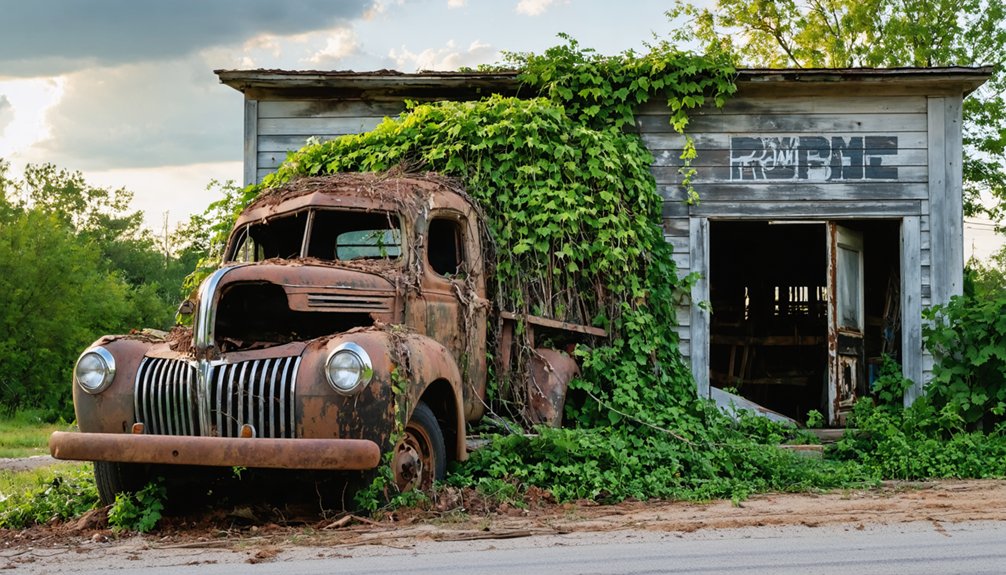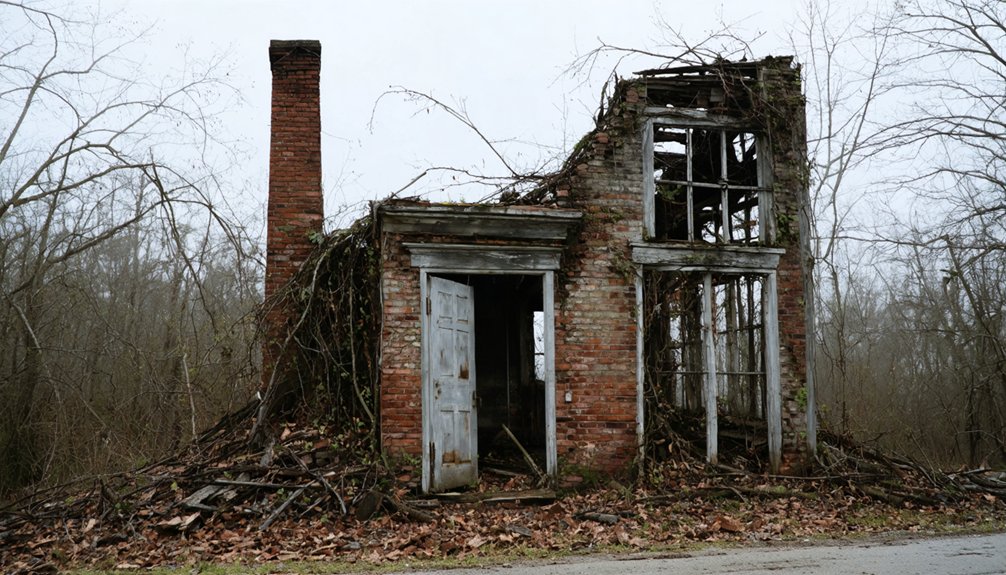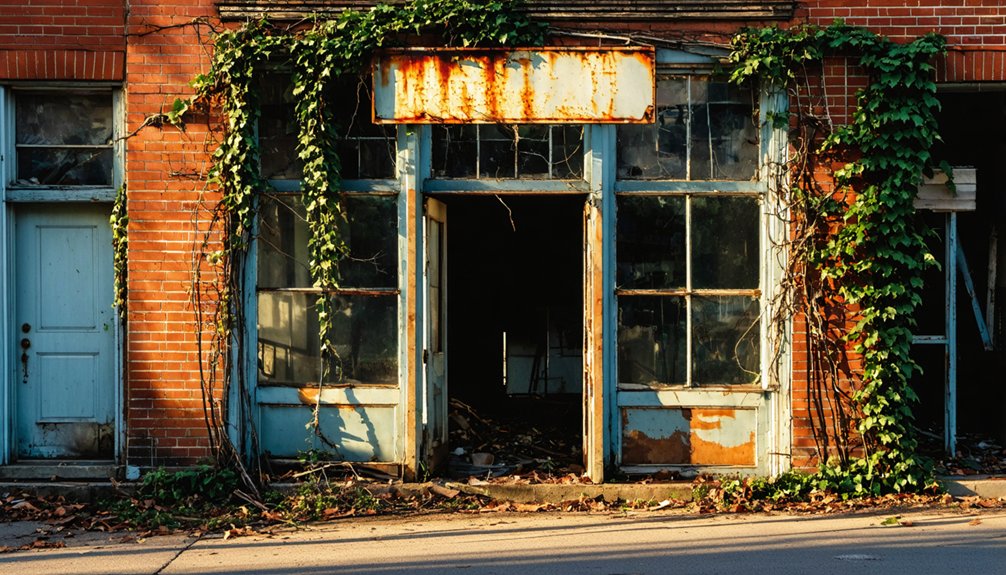
Alabama’s ghost towns reveal compelling stories of ambition and decline across the state’s landscape. You’ll discover Old Cahawba, the state’s first capital, which flourished until floods and political shifts led to its abandonment. The underwater ruins of Riverton, the Civil War-ravaged Bellefonte, and the French settlement of Arcola each tell unique tales of lost communities. Even Hollywood left its mark with Spectre, a decaying movie set from “Big Fish.” These forgotten places hold centuries of untold secrets within their remaining structures.
Key Takeaways
- Old Cahawba, Alabama’s first capital, became a ghost town after floods and relocation of the county seat to Selma.
- Bellefonte declined after Civil War devastation and the relocation of Jackson County’s seat, leaving only ruins today.
- The town of Riverton was completely submerged by Pickwick Landing Dam in 1938, with underwater ruins still visible.
- Historic Blakeley, once home to 4,000 residents, fell to yellow fever epidemics and is now preserved within Blakeley State Park.
- Arcola, founded by French expatriates in the 1820s, faded into abandonment due to changes in river navigation patterns.
The Rise and Fall of Old Cahawba: Alabama’s First Capital
While many abandoned towns dot Alabama’s landscape, none holds more historical significance than Old Cahawba, the state’s first permanent capital. You’ll find its remains at the confluence of the Alabama and Cahaba Rivers, where Native Americans once built a thriving Mississippian settlement.
In 1818, Governor William Wyatt Bibb established Cahawba as the capital, with a grid-style layout featuring streets named after trees and notable figures.
Cahawba’s history as a capital began in 1820 when the newly-formed state government established itself there, building a brick statehouse and auctioning town lots that sparked intense speculation. The initial lot auction raised an impressive $123,856 for 182 lots.
Despite reaching a population of over 1,000 and boasting fine homes and a state bank, Cahawba’s reign was brief. The capital’s migration to Tuscaloosa in 1826 triggered an exodus, though the town later revived as a cotton hub.
After the Civil War, floods and the county seat’s relocation to Selma sealed Cahawba’s fate, transforming it into the ghost town you can explore today.
Arcola: The Lost River Landing of the Black Warrior
Remnants of Alabama’s French colonial heritage live on in Arcola, a lost river landing established in the early 1820s as part of the Vine and Olive Colony.
You’ll find its origins traced to French Bonapartist expatriates who received land grants from Congress, with Frederic Ravesies marking the first permanent settlement.
The Hatch Plantation, featuring a grand house built in 1856 by Parker, became a cornerstone of the transformed landscape.
While river commerce initially thrived along the Black Warrior River, Arcola’s identity transformed as American settlers acquired French holdings in the 1830s, converting the area into cotton plantations.
The settlement gained strategic importance due to its location along the 178-mile waterway that connected it to major trade routes.
The settlement’s French heritage gradually faded as Anglo-American plantation culture took hold, and the once-bustling river landing diminished in importance.
Navigation changes and new lock-and-dam systems further reduced Arcola’s relevance until it faded into abandonment, leaving behind only whispers of its French colonial past in Alabama’s Black Belt region.
Bellefonte: A Civil War Casualty in Jackson County
Like its French colonial counterpart upriver, Bellefonte stands as another representation of Alabama’s lost settlements. Incorporated in 1821 on 60 acres of former Cherokee land, Bellefonte thrived as Jackson County’s first permanent seat.
You’ll find its history marked by early prosperity, with Dr. George W. Higgins and Stephen Carter among its founders establishing a vibrant town center complete with brick stores and civic buildings. Annual elections for councillors were held each February to govern the growing settlement. By 1844, the town had grown to a population of 400 residents.
The Civil War’s impact proved devastating. Federal troops occupied Bellefonte in 1863-64, burning structures and disrupting community life.
Already weakened by the county seat’s relocation to Scottsboro in 1859 and the railway depot’s establishment three miles away, the town couldn’t recover.
The destruction of legal records during the war further complicated land claims, accelerating Bellefonte’s decline into abandonment.
Riverton: The Town Beneath Pickwick Lake
The story of Riverton begins as a French trading post at Muscle Shoals in 1715, later evolving into a bustling river settlement when Philadelphia investors established the town in 1887.
Before relocation, three-fourths of residents depended on government relief due to widespread poverty.
You’ll find Riverton’s history marked by its strategic location at the junction of the Tennessee River and Bear Creek, where an unincorporated village thrived with a post office, depot, hotel, and stores.
The town’s destiny changed dramatically in 1934 when the TVA authorized Pickwick Landing Dam. By February 1938, the dam’s completion submerged Riverton beneath its waters, forcing residents to relocate.
In a single act of progress, the rising waters of Pickwick Dam erased Riverton from the map, displacing an entire community.
The visionary Alfred Parrish had grand plans to transform Riverton into a major industrial city, but the economic recession of 1891 devastated these ambitions.
Today, underwater ruins of the Riverton Lock, once the highest single-lift lock in America at 26 feet, remain visible above the waterline, sparking legends of submerged buildings and a forgotten way of life.
Historic Blakeley: Nature’s Reclamation of a Southern Port
Founded by entrepreneur Josiah Blakeley in 1814, Historic Blakeley once stood as Mobile’s formidable commercial rival, reaching a population of 4,000 residents by the early 1820s.
You’ll find its dramatic decline began with devastating yellow fever epidemics in 1822, 1826, and 1828, forcing mass burials in Blakeley Cemetery.
By the Civil War, only 100 residents remained, though the site gained significance as Fort Blakeley’s battlefield in the war’s final days. The area had been a thriving home to Native American settlements for over 4,000 years before European arrival.
Today, you can explore this ghost town’s remnants within Historic Blakeley State Park, established in 1981.
The park’s nature trails wind through the Mobile-Tensaw Delta, where you’ll discover original street patterns, historic preservation efforts, and ancient oak trees surrounding the foundations of the old courthouse and jail. Visitors can follow the auto tour guide to explore the site’s historical landmarks while listening to detailed cell phone descriptions.
Spectre: Alabama’s Mysterious Abandoned Settlement
While many abandoned towns in Alabama grew naturally before fading into history, you’ll find Spectre’s origins are uniquely tied to Tim Burton’s 2003 film *Big Fish*, where it served as a purpose-built movie set on Jackson Lake Island near Millbrook.
After filming wrapped, the owners preserved the deteriorating collection of façades, which included six homes, a chapel, and two artificial trees crafted by Stan Winston Studio.
You can still visit this artificial ghost town today for a small fee, where goats and sheep now inhabit the weathered structures alongside the Alabama River, creating an eerily authentic abandoned atmosphere.
Historical Records and Location
Nestled at the confluence of the Cahaba and Alabama Rivers, Spectre emerged as Alabama’s inaugural state capital in 1819, setting the stage for its tumultuous history as one of America’s most enigmatic ghost towns.
Today, you’ll find this historically significant site in Dallas County, just 3.5 miles southeast of a point nine miles southwest of Selma on SH 22.
The Cahawba history reflects a dramatic rise and fall, with its population peaking at 2,000 residents in 1860, two-thirds of whom were enslaved African Americans.
The archaeological significance of the site is preserved in the Old Cahawba Archaeological Park, where you can explore the original street grid, the haunting Crocheron Columns, and the ruins of Castle Morgan prison, all evidence of a once-thriving river town that succumbed to floods, fires, and abandonment by 1900.
Movie Set Origins
Unlike the historically established ghost town of Cahawba, Spectre stands as a peculiar addition to Alabama’s abandoned landscapes – one born from Hollywood imagination rather than natural settlement.
The town emerged in 2003 as a custom-built film set for Tim Burton’s “Big Fish,” constructed on Jackson Lake Island near Millbrook. Production designer Dennis Gassner crafted the town specifically for visual effects, focusing on exterior facades rather than functional buildings.
- Structures were built as lightweight shells with minimal interiors, using materials like styrofoam and thin sheathing.
- The set underwent deliberate aging by the art department, evolving from pristine to weathered for different scenes.
- After filming wrapped, the Bright family, who owned the island, preserved the set instead of demolishing it, allowing it to naturally decay into its current state.
Exploring Modern Day Remains
Today, Spectre stands as a haunting memorial to Hollywood’s fleeting presence in Alabama, with its deteriorating structures offering visitors a unique blend of artificial history and natural decay.
You’ll find the ghost town nestled on private property near Fort Morgan, where guided tours provide your only access to this mysterious settlement.
During modern exploration, you can wander along overgrown paths that reveal the skeletal outlines of former film sets. The wooden church structure remains intact, while crumbling brick walls and foundations peek through the undergrowth.
Your visitor experiences might include photographing moss-covered remnants against Mobile Bay’s scenic backdrop or spotting local wildlife amid the ruins.
As evening approaches, the site’s eerie atmosphere intensifies, with fading light casting long shadows across this carefully preserved piece of Alabama’s cultural landscape.
Legacy of Lost Towns: Preserving Alabama’s Ghost Town Heritage
You’ll find Alabama’s historic ghost towns receive significant protection through strategic preservation initiatives, as exemplified by Old Cahawba Archaeological Park’s successful public-private partnerships and multi-million dollar fundraising campaigns.
These efforts have spurred interest in ghost towns for sale in Alabama, attracting history enthusiasts and investors alike. As these towns are revitalized, they offer a unique opportunity to preserve the stories of the past while contributing to local economies. With many of these properties on the market, there has never been a better time to explore the potential of Alabama’s abandoned gems.
As interest grows in revitalizing these historic sites, people are also drawn to the allure of abandoned settlements in Alabama. By uncovering the mysteries of these forgotten places, communities can foster a deeper connection to their heritage. This exploration not only enhances cultural appreciation but also encourages tourism that can invigorate nearby local businesses.
Through archaeological surveys, restoration projects, and interpretive programs, these abandoned settlements transform into living museums that tell vital stories about Alabama’s past.
The combination of federal recognition, state oversight, and local stewardship guarantees these fragile historic sites will continue educating future generations about Alabama’s rich cultural heritage.
Historical Sites Today
While many of Alabama’s ghost towns have vanished completely, several significant sites remain preserved as historical landmarks and archaeological parks, offering visitors tangible connections to the state’s pioneering past.
These locations showcase archaeological findings that reveal the historical significance of Alabama’s early settlements.
- Old Cahawba Archaeological Park stands out with its dramatic Crocheron Columns, restored St. Luke’s Episcopal Church, and the remains of Castle Morgan, providing glimpses into antebellum life.
- St. Stephens Historical Park features carefully preserved 200-year-old remains and reconstructed street layouts that help researchers understand early Alabama settlement patterns.
- The Arcola Historic District and Bellefonte Remains remind visitors of the Civil War’s devastating impact, with the Alfred Hatch Place and a solitary inn chimney serving as silent witnesses to their once-thriving communities.
Preservation Efforts Matter
Recognizing the irreplaceable value of Alabama’s ghost towns, numerous organizations have united to protect and preserve these historic sites for future generations.
Through community engagement, the Cahawba Advisory Committee and Foundation have secured nearly 65% of the original 1,000-acre town site while implementing sustainable practices for long-term preservation.
You’ll find their efforts evident in carefully restored structures like St. Luke’s Church and the Kelly house, which showcase the 1845-1850 period.
The Alabama Historical Commission manages these sites as archaeological parks, offering bike tours and ghost walks that connect you to the past.
Working alongside the Alabama Trust for Historic Preservation, they’re safeguarding everything from indigenous mounds to plantation homes, ensuring these remnants of history don’t fade into obscurity.
Frequently Asked Questions
Are Any of Alabama’s Ghost Towns Considered Haunted by Paranormal Investigators?
You’ll find documented haunted locations at Harper Hill Church and Cemetery and Old Abandoned Church, where paranormal activity includes apparitions, ghostly masses, and unexplained phenomena verified by paranormal investigators.
Can Visitors Take Artifacts Found at These Abandoned Town Sites?
You can’t legally remove artifacts from these sites. Legal regulations protect historical items on public and private lands, and artifact preservation laws require permits for any collection activities.
What Safety Precautions Should Explorers Take When Visiting These Ghost Towns?
You’ll need proper safety gear including sturdy boots and flashlights. Follow exploration guidelines by traveling in groups, avoiding unstable structures, respecting property boundaries, and carrying emergency supplies and phones.
Do Any of These Ghost Towns Host Historical Reenactments or Tours?
You’ll find guided tours and historical events primarily at Old Cahawba, while other ghost towns like Spectre, Bellefonte, and Arcola are limited to self-guided exploration of their remaining structures.
Which Ghost Towns Are Accessible by Public Transportation From Major Alabama Cities?
While you’ll need taxis for final legs, you can reach Cahawba via Selma’s Greyhound stop, Arcola through Tuscaloosa’s bus station, and St. Stephens from Mobile’s transit hub for authentic ghost town exploration.
References
- https://thebamabuzz.com/5-alabama-ghost-towns-to-put-on-your-bucket-list/
- https://www.onlyinyourstate.com/experiences/alabama/alabama-ghost-towns
- https://digitalalabama.com/alabama-ghost-towns/alabama-ghost-towns/9449
- https://deepsouthurbex.com/2020/01/02/6-south-alabama-ghost-towns/
- https://freepages.history.rootsweb.com/~gtusa/usa/al.htm
- https://www.abandonedalabama.com
- https://kids.kiddle.co/List_of_ghost_towns_in_Alabama
- https://www.abandonedalabama.com/old-cahawba/
- https://theforgottensouth.com/cahawba-alabama-ghost-town/
- https://encyclopediaofalabama.org/article/cahaba/