You’ll find Alaska’s ghost towns scattered across its rugged wilderness, from Kennicott’s abandoned copper empire to Dyea’s Gold Rush ruins. These settlements tell tales of dramatic booms and busts, with some yielding over $200 million in minerals before their sudden abandonment. While mining towns like Treadwell collapsed from industrial disasters, others fell victim to natural forces. Today, climate change continues to create new ghost towns as coastal villages face relocation, adding fresh chapters to Alaska’s story of abandoned places.
Key Takeaways
- Kennicott, a former copper mining town, became a ghost town in 1938 after yielding $200 million worth of copper through its massive operations.
- Dyea transformed from a Tlingit village into a bustling gold rush town of 8,000 before declining due to avalanches and competition.
- Treadwell’s mining complex, once the world’s largest hard-rock gold mine, became abandoned after catastrophic flooding in 1917.
- The 1964 Good Friday Earthquake created ghost towns like Portage and old Girdwood due to ground subsidence and structural damage.
- Climate change is creating modern ghost towns across Alaska as coastal erosion and permafrost thaw force communities to relocate.
Mining Riches to Ruins: The Story of Kennicott
When prospectors discovered rich deposits of green malachite and chalcocite on the Bonanza claim in 1900, they couldn’t have imagined the empire that would rise and fall in Alaska’s Wrangell Mountains.
Within a decade, the Kennicott Copper Corporation had built a 196-mile railroad and established massive mining operations that would yield over $200 million in copper by 1938.
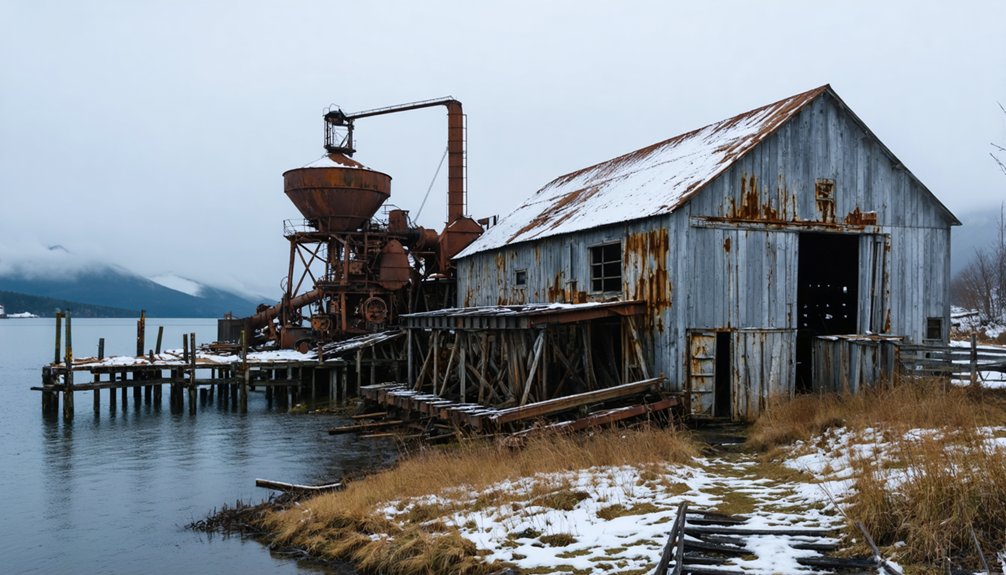
You’d have found a thriving company town with a 14-story mill, where 600 workers enjoyed modern amenities including electricity, a hospital, and even a wood-surfaced tennis court.
The town infrastructure supported a self-contained community, though the nearby settlement of McCarthy provided forbidden pleasures like alcohol.
Today, the National Historic Place designation protects many original buildings that remain standing as testaments to Alaska’s mining heritage.
Visitors can now take guided tours daily to explore the historic mining structures and learn about this remarkable chapter in American history.
When the ore played out in 1938, residents had just 24 hours to catch the final train, leaving behind a ghost town that still stands today.
Gold Rush Legacy: Dyea’s Rise and Fall
Long before stampeders rushed north for Klondike gold, a small Tlingit village marked the spot where Dyea would later flourish.
Before gold seekers dreamed of fortune, the Tlingit people called this sacred ground home, living where Dyea would rise.
In the mid-1880s, John J. Healy established a trading post, laying the groundwork for Dyea’s significance as an essential gateway to the goldfields. The name “Dayéi” comes from the Tlingit word meaning to pack, reflecting its early trading heritage. The bustling settlement quickly grew to include over 150 businesses, from hotels to saloons.
When news of the Klondike strike broke in 1897, you’d have found Dyea transformed into a bustling boomtown of 8,000 people.
The Chilkoot Trail, starting from Dyea’s shores, became the lifeline for over 40,000 fortune seekers heading north.
But the town’s prosperity wouldn’t last. The gold rush aftermath proved harsh – devastating avalanches, fierce competition from neighboring Skagway, and the completion of the White Pass & Yukon Route railroad sealed Dyea’s fate.
Natural Forces and Ghost Towns: Environmental Impacts
You’ll find stark evidence of nature’s power to erase Alaska’s past in places like Shishmaref, where rising seas and fierce storms now threaten to transform this living community into tomorrow’s ghost town.
Climate change has accelerated coastal erosion and permafrost thaw across Alaska’s western coast, with some villages losing up to 50 feet of shoreline in a single storm. The community voted in 2016 to relocate inland, but lacks sufficient funding to complete the move.
While gold rush towns fell to economic forces, today’s Alaskan communities face abandonment from environmental pressures, as demonstrated by the 31 villages at imminent risk of displacement from flooding and erosion. The village of Newtok exemplifies this crisis, where melting permafrost has severely compromised the structural integrity of buildings and infrastructure.
Earthquakes Reshape Historic Sites
Throughout Alaska’s history, the 1964 Good Friday Earthquake stands as the most devastating natural force to reshape and abandon numerous settlements.
You’ll find the earthquake impacts most dramatically displayed in places like Portage, where the ground sank 6-10 feet, creating an eerie ghost forest of salt-killed trees. The massive tremor lasted 4.5 minutes, terrorizing residents and forever changing the landscape. A similar destructive force was seen in the 7.2 magnitude quake that devastated Dome City in 1912.
The seismic destruction transformed Girdwood, forcing residents to relocate inland after the ground dropped along Turnagain Arm.
At Afognak Village, tectonic subsidence of up to 5.5 feet combined with seismic waves made the site uninhabitable, while Kaguyak‘s entire settlement vanished under 25-foot waves.
The quake’s power reshaped the landscape dramatically – from Anchorage’s Turnagain Heights sliding 2,000 feet to Chenega village’s devastating 27-foot tsunami that claimed 23 lives.
Weather Erases Town Remains
As climate change accelerates across Alaska, a combination of thawing permafrost, declining sea ice, and intensifying storms threatens to erase numerous coastal communities from the map.
You’ll find dramatic weather patterns reshaping the landscape, with permafrost temperatures rising three degrees Celsius since the 1980s, destabilizing ground that once held firm. The recent back-to-back storms have already displaced 2,000 residents and completely destroyed one village. Rural communities face particularly severe challenges as slow permafrost thaw complicates efforts to protect and preserve their historic structures.
The erosion effects are staggering – along the Beaufort Sea coast, you’re witnessing shorelines retreat up to 62 feet annually during ice-free months.
Ex-Typhoon Halong’s 100-mph gusts have torn apart villages like Kipnuk, while in Quinhagak, fierce storms devoured 60 feet of shoreline, scattering ancient Yup’ik artifacts.
These forces don’t just threaten current settlements; they’re actively erasing the physical remnants of Alaska’s ghost towns, washing away the last traces of abandoned communities.
Lost Villages of Alaska Native Communities
When you explore Alaska’s lost Native villages, you’ll find poignant stories of communities fractured by war, disease, and forced relocation – from the WWII displacement of Attu’s Unangax̂ people to the devastating impact of the Spanish Flu on Dena’ina settlements.
Throughout the state, once-vibrant cultural centers like Afognak and Klukwan now stand empty, their traditional clan houses and gathering spaces abandoned as residents scattered to other communities.
While many sacred sites remain, including graveyards and former village grounds, these places serve as powerful reminders of Alaska Native communities’ resilience in the face of profound displacement and change.
Cultural Impacts of Relocation
The forced relocation of Alaska Native communities has inflicted profound cultural wounds that continue to deepen with each passing generation.
You’ll find that cultural resilience faces unprecedented challenges as climate change forces villages like Shishmaref and Kivalina to abandon ancestral lands where they’ve practiced traditional subsistence for thousands of years.
Identity preservation becomes nearly impossible when communities must leave behind sacred sites and hunting grounds.
- Spiritual connections to specific locations are severed, disrupting oral histories and traditional practices.
- Language transmission suffers as communities scatter, breaking traditional teaching patterns.
- Traditional subsistence lifestyles collapse when groups are forced into urban settings, destroying generations-old hunting and gathering patterns.
These relocations echo painful historical forced movements, like the 1960s King Island resettlement to Nome, which fragmented entire cultural systems.
Traditional Sites Now Empty
Through decades of natural disasters, federal policies, and demographic shifts, countless traditional Alaska Native village sites now stand empty across the vast territory.
You’ll find abandoned Aleutian villages like Biorka and Kashega, where only foundations and cemeteries remain after WWII relocations. The 1912 Novarupta eruption buried Katmai village, while the devastating 1964 tsunami forced Chenega’s residents to establish a new community elsewhere.
Indigenous resilience emerged as communities adapted to forced changes – from King Island’s exodus following school closures to the military’s requisition of Barter Island lands.
Community displacement continued as government policies centralized services in regional hubs, while younger generations moved away for education and jobs.
Today, these empty sites stand as powerful reminders of Alaska Native communities’ endurance through profound changes.
Preserving Sacred Ancestral Spaces
Sacred ancestral spaces across Alaska tell profound stories of indigenous resilience and adaptation.
You’ll find communities taking decisive action to protect their heritage sites through sacred preservation efforts, from Yakutat’s carefully managed seal rookeries to Sitka’s endangered clan houses.
Native villages face mounting pressure from climate change, yet remain committed to ancestral protection through strategic relocation and cultural documentation.
- The X’aaká Hít Point House preservation project counters historical attempts to dismantle communal living traditions
- Quinhagak villagers combine archaeological work with elder interviews to safeguard cultural heritage
- The Gwich’in people defend the Arctic Refuge’s Coastal Plain, their “Sacred Place Where Life Begins,” from seismic surveying threats
These preservation efforts showcase indigenous communities’ determination to maintain their sacred connections while adapting to environmental changes.
Industrial Heritage: Treadwell’s Mining Complex
Located on Douglas Island near Juneau, Treadwell’s mining complex emerged as the world’s largest hard-rock gold mine during its peak years of 1911-1917.
The Treadwell heritage began in 1880 when prospectors discovered gold, leading to the formation of the Alaska Mill & Mining Company.
You’ll find the remnants of four interconnected mines that processed an astounding 20.7 million tons of ore, yielding over 3 million troy ounces of gold.
The operation’s innovative use of hydroelectric power and 960 stamps across five mills enabled 24/7 production, processing 5,000 tons daily.
This industrial marvel employed over 2,000 workers until April 21, 1917, when a catastrophic cave-in flooded three mines.
Only the Ready Bullion mine continued operations until the complex’s final closure in 1922.
Transportation’s Role in Town Abandonment
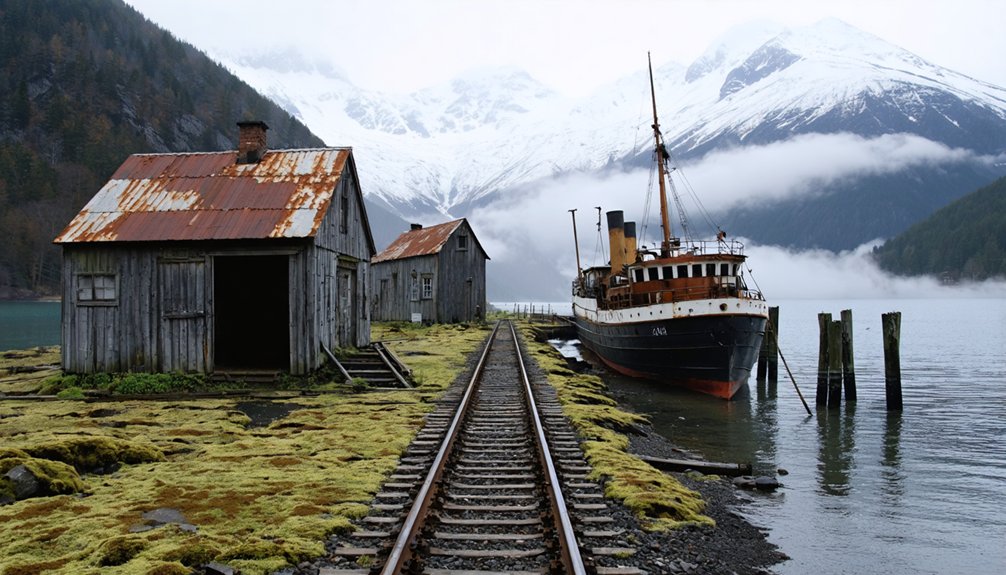
While many factors contributed to Alaska’s ghost towns, transportation changes proved especially devastating to remote settlements that relied on specific transport modes for survival. The rapid transportation decline often began when rail lines closed, steamships stopped calling, or highways redirected traffic away from established communities.
- You’ll find stark evidence of infrastructure loss in places like Kennicott, where discontinued railroad service after mine closure sealed the town’s fate.
- The 1964 Good Friday earthquake’s destruction of Portage’s transport links shows how natural disasters could instantly sever crucial connections.
- Even seemingly minor changes, like the Sterling Highway’s rerouting, could doom towns by diverting essential commercial traffic to new corridors.
The combined impact of aging facilities, shifting technologies, and rising operational costs made many remote transport hubs economically unsustainable.
Preservation Efforts in Alaska’s Historic Sites
Recognizing the historical significance of Alaska’s ghost towns, preservation organizations have launched extensive efforts to protect these abandoned settlements from complete deterioration.
You’ll find remarkable heritage conservation work at Kennicott, where the National Park Service maintains the impressive 14-story red mill building and surrounding structures through an arrested decay approach.
The Conservation Fund’s 1998 acquisition has enabled careful stabilization of these historic landmarks while maintaining their authentic abandoned character.
You’re free to explore these preserved sites, where strict regulations guarantee the delicate balance between tourism access and historical integrity.
Local preservation groups throughout Alaska, particularly in the Skagway region, continue working to protect diverse sites ranging from Gold Rush-era structures to indigenous settlements, safeguarding these irreplaceable pieces of Alaska’s past.
Modern Ghost Towns: Climate Change and Relocation
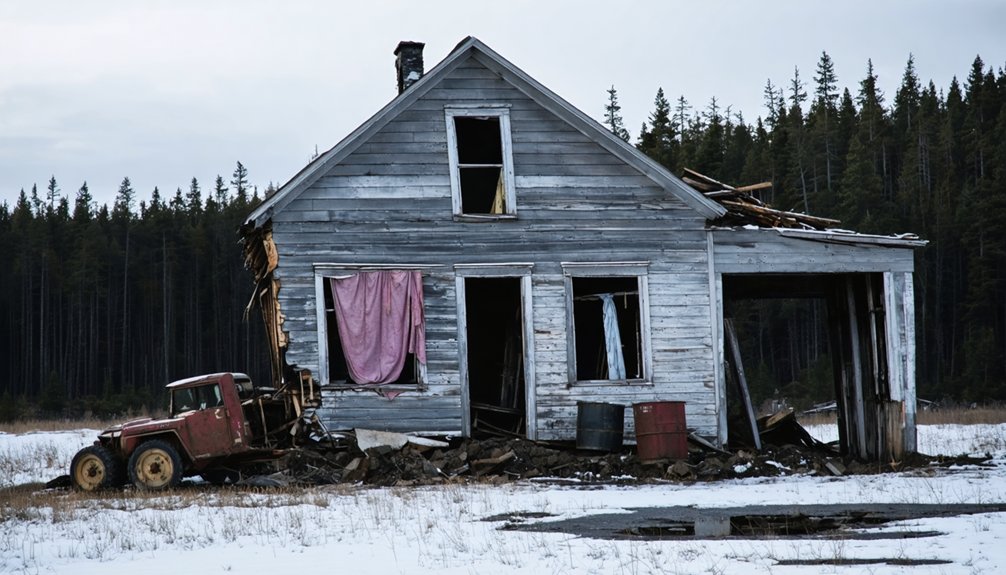
Unlike the deliberately preserved ghost towns of Alaska’s Gold Rush era, a new wave of abandoned settlements is emerging due to climate change.
You’ll find communities like Newtok facing relocation challenges as thawing permafrost and coastal erosion threaten their very existence. Climate displacement is forcing Native villages to abandon their ancestral lands, with 31 communities facing imminent destruction within decades.
- The Newtok to Mertarvik relocation has become a cautionary tale, with $150 million spent yet failing to provide basic necessities like insulation and running water.
- Napakiak shows a more promising path, systematically moving buildings away from the eroding Kuskokwim River.
- At least 144 of Alaska’s 200 rural Native villages are battling erosion, storms, and permafrost degradation, creating tomorrow’s ghost towns.
Frequently Asked Questions
Are There Any Laws Against Taking Artifacts From Alaska’s Ghost Towns?
You can’t legally take artifacts from ghost towns – it violates state and federal preservation laws. You’ll face serious legal consequences including fines, jail time, and felony charges for removing historical items.
Which Ghost Towns in Alaska Are Completely Off-Limits to Visitors?
You’ll find the Buckner Building in Whittier and Ukivok on King Island completely off-limits due to restricted access and dangerous conditions, despite their historical significance as essential military and indigenous sites.
What Supernatural Legends Are Associated With Alaska’s Abandoned Settlements?
You’ll encounter supernatural sightings of the Woman in White at Eklutna Cemetery, shadowy entities in Whittier’s Buckner Building, restless spirits in Ukivok’s stilted homes, and local folklore about mysterious disappearances in Portlock.
Can People Purchase Property in Alaska’s Ghost Towns Today?
You can buy private properties in Alaska’s ghost towns if they have clear property rights, though most historic settlements are protected state lands or require special ownership permits.
Several ghost towns available in Alaska offer a glimpse into the state’s rich history and unique culture. Exploring these abandoned places can provide insight into the lives of those who once inhabited them, as well as potential investment opportunities for adventurous buyers. However, it is essential to conduct thorough research to understand the specific regulations governing these properties.
As you explore ghost towns in Alaska, you may encounter remnants of old buildings, mining equipment, and even artifacts that tell stories of a bygone era. Each site presents a unique opportunity to connect with the past, offering potential for restoration projects that can preserve their historical significance. Whether for personal interest or investment, the charm of these ghost towns attracts those looking to uncover the mysteries of Alaska’s frontier history.
How Many Undiscovered Ghost Towns Might Still Exist in Alaska?
While exact counts are impossible, you’ll find dozens of hidden towns beyond the known 100 sites, with remote settlements scattered across Alaska’s vast wilderness, especially along river systems and abandoned trading routes.
References
- https://thealaskafrontier.com/ghost-towns-in-alaska/
- https://getlostinamerica.com/alaska-ghost-towns/
- https://www.atlasobscura.com/things-to-do/alaska/ghost-towns
- https://live.laborstats.alaska.gov/sites/default/files/trends/may24art2_0.pdf
- https://www.thealaskalife.com/blogs/news/alaska-ghost-towns-youve-probably-never-heard-of
- https://www.gi.alaska.edu/alaska-science-forum/ghost-towns-scattered-across-alaska-map
- https://www.youtube.com/watch?v=Cz0IGc2Uy0E
- https://www.atlasobscura.com/places/kennicott-ghost-town
- https://www.kennicottlodge.com/about-the-area/kennicott-national-historic-landmark/
- https://en.wikipedia.org/wiki/Kennecott