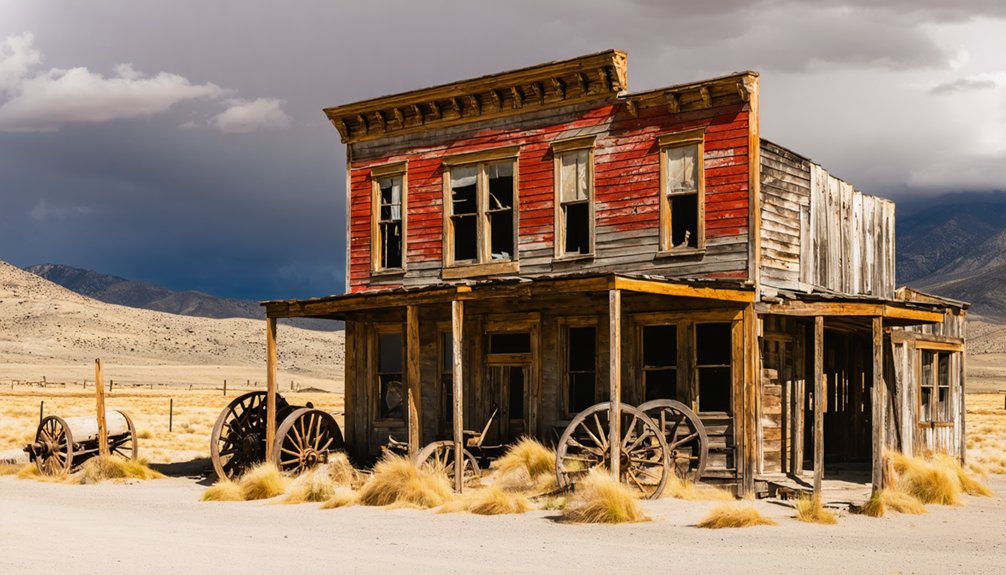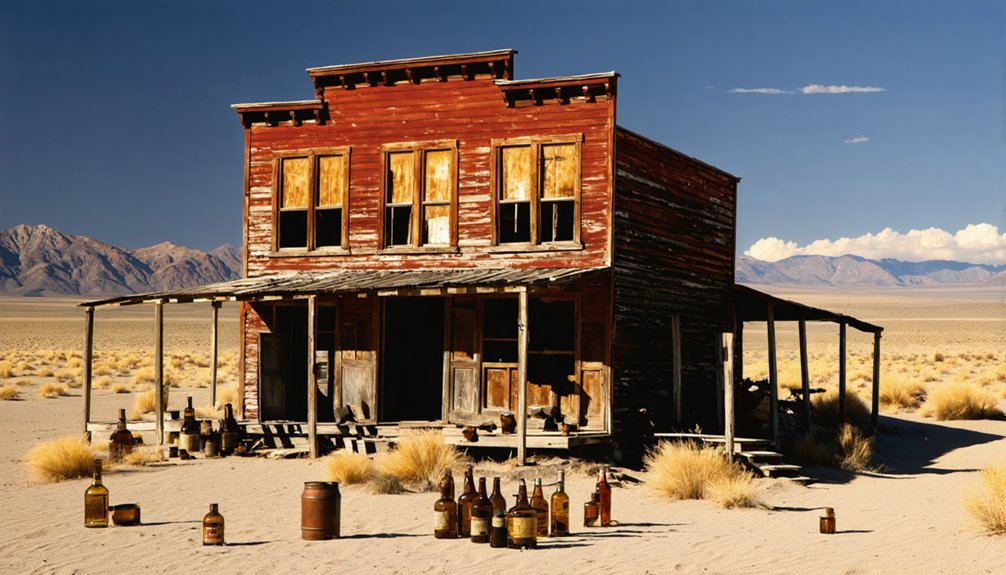
You’ll find ghost towns across America, from abandoned mining settlements in the West to modern urban zones with soaring vacancy rates. Notable examples include Gary, Indiana’s ZIP 46404 with 1,000 empty homes and historic Garnet, Montana. Today’s ghost towns emerge from economic decline, with cities like Detroit showing 30% long-term vacancy rates and Baltimore experiencing a 9% population drop since 2010. These silent remnants tell complex stories of boom, bust, and preservation.
Key Takeaways
- Historical mining ghost towns emerged during the California Gold Rush of 1848, with communities like Garnet, Montana becoming deserted remnants.
- Modern ghost towns are forming across America’s Rust Belt, with cities like Detroit showing 30% of homes vacant for over two years.
- Gary, Indiana’s ZIP 46404 exemplifies contemporary abandonment with 1,000 empty homes and vacancy rates reaching 32.1%.
- Economic factors, including manufacturing job losses and population exodus, drive the creation of new ghost towns in urban areas.
- Preservation efforts range from “arrested decay” maintenance to full restorations, turning abandoned towns into tourist attractions.
The Rise of Modern Ghost Towns: Vacancy Rates Across America
While abandoned towns have long captured America’s imagination, a new wave of modern ghost towns is emerging across the nation, with vacancy rates painting a stark picture of demographic shifts.
You’ll find 1.3 million vacant homes nationwide, representing 1.27% of all properties in Q4 2023. The Midwest and Rust Belt regions show particularly high concentrations of vacant properties. Vacancy trends reveal concerning patterns, with San Francisco leading urban decay at a 7.4% population drop since 2020.
Cities like St. Louis, Detroit, and New York are showing similar signs of decline. In St. Louis, you’re seeing a 6% retail vacancy rate alongside a 6.6% population decrease.
Major urban centers across America face a troubling exodus, with St. Louis exemplifying the crisis through rising vacancies and shrinking populations.
Detroit’s situation is particularly striking, with nearly 30% of vacant homes remaining empty for over two years. Dayton leads the nation with 46.2% vacant homes persisting for over two years. These vacancy patterns span over 16,000 ZIP codes nationwide, excluding seasonal areas, indicating a significant transformation in America’s urban landscape.
Population Exodus: Cities Facing Major Demographic Shifts
You’ll find striking similarities between historic ghost towns and today’s urban population losses, as cities like St. Louis and Spring Valley shed residents at alarming rates reminiscent of past boom-and-bust cycles.
Baltimore saw its population drop 9% between 2010 and 2023, highlighting the continuing pattern of urban exodus seen nationwide.
Memphis faces significant outmigration as crime rates soar and limited economic opportunities drive residents to seek safer communities elsewhere.
While the Rust Belt’s industrial collapse drove multi-decade exoduses in Detroit and Cleveland, coastal hubs like San Francisco and New York now face their own demographic challenges due to high costs and remote work shifts.
The modern urban flight patterns reveal both traditional economic drivers – such as job losses and housing costs – and newer factors like quality-of-life concerns pushing working-age residents toward more affordable regions.
Modern Urban Flight Patterns
As major cities across America grapple with unprecedented population shifts, recent data reveals a complex pattern of urban exodus that’s reshaping the nation’s demographic landscape.
You’ll find the most dramatic examples of urban decay in places like Spring Valley, Nevada, where the population plummeted by over 10% in just one year. Paradise, Nevada experienced an especially devastating decline of 65,000 residents over five years. Liberal-leaning coastal hubs like New York, Los Angeles, and San Francisco are experiencing significant declines as suburban migration accelerates, driven by high living costs and remote work flexibility.
This trend is further intensified by a net migration loss of up to 525,000 expected in 2025.
The impact extends beyond major metros, with 76% of nonmetro counties facing natural population decrease.
You’re witnessing a transformation where even traditionally stable urban centers can’t maintain their populations without immigration, leading to reduced tax bases and dwindling public services. This trend particularly affects the Northeast and West Coast, where affordability issues continue driving residents away.
Historic Population Displacement Trends
Since the late 19th century, America’s population distribution has undergone dramatic transformations that continue to reshape the nation’s demographic landscape.
You’ll find that population trends shifted markedly as urban areas grew from 28% to 40% between 1880-1900, largely driven by European immigration that pushed urban populations to 50% by 1920. The influx saw approximately 1.7 million immigrants entering between 1841-1850 due to events like the Irish famine.
The post-WWII era marked another pivotal change in migration patterns, as you witnessed Americans leaving cities for suburban areas, facilitated by government-backed loans and interstate highways.
Manufacturing cities lost up to half their populations between 1950-1980, while the Sun Belt states experienced substantial growth.
Today, you’re seeing this evolution continue as Texas and Florida gain residents while California and New York face declining populations, reflecting a persistent southward and westward demographic shift. Texas demonstrated this trend by gaining nearly 800,000 new residents between 2020 and 2022, marking a significant milestone in America’s ongoing population redistribution.
Long-Term Vacancy Crisis: Communities in Decline
As you examine America’s emerging ghost towns, you’ll find alarming vacancy rates exceeding 40% in cities like Dayton (46.2%) and Jackson (44.8%), where properties sit empty for years.
These abandoned properties create a devastating ripple effect, driving down neighboring home values and eroding the local tax base that funds essential community services.
California cities are experiencing population outflows of up to 2.9%, mirroring the broader crisis of abandonment across the nation.
The crisis particularly impacts older industrial cities, where population declines of over 6% in places like St. Louis and Jackson accelerate the cycle of abandonment and economic decay. Cities like Pine Bluff, Arkansas exemplify this trend as America’s fastest-shrinking city, with its population plummeting from 57,000 to 39,000 in just three decades.
Vacant Properties Spread Rapidly
While many American cities experience normal housing market fluctuations, a troubling pattern of long-term vacancies has emerged across multiple regions, with some communities facing vacancy rates approaching 50%.
You’ll find Dayton, Ohio leading this crisis with a staggering 46.2% vacancy rate, followed closely by Jackson, Mississippi at 44.8%.
The spread of vacant land isn’t limited to smaller cities. Even major urban centers like San Francisco and New York have seen population drops exceeding 6% from 2020 to 2023, accelerating property neglect.
In specific ZIP codes, the situation becomes more severe – Toledo’s 43604 shows 15.7% vacancy rates while Montgomery’s 36104 reaches 19.6%.
These numbers reflect a broader national crisis, with 1.3 million vacant homes across America in late 2023, signaling fundamental shifts in community sustainability.
Economic Impact on Communities
When rural hospitals close their doors, entire communities begin a devastating economic spiral that transforms once-vibrant towns into shadows of their former selves.
You’ll witness how these closures trigger a domino effect: businesses shutter, tax revenues plummet, and essential services deteriorate. Texas alone has lost 26 rural hospitals since 2010, severely undermining community resilience.
The impact ripples through every sector. You’ll find vacant storefronts dominating former commercial districts, while housing values plunge – just look at Detroit’s 30% long-term vacancy rate.
Despite attempts at economic revitalization, including Texas’s billion-dollar infrastructure investments and $180 million wind-farm projects, many towns continue to struggle.
Failed reinvention efforts, combined with the collapse of traditional industries like agriculture, mining, and manufacturing, leave communities facing unprecedented challenges in maintaining basic services and infrastructure.
Ghost ZIP Codes: A Closer Look at Neighborhood Abandonment
Despite the nation’s overall housing shortage, certain ZIP codes across America have become virtual ghost towns, with vacancy rates soaring up to 32.1% – far above the national average.
You’ll find stark examples in places like Gary, Indiana’s ZIP 46404, where 1,000 homes stand empty, and Robbins, Illinois’ ZIP 60472, with a 21.4% vacancy rate.
These ghost neighborhoods tell a story of urban decay, with populations plummeting by over 20% in 26 ZIP codes from 2010 to 2020.
Property values in these areas often fall to just 14-80% of their state’s median.
Major cities aren’t immune – San Francisco’s lost over 100,000 residents since 2021, while Chicago’s seen 110,000 people leave since 2017, transforming once-vibrant communities into deserted streets.
Historic Mining Towns: Relics of the American Frontier
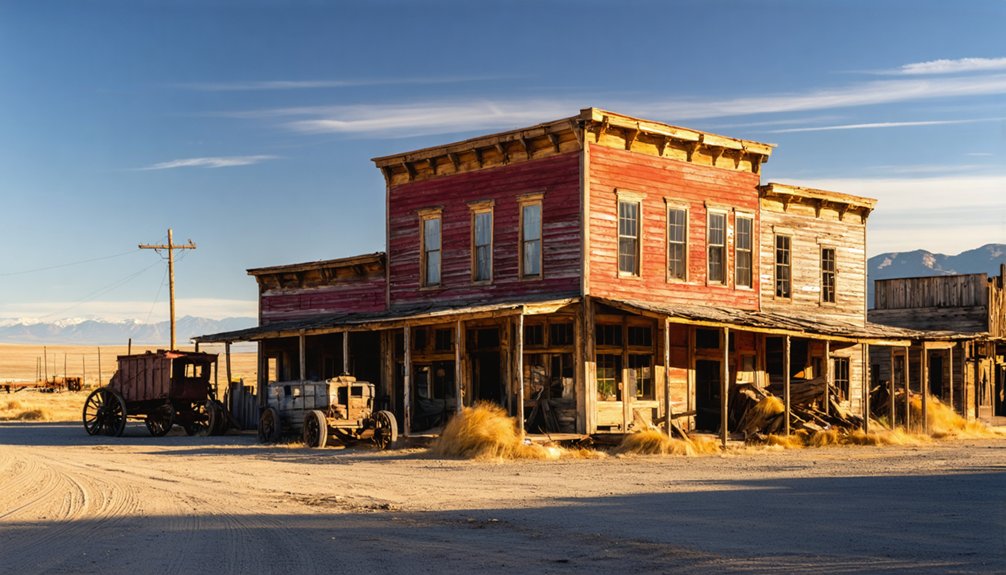
Throughout America’s westward expansion, mining towns emerged as vibrant epicenters of the frontier dream, sparked by the momentous discovery of gold at Sutter’s Mill in 1848.
The California Gold Rush ignited a wave of western settlement, transforming remote wilderness into bustling mining communities filled with ambitious pioneers.
You’ll find this mining heritage etched across the western landscape, from Virginia City’s Comstock Lode to Leadville’s silver bonanza, where over 250,000 prospectors extracted more than $200 million in precious metals within five years.
The frontier resilience of these settlements faced ultimate tests as ore deposits depleted. Once-bustling communities like Garnet, Montana, with its 1,000 residents and 13 saloons, transformed into silent remnants of the American West.
From 1880 to 1940, countless boomtowns fell victim to the mining industry’s brutal cycles, though some, like San Francisco, evolved into lasting metropolitan centers, forever shaped by the mineral wealth that drove their early growth.
Economic Forces Behind Urban Abandonment
While America’s abandoned ghost towns often evoke romantic images of the Old West, modern urban abandonment stems from complex economic forces that have reshaped cities since the mid-20th century.
The process of economic polarization has created a devastating cycle of urban decay, particularly in the Rust Belt, where deindustrialization triggered widespread vacancy.
You’ll find these key factors driving urban abandonment:
- Manufacturing job losses sparked population exodus and plummeting property values
- Suburbanization drew residents away with cheaper housing and better services
- Housing market collapse reduced property values, attracting low-income residents
- Shrinking tax bases crippled cities’ ability to maintain infrastructure
This perfect storm of economic pressures transformed once-thriving industrial centers into modern ghost towns, especially affecting African American communities trapped by spatial mismatch and discriminatory policies.
State-by-State Analysis of Vacant Properties
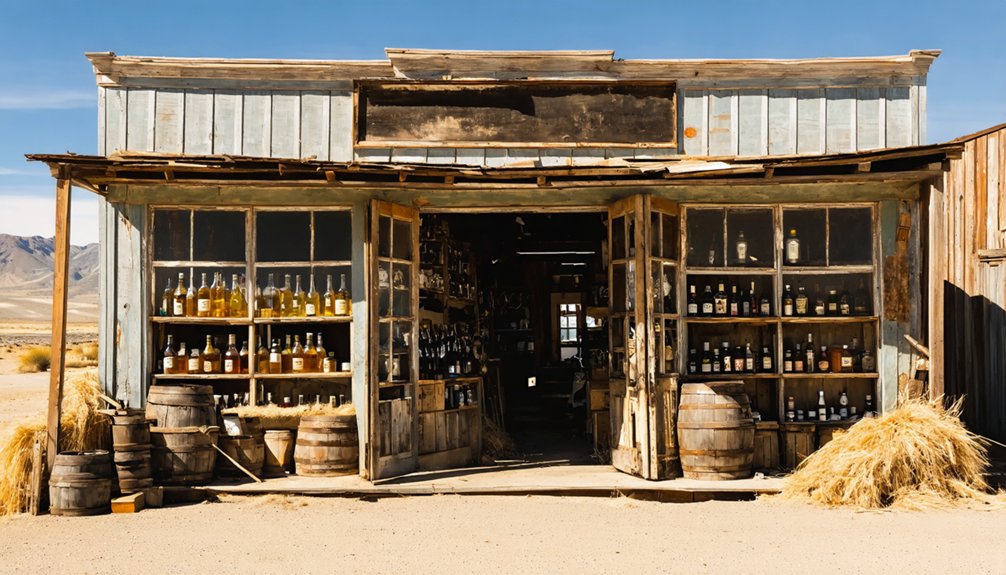
As America’s landscape of abandonment reveals distinct regional patterns, the distribution of ghost towns across states tells a compelling story of boom-and-bust cycles.
You’ll find Texas leading the charge with 550 ghost towns, while Oklahoma, Kansas, California, Florida, and South Dakota each harbor over 240 abandoned settlements.
For ghost town exploration enthusiasts, certain names repeatedly dot the map – Center Point appears seven times in Texas alone, while towns like Clifton and Hopewell each claim five instances nationwide.
The historical significance of these sites varies dramatically by region.
In the West, you’ll discover Bodie, California preserved in arrested decay, while the East offers Batsto Village, New Jersey as an accessible reminder of America’s industrial past.
Within Texas, Wilson County stands out with over 30 ghost towns, reflecting the state’s dynamic settlement history.
From Boom to Bust: The Lifecycle of Ghost Towns
When prospectors struck gold in places like Grasshopper Creek and Rhyolite, they set in motion a predictable pattern of explosive growth and inevitable decline that would define America’s ghost towns.
The ghost town origins typically followed a swift progression driven by mining industry impact, where boomtowns emerged practically overnight with sophisticated infrastructure.
You’ll find these settlements followed a common lifecycle:
- Initial resource discovery sparking rapid population influx
- Peak prosperity with development of railways, telegraph systems, and auxiliary markets
- Resource depletion leading to mass exodus
- Final abandonment due to catastrophic events or planned dismantling
Preservation Efforts and Tourism Potential
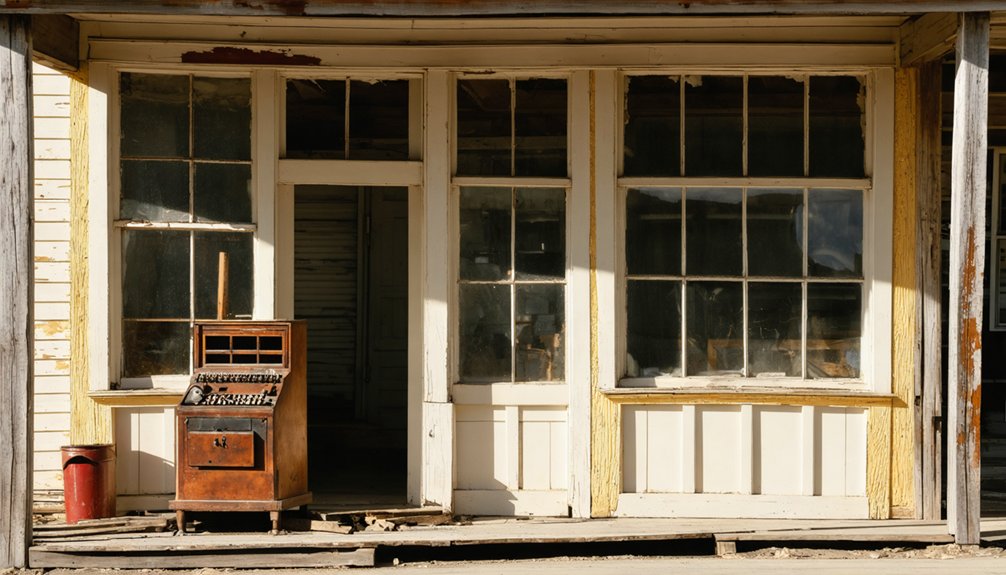
Today’s ghost towns stand at a crossroads between decay and revival, with preservation organizations and tourism initiatives breathing new life into these abandoned settlements.
You’ll find diverse preservation strategies at work, from the “arrested decay” approach at Bodie State Historical Park to full restorations like Jerome, Arizona’s transformation into a cultural destination.
Organizations such as the Ghost Town Club of Colorado and San Juan County Historical Society implement innovative solutions, including 3D digital mapping and structural stabilization.
Modern preservation groups are revolutionizing ghost town conservation through cutting-edge technology and engineering solutions.
Tourism opportunities have evolved beyond simple sightseeing. You can explore Goldfield’s 50 historic buildings, join ghost tours at the Goldfield Hotel, or discover modern art installations at Nevada’s International Car Forest.
These initiatives balance historical integrity with visitor experiences while local communities and preservation groups secure funding for sustainable, long-term protection of America’s abandoned heritage.
Frequently Asked Questions
How Do Insurance Companies Handle Properties in Modern Ghost Towns?
You’ll face strict property assessments and limited insurance policies, with higher premiums and extensive restrictions. Most standard insurers won’t cover these locations, forcing you toward specialty carriers or state-run programs.
What Happens to Mail Delivery Services in Areas With High Abandonment?
You’ll face delivery challenges as mail forwarding becomes necessary, while USPS reduces or discontinues service to areas showing consistent vacancy patterns, tracking abandoned properties through 90-day monitoring periods.
Are There Squatter Rights Laws Specific to Ghost Towns?
You won’t find squatter rights laws specifically for ghost towns – they’re governed by standard state adverse possession statutes. The same rules apply whether you’re claiming an abandoned storefront or ghost town property.
Do Ghost Towns Affect Property Taxes in Neighboring Communities?
You’ll see up to 20% drops in neighboring property values when ghost towns emerge nearby, creating negative tax implications that ripple through your community’s assessment values and local government revenues.
How Do Utility Companies Manage Infrastructure in Largely Abandoned Areas?
You’ll find utilities reduce infrastructure maintenance in abandoned areas by cutting off services, minimizing inspections, using remote monitoring, and transferring remaining customers to other circuits to decrease utility costs.
References
- https://themortgagepoint.com/2024/10/25/americas-new-ghost-towns/
- https://247wallst.com/housing/2024/04/11/americas-modern-ghost-towns-2/
- https://www.youtube.com/watch?v=aTbMdOZRZO4&vl=en
- https://www.geotab.com/ghost-towns/
- https://en.wikipedia.org/wiki/Lists_of_ghost_towns_in_the_United_States
- https://joybird.com/blog/top-ghost-towns-in-america/
- https://worldpopulationreview.com/world-city-rankings/abandoned-cities
- https://www.youtube.com/watch?v=HS-FP_iDByo
- https://www.youtube.com/watch?v=9Q3IEfnUqyM
- https://www.youtube.com/watch?v=lBP97B2Pc3s