You’ll discover over 275 ghost towns scattered across Arizona, with many dating back to the 1857 gold rush near the Colorado River. Notable sites include Jerome’s preserved galleries, Tombstone’s historic Boothill District, and Ruby’s intact mining village within Coronado National Forest. While some towns like Bisbee have been revitalized into tourist destinations, others remain authentically abandoned, offering glimpses into the Wild West’s lawless mining era. These time capsules hold countless stories of fortune, conflict, and survival.
Key Takeaways
- Jerome transformed from a copper mining boomtown into a preserved historic site with museums and galleries showcasing Arizona’s mining heritage.
- Tombstone remains famous for its silver mining history, preserved 1880s architecture, and historical sites like the Boothill Historic District.
- Ruby contains 25 intact buildings from its mining era, making it one of Arizona’s best-preserved ghost towns within Coronado National Forest.
- Bisbee features restored Victorian buildings and offers guided tours of its copper mining past, attracting history enthusiasts year-round.
- Vulture City generated over $200 million in precious metals during its peak and maintains significant architectural remnants from mining operations.
The Rich Mining History of Arizona’s Ghost Towns
While California’s gold rush drew thousands westward in the 1850s, Arizona’s mineral wealth remained largely untapped until prospectors began discovering rich deposits of gold, silver, and copper throughout the territory.
You’ll find that Arizona’s gold rushes started in 1857 near the Colorado River, with mining techniques evolving from simple placer mining to more complex operations.
The territory’s mining boom truly exploded in the 1870s and 1880s, transforming remote areas into bustling communities.
Towns like Tombstone flourished with silver discoveries, while places like Bisbee and Jerome became copper mining powerhouses.
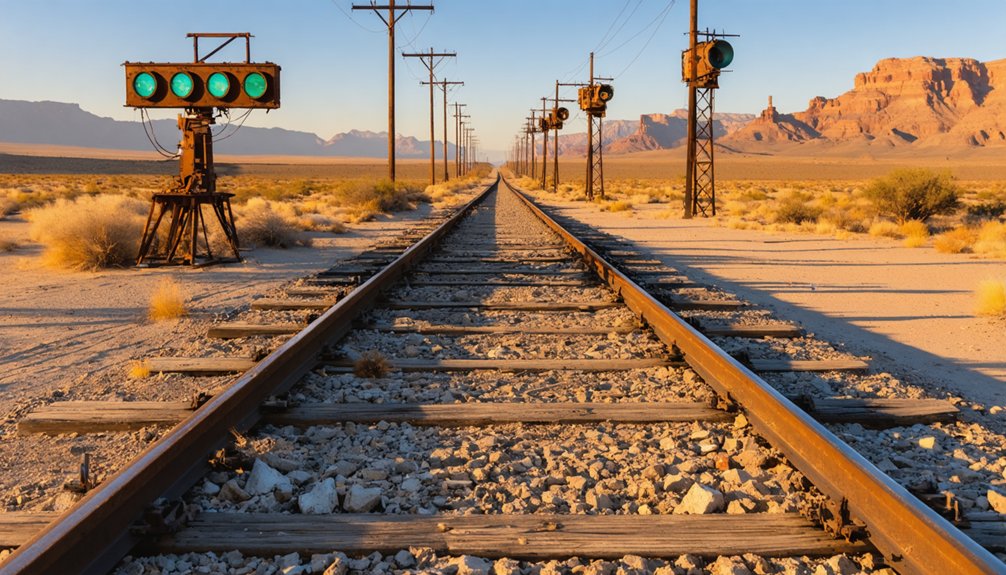
The Morenci Southern Railway served as a vital transportation link around 1900, allowing mines to transport ore efficiently and sustain operations.
Railroad expansion proved essential, allowing mines to transport ore efficiently and sustain operations.
However, these towns’ fortunes rose and fell with mineral prices and depletion, leaving behind fascinating remnants of Arizona’s mining heritage that include preserved historic buildings maintained by organizations like the Bureau of Land Management.
Must-Visit Ghost Towns for History Enthusiasts
Today’s history enthusiasts can explore dozens of preserved ghost towns across Arizona, each offering unique glimpses into the state’s mining and frontier past.
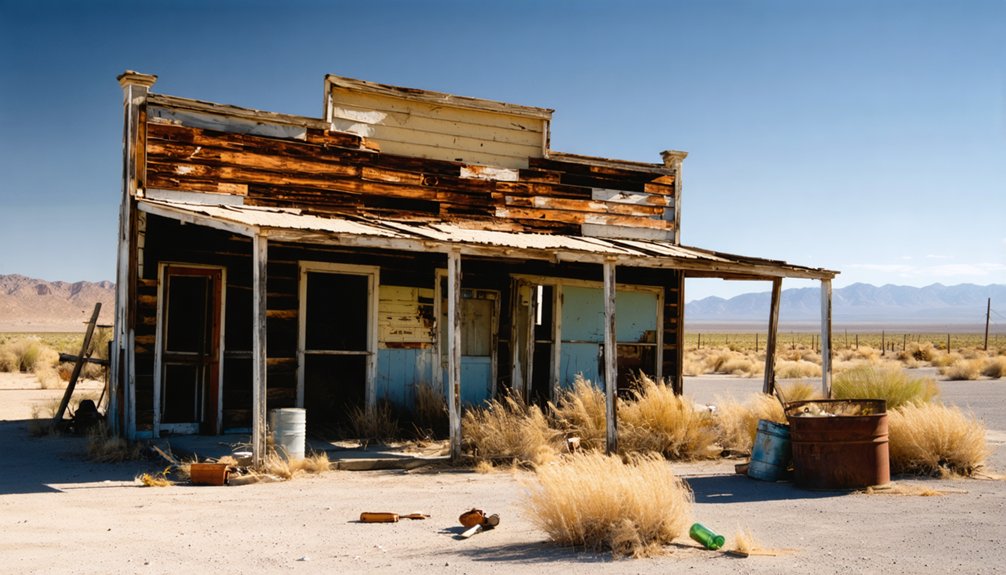
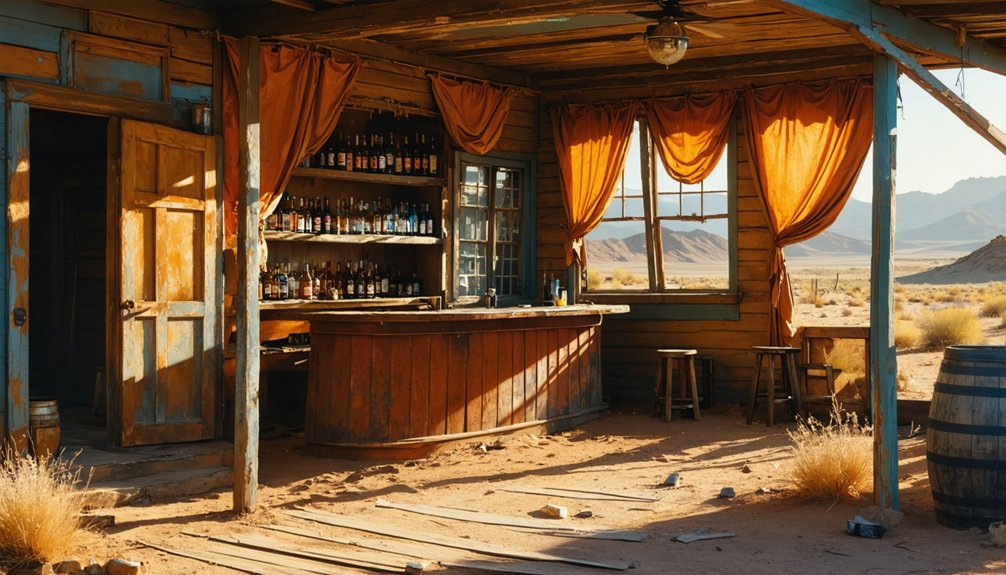
Among these captivating sites, the ghost towns of Arizona history reveal the stories of the brave souls who once sought fortune and adventure in the rugged terrain. Visitors can wander through dilapidated buildings, envisioning the bustling activity that once filled these now-silent streets. Each location serves as a testament to the resilience of those who embraced the challenges of life in the arid landscape.
Among the most intriguing aspects of these abandoned towns in Arizona is their architecture, which reflects the diverse cultural influences that shaped the region. From adobe structures to remnants of Victorian-style homes, each site tells a story etched in its walls. Visitors often capture the haunting beauty of these places through photography, preserving the memory of a bygone era.
From the streets of Jerome to the iconic Tombstone, ghost town tourism lets you step back into the Wild West era. You’ll discover well-preserved structures, museums, and historical reenactments that bring these once-bustling communities to life.
Step into Arizona’s Wild West past, where preserved ghost towns showcase authentic frontier life through living history and architectural treasures.
In Oatman, visitors can experience authentic Old West charm and participate in the annual Sidewalk Egg Fry that celebrates the town’s revival. Fort Bowie’s ruins require a 1.5-mile hike to access its historical treasures.
- Jerome stands as Arizona’s crown jewel of ghost towns, featuring extensive preserved buildings transformed into galleries and museums.
- Tombstone’s Boothill Historic District showcases 1880s silver boom architecture and famous gunfight locations.
- Ruby offers one of the most complete mining-era villages within Coronado National Forest.
- Bisbee’s copper mining heritage comes alive through guided tours and restored Victorian-era structures.
Preservation Efforts and Current State of Arizona’s Ghost Towns
Despite facing significant preservation challenges, Arizona’s historic ghost towns have benefited from a complex network of federal, state, and local funding initiatives that keep these cultural treasures alive.
You’ll find the State Historic Preservation Office leading essential efforts through grant programs and tax credits that support adaptive reuse projects across these remote settlements.
Recent emergency funding of $8.5 million and preservation planning initiatives like PreserveAZ 2025 have strengthened protection for these historic sites.
Many ghost towns are finding new life through creative entrepreneurs who’re converting old structures into hospitality venues and mixed-use spaces while maintaining their historic character.
The “arrested decay” approach has proven particularly effective in areas where full restoration isn’t feasible, allowing you to experience these sites in their authentic, weathered state while ensuring their basic preservation.
Jerome stands as a prime example where artists and entrepreneurs have successfully transformed a former copper mining town into a vibrant cultural destination.
Without immediate intervention, these preservation efforts could halt by August 2025 when SHPO faces potential shutdown due to funding issues.
Tales of Lawlessness and Life in Arizona’s Mining Communities
From the infamous Ruby Murders to daring train heists, Arizona’s mining communities endured a perilous era of lawlessness that defined the American frontier.
You’ll find tales of Mexican bandits releasing terror in border towns like Ruby, where double homicides in 1920 and 1921 sparked the Southwest’s largest manhunts. The frontier’s dangerous reputation drew outlaws and desperados, while store owners like Philip Clarke armed every room against border raids and rustling. The Eagle-Picher Lead Company transformed Ruby into a thriving town of 2,000 residents after purchasing local mining operations in 1926.
Small-scale prospectors often abandoned their mines after financial backing dried up, leaving dangerous hazards throughout the territory.
- Vulture Mine’s $200 million gold strikes triggered bloody conflicts with Native Americans
- The Fairbank train robbery showcased lawman Jeff Milton’s heroic defense of Wells Fargo gold
- Ruby store owners faced constant threats, keeping weapons ready at their counters
- Border raids and cattle rustling plagued mining communities, with outlaws slipping into Mexico
Exploring the Architectural Remains of Arizona’s Mining Era
Standing as silent witnesses to Arizona’s mining heyday, the architectural remnants of once-bustling boomtowns offer glimpses into the state’s prosperous past.
Weathered brick walls and crumbling foundations tell tales of Arizona’s golden age, when precious metals sparked dreams of wealth.
You’ll find diverse architectural styles across these preserved settlements, from Ruby’s impressive collection of 25 roofed buildings to Vulture City’s restored 1800s structures.
In Swansea, you can explore the remaining adobe and brick buildings that once housed a thriving copper mining community. The mining structures still dot these landscapes – from Courtland’s concrete jail to the visible mine shafts throughout Swansea. The town’s machine shop remains extensively preserved, offering multiple levels for visitors to explore.
Harshaw’s adobe walls of the James Finley House stand as proof of silver mining prosperity, while Ruby’s Montana Mine complex showcases the extensive infrastructure that made it the largest mining camp in southwest Arizona. Among these historic sites, Vulture City’s legacy stands out with its remarkable over $200 million in precious metals production during its prime.
Frequently Asked Questions
Are There Guided Ghost Town Tours Available During Night Hours?
Under star-filled skies, you’ll find guided tours and night explorations waiting in Goldfield, Jerome, and Bisbee, where lantern-lit paths lead you through mines, bordellos, and haunted historic buildings.
What Survival Supplies Should Visitors Bring When Exploring Remote Ghost Towns?
Pack a first aid kit, water, flashlights, navigation tools like maps and compass, emergency shelter, sturdy boots, and charged phone. Don’t forget sun protection and snake bite supplies.
Can Metal Detectors Be Legally Used in Arizona Ghost Towns?
You can’t legally use metal detectors in Arizona ghost towns. Metal detecting regulations and historical preservation laws strictly prohibit this activity to protect archaeological resources, with violations resulting in arrests and equipment seizure.
Are There Seasonal Road Closures Affecting Access to These Ghost Towns?
You’ll face seasonal road closures due to weather conditions and maintenance projects, especially US 60’s restrictions between Superior and Miami. Winter access to North Rim routes ends October 15 through May 15.
Do Any Ghost Towns Offer Special Photography Permits or Workshops?
You’ll need a permit at Gold King Mine for photography workshops at $25 per person daily, or choose annual ($250) or one-time ($50) permits for professional shooting and image resale.
References
- https://www.visittucson.org/blog/post/8-ghost-towns-of-southern-arizona/
- https://www.visitarizona.com/like-a-local/4-arizona-ghost-towns-you-may-have-never-heard-of
- https://www.atlasobscura.com/things-to-do/arizona/ghost-towns
- https://www.arizonahighways.com/article/arizona-ghost-towns
- https://www.youtube.com/watch?v=l_ogVgvyw7Y
- https://www.tripadvisor.com/Attractions-g28924-Activities-c47-t14-Arizona.html
- https://pinintheatlas.com/travel-blogs/ghost-towns/
- https://en.wikipedia.org/wiki/List_of_ghost_towns_in_Arizona
- https://winfirst.wixsite.com/arizonamininghistory/history
- https://www.azcentral.com/picture-gallery/news/local/arizona/2025/04/27/arizona-mining-history-and-ghost-towns-photos/82766419007/