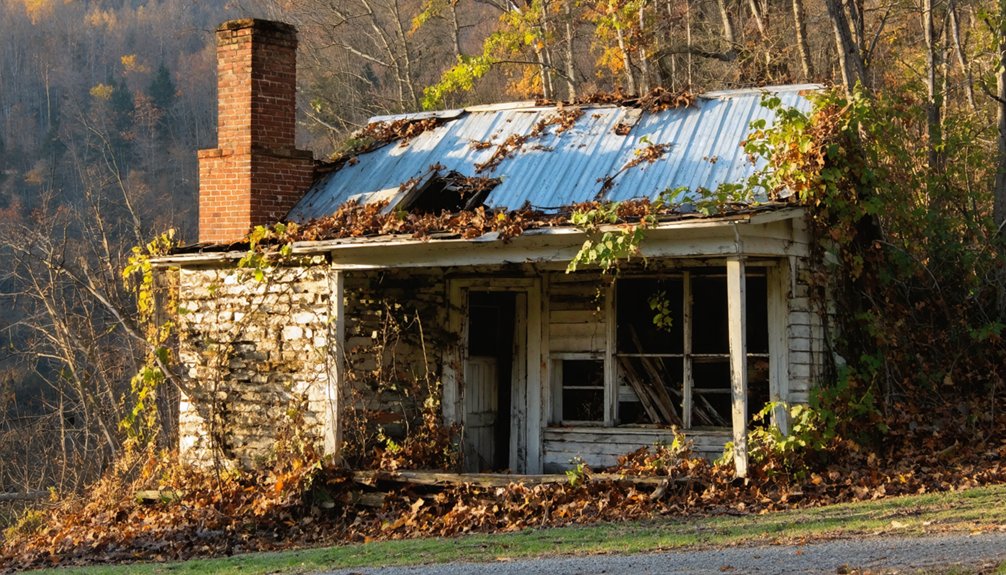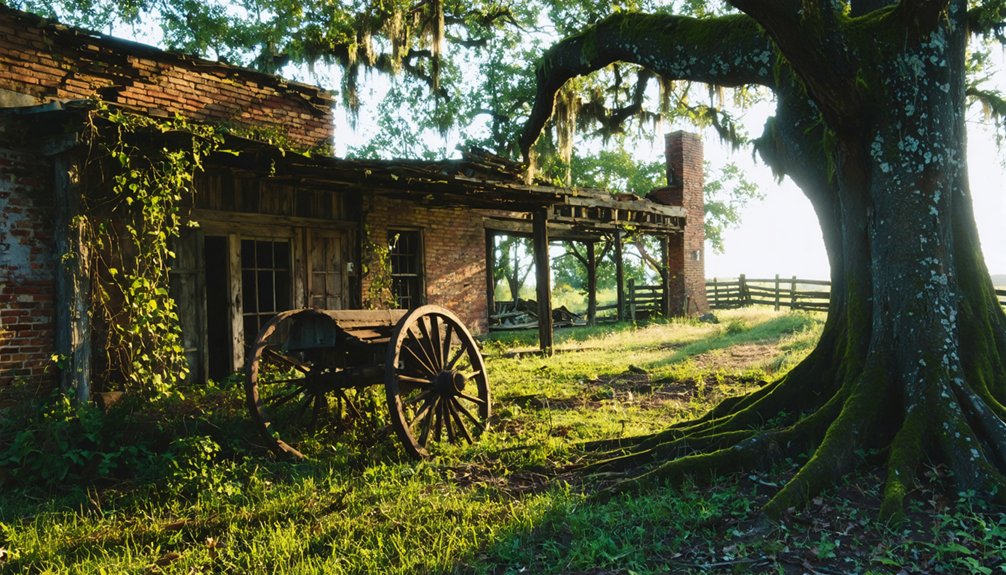
You’ll find several fascinating ghost towns scattered across Arkansas, each with its own unique story of rise and decline. Rush thrived as a zinc mining hub until the 1960s, while Monte Ne’s grand resort lies mostly underwater beneath Beaver Lake. Graysonia’s timber empire collapsed during the Great Depression, and Historic Davidsonville preserves territorial-era ruins. These abandoned communities, from mining camps to resort destinations, offer glimpses into Arkansas’s dynamic past, with many secrets still waiting to be uncovered.
Key Takeaways
- Rush became Arkansas’s largest zinc mining ghost town, featuring 15 active mines before its abandonment in the 1960s.
- Monte Ne resort town now lies mostly underwater in Beaver Lake, with ruins visible during drought conditions.
- Graysonia thrived as a timber town until 1931, when the Great Depression and depleted resources led to its abandonment.
- Historic Davidsonville preserves early Arkansas settlement history through archaeological sites and interpretive trails at its state park.
- Pinnacle Springs, once a popular resort with hotels and bathhouses, declined rapidly after 1891 and was reclaimed by nature.
The Rise and Fall of Rush: A Zinc Mining Legacy
Hidden in southern Marion County along the Buffalo River, Rush emerged as Arkansas’s premier zinc mining community after John Wolfer’s fortuitous discovery of zinc deposits along Rush Creek.
What started as a mistaken search for silver quickly transformed into a zinc mining powerhouse during World War I, with the town’s population swelling to 5,000 as demand for zinc soared.
You’ll find that Rush’s heyday featured 15 active mines, with the Morning Star Mine leading production and extracting massive smithsonite specimens. The mine’s most impressive find was a single smithsonite mass weighing 12,750 pounds.
Historic gravity-fed tramways transported ore from the mountainside mines to processing mills in the valley below.
But the post-war zinc market collapse proved devastating – by 1920, only 344 residents remained. The last inhabitants departed in the 1960s, and Rush earned official ghost town status in 1972.
Today, you can explore the historic district’s abandoned buildings, century-old cemetery, and remnants of Arkansas’s zinc mining legacy.
Monte Ne: The Submerged Resort Town
You’ll find few ghost towns as fascinating as Monte Ne, where William “Coin” Harvey’s ambitious 1900s resort once drew nationwide visitors with its massive log hotels, Venetian gondolas, and spring-fed amenities.
The resort’s fortunes declined sharply in the 1920s as Harvey faced bankruptcy, leading to his death as a pauper in 1936 at his beloved Monte Ne.
Today, you can glimpse remnants of this lost paradise only during extreme drought conditions, as Beaver Lake’s waters submerged most of the 320-acre resort town by the early 1980s, leaving just scattered ruins and underwater mysteries for modern explorers. The resort’s greatest architectural achievement was its first indoor swimming pool in Arkansas, which opened with the Hotel Monte Ne in 1901. Harvey’s vision included building a massive pyramid as a time capsule to preserve knowledge for future civilizations.
Resort’s Grand Early Days
At the dawn of the 20th century, William Hope “Coin” Harvey transformed 320 acres of Arkansas wilderness into Monte Ne, an ambitious resort destination that would briefly shine as one of the region’s premier vacation spots.
You’d have found grand innovations like Arkansas’s first golf course, an indoor heated swimming pool with slides and springboards, and a unique transportation system featuring a 50-foot Venetian gondola.
The resort’s massive log hotels hosted extended-stay visitors who’d come for health retreats and social gatherings, complete with dances and organized hunts along the White River.
Monte Ne wasn’t just a hotel – it was a self-contained community with its own post office, bank, and even a dedicated railroad line from Lowell, offering guests a truly luxurious escape from city life.
The resort’s visionary founder established the Bank of Botany to help finance his ambitious development plans for the property.
The resort celebrated its official debut with a grand opening on May 4, 1901, marking the completion of the Hotel Monte Ne.
Beaver Lake’s Rising Waters
Once the U.S. Army Corps of Engineers began construction of Beaver Dam in 1960, Monte Ne’s fate was sealed.
You’d witness a massive undertaking that required the Corps to purchase over 40,000 acres and relocate countless homes, farms, and cemeteries. By June 1966, the rising waters of Beaver Lake had engulfed the once-thriving resort town.
Before its flooding, the resort enjoyed grand hotel amenities, including an indoor heated pool, tennis courts, and even a golf course built before 1909.
The resort’s founder W.H. Coin Harvey had transformed this area into a popular tourist destination before the lake’s creation.
Today, you’ll find Monte Ne’s submerged history revealed only during significant drawdowns. The Oklahoma Row hotel tower stood as a lonely sentinel above the waterline for decades until its demolition in 2023.
When lake levels drop substantially, you can spot the amphitheater’s upper sections, retaining walls, and building foundations emerging from their watery tomb. Local dive operators now guide underwater explorers to these haunting remains of Arkansas’s lost resort town.
Ruins Slowly Fade Away
The story of Monte Ne’s slow disappearance began long before Beaver Lake’s waters claimed it.
You’ll find decaying structures scattered across what was once Arkansas’ grandest resort town, with only fragments remaining to tell its tale. The most visible ruins include Missouri Row’s foundation, a lonely fireplace, and remnants of a retaining wall, while forgotten memories of Italian gondolas and the world’s largest log hotels slip further into history.
In 2023, workers removed parts of Oklahoma Row for safety, marking another chapter in Monte Ne’s fade into obscurity. The destination once drew visitors from around the country as the site of three luxury hotels and numerous amenities. The resort originally encompassed over 300 acres of prime Arkansas land.
When lake levels drop dramatically, you can still glimpse the amphitheater and original Hotel Monte Ne foundation – silent witnesses to William Harvey’s ambitious dream that now lies mostly beneath Beaver Lake’s surface.
Graysonia’s Timber Empire: From Boom to Bust
Founded in 1907 by the Grayson-McLeod Lumber Company, Graysonia emerged as a bustling timber town after the company depleted its resources near Daleville and relocated its mill operations.
Named for company president William Grayson, the town’s timber industry quickly became the heartbeat of local community dynamics, with a peak population of nearly 1,000 residents.
Under William Grayson’s namesake, this timber town flourished into a vibrant community of 1,000 souls bound together by sawdust and determination.
You’d have found one of the South’s largest sawmills there, churning out 150,000 board feet daily. The company built everything – from housing and hotels to an ice plant and utilities.
But by 1931, the combined punch of the Great Depression and depleted timber reserves forced the mill to close. A brief mercury mining venture in 1932 couldn’t save the town, and by 1950, Graysonia’s population had dropped to zero.
Davidsonville: Preserving Arkansas’s Territorial Past
Deep in Arkansas’s territorial past lies Davidsonville, a pioneering settlement that blazed numerous trails in early American frontier development.
You’ll find remarkable historical significance in this ghost town, which housed Arkansas Territory’s first federal land office, post office, and recorded courthouse around 1820. Originally founded as Lawrence in 1815, the town quickly became a bustling center along the Southwest Trail and Black River.
While local legends blame yellow fever or fire for its demise, archaeological findings reveal a different story. The town’s decline stemmed from losing key government functions and transportation routes to emerging settlements like Batesville.
Today, you can explore the 35-acre site at Historic Davidsonville State Park, where ghost structures and interpretive trails help you visualize this forgotten frontier capital’s brief but impactful existence.
Lost Communities Along Buffalo River
Along the scenic Buffalo River, countless communities once thrived during the region’s peak settlement period between 1820 and 1840.
You’ll find traces of these lost settlements in places like Boxley Valley, Erbie, and Rush, where foundations, cellar holes, and cemeteries tell stories of bygone eras. Early settlers, mostly from Missouri and Tennessee, established small bottomland farms and built communities around schools, churches, and resource extraction sites.
These communities faced multiple challenges that led to their decline. Poor soil conditions, limited transportation, and resource depletion forced many residents to abandon their homes.
Later, the creation of Buffalo National River in 1972 resulted in significant community displacement through federal land acquisition. Post-World War II demographic shifts also contributed to their demise as younger generations moved to cities, leaving these once-vibrant communities to fade into history.
Mining Ghost Towns of the Ozark Mountains
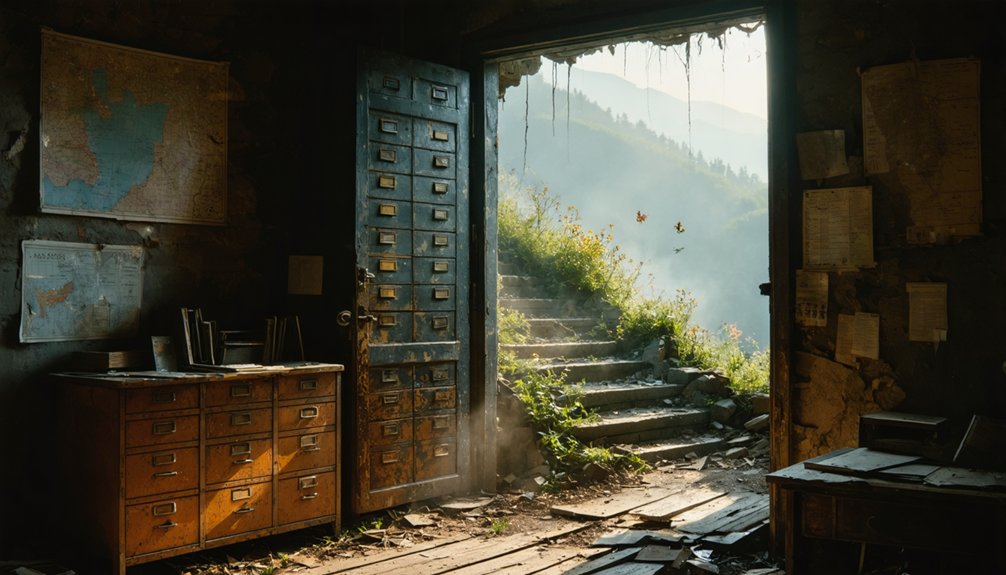
When zinc ore surfaced along Rush Creek in the 1880s, hopeful farmers and prospectors initially mistook its metallic sheen for silver deposits.
You’ll discover that this misconception led to the construction of a rock smelter in 1886, which revealed the truth during its first test run: the ore produced zinc oxide fumes instead of precious silver.
The area’s mining heritage flourished nonetheless, as zinc extraction operations expanded rapidly.
By World War I, you could’ve found yourself among 2,000-5,000 residents, with ten mining companies operating 13 developed mines.
Today, you can explore this preserved ghost town within Buffalo National River, where abandoned structures, mining caves, and a historic blacksmith shop tell the story of Rush’s boom-and-bust cycle.
The 1886 smelter still stands as the oldest reminder of Rush’s mining ambitions.
The Hidden Remnants of Pinnacle Springs
In northern Faulkner County, the forgotten resort town of Pinnacle Springs first caught Jeff Collier’s attention in 1880 while he herded cattle near Cadron Creek.
After discovering the spring’s unusual taste, local businessmen transformed the area into a bustling resort town. By 1885, you’d have found two hotels, twelve bathhouses, eight stores, and fifty houses with permanent residents.
Today, the ghostly remnants of Pinnacle Springs tell a different story.
After its post office closed in 1891, the town rapidly declined due to its reputation for immoral behavior and ineffective spring water treatments.
Fire claimed several buildings, while others were dismantled and moved. By 1950, nature had reclaimed most traces of the town, leaving only carved names and dates on rock walls as silent witnesses to its brief prosperity.
Arkansas Ghost Towns Through Historical Records
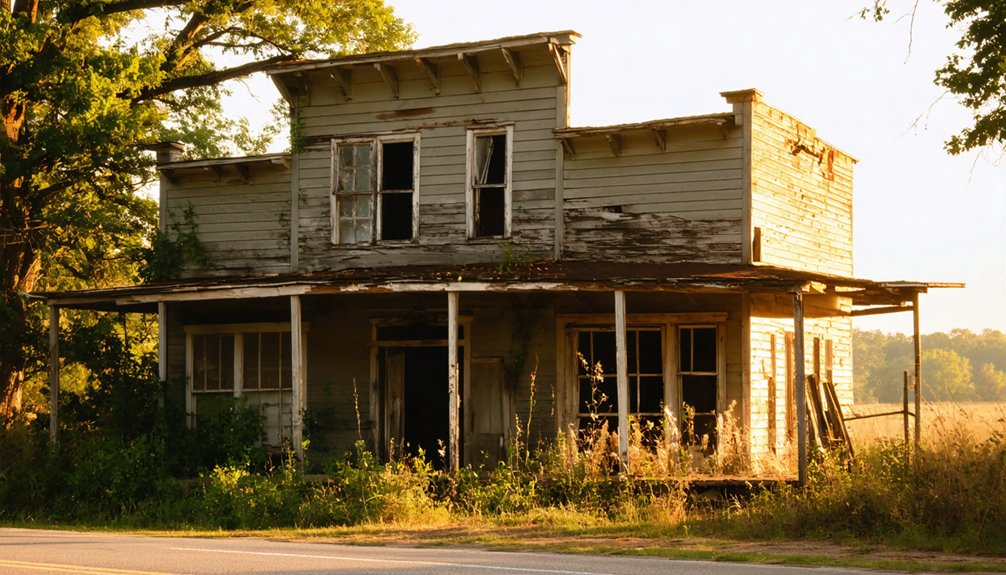
Historical records scattered across Arkansas reveal the fascinating stories of numerous ghost towns that once thrived during different eras of the state’s development.
Many of these ghost towns in Arkansas are remnants of the booming mining and rail industries, now standing silent as a tribute to the past. Explorers and history enthusiasts often venture into these abandoned places, seeking to uncover the secrets held within their dilapidated structures. Each town tells a unique story, reflecting the challenges and triumphs faced by its former inhabitants.
You’ll find these forgotten places documented in historical archives, from Rush’s zinc mining heyday to Monte Ne’s ambitious resort dreams.
Through preserved records, you can trace Arkansas Post‘s evolution from a French trading outpost to a Spanish fort, while Daleville and Graysonia’s rise and fall mirror the state’s timber industry boom.
The ghost town significance extends beyond physical remnants – places like Blanchard Springs, Cadron, and Frog Level have left their mark through documented accounts of early settlements.
These records paint a vivid picture of communities that shaped Arkansas’s industrial, commercial, and colonial heritage.
Urban Exploration and Safety Considerations
Exploring Arkansas’s ghost towns requires careful attention to both legal requirements and safety protocols. Before starting your urban exploration adventure, you’ll need to secure proper permissions, whether from private landowners, federal parks, or state agencies.
Don’t risk trespassing charges – stick to sanctioned access points and permitted areas.
Your safety gear is essential: wear a hard hat, respirator, and sturdy boots to protect against structural hazards and environmental contaminants. Always explore with at least one partner, establish emergency plans, and carry navigation tools and first-aid supplies.
Watch for hidden dangers like unstable floors, open mine shafts, and wildlife hazards. Instead of entering precarious structures, use telescoping poles or long-range photography to document these historic sites safely.
Photographing Arkansas’s Abandoned Places
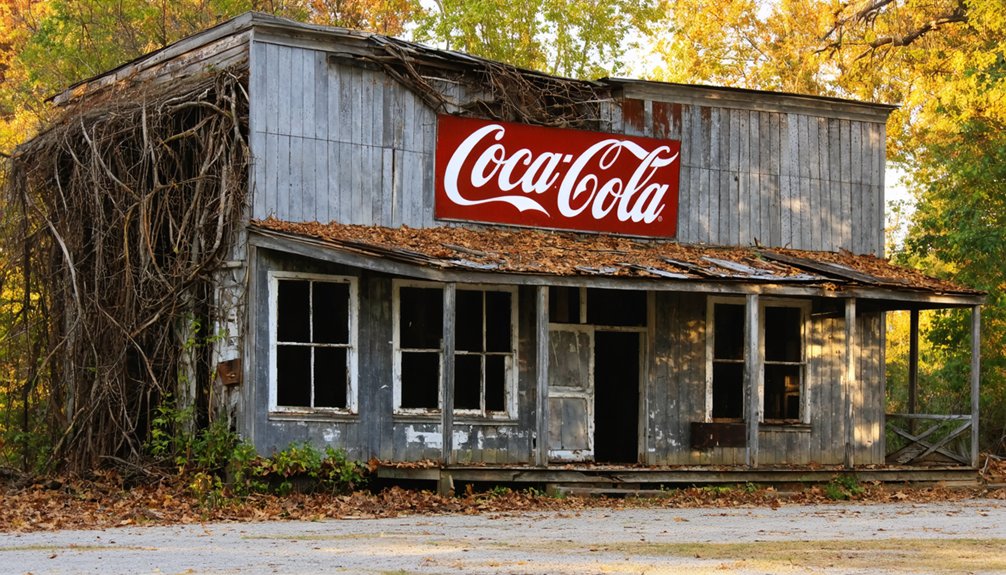
Whether you’re documenting crumbling zinc mines at Rush Historic District or capturing the quiet decay of Smithville’s abandoned streets, Arkansas’s ghost towns offer photographers rich opportunities for compelling imagery.
You’ll find diverse subjects ranging from 1890s architecture to industrial ruins, with seasonal wildflowers providing striking natural contrasts against weathered structures.
For the best results, scout locations carefully and confirm access permissions, especially since many abandoned structures sit on private land.
While federally protected sites like Rush require shooting from designated viewpoints, you can still capture dramatic compositions along public trails like Morning Star Loop.
Pack both wide-angle lenses for environmental shots and mid-range telephotos for architectural details.
The state’s inventory of over 300 abandoned sites, including old schools and hotels, guarantees you’ll have plenty of atmospheric locations to explore.
Frequently Asked Questions
Are There Any Ghost Towns in Arkansas That Offer Guided Tours?
At Rush Ghost Town, you’ll find National Park Service’s preserved district where 20+ historic structures await. You can take the self-guided walking tour through the Old Quarter’s interpretive signage and Morning Star Loop.
What Wildlife Commonly Inhabits Abandoned Arkansas Ghost Towns Today?
You’ll find wildlife sightings including deer, foxes, raccoons, and diverse bird species. Fish and amphibians thrive near riverine ruins, while animal adaptations have transformed abandoned buildings into natural habitats.
Which Arkansas Ghost Towns Are Most Accessible During Winter Months?
You’ll find RushGhostTown and Booger Hollow most accessible for winter exploration, with maintained roads and parking. Both offer easy ghost town accessibility without requiring 4WD vehicles or special winter gear.
Do Any Arkansas Ghost Towns Still Have Active Cemeteries?
Time stands still, yet life goes on – you’ll find active cemeteries in Rush, Bruno, and Eros ghost towns. They maintain historical significance through periodic burials, preservation efforts, and family visitation.
Can Metal Detecting Be Legally Done at Arkansas Ghost Town Sites?
You can’t legally metal detect at ghost town sites due to metal detecting regulations and historical preservation laws, unless you’re an authorized Arkansas Archeological Survey agent or have explicit written permission.
References
- https://www.axios.com/local/nw-arkansas/2024/01/02/arkansas-ghost-towns-mapped
- https://www.youtube.com/watch?v=U4kJjjbcnMM
- https://aymag.com/arkansas-backstories-ghost-towns/
- https://kkyr.com/arkansas-top-5-ghost-towns/
- https://metaldetectingforum.com/index.php?threads/arkansas-ghost-towns.80591/
- https://abandonedar.com
- https://en.wikipedia.org/wiki/List_of_ghost_towns_in_Arkansas
- https://kids.kiddle.co/List_of_ghost_towns_in_Arkansas
- https://en.wikipedia.org/wiki/Rush_Creek_mining_district
- https://www.nps.gov/articles/rush-historic-district-500856.htm