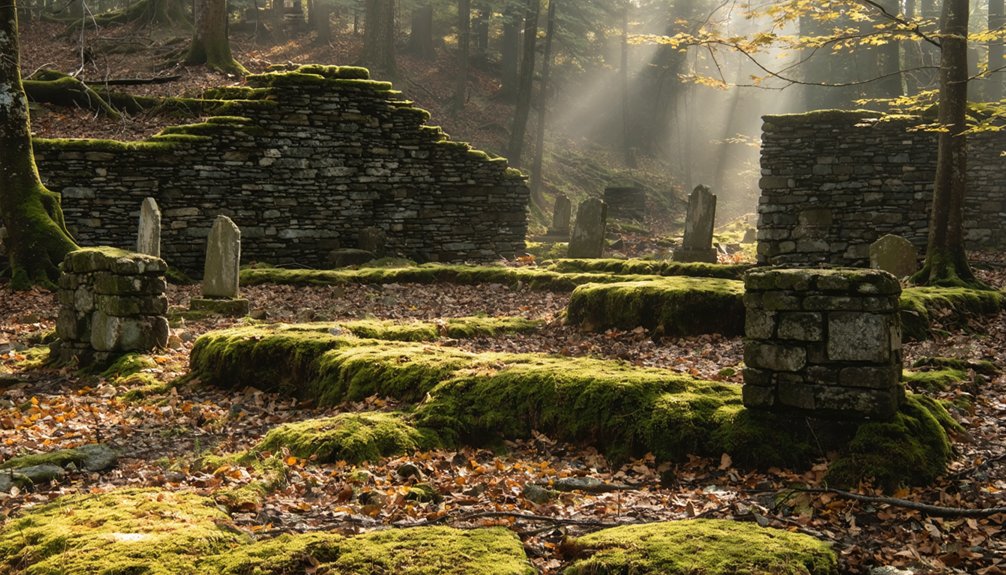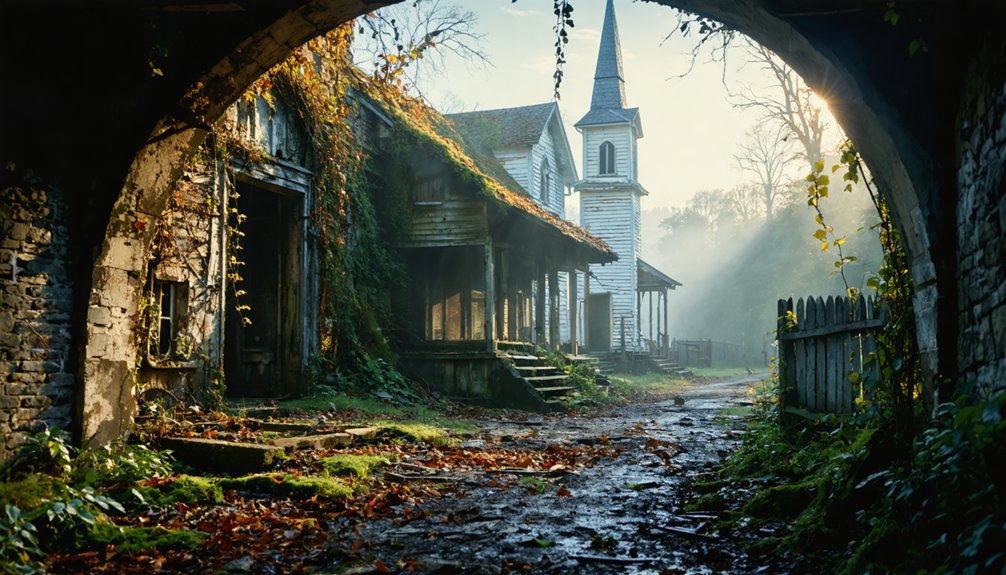
You’ll discover several fascinating ghost towns scattered across Connecticut, from the notorious Dudleytown with its dark legends to the ruins of textile mills at Gay City State Park. While some settlements like Johnsonville showcase preserved Victorian architecture, others like Bara-Hack contain only stone foundations and Welsh cemeteries. Many of these abandoned communities date back to the 1700s and 1800s, though access varies considerably – some sites welcome visitors while others remain strictly off-limits, each holding unique stories of Connecticut’s industrial and social past.
Key Takeaways
- Gay City State Park contains well-preserved ruins of a former Methodist settlement with textile mills and is open for public exploration.
- Dudleytown, known for its haunted reputation and mysterious past, is strictly off-limits and protected by private conservation groups.
- Johnsonville features abandoned Victorian-era buildings and structures but remains closed to public access due to private ownership.
- Bara-Hack, an 18th-century Welsh settlement, contains stone ruins and a historic cemetery but is located on private property.
- Valley Forge ghost town remains submerged beneath the Saugatuck Reservoir but becomes visible during drought conditions.
Uncovering Connecticut’s Lost Settlements
While many of Connecticut’s historic settlements still thrive today, several once-bustling communities have faded into obscurity, leaving behind only scattered ruins and forgotten stories.
Time has erased these once-vibrant Connecticut towns, leaving only crumbling stones and lost tales in their wake.
You’ll discover these hidden remnants of lost architecture across the state, from Gay City’s preserved stone foundations to Bara-Hack’s isolated Welsh cemetery. Each site tells a tale of economic decline that shaped Connecticut’s landscape during the 18th and 19th centuries.
At Gay City State Park, you can explore 4,000 acres containing the remains of a Methodist settlement that once boasted textile mills and distilleries before fires led to its downfall.
Meanwhile, Johnsonville’s Victorian-era buildings stand frozen in time behind “No Trespassing” signs, and Bara-Hack’s stone ruins whisper stories of Welsh settlers who abandoned their farming community before the Civil War.
The mysterious town of Dudleytown, built on ancient Mohawk grounds, remains sealed off from public access due to its haunted reputation and local concerns about trespassers.
Another notable lost settlement is Valley Forge, where drought conditions occasionally reveal submerged stone foundations from homes that were forcibly acquired through eminent domain for reservoir construction.
Dark Tales From Dudleytown’s Cursed Past
Among Connecticut’s abandoned settlements, none carries a darker reputation than Dudleytown.
You’ll find its origins traced to the 1700s when Thomas Griffis first settled the land, followed by Gideon Dudley’s family in 1747. The Dudley name brought with it a centuries-old curse dating back to Edmund Dudley’s 1510 beheading under King Henry VIII.
As Dudleytown hauntings began to surface, family tragedies mounted – from Gershon Hollister’s 1792 murder to Nathaniel Carter’s loss of his wife and infant to Native American attacks.
The isolated village, nestled in Dark Entry Forest’s valley, witnessed unexplained deaths, bouts of insanity, and suicides. Today, the area is strictly private property with no public access permitted. Historical research has revealed that no ancestral connection exists between Dudleytown’s residents and the executed English noblemen.
The Rise and Fall of Industrial Mill Towns
As Connecticut’s agrarian landscape gave way to industrial progress in the early 1800s, entrepreneurs began establishing water-powered mill towns along the state’s rivers and streams.
You’ll find their industrial heritage in the remnants of textile mills, metal works, and company-built communities that once thrived across the region.
These self-contained villages featured worker housing, stores, schools, and social halls, creating tight-knit communities under company control. Mill owners believed that better worker treatment resulted in more reliable and productive employees.
Mill towns functioned as complete micro-societies, with company-owned housing, shops and social spaces binding workers together into close communities.
In eastern Connecticut, textile manufacturing dominated, while precision metalworking flourished in the west, earning nicknames like Waterbury’s “Brass City.”
But this community legacy wouldn’t last forever. The rise of metalworking industries shaped many towns, with tap and die manufacturing making some communities among the wealthiest globally by the early 1900s.
Nature Reclaiming Historical Ruins
Throughout Connecticut’s landscape, abandoned settlements and industrial ruins slowly surrender to nature’s persistent advance.
You’ll find stone foundations at Gay City State Park disappearing beneath thick forest growth, while Johnsonville Village’s Victorian buildings stand frozen in time as vegetation claims their weathered walls.
At Bara-Hack, moss-covered gravestones peek through fallen leaves, marking nature’s reclamation of this historic settlement.
The historical significance of these sites lies partly in their dramatic transformation. In Norwich, a chilling reminder remains where criminally insane patients once resided, now hidden behind decades of untamed growth.
Water now conceals Hopeville’s mill foundations and Jerusalem’s entire community beneath Candlewood Lake’s surface.
Time has woven a complex tapestry where human industry once thrived – dense woods now shadow forgotten roads, vines embrace crumbling walls, and forests march steadily onward, writing new chapters in these abandoned places’ stories.
In Dudleytown, remnants of colonial life fade away as poor farming soil contributed to the village’s eventual abandonment.
Legends and Supernatural Claims
You’ll find Connecticut’s abandoned settlements steeped in claims of supernatural activity, from Dudleytown’s reported demonic presence to Bara-Hack’s mysterious disembodied voices.
Litchfield hill teens often dare each other to explore these eerie locations, spreading tales of their encounters across generations.
The legends gained significant traction through paranormal investigators‘ accounts of shadow figures, temperature drops, and unexplained phenomena throughout the Dark Entry Forest and surrounding areas.
These stories have become deeply woven into local folklore, with prominent investigators like Ed and Lorraine Warren documenting alleged encounters at sites like Union Cemetery, where the “White Lady” and “Red Eyes” phenomena continue to captivate visitors. The Warrens Occult Museum stands as a testament to their extensive investigations, housing artifacts and evidence gathered from these haunted locations.
Demonic Activity Reports
While Connecticut’s ghost towns hold fascinating historical significance, their reputations for supernatural activity have made them legendary among paranormal enthusiasts.
You’ll find some of the most compelling demonic hauntings in Dudleytown, where the Warrens documented possessions during their 1970s Halloween investigation. The town’s dark history includes reports of suicides and ritualistic activity, with visitors experiencing phantom touches and overwhelming dread.
Similar paranormal encounters have emerged from Johnsonville and Bara-Hack, where investigators have recorded unexplained voices, spectral sounds, and ghostly figures.
Dark Entry Forest has become particularly notorious for shadowy apparitions and unseen forces touching trespassers. These locations have attracted so many ghost hunters that property owners have been forced to restrict access, though reports of electronic malfunctions, temperature drops, and violent incidents continue to surface.
Local Folklore Stories
Deep within Connecticut’s abandoned settlements, folklore and supernatural claims have woven an intricate tapestry of local legends.
From ghostly encounters to chilling folklore origins, you’ll discover stories that have persisted through generations.
Here are some of Connecticut’s most haunting tales:
- The White Lady of Union Cemetery, who darts in front of cars before vanishing – a spirit linked to a dark tale of murder and revenge.
- Bara-Hack’s mysterious disembodied voices, echoing through an 18th-century Welsh settlement abandoned for over 125 years.
- Great Hill Cemetery’s infamous Hookman, whose metal hook still scratches cars parked beneath his final resting place.
- Little People’s Village, where a man’s obsession with fairy visions led to the construction of miniature ruins that allegedly drive visitors mad.
Preservation Efforts and Protected Sites
Connecticut’s State Historic Preservation Office leads efforts to protect abandoned settlements through landmark designations and preservation programs, as evidenced by their management of significant sites like Old Newgate Prison.
You’ll find many ghost towns now operate as protected state parks, with organizations like Connecticut Landmarks and Preservation Connecticut providing essential support through grants, technical assistance, and community education programs.
The revitalization of these areas has led to a growing interest in abandoned properties for sale in Connecticut, enticing investors and history enthusiasts alike. Many see the potential to restore these sites and bring new life to forgotten communities. As awareness increases, more people are exploring the rich history behind these properties, eager to preserve their stories while contributing to the local economy.
Among the intriguing opportunities are ghost towns in Connecticut, where remnants of past civilizations offer a glimpse into history. As preservation efforts evolve, these towns stand as testaments to the resilience of local communities. They not only attract tourists and researchers but also inspire local initiatives aimed at fostering sustainable development in the region.
The state’s commitment to preservation extends beyond basic protection, incorporating heritage sites like Falls Mill at Uncas Leap into educational spaces that connect visitors to Connecticut’s industrial and cultural past.
Historical Landmark Status
Although many of Connecticut’s ghost towns hold significant historical value, few have secured official landmark status or protected designations. While historic preservation efforts continue, most sites rely on private ownership or state park status rather than formal landmark protection.
You’ll find varying levels of site protection across Connecticut’s abandoned settlements:
- Johnsonville Village depends on church-led restoration without landmark status.
- Gay City State Park maintains ruins through public land management.
- Dudleytown remains strictly controlled by a private conservation group.
- Saugatuck Reservoir sites fall under water company jurisdiction.
The lack of unified landmark designation leaves most ghost towns vulnerable to deterioration or development, though some benefit from individual preservation efforts through private owners, conservation groups, or state agencies.
State Park Management
State parks play an essential role in preserving Connecticut’s ghost towns, with agencies like CT DEEP managing extensive protected areas that safeguard historical ruins while providing public access.
You’ll find varying levels of visitor management across these sites – Gay City State Park welcomes exploration of its 1,500 acres and historic mill ruins, while Dudleytown remains strictly off-limits under private protection.
Camp Columbia State Park offers public access to military remnants, and the Air Line State Park Trail demonstrates coordinated stewardship across multiple towns.
State park funding supports these preservation efforts through initiatives like the $7.1M Seaside State Park improvements and $200,000 for habitat management.
CT DEEP’s oversight guarantees these abandoned settlements remain protected while serving as educational resources for future generations.
Modern Day Access and Exploration Tips
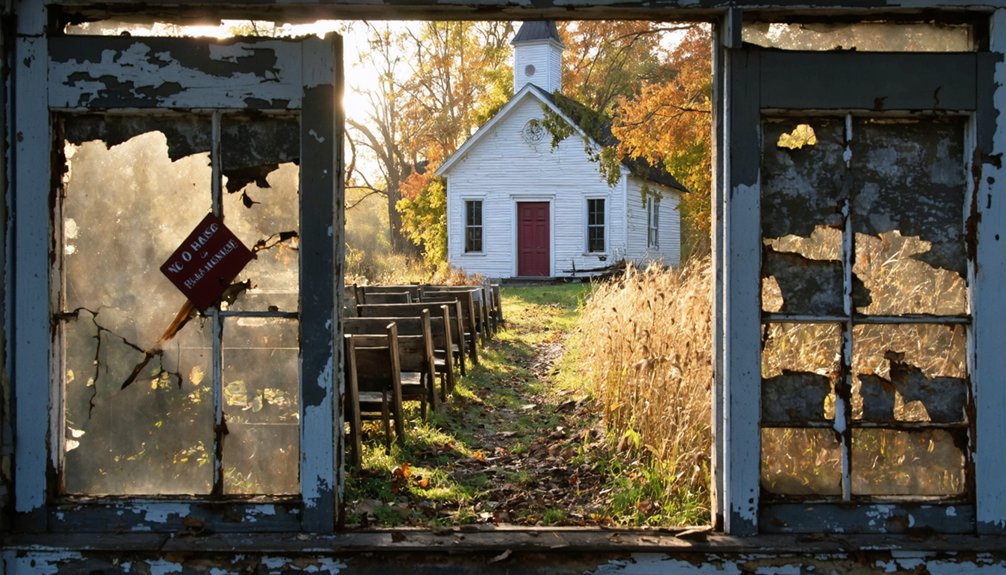
Five notable ghost towns dot Connecticut’s landscape, each with distinct access limitations that modern-day explorers must carefully consider.
While ghost town exploration captivates many adventurers, urban legend preservation requires respecting legal boundaries.
- Gay City State Park offers the most accessible experience, with maintained trails leading to historic ruins.
- Valley Forge becomes visible only during drought seasons, accessed via designated reservoir trails.
- Bara-Hack, Johnsonville, and Dudleytown remain strictly off-limits on private property.
- You’ll need proper permits and should avoid any restricted areas to stay within legal bounds.
Frequently Asked Questions
What Roles Did Native Americans Play in These Abandoned Settlements?
You’ll find that 12,000+ years of tribal interactions shaped these lands before settlers arrived. Native Americans’ cultural influences remain visible in abandoned settlements through place names and archaeological sites.
How Did the Revolutionary War Impact These Ghost Towns?
You’ll find the Revolutionary impact devastated these settlements through British coastal raids, supply disruptions, and Loyalist persecution. The war’s aftermath left many towns depopulated as residents fled the destruction.
Were There Any Documented Epidemics That Contributed to These Towns’ Abandonment?
You won’t find documented epidemic outbreaks as primary causes of these ghost towns’ abandonment. While local folklore mentions disease impact, historical records point to economic decline, fires, and flooding as key factors.
Which Ghost Town Has the Most Intact Original Structures Today?
You’ll find Johnsonville has the most intact abandoned architecture, with the largest collection of standing Victorian buildings, thanks to private preservation efforts that maintained these structures through the late 20th century.
Did Any Famous Historical Figures Visit These Towns Before Abandonment?
Perusing past particulars, you’ll find no prominent historical figures documented visiting these places. The towns’ historical significance stems from their industrial roles rather than notable visitors during their operational years.
References
- https://en.wikipedia.org/wiki/List_of_ghost_towns_in_Connecticut
- https://kids.kiddle.co/List_of_ghost_towns_in_Connecticut
- https://patch.com/connecticut/brookfield/abandoned-not-forgotten-4-connecticut-ghost-towns
- https://www.atlasobscura.com/things-to-do/connecticut/ghost-towns
- https://www.youtube.com/watch?v=V3k1shmJqeU
- https://earlybirdonthetrail.com/haunted-hikes-in-connecticut/
- https://ctvisit.com/articles/ghost-hunting-in-connecticut
- https://www.ctpost.com/entertainment/article/Explore-at-your-own-risk-5-abandoned-spots-in-CT-16191259.php
- https://www.youtube.com/watch?v=RODeJvoS7NE
- https://www.islands.com/1890369/connecticut-underrated-gay-city-state-park-trrails-remains-abandoned-town-dark-history/