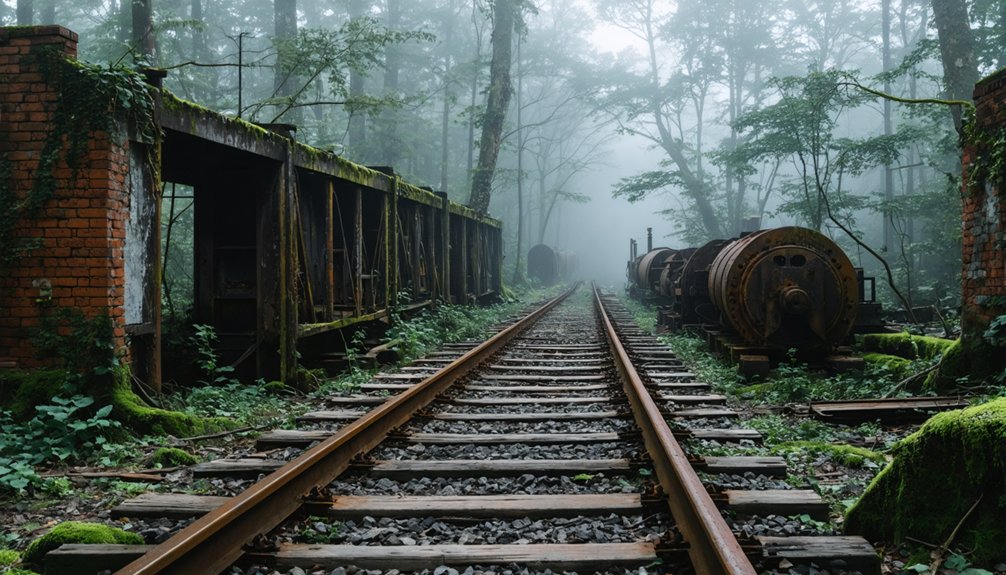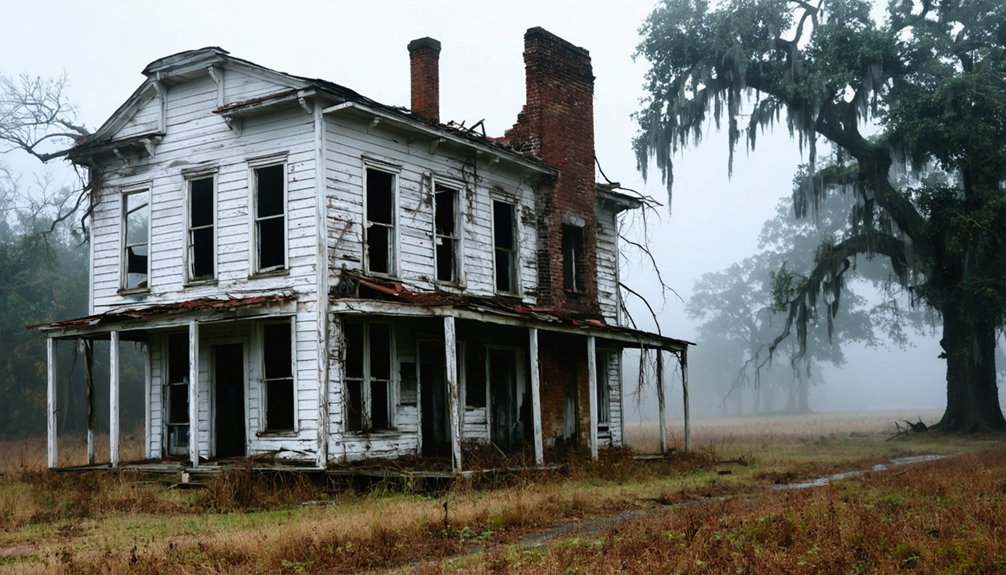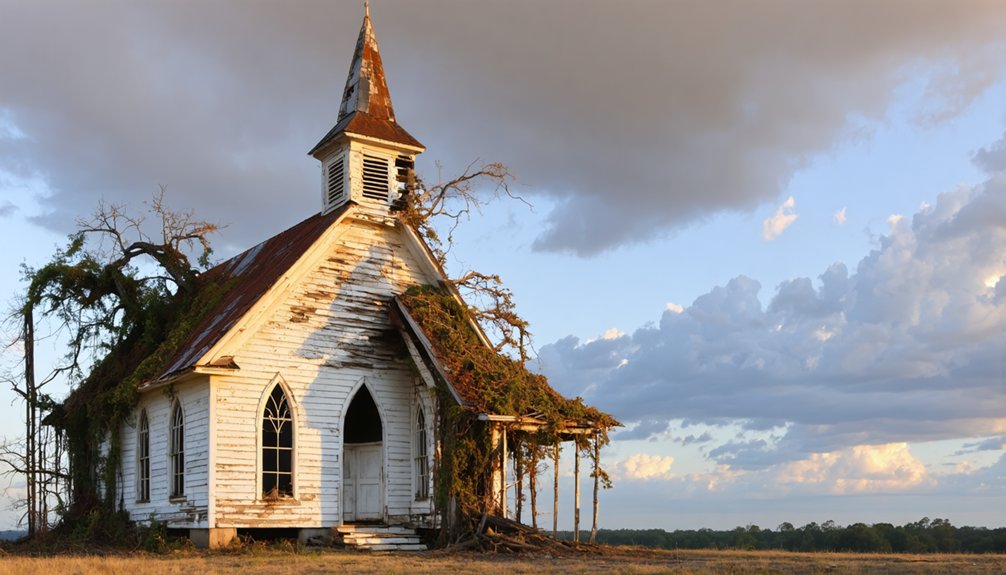
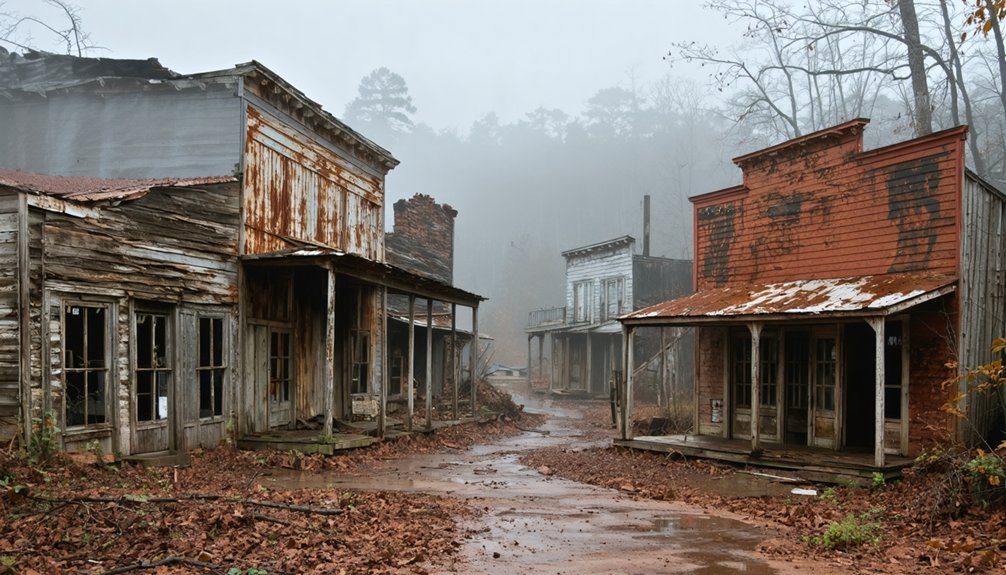
You’ll find Georgia’s abandoned ghost towns scattered across the state, each preserving unique stories of America’s past. The Quaker settlement of Wrightsboro (1767) stands as a symbol of religious persecution, while Scull Shoals showcases early industrial might along the Oconee River. Auraria emerged during Georgia’s gold rush, and Central State Hospital’s ruins remind us of complex social histories. These forgotten places, from Providence Canyon to Mallory, hold countless untold secrets within their weathered walls.
Key Takeaways
- Wrightsboro, Georgia’s only Quaker settlement, thrived from 1767 until mass migration in 1805, leaving only Rock House and cemetery remains today.
- Auraria became a booming gold rush town in 1832 but declined after 1833 when gold deposits depleted and the county seat relocated.
- Scull Shoals transformed from frontier outpost to industrial powerhouse before devastating floods in 1887 led to complete abandonment.
- New Ebenezer preserves German-American heritage through original structures and documents from its early settlement period.
- Providence Canyon, though not technically a ghost town, showcases abandoned 19th-century farmland transformed by erosion into deep gullies.
The Lost Quaker Settlement of Wrightsboro
While many colonial settlements dotted Georgia’s landscape, the Quaker settlement of Wrightsboro stands out as a unique religious refuge established in 1767.
Less than one-fifth of settlers were actually Quaker families, though the community maintained its religious identity.
Led by Joseph Maddock and Jonathan Sell, forty Quaker families from North Carolina carved out a new home on 12,000 acres in St. Paul’s Parish. As Georgia’s only Quaker settlement, Wrightsboro thrived initially through farming, milling, and hunting. The community was described as a thriving settlement by naturalist William Bartram in 1773.
However, the Revolutionary War brought devastating consequences. You’ll find that Quaker pacifism made them targets – they suffered brutal raids, with 35 murders by 1781 including Maddock himself.
Pacifist beliefs made the Wrightsboro Quakers easy prey during the Revolution, with deadly raids claiming dozens of innocent lives.
This violence, coupled with their strong anti-slavery stance, sparked a massive Quaker migration northward between 1805-1809.
Today, only the Rock House and a cemetery remain as silent witnesses to this lost settlement.
Scull Shoals: A Hidden Industrial Village
Along the banks of Georgia’s Oconee River, you’ll find the ruins of Scull Shoals, an early American industrial settlement that transformed from a frontier outpost into a manufacturing powerhouse between 1782 and 1887.
You can trace the village’s growth from its humble beginnings with a grist mill and sawmill to its peak as a 600-resident industrial center featuring Georgia’s first paper mill, a four-story textile factory, and extensive cotton processing operations.
The site’s remaining brick walls, stone foundations, and arched bridge stand as evidence to the economic ambitions of early Georgian entrepreneurs who harnessed water power to build one of the state’s most significant 19th-century manufacturing communities.
Under the leadership of Dr. Thomas Poullain from 1827 to 1868, the town experienced its greatest period of industrial expansion.
After the devastating flood of 1887, the town entered a period of decline that eventually led to its abandonment.
Early Industrial Development
As settlers pushed westward in Greene County during the late 18th century, the frontier settlement of Scull Shoals emerged in 1782 along the banks of the Oconee River.
The settlement’s growth accelerated significantly after the 1802 treaty opened new lands west of the Oconee River. You’ll find the area’s early mills played an essential role in transforming this wilderness outpost into an industrial hub. After Fort Clark’s construction in 1793 provided protection from Indian raids, the settlement witnessed rapid industrial expansion. The Oconee Navigation Company worked to clear obstacles and improve river transport in the early 1800s.
- Zachariah Sims and Thomas Ligon built the first water-powered grist mill and sawmill around 1800
- Georgia’s first paper mill emerged in 1811, funded by a $3,000 state legislature loan
- Thomas Ligon established Greene County’s first cotton ginnery in 1807
- By 1815, the settlement expanded to include multiple mills, a distillery, and growing industrial operations
The foundation laid by these early developments would transform Scull Shoals into one of Georgia’s most significant industrial villages.
River-Powered Economic Growth
The power of the Oconee River’s shoals transformed Scull Shoals into a thriving industrial powerhouse during the early 1800s. Dr. Thomas N. Poullain’s 1827 purchase of the river mills and surrounding 1,620 acres marked the beginning of unprecedented economic growth.
You’ll find evidence of his ambitious vision in the four-story brick textile mill, which operated 4,000 spindles and employed over 600 workers. Poullain’s success was reflected in his status as the largest slave owner in Greene County with 145 slaves.
The river mills’ economic impact reached far beyond the village’s peak population of 500-600 residents. Local farmers supplied 12,000 bales of cotton annually, while federal tariffs protected domestic textile production.
Water-powered grist mills, sawmills, and a distillery diversified the industrial base. Under Poullain’s leadership, Scull Shoals Manufacturing Company became Greene County’s largest employer until devastating floods and Civil War disruptions ultimately led to its decline.
Remnants of Lost Commerce
Today’s visitors to Scull Shoals encounter scattered brick walls and foundations that hint at its former commercial grandeur. Before its economic decline, this industrial village thrived as a bustling commercial center with extensive infrastructure supporting its textile operations.
- A massive four-story brick textile mill employed 500-600 workers and operated 4,000 spindles.
- The complex included grist mills, sawmills, boarding houses, stores, warehouses, and a toll bridge.
- A post office operated from 1825-1861, serving the company town’s regional trade needs.
- The 1846 warehouse and company store survived both floods and the Civil War.
The industrial ruins you’ll find today tell a story of prosperity cut short by natural disasters, post-war economic struggles, and agricultural erosion that ultimately led to the site’s abandonment and current historic preservation status.
Auraria’s Golden Legacy
During summer 1832, pioneer William Dean established the first cabin between Georgia’s Chestatee and Etowah rivers, unknowingly laying the foundation for what would become one of America’s earliest gold rush towns.
The settlement first operated under various names including Dean’s and Nuckollsville before adopting its final Latin-derived name.
You’ll find Auraria’s mining legacy etched into the landscape through the remnants of placer operations that once required massive water diversions to extract gold.
Within months, the settlement transformed from Dean’s solitary cabin into a bustling boomtown of thousands, complete with hotels, law offices, and the Western Herald newspaper.
The town’s vibrant atmosphere included several taverns and saloons where miners would gather after long days of work.
While the town’s prominence faded after losing its county seat status to Dahlonega in 1833, followed by westward migration and depleted gold deposits, you can still trace its golden heritage through surviving ruins along the historic Gold Diggers’ Road.
The Forgotten Community of Mallory
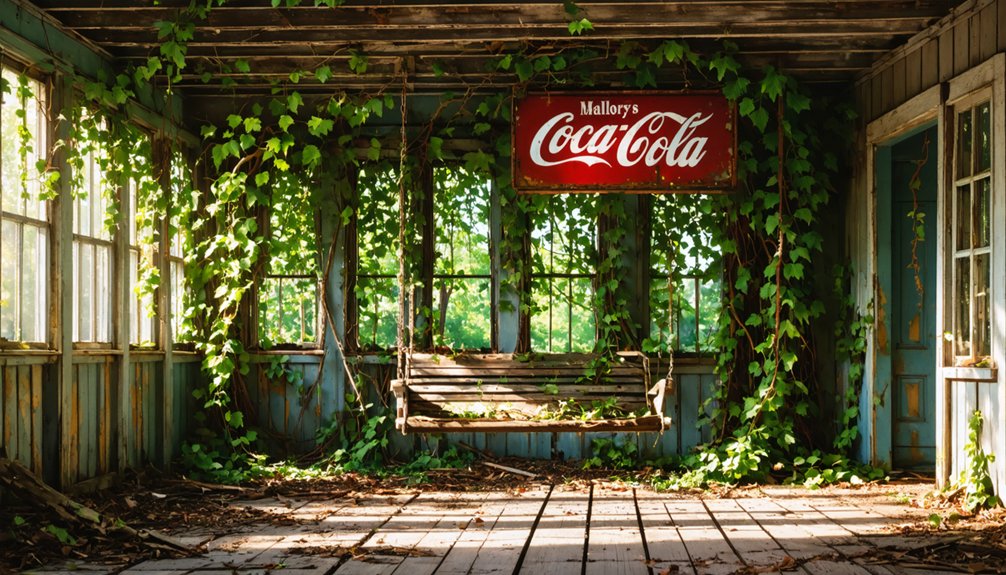
Hidden among the backroads near Madison, Georgia, lies the remnants of Mallory, a once-thriving community that peaked at 2,000 residents by the turn of the twentieth century.
You’ll find historical relics scattered throughout the area, beginning with a marker positioned in front of a small graveyard. The settlement, established on Mallory family land, flourished with various enterprises before its abandonment in the early 1900s.
- A general store, grist mill, and multiple cotton gins formed the economic backbone
- Several outbuildings, including a structure resembling former slave quarters, stand 300 yards from the main house
- A well-preserved second house features an adjacent outhouse and well
- The 1897 church development marked significant community growth
Today, you can explore these remnants just minutes from the Firefly Bed and Breakfast, discovering pieces of Georgia’s past along the quiet backroads. A striking Greek Revival house stands as a testament to the architectural grandeur of the 1820-1850 period.
Central State Hospital’s Haunting Past
A dark chapter in Georgia’s mental health history unfolded at Central State Hospital in Milledgeville, which opened its doors in 1842 as the Georgia State Lunatic, Idiot, and Epileptic Asylum.
You’ll find a haunted history within its sprawling 2,000-acre campus, where 200 buildings once housed the world’s largest mental health facility.
By the 1960s, the hospital’s population swelled to 12,000 patients, leading to severe overcrowding and understaffing. A shocking 1959 exposé revealed disturbing conditions: children in cages, forced shock therapy, and experimental treatments.
The facility’s dark legacy includes 25,000-35,000 unmarked graves across five cemeteries.
Though it closed in 2010, Central State’s abandoned buildings stand as silent witnesses to decades of institutional abuse and neglect.
Providence Canyon’s Eroded Heritage
While many natural wonders take millennia to form, Providence Canyon‘s massive gullies emerged in just decades through catastrophic agricultural mismanagement.
You’ll witness the devastating consequences of 19th-century farming practices where slaveholding plantation owners’ relentless pursuit of cotton profits transformed fertile fields into Georgia’s “Little Grand Canyon.”
Historical significance runs deep in Stewart County, where the canyon erosion began after the 1825 Treaty of Indian Springs opened Creek lands to settlers.
The Creek people’s forced removal in 1825 marked the beginning of Stewart County’s transformation into an eroded wasteland.
- Gullies reach depths over 150 feet, exposing 43 distinct soil colors
- Once-thriving cotton farms, homes, and churches abandoned as erosion consumed the land
- Formation accelerated by up-and-down hill plowing and clear-cutting by slave labor
- Continuous erosion persists today, serving as a stark reminder of human environmental impact
Preservation Efforts and Historical Significance
You’ll find extensive preservation efforts across Georgia’s ghost towns through local Historic Preservation Commissions, which document cultural heritage and protect structural remains according to the Georgia Historic Preservation Act of 1980.
abandoned properties in Georgia present unique opportunities for revitalization and community development. Many organizations are now focusing on transforming these spaces into vibrant areas that honor the past while serving present needs. These efforts not only preserve history but also encourage local engagement and tourism.
Through initiatives like Places in Peril and the Revolving Fund administered by the Georgia Trust for Historic Preservation, endangered historic sites receive critical protection and rehabilitation support.
The documentation of ghost towns like Pineville demonstrates how preservationists combine physical conservation with the collection of oral histories and family records to maintain these sites’ historical significance for future generations.
Protecting Historic Site Ruins
Through decades of dedicated preservation initiatives, Georgia’s historic ruins have received essential protection from state and local programs designed to safeguard these irreplaceable cultural assets.
You’ll find thorough historic site preservation strategies implemented through Georgia Trust’s Places in Peril program and local preservation commissions, which actively engage communities in protecting endangered structures.
- The Georgia Heritage Grant program has matched $1.9 million in local funds, demonstrating strong community engagement
- Local Historic Preservation Commissions enforce protective regulations in 87 communities
- The Revolving Fund acquires and sells distressed properties with mandatory rehabilitation agreements
- Emergency response protocols, developed after the 1994 floods, provide rapid protection for threatened sites
When you explore Georgia’s ghost towns, you’ll discover these preservation efforts have helped protect significant ruins like the Historic Rock House, despite ongoing challenges of vandalism and environmental threats.
In addition to their historical importance, ghost towns in Georgia’s wilderness offer a glimpse into the past, allowing visitors to imagine life during a different era. The beautiful, overgrown landscapes surrounding these towns contribute to their eerie charm, drawing in adventurers and photographers alike. Each site tells a unique story of hardship and resilience, making them worthwhile destinations for those interested in history and exploration.
Documenting Cultural Heritage Values
Georgia’s systematic documentation of cultural heritage values forms the backbone of its preservation strategy, building upon the protective measures already in place.
You’ll find the University of Georgia’s FindIt Program at the forefront, having surveyed 460 sites in Monticello alone, while capturing essential cultural narratives through resident interactions and family histories.
The Georgia Historic Preservation Division‘s statewide efforts complement local initiatives, collecting significant data that guides heritage preservation in rural communities.
You’ll discover how programs like Georgia Trust’s Places in Peril actively identify and document threatened sites, while communities like New Ebenezer preserve their unique German-American heritage through careful documentation of original structures, gravestones, and church records.
These combined efforts guarantee that each ghost town’s distinct cultural legacy remains accessible for future generations.
Frequently Asked Questions
Are Any of These Ghost Towns Legally Accessible for Overnight Camping?
You’ll find legal camping near Scull Shoals within Oconee National Forest’s designated areas. Other ghost towns lack explicit camping regulations, but you’d need to verify local property boundaries and permissions.
What Paranormal Activities Have Been Reported in These Abandoned Georgia Towns?
While you might expect ghost sightings and eerie sounds, historical records don’t confirm paranormal activity at these sites, though Central State Hospital’s 25,000 unmarked graves make it particularly unsettling.
How Safe Are These Locations for Solo Explorers?
You shouldn’t explore these sites alone due to structural collapse risks, criminal activity, and wildlife dangers. Always bring a partner, notify others of your plans, and respect legal boundaries.
Do Any Descendants of Original Residents Still Live Nearby?
You’ll find descendants near preserved sites like New Ebenezer, where local preservation efforts and church records confirm family ties. Cemetery surveys and descendant stories reveal multigenerational connections to these historic places.
What Items Have Treasure Hunters Found in These Abandoned Towns?
You’ll find treasure hunters have uncovered gold bars, silver coins, Revolutionary War letters, lost artifacts, whiskey jugs, Native American relics, and mining tools, though treasure maps remain scarce in these areas.
References
- https://www.atlasobscura.com/things-to-do/georgia/abandoned
- https://roughdraftatlanta.com/2021/05/23/travels-with-charlie-georgias-ghost-towns-slideshow/
- https://www.ezhomesearch.com/blog/ghost-towns-in-georgia/
- https://www.fireflymadison.com/2022/08/31/ghost-towns-in-georgia/
- http://www.ghosttowns.com/states/ga/ga.html
- https://www.freakyfoottours.com/us/georgia/
- https://www.youtube.com/watch?v=jXOJ2NhkL1U
- https://vanishinggeorgia.com/tag/georgia-ghost-towns/
- https://theforgottensouth.com/quaker-rock-house-georgia/
- https://www.georgiaencyclopedia.org/articles/history-archaeology/wrightsborough/