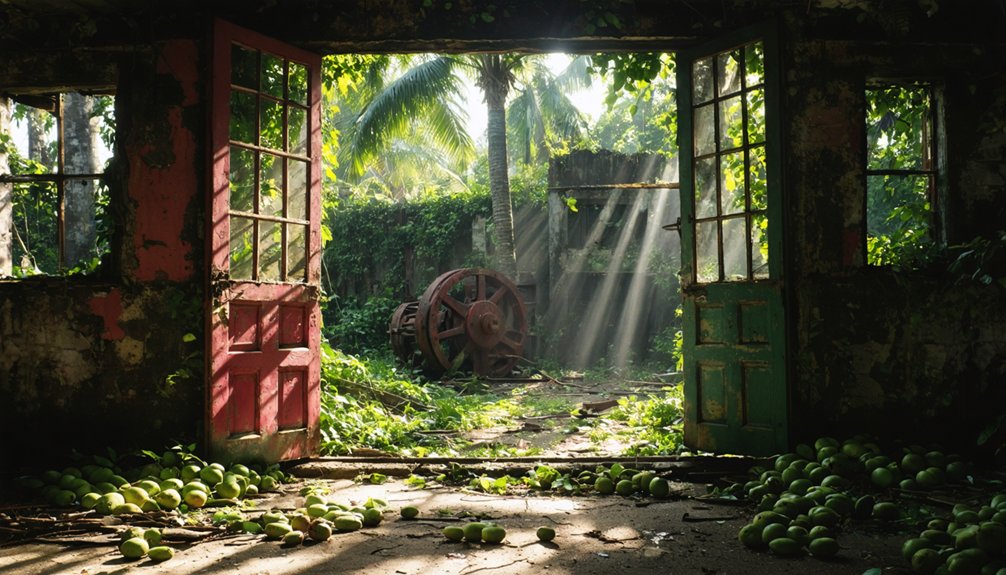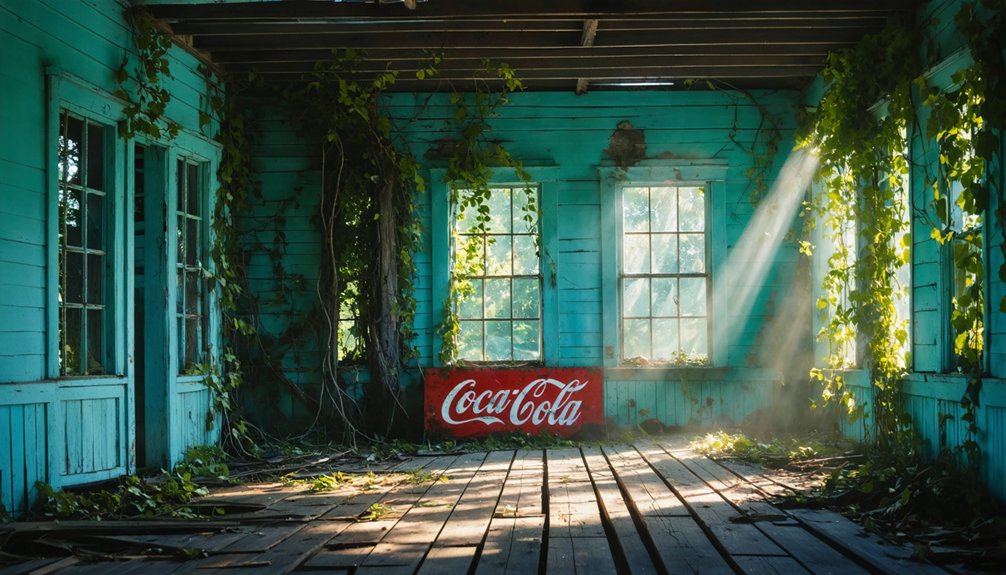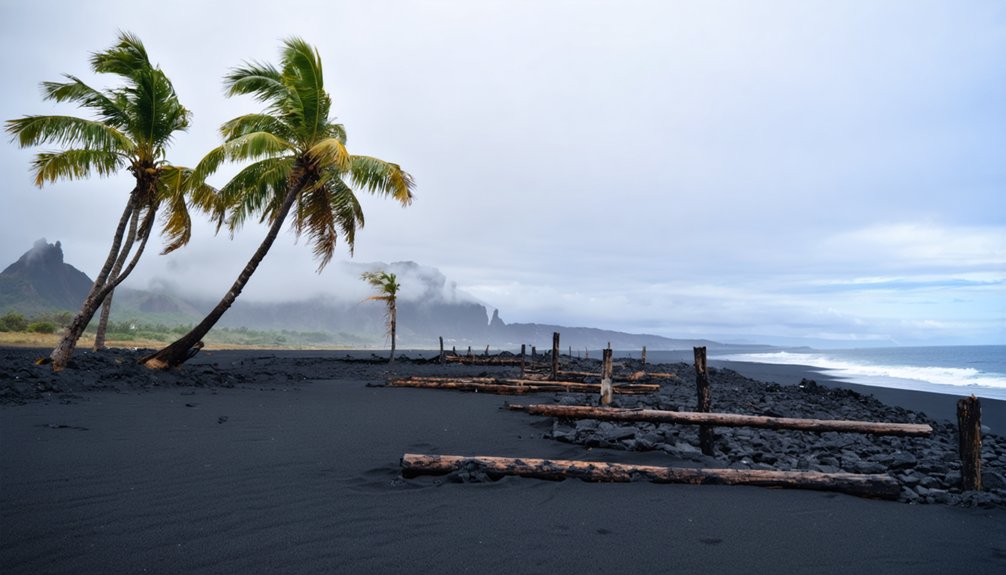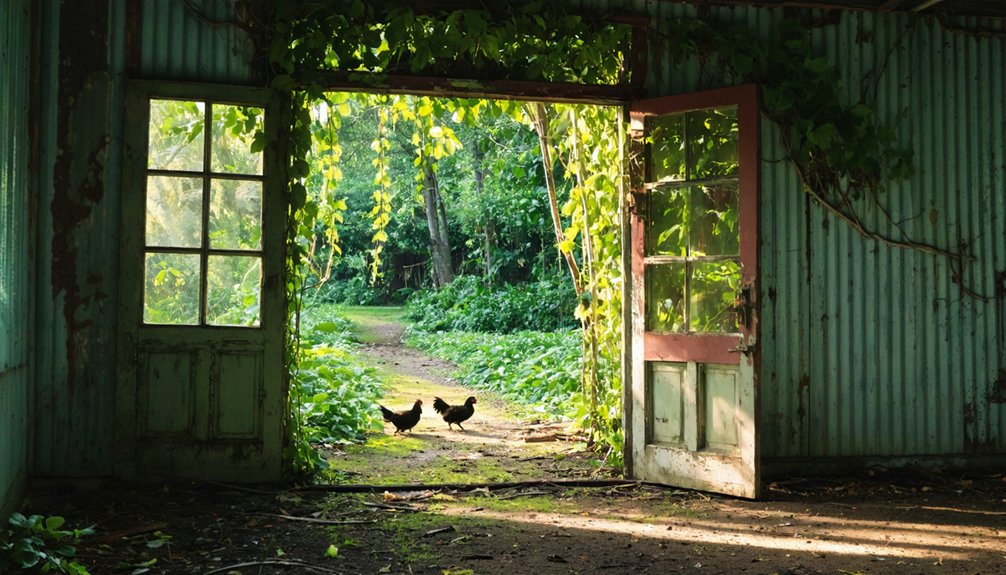
You’ll find Hawaii’s abandoned ghost towns scattered across the islands, from tsunami-ravaged coastal villages to forgotten sugar plantation communities. On the Big Island, places like Kalapana and Punalu’u Village lie buried beneath lava flows, while O’ahu’s historic mill towns like Waipahu preserve the sugar industry’s legacy. Kauai’s rusting factories and Maui’s silent mills stand as powerful reminders of plantation life. These lost communities hold fascinating stories of natural disasters, industrial heritage, and sacred Hawaiian sites waiting to be discovered.
Key Takeaways
- Punalu’u Village contains earthquake-damaged structures buried beneath sand, serving as a testament to Hawaii’s natural disaster history.
- Kalapana was completely abandoned after devastating lava flows forced all residents to permanently relocate.
- Waipi’o Valley, once known as “Valley of the Kings,” became largely deserted after the destructive 1946 tsunami.
- Waiākea Town was submerged during the 1960 tsunami, with only a stopped clock remaining as evidence.
- Kikala-Keokea subdivision stands as an abandoned failed relocation attempt for volcanic refugees seeking new homes.
Lost Communities of the Big Island
While many visitors flock to Hawaii’s pristine beaches and volcanic wonders, the Big Island harbors forgotten communities that tell a deeper story of its past.
You’ll find ghostly remnants in places like Punalu’u Village, where earthquake-damaged structures lie buried beneath sand, and Kalapana, where lava flows forced residents to abandon their homes. Ancient brackish water fishponds at Wai Opae remain as evidence of traditional aquaculture practices. The Kikala-Keokea subdivision stands as another failed attempt to relocate displaced families after volcanic devastation.
The cultural significance of Waipi’o Valley, once home to thousands and known as the “Valley of the Kings,” stands as a tribute to Hawaiian heritage before the devastating 1946 tsunami.
In Honoka’a, you can still glimpse the legacy of Hawaii’s sugar era through preserved architecture, while Pu’uhonua o Honaunau’s ancient village structures and petroglyphs remind you of the islands’ sacred traditions.
Historical Sugar Mill Towns of Oahu
You’ll find Oahu’s sugar mill towns tell a powerful story of Hawaii’s industrial transformation, from the 1897 establishment of Oahu Sugar Company in Waipahu to the 1996 closure of Waialua Agricultural Company.
Plantation life shaped entire communities through the piecework system, where workers earned their wages cutting cane by the ton and plowing by the acre, while towns like Waipahu grew to support the bustling sugar operations. After Castle & Cooke formed the Waialua Agricultural Company in 1898, the plantation underwent major technological upgrades. The plantation’s first year yielded 7,900 tons of sugar, marking the beginning of decades of successful production.
Today, remnants of this era stand as silent sentinels, from Waipahu’s preserved 175-foot smokestack to Ewa’s historic buildings, marking where these once-vibrant communities powered Hawaii’s sugar industry for nearly a century.
Mill Worker Communities
Beginning in the late 1800s, Hawaii’s sugar plantations transformed into self-contained communities that shaped the islands’ cultural landscape.
You’ll find plantation memories woven into the fabric of these former mill towns, where workers from China, Japan, Portugal, and the Philippines built lives around 10-12 hour workdays. By 1925, Oahu Sugar Company alone employed a workforce of nearly 10,000 laborers.
These resilient communities developed their own character, with plantation-provided housing, hospitals, shops, and even baseball teams. Workers faced harsh conditions under the Master and Servants Act that kept them bound to plantations.
Community resilience emerged through shared experiences, as laborers united under the ILWU to advocate for better conditions, culminating in the pivotal 1946 strike.
By then, plantation residents made up 20% of Hawaii’s population.
Though most sugar operations ceased by the late 1990s, with Waialua being Oahu’s last in 1996, the multicultural legacy of these mill worker communities continues to influence Hawaii’s social fabric today.
Industrial Heritage Sites
As Hawaii’s sugar industry grew to dominate Oahu’s landscape in the late 1800s, five major mill towns emerged as industrial powerhouses that would shape the island’s development for nearly a century.
You’ll find Waialua Sugar Mill‘s legacy in its impressive production growth from 1,741 tons in 1899 to over 50,000 tons annually during its peak years. Today, the historic site hosts over 30 businesses within its preserved industrial complex.
Waipahu’s Oahu Sugar Company transformed into a bustling commercial hub, while Ewa Plantation stands today as one of Hawaii’s most intact sugar towns, its cultural significance preserved through careful industrial preservation efforts. The town’s memory wall chronicles the rich history of sugar production from 1890 to 1990.
The hillside Aiea Mill overlooking Pearl Harbor and Haleiwa’s sugar connections round out these remarkable sites that once drove Hawaii’s economy.
Though operations have ceased, these industrial heritage landmarks continue telling the story of Hawaii’s plantation era.
Sugar Production Legacy
The rich legacy of Oahu’s sugar production comes alive through four iconic mill towns that shaped the island’s industrial and cultural landscape.
You’ll find Waialua Sugar Mill on the North Shore, where until 1996, the last operating sugarcane plantation on O’ahu produced 8% of Hawaii’s sugar output.
In Waipahu, O’ahu Sugar Company’s operations revolutionized agricultural technology advancements through mechanical harvesting.
The ‘Aiea Sugar Mill, operated by Honolulu Sugar Company, thrived until World War II’s military expansion forced its closure in 1946. The mill was highly regarded in the industry, becoming a model tourist site by 1914.
These plantations transformed O’ahu’s environment through extensive irrigation systems and technological innovations, while their multicultural workforce created diverse communities that define Hawaii’s sugar cultivation history.
Today, places like Hawaii’s Plantation Village preserve this heritage, telling stories of the families who built these remarkable communities. Workers who helped build these communities earned just $2 per month in specialized currency that could only be spent at plantation-owned stores.
Maui’s Abandoned Plantation Heritage
As you explore Maui’s historic plantation towns today, you’ll find towering sugar mill smokestacks and weathered worker camps that tell the story of an industry that once dominated the island’s economy and reshaped its cultural landscape.
The massive irrigation systems and industrial ruins, from Pioneer Mill’s iconic stack to the preserved buildings at Pu’unēnē, stand as monuments to the thousands of immigrant laborers who built their lives in these company towns.
Plantation Life and Economy
While Native Hawaiians thrived for generations through sustainable kalo farming, Maui’s agricultural landscape evolved dramatically in the 1840s with the rise of sugar plantations.
You’ll find the roots of this change in places like Lahaina’s Pioneer Mill and Wailuku Sugar Company, which reshaped the island’s economy through massive water diversions that devastated traditional farming practices.
The plantation economy created a stark divide, forcing Native Hawaiians from their ancestral lands while importing thousands of immigrant laborers who lived in company towns.
These workers endured difficult conditions until the watershed 1946 strike, which altered labor relations.
Sugar Mill Remnants Today
Today’s visitors to Maui can explore haunting reminders of the sugar industry’s once-dominant presence through several preserved mill sites scattered across the island.
You’ll find the massive Puʻunēnē Mill, known as “the Beast,” which processed sugar until 2016 and now awaits transformation while preserving its distinctive industrial architecture.
In Lahaina, the Pioneer Mill smokestack stands as a silent sentinel to plantation history, while the atmospheric Haiku Mill ruins offer a glimpse into early steam-powered innovation amid restored tropical gardens.
These monuments to industrial nostalgia tell complex stories of technological progress, cultural change, and economic transformation.
Each site serves as both historical marker and gathering place, where you can connect with Maui’s plantation heritage through guided tours, educational displays, and preserved structures.
1970s Industry Mass Exodus
During the pivotal decades of the 1950s through 1970s, Maui’s plantation era drew to a dramatic close as major agricultural operations shuttered their gates across the island.
You’ll find that this plantation decline transformed entire communities, as Hawaii Commercial & Sugar Company ended its 145-year legacy amid fierce global competition and plummeting sugar prices.
The mass exodus left an indelible mark on Maui’s landscape. Labor migration scattered plantation workers as camps deteriorated and became too costly to maintain.
Alexander & Baldwin’s shift of 36,000 acres to Mahi Pono marked the end of an era, while operations like Waiheʻe Dairy closed after 51 years of service.
As you explore these abandoned sites today, you’ll witness the physical remnants of an industry that once dominated Maui’s economy and reshaped its cultural fabric.
Kauai’s Forgotten Industrial Past
Long before tourism dominated Kauai’s economy, the island’s rich volcanic soil and abundant rainfall created perfect conditions for what would become Hawaii’s most influential industry – sugar production.
You’ll find industrial relics scattered across the island, from the historic Old Koloa Sugar Mill, established in 1835, to the abandoned processing factories near Lihue.
These cultural remnants tell the story of German colonists who founded the Lihue Sugar Plantation in 1849, building their homes and Lutheran church amid the cane fields.
While the Grove Farm Homestead Museum preserves this era’s memory, many sites have surrendered to time. The rusting machinery, weathered plantation houses, and crumbling mill chimneys stand as silent witnesses to an industry that shaped Kauai for over a century before succumbing to global competition.
Sacred Places and Ancient Hawaiian Settlements
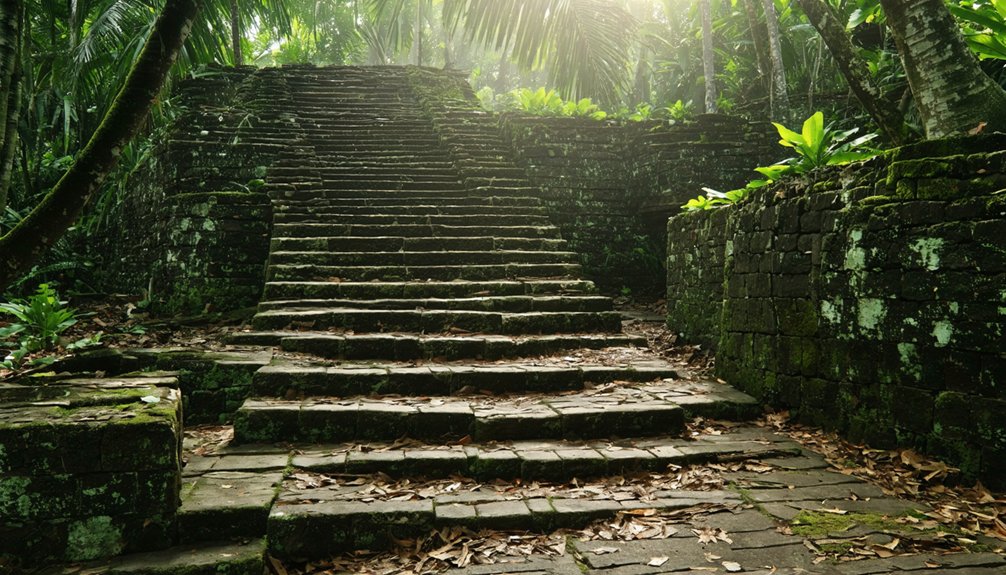
Hidden across the Hawaiian Islands lie extraordinary archaeological treasures that reveal centuries of indigenous life and spiritual practice.
Ancient Hawaii’s archaeological wonders stand as silent witnesses, unveiling the deep spiritual legacy and cultural richness of these sacred islands.
You’ll discover sacred rituals preserved in the remains of ancient structures, from massive heiau temples to coastal fishing villages that thrived for generations.
As you explore these powerful sites, you’ll encounter:
- Mokumanamana’s 45 ceremonial heiau shrines with their distinctive upright stones and ritual platforms
- Kalaupapa Peninsula’s extensive network of taro fields, irrigation systems, and stone temples that supported thousands
- Ulupo Heiau’s impressive engineering feat, where massive stones were transported over 10 miles from Kualoa
- Puʻukohola Heiau’s towering 20-foot walls that stand as evidence to ancient Hawaiian architectural mastery
These sacred places connect you directly to Hawaii’s rich cultural heritage, offering glimpses into a sophisticated civilization that flourished here for centuries.
Nature’s Reclamation of Historical Sites
While ancient Hawaiian settlements stand as powerful monuments to indigenous culture, nature wages a constant battle to reclaim these historic sites.
You’ll find abandoned sugar mills crumbling beneath advancing mountain vegetation and deserted piers surrendering to nature’s resilience. The viridescent transformation is particularly striking in places like He’eia ahupua’a, where 80-foot invasive mangroves once choked shorelines and fishponds.
Yet ecological restoration efforts have turned the tide. Native Hawaiian groups have replaced harmful invasives with indigenous plants, transforming landscapes through traditional knowledge.
At Papahana Kuaola, you can witness restored taro patches fed by freshwater springs, while at Kaloko-Honokohau, ancient fishponds blend seamlessly with renewed native growth.
These sites demonstrate how human-built structures and natural systems can find harmony through careful stewardship.
Tsunami and Natural Disaster Impact on Towns
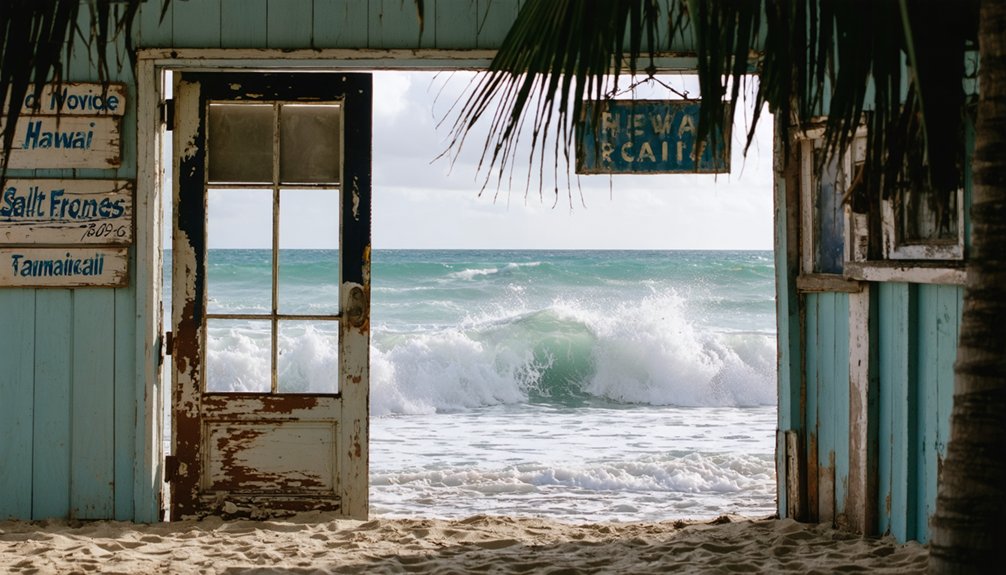
Throughout Hawaii’s history, devastating tsunamis have transformed thriving communities into ghost towns, with the 1946 Aleutian waves and 1960 Chilean tsunami delivering particularly catastrophic blows to coastal settlements.
In the tsunami aftermath, you’ll discover how these natural disasters reshaped Hawaii’s landscape and communities:
- Waipi’o Valley lost its essential infrastructure in 1946, prompting an exodus that forever altered this sacred Hawaiian community.
- Waiākea Town vanished beneath 35-foot waves in 1960, with only a stopped clock marking its final moments.
- The 1868 earthquake-triggered tsunami wiped out entire settlements that were never rebuilt.
- Halape’s devastating 1975 disaster forced further coastal abandonments.
These recurring catastrophes have led to significant changes in Hawaii’s disaster recovery approaches, including revised evacuation zones and stricter building codes to protect future generations.
Preservation Efforts and Tourist Attractions
Despite the devastating impact of natural disasters on Hawaii’s historic sites, dedicated preservation efforts across the islands now protect these cultural treasures for future generations.
You’ll find remarkable initiatives like the Oahu Historic Preservation Commission tackling preservation challenges at burial sites and landmarks, while places like Pu’uhonua o Hōnaunau showcase traditional Hawaiian masonry techniques passed down to local youth.
The cultural significance of these sites extends beyond their physical structures.
At Kaloko-Honokohau, you can explore 600-year-old fishponds and ancient village remnants, while Pahua Heiau’s preservation plan guarantees proper site maintenance and cultural landscape management.
Organizations like OHA implement buffer zones and consultation processes, showing how modern preservation efforts respect and maintain Hawaii’s rich heritage while making these historic locations accessible to visitors.
Frequently Asked Questions
Are There Any Reported Paranormal Activities in Hawaii’s Ghost Towns?
You won’t find documented paranormal sightings in these particular ghost towns, though Hawaiian culture deeply respects ancestral spirits. These haunted locations remain culturally significant without specific ghostly reports being verified.
What Safety Precautions Should Visitors Take When Exploring Abandoned Hawaiian Settlements?
You’ll need proper safety gear including respirators and flashlights, while staying alert for wild pigs and centipedes. Respect kapu signs, maintain distance from heiau sites, and don’t disturb ancient structures.
Can Visitors Legally Collect Artifacts From Hawaii’s Ghost Towns?
You can’t collect artifacts – it’s strictly forbidden. You’ll face serious legal repercussions, including hefty fines and possible jail time. Instead, respect Hawaiian cultural sites and practice pono (righteous) tourism.
Which Ghost Towns in Hawaii Are Completely Underwater Today?
You won’t find any completely underwater ghost towns in Hawaii today. While there are submerged histories along coastlines and sunken settlements partially lost to erosion, no intact towns lie fully beneath Hawaiian waters.
However, there are intriguing opportunities for ghost towns in Hawaii for investment, particularly in areas with rich historical significance and potential for tourism. Investors may want to explore properties that hint at Hawaii’s past, where the remnants of old communities could be revitalized for modern use. With careful planning and creativity, these sites could become unique attractions that draw visitors eager to experience Hawaii’s diverse history.
Among these intriguing opportunities are abandoned towns in Hawaii, where the stories of past residents linger in the air. Exploring these forgotten places allows for a deeper understanding of the cultural tapestry that has shaped the islands. By embracing the history encapsulated in these towns, developers can create a unique blend of preservation and modern attraction that celebrates Hawaii’s rich heritage.
Do Any Hawaiian Families Still Claim Ownership of Abandoned Town Properties?
Through generations of family heritage, you’ll find native Hawaiian families maintain spiritual connections to ancestral lands, though there’s little documented evidence of active legal ownership claims to abandoned town properties today.
References
- https://nvtami.com/2023/04/26/big-island-hawaii-ghost-towns/
- https://www.geotab.com/ghost-towns/
- https://www.wikiwand.com/en/articles/List_of_ghost_towns_in_Hawaii
- https://www.youtube.com/watch?v=q56mo4VCXtE
- https://www.atlasobscura.com/things-to-do/hawaii/abandoned
- https://www.ghosttowns.com/states/hi/hi.html
- https://freepages.rootsweb.com/~gtusa/history/usa/hi.htm
- https://kids.kiddle.co/List_of_ghost_towns_in_Hawaii
- https://www.civilbeat.org/2018/07/big-island-last-time-hawaii-had-lava-refugees-it-built-a-ghost-town/
- https://raisethestakeseditions.com/punaluu-village/