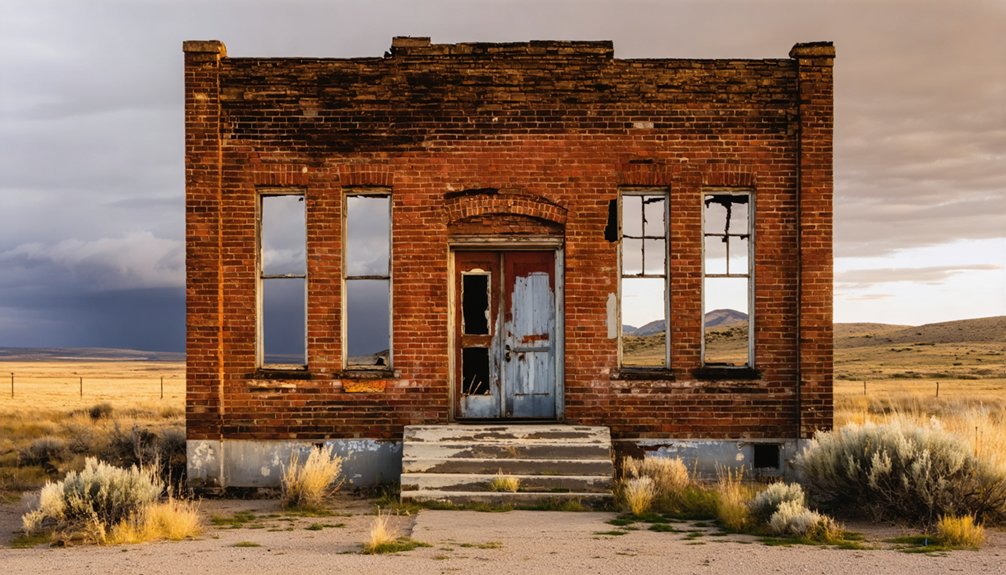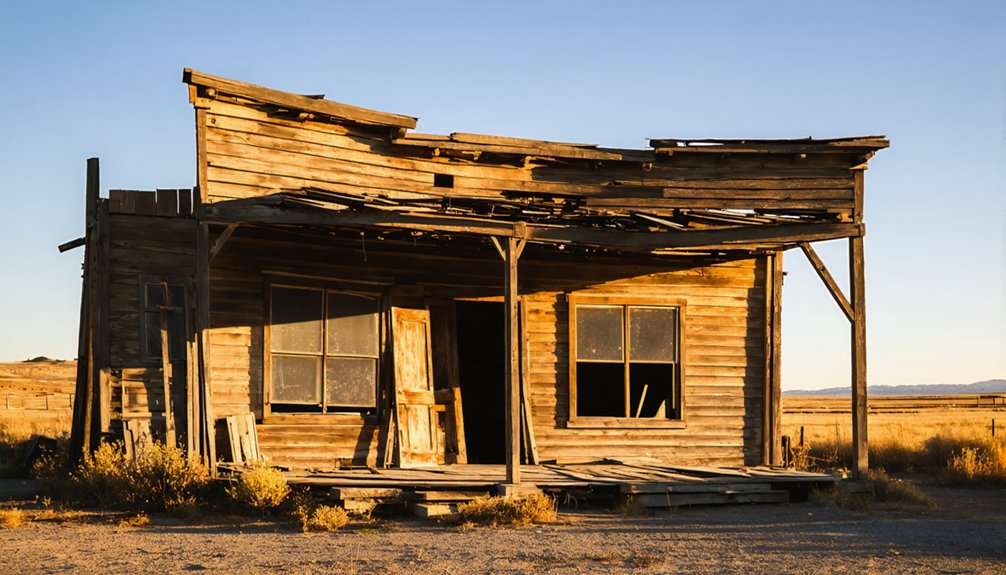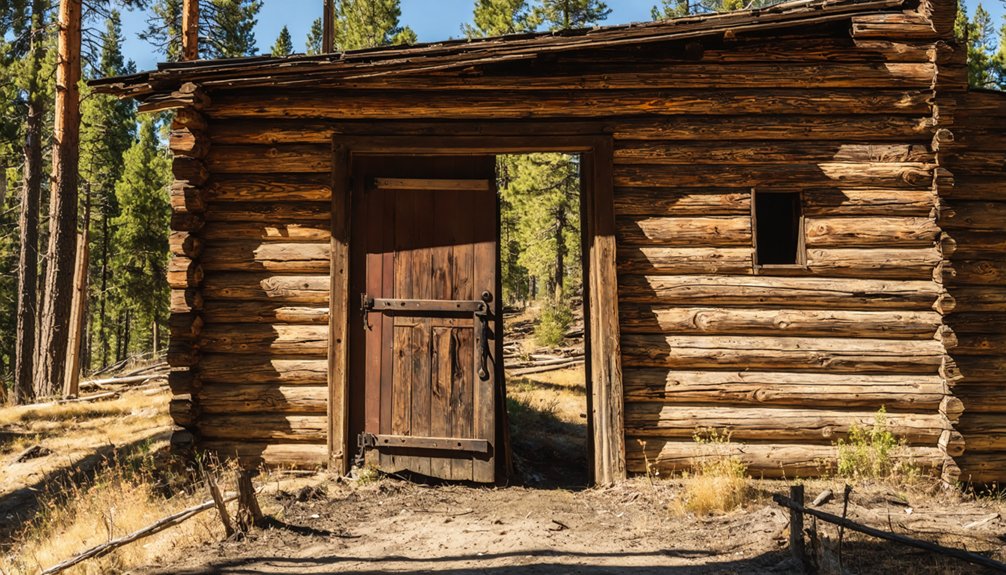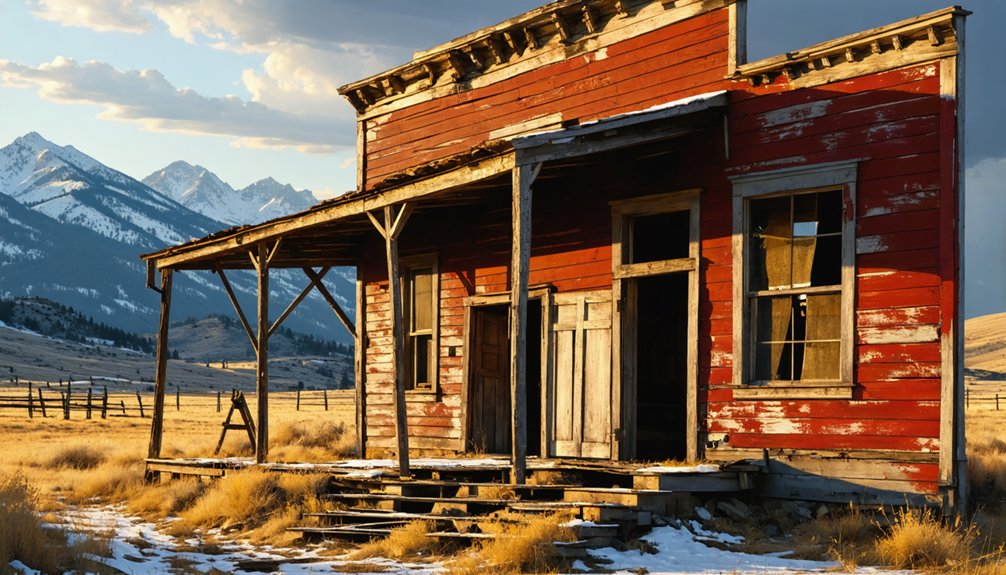
You’ll discover over 130 abandoned ghost towns across Idaho’s rugged landscape, each telling stories of America’s mining heritage. The most notable include Silver City with 70 original structures, Custer’s gold-rich past, and Bayhorse’s silver boom that yielded $10 million in ore by 1900. These preserved settlements, from Gilmore’s weathered buildings to Chesterfield’s elegant brick homes, offer windows into Idaho’s dramatic boom-and-bust mining era. The deeper you explore, the more secrets these silent towns reveal.
Key Takeaways
- Custer became a thriving mining town with 600 residents before declining in 1904 after the closure of Lucky Boy and General Custer mines.
- Silver City peaked at 2,500 residents in the 1880s and maintains nearly 70 original structures, including the historic Idaho Hotel.
- Bayhorse reached 400 residents during the 1880s silver boom, producing over $10 million in ore by 1900.
- Gilmore flourished with 600 residents until a 1927 power plant explosion and 1929 mine closures led to abandonment.
- Chesterfield grew from a horse ranch to 400 residents, featuring preserved brick homes and earning National Register status in 1980.
Tales of Mining Glory: Custer and Bonanza
When three prospectors discovered the General Custer Mine in August 1876, they couldn’t have known they’d sparked one of Idaho’s most significant mining booms.
Today, visitors can explore the historic Empire Saloon where original bullet holes mark the poker tables from wild frontier days. You’d have found a bustling community of 600 residents by 1896, complete with a schoolhouse, jail, and even a baseball team. The Yankee Fork Dredge recovered approximately $11 million in ore during its years of operation. The town’s fortunes soared when fires in neighboring Bonanza pushed businesses toward Custer, making it the region’s commercial heart.
But Custer’s decline came swiftly after 1904 when both the Lucky Boy and General Custer operations shut down.
While Bonanza’s legacy faded into ash, Custer’s buildings stood strong through time. Today, you’ll find a remarkably preserved slice of mining history, protected since 1981 on the National Register of Historic Places, where annual Custer Days celebrations keep the frontier spirit alive.
Bayhorse: The Silver Sentinel of Salmon-Challis
You’ll find Bayhorse’s rich mining legacy immortalized in its stone Wells Fargo building and iconic Bayhorse Saloon, standing as monuments to the town’s 1880s silver boom when the population reached 400 residents. The mining district yielded over $10 million in precious ore by the turn of the century.
The stamp mill and smelter constructed in 1880 revolutionized ore processing in the region. The town’s perfectly preserved beehive charcoal kilns, considered Idaho’s finest surviving examples, remind you of the intense industrial operations that once fueled this mining powerhouse.
As you explore the 14 remaining structures protected within Land of the Yankee Fork State Park since 2006, you’ll walk among the authentic remnants of Idaho’s silver mining era, from weathered miners’ cabins to the sprawling mill site that processed precious ore until the town’s decline in the early 1900s.
Mining Riches and Remnants
The silver-rich veins of Bayhorse transformed this remote Idaho outpost into one of the territory’s most productive mining districts during the 1880s.
You’ll find evidence of sophisticated mining techniques in the remnants of the water-powered stamp mill and smelter that once processed 30 tons of ore daily. By 1885, steam power and an on-site refinery revolutionized production, churning out 80 tons of silver bullion monthly.
The ghostly artifacts you’ll discover tell a story of remarkable wealth – over $10 million in precious metals extracted through 1898, including 6.3 million ounces of silver.
The Nevada Hotel became a social hub for the bustling community of over 300 residents during its peak years.
Today, you can explore the surviving beehive kilns, cabin ruins, and mine tunnels that pierce the dolostone cliffs, silent witnesses to Bayhorse’s brief but magnificent mining empire.
The Wells Fargo building stands among the best-preserved structures, offering visitors a glimpse into the town’s prosperous past.
Preserved Stone Structures Stand
Stone sentinels stand guard over Bayhorse’s mining legacy, with the Wells Fargo building‘s volcanic stonework and coursed masonry defying time since the 1880s.
You’ll find this remarkable structure survived the devastating 1889 fire that claimed many wooden buildings, showcasing the historical significance of stone preservation in Idaho’s mining country. The town reached its zenith with a thriving population of 400 residents. The site earned recognition when it was added to the National Register in 1976.
- The Wells Fargo building’s locally quarried stone walls remain intact, though its roof needs stabilization.
- Two to three beehive-shaped charcoal kilns display some of Idaho’s finest stonework craftsmanship.
- The mill’s stone foundations reveal the scale of silver and lead processing operations.
- Archaeological evidence in the stone remains helps you trace ore flow patterns and processing steps.
Today, you can explore these enduring monuments under the protection of Land of the Yankee Fork State Park, where preservation efforts guarantee their stories continue.
Adventures Through Mining History
Rising from the rugged Salmon-Challis mountains, Bayhorse’s mining legacy began in 1864 when prospectors first discovered mineral deposits that would transform this remote Idaho wilderness.
Today, you’ll find remarkably preserved mining techniques on display throughout the historic district, from the gravity-fed mill that processed precious metals to the massive charcoal kilns that fueled the smelting operations. The native stone kilns operated continuously until 1895, providing essential fuel for the mining operations.
You can trace the footsteps of the 400 souls who once called this boomtown home, exploring historical artifacts left behind when $10 million worth of silver, gold, copper, and lead poured from these hills.
The Ramshorn Mine, which shipped ore worth $800 per ton to Salt Lake City, stands as evidence to the incredible wealth this land once yielded before its decline in the 1890s. In 2006, the Idaho Parks Department acquired the site, launching extensive preservation efforts to protect this valuable piece of mining history.
Silver City’s Haunting Legacy
Nestled high in the Owyhee Mountains at 6,200 feet, Silver City emerged in 1864 as one of Idaho Territory’s most promising mining settlements after prospectors discovered rich silver deposits on War Eagle Mountain.
The town’s mining heritage quickly transformed it from a rugged outpost into a bustling hub of 2,500 residents during its 1880s peak.
You’ll find remarkable remnants of Silver City’s dramatic past:
- Nearly 70 original structures still stand, largely untouched since the early 1900s
- The historic Idaho Hotel, relocated from Ruby City in 1866, offers seasonal tours
- Evidence of fierce mining conflicts, including the deadly 1868 underground battle
- A network of hand-dug tunnels spanning 70 miles beneath the mountain
Though the mines depleted by 1912, Silver City’s authentic character endures, drawing history seekers to its well-preserved streets.
The Silver Saga of Gilmore
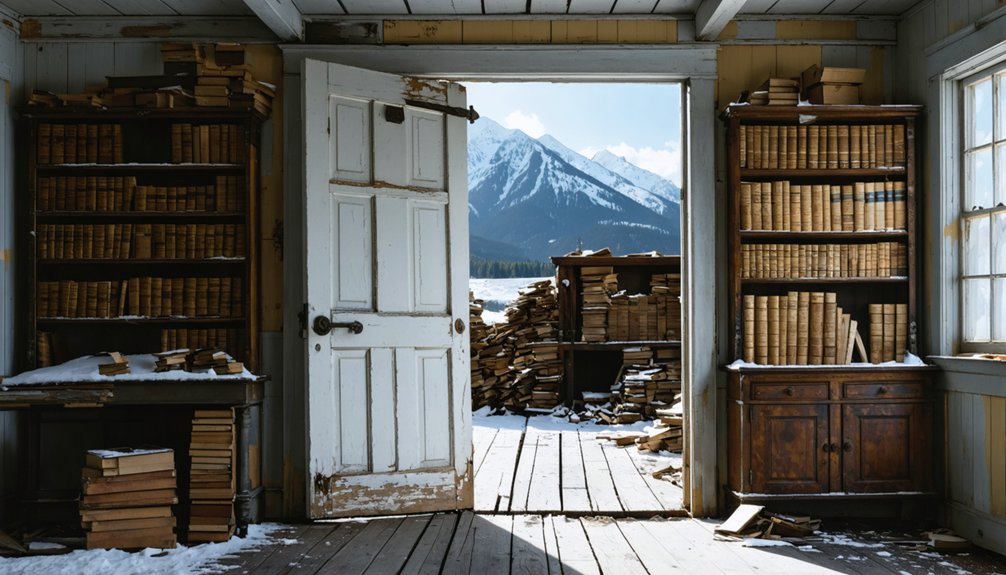
Deep within Idaho’s Lemhi County, the ghost town of Gilmore stands as a tribute to the region’s mining legacy.
You’ll find its origins in the 1880s when prospectors discovered rich deposits of lead and silver, transforming a simple mining camp into a bustling town of 600 residents.
Named after Jack T. Gilmer (though misspelled by the postal service), the town flourished with the arrival of the Gilmore & Pittsburgh Railroad in 1910.
At its peak, you’d have seen a thriving community with a power plant, stores, and fine homes.
But fate dealt harsh blows – a devastating power plant explosion in 1927, followed by mine closures in 1929, spelled the town’s end.
Today, you can explore about eight stabilized log structures, while roughly 60 weathered buildings remind visitors of Gilmore’s silver-laden history.
Mormon Pioneers and Prairie Life in Chesterfield
While searching for fertile grazing lands in 1879, Chester Call of Bountiful, Utah, discovered the pristine Portneuf River Valley that would become Chesterfield, Idaho.
Despite pioneer struggles, this Mormon settlement grew from a simple horse ranch to a thriving community of 400 residents within just two decades.
You’ll find evidence of community resilience in these notable developments:
- The change from crude log cabins to elegant brick homes between 1884-1904
- Implementation of the traditional Mormon grid street system
- Construction of essential buildings including a church, school, and general store
- Formation of a formal LDS ward in 1884 under Bishop Chester Call’s leadership
Though Chesterfield’s glory days ended by the 1920s, its preserved structures now stand as proof of Mormon frontier determination, earning National Register status in 1980.
Gold Rush Remnants: Placerville’s Past
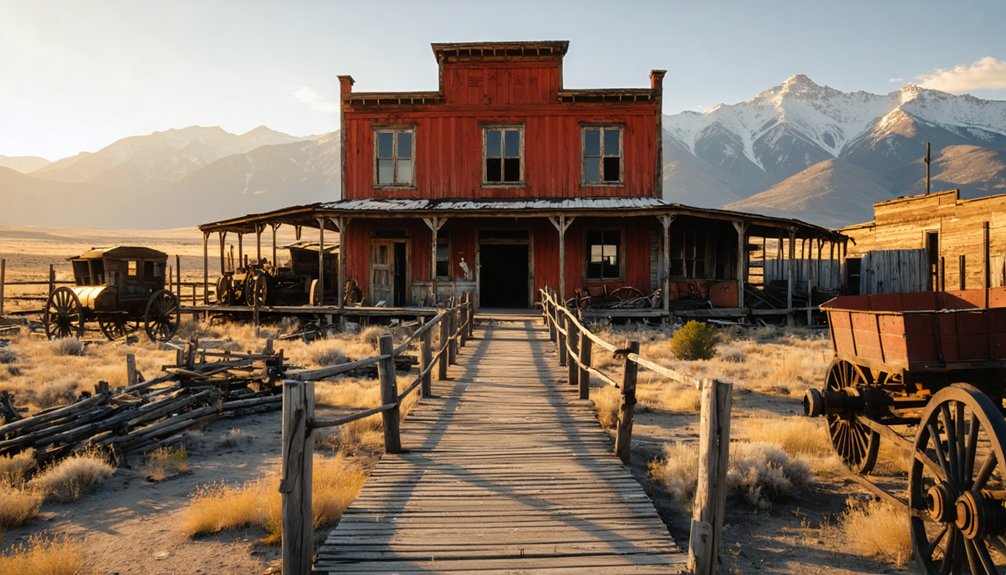
A fateful discovery on Grimes Creek in August 1862 transformed the Boise Basin into Idaho’s most legendary gold district.
You’ll find Placerville’s story began when rich placer deposits drew thousands of fortune seekers, quickly establishing a bustling town with 90 houses, 13 saloons, and numerous businesses by 1863.
The mining evolution here tells a familiar tale of boom and bust. You’d have seen initial claims yielding $100-$200 daily, but winter freezes and summer droughts limited operations.
As surface placers dwindled, miners turned to hard rock mining and quartz veins. By 1870, Chinese laborers reworked abandoned claims, and later, dredging operations emerged on Granite Creek around 1908.
Today, you can still trace Placerville’s golden legacy, which contributed to the Basin’s impressive yield of nearly 3 million troy ounces.
Preserving Idaho’s Ghost Town Heritage
Since Idaho’s ghost towns face mounting preservation challenges, a dedicated network of organizations works tirelessly to protect these irreplaceable historic treasures. Federal agencies, local historical societies, and volunteer groups collaborate to guarantee ghost town preservation through strategic conservation efforts.
These efforts are crucial as ghost towns in Idaho’s wilderness serve as a window into the state’s rich history and cultural heritage. By showcasing the stories of those who once inhabited these areas, the preservation initiatives foster a deeper appreciation for Idaho’s past among current and future generations. As tourism grows, these towns not only attract history enthusiasts but also contribute to the local economy through eco-tourism and educational opportunities.
- You’ll find the U.S. Forest Service and Bureau of Land Management providing essential site stabilization and interpretive frameworks at numerous locations.
- Local organizations like the Chesterfield Foundation contribute hundreds of volunteer hours for building rehabilitation and artifact cataloging.
- Conservation easements and land acquisitions help safeguard historic properties, while National Register listings reveal critical funding opportunities.
- The historical significance of these sites remains threatened by structural decay, looting, and environmental hazards, making ongoing preservation work essential for future generations to experience Idaho’s authentic mining heritage.
Frequently Asked Questions
Are There Any Dangerous Wildlife Encounters Reported in These Ghost Towns?
You’ll need to watch for bears, wolves, and moose near Mackay’s ghost towns, while elk and aggressive birds pose risks around Silver City. Wildlife safety demands caution during your ghost town encounters.
What’s the Best Season to Visit Idaho’s Ghost Towns?
Like a ghost beckoning through autumn mist, October’s your sweet spot. You’ll get the best weather for exploring, seasonal spooky vibes, and accessible roads before winter closures lock everything down.
Can Visitors Take Artifacts or Rocks From These Locations?
No, you can’t remove any artifacts or rocks. Legal regulations strictly prohibit taking items from ghost towns, as they’re protected for artifact preservation. Violations result in serious penalties under federal law.
Do Any of These Ghost Towns Still Have Permanent Residents?
While most are empty, Silver City maintains 1-3 current residents year-round among its 70 historic structures. You’ll find the other ghost towns like Burke and Rocky Bar are completely abandoned despite their rich town history.
Are There Camping Facilities Near These Abandoned Towns?
You’ll find both developed campgrounds and primitive camping near these ghost towns, with most sites 2-15 miles away. Follow local camping regulations and bring supplies—services are limited in these remote areas.
Ghost towns available in Idaho can also serve as excellent starting points for exploring the state’s rugged landscape. Many visitors enjoy hiking the nearby trails, which lead to breathtaking views and hidden natural wonders. Each town has its own unique history, providing a sense of adventure as you immerse yourself in the stories of the past.
References
- https://www.thegoldminehotel.com/ghost-towns-and-haunted-places-in-idaho
- https://idaho-forged.com/idahos-ghost-towns-eerie-yet-approachable/
- https://history.idaho.gov/wp-content/uploads/2018/08/0064.pdf
- https://www.youtube.com/watch?v=4AOqi64Inkg
- https://visitidaho.org/things-to-do/ghost-towns-mining-history/
- https://www.legendsofamerica.com/id-bonanzacuster/
- https://www.atlasobscura.com/places/custer-ghost-town
- https://www.eastidahonews.com/2025/12/small-mining-community-near-challis-rose-and-fell-in-30-years-and-now-its-one-of-idahos-ghost-towns/
- https://www.wanderingidahoan.com/adventures/custer-city-ghost-town
- https://history.idaho.gov/wp-content/uploads/2018/09/Custer_Historic_District_81000207.pdf