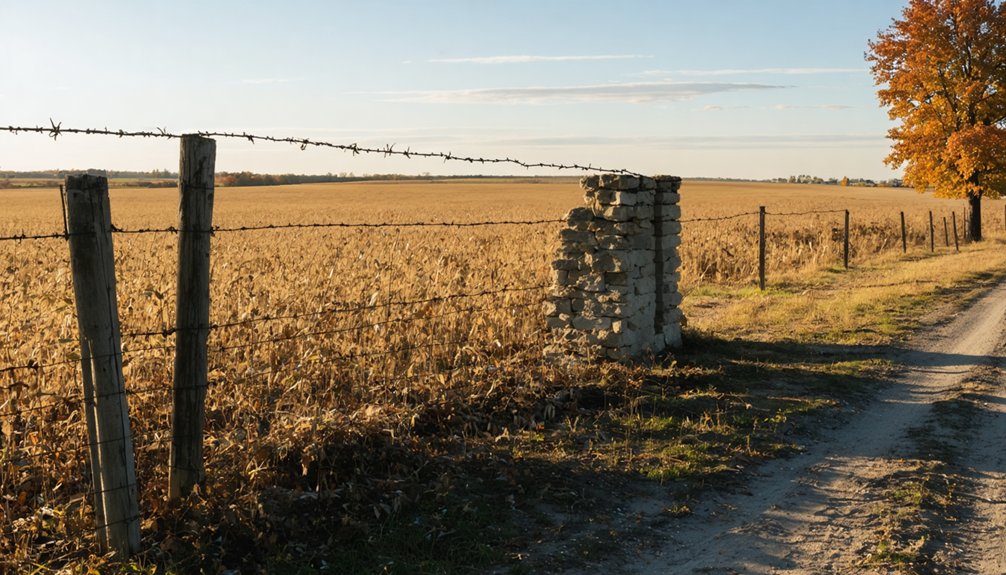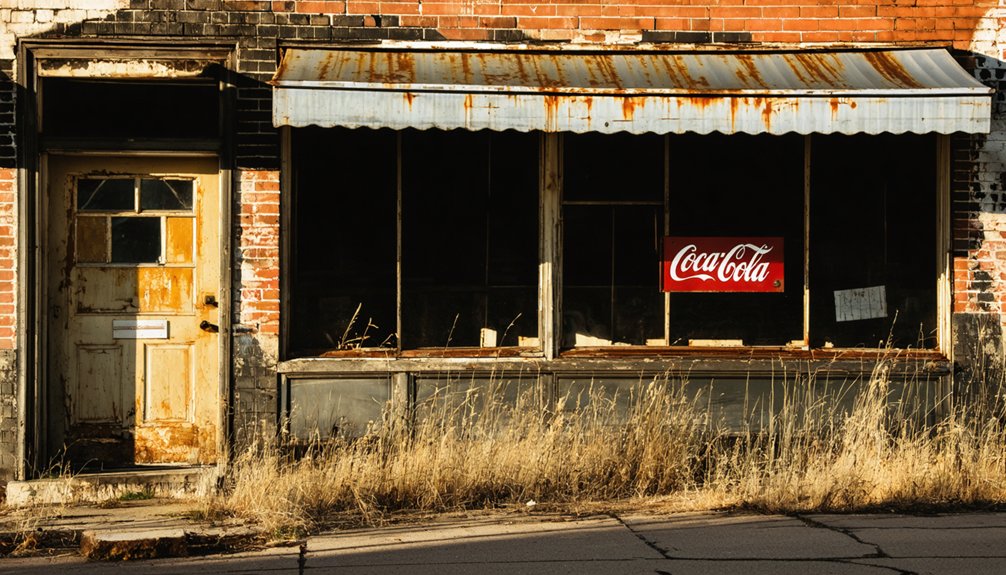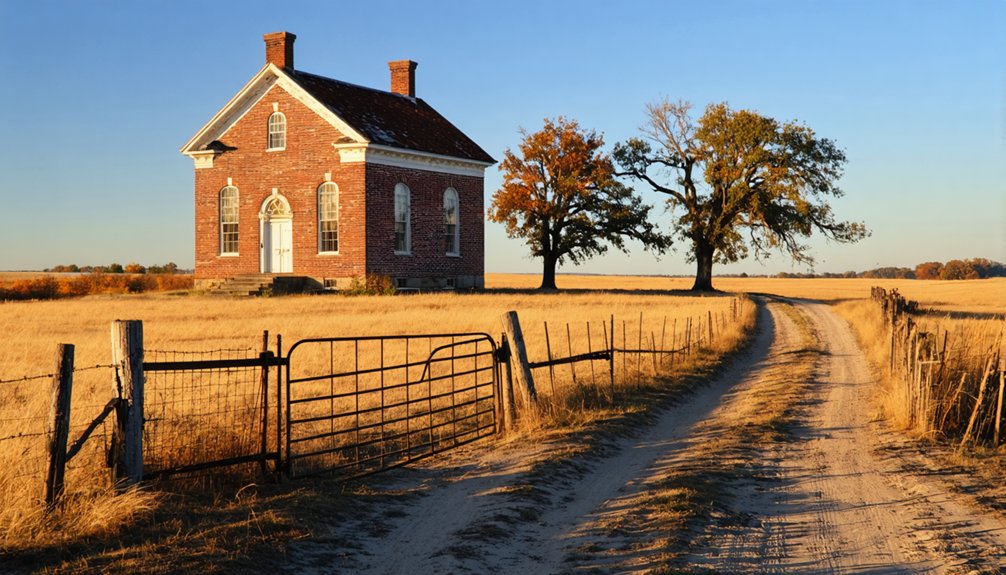
You’ll find Illinois’s ghost towns scattered across the state, telling stories of boom-and-bust mining operations, devastating floods, and bypassed railroads. Places like Braceville and Braidwood showcase remnants of coal mining‘s heyday, while Old Shawneetown and Cairo bear witness to the Ohio River‘s fury. Former railroad hubs like Ellisville Station and Buda now stand silent, with only foundations and overgrown roadbeds remaining. These abandoned communities hold deeper secrets, from paranormal tales to preserved historical treasures.
Key Takeaways
- Old Shawneetown relocated inland after the 1937 Ohio River flood, leaving the original town site largely abandoned.
- Benjaminville became deserted after being bypassed by the Chicago & Paducah railroad, leaving only its historic White Frame Building.
- Cairo’s population plummeted from 15,000 to 2,000 due to recurring floods and economic decline.
- Braceville and Braidwood showcase remnants of Illinois’ industrial mining past, with abandoned structures from coal operations.
- Zanesville transformed into a ghost town after being bypassed by new Route 66 alignments.
The Legacy of Mining Towns and Their Mysterious Remains
While Illinois’s landscape today appears serene, its abandoned mining towns tell a dramatic story of boom-and-bust cycles that transformed the state’s geography and economy.
You’ll find these remnants of mining heritage scattered across the state, where towns once boomed in the 1860s-1890s after coal and fluorspar discoveries. Corporate-backed operations built entire communities, complete with company stores, worker housing, and fortified mine sites.
Nineteenth-century mining companies transformed Illinois, building complete towns around coal and fluorspar discoveries that drew thousands of workers.
Today, you can explore these ghost towns‘ abandoned infrastructure – from collapsed tipples to empty opera houses and decaying storefronts. In places like Braceville and Braidwood, where populations once reached 8,000, you’ll discover the physical traces of this industrial past. In Rosie Claire, the largest fluorospar operation in the United States thrived until 1995, when cheaper imports forced mines to close. Coal production in the region peaked in 1895 with 1 million tons extracted.
Beneath your feet lie forgotten tunnels and voids, while above ground, sprawling mine dumps and spoil piles mark the landscape, silent witnesses to Illinois’s mining legacy.
River’s Wrath: Towns Reshaped by Floods and Nature
Although Illinois’s heartland appears safe from coastal disasters, its rivers have devastated and reshaped numerous communities throughout history.
You’ll find the most dramatic flood impacts in Old Shawneetown, where the 1937 Ohio River surge towered 15 feet above 60-foot levees, forcing residents to establish New Shawneetown inland. Salt production from the Great Salt Springs once made the town a bustling commercial center before the catastrophe.
Nature’s reclamation is evident in Kaskaskia, where the Mississippi River’s 1881 course change left fewer than 20 residents stranded on Missouri’s side. The town’s rich heritage as the first Illinois capital remains preserved in its historic church bell, a gift from King Louis XV of France.
The Illinois River’s fury transformed Griggsville Landing and Tuscumbia into overgrown ruins, their once-bustling ports now silent.
Similar fates befell Millville, completely erased by the Apple River in 1892, while Cairo’s population plummeted from 15,000 to 2,000 as recurring floods drove residents away from the Mississippi-Ohio confluence.
When the Railroad Passed Them By
You’ll find a sobering pattern across Illinois where promising frontier towns like Delevan and Vanopolis staked their futures on anticipated railroad lines that never came.
When railroads chose different routes, bypassing these hopeful settlements for cities like Warsaw, the abandoned communities quickly faded into farmland and forest.
The opposite fate struck places like Ellisville Station and Bybee, where railroad service initially brought prosperity but later cutbacks and mine closures transformed bustling stops into empty plots marked only by old rights-of-way and forgotten cemeteries.
The Chicago Burlington and Quincy Railroad helped establish and develop the town of Buda in 1854, bringing early growth and prosperity.
The town of West Havana thrived as a busy railroad terminal for both freight and passenger transport until service was discontinued around 1935.
Empty Tracks, Empty Towns
In the late 19th century, a town’s survival often hinged on whether railroad tracks ran through it or passed it by. You can still find traces of this harsh reality in Illinois’s landscape, where abandoned settlements tell the story of railroad routes determining town viability.
When the Chicago and Paducah Railroad bypassed Benjaminville in the 1870s, the town’s fate was sealed. Abandoned stores and meeting houses in New Philadelphia suffered the same fate once railroads skipped the integrated community in the 1860s.
The impact was swift and devastating. Once railroads redirected their routes, local businesses shuttered, industries collapsed, and essential services vanished. With seven rail lines supporting Cairo’s peak population of 6,300 by 1890, the town exemplified how railroad access could make or break a community.
You’ll see this pattern in places like Cairo, where the 1905 railroad bridge diverted traffic from its ferries, triggering an economic death spiral. Many communities tried to adapt by physically relocating near new tracks, while others simply faded into farmland, leaving only cemeteries and lonely landmarks as evidence of their existence.
Bypassed Communities Fade Away
When railroads chose alternate routes in 19th-century Illinois, the bypassed communities faced swift economic decline.
You’ll find the stark evidence in places like Benjaminville, where only a Quaker meeting house and cemetery remain after the Chicago & Paducah railroad selected a different path in the 1870s.
The railroad’s impact rippled through these towns immediately. Local merchants and farmers lost essential market access, while nearby rail-connected communities flourished. Like the once-prosperous Depew, Oklahoma, these towns saw their populations dwindle when vital transportation links disappeared.
Without freight and passenger traffic, businesses shuttered, families moved away, and tax bases crumbled. Within one or two decades, many settlements vanished beneath farmland, leaving only scattered foundations and overgrown roadbeds.
Places like Coltonville and Hitesville demonstrate how a single routing decision could determine whether your town would thrive or disappear into the prairie. Zanesville’s fate followed this pattern, becoming a Route 66 ghost town after being bypassed by newer transportation alignments.
Haunting Tales and Supernatural Connections
You’ll find Illinois ghost towns harbor a rich tapestry of supernatural tales, from the werewolf legends at Ramsey Cemetery to the Hatchet Lady guarding her son’s grave at Moon Point Cemetery.
The abandoned buildings and empty streets have spawned countless reports of paranormal activity, including the famous McPike Mansion in Alton where the spirits of Eleanor and Henry McPike still roam.
The darkened railroad tracks and swamplands around Cairo carry their own ghostly phenomena, with witnesses reporting mysterious lights, phantom trains, and spectral figures that vanish into the night.
Ghostly Cemetery Legends
Throughout Illinois’s ghost towns, centuries-old cemeteries harbor dark legends that trace back to 19th-century epidemics, Civil War casualties, and violent crimes.
You’ll hear graveyard whispers of the Hatchet Lady at Moon Point Cemetery, who’s said to guard her son’s grave with menacing threats to trespassers.
In Effingham’s Ramsey Cemetery, locals report spectral sightings of a mysterious black-caped figure prowling among the headstones.
Near Cairo’s swamplands, unexplained ghost lights dance above abandoned burial grounds, while phantom train whistles echo through the night.
These stories often serve as cautionary tales, warning against nighttime trespassing while preserving memories of traumatic community events.
From Native American burial grounds to relocated pioneer graves, each cemetery holds its own eerie folklore passed down through generations.
Haunted Building Accounts
Among Illinois’s most notorious haunted structures, the 1869 McPike Mansion stands as a tribute to the state’s supernatural heritage.
You’ll discover original owners Henry and Eleanor McPike still roaming the corridors, while servant spirits inhabit the kitchen and bathtub where tragedy struck.
At Mineral Springs Mall, violent deaths have left an indelible mark, with spirits tied to specific locations throughout the former luxury hotel.
- Native American entities predate the McPike property, connecting to Underground Railroad history
- First Unitarian Church’s pastoral apparition links to Elijah Lovejoy’s tragic 1837 death
- Jacoby Arts Center’s basement mortuary operations fuel ongoing paranormal encounters
- Confederate soldier spirit haunts Piasa Masonic Lodge’s basement, tied to prison deaths nearby
Preserved Historical Sites and Architectural Remnants

Despite the passage of time, several ghost towns in Illinois have left behind notable historical structures and architectural remnants that offer glimpses into the state’s past.
Among these sites, abandoned towns in Illinois reveal stories of once-thriving communities, showcasing antique storefronts and decaying homes that stand as testaments to a bygone era. Exploring these locations can evoke a sense of nostalgia and curiosity, inviting visitors to imagine the lives that were lived there. Each crumbling structure tells a unique story, contributing to the rich tapestry of Illinois’s history.
You’ll find the architectural preservation of the 1850s Griggsville Lime Kiln standing proudly in Pike County, while the Benjaminville Friends Meeting House remains a solitary sentinel on the open prairie.
Though New Philadelphia’s buildings are gone, archaeological excavations have revealed its historical significance through foundation stones and artifacts.
Beneath the prairie soil, New Philadelphia’s legacy lives on through excavated foundations and artifacts of Illinois’s pioneering past.
The Ira and Reatha T. Post Wildlife Sanctuary preserves traces of an early 20th-century settlement, complete with remnants of a former hotel and amusement park.
At the Joliet Iron and Steel Works, you can explore the sprawling ruins of what was once America’s second-largest steel mill, now transformed into a public park.
Economic Forces Behind the Exodus
When economic forces converged in Illinois’s small towns during the late 19th and early 20th centuries, they triggered a mass exodus that would transform vibrant communities into ghost towns.
You’ll find that economic shifts hit these towns from multiple directions, creating a perfect storm of population decline. Manufacturing plants closed as global competition intensified, while agricultural mechanization meant fewer workers were needed on farms.
- Transportation changes bypassed once-bustling communities like Cairo when new railroad bridges eliminated river crossing needs.
- Resource-dependent towns collapsed when local materials were depleted or cheaper alternatives emerged.
- Factory closures in industrial centers like Joliet forced thousands to seek work elsewhere.
- The Great Depression and natural disasters like the 1937 flood delivered crushing blows to already struggling communities.
Notable Ghost Towns Worth Exploring
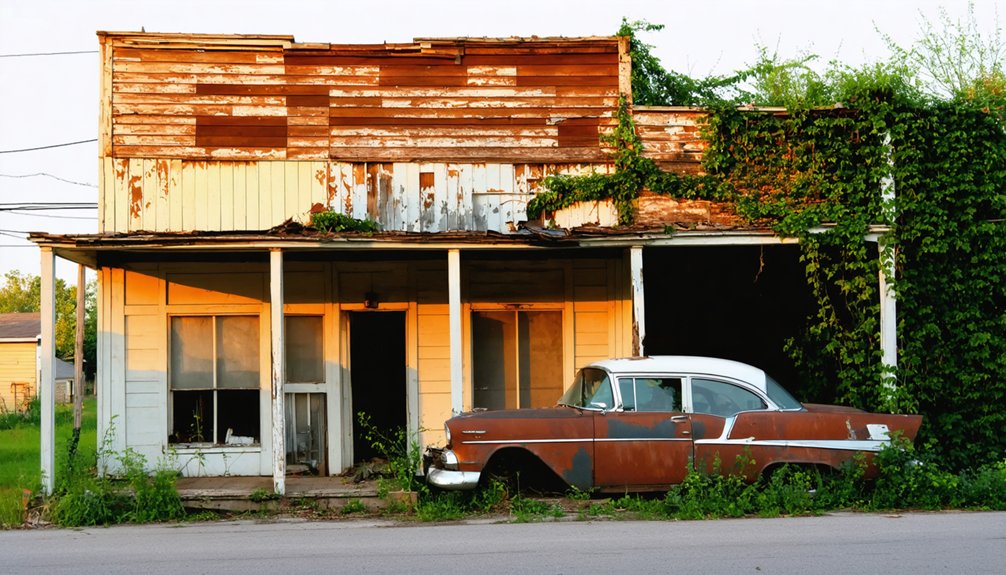
Illinois’s abandoned ghost towns offer fascinating windows into the state’s past, with several historically significant sites still accessible to modern-day explorers.
You’ll find the historic White Frame Building at Benjaminville’s ghost town site, where an accompanying burial ground stands as evidence to the original settlement.
In Tuscumbia, you can explore ancient tombstones while imagining its bustling days as a river hub.
Old Valmeyer’s visible street grid lets you trace the footsteps of former residents, while Brownsville’s coal mining heritage is marked by historical indicators that pinpoint its exact location.
For ghost town exploration enthusiasts, Wandborough’s site near Albian cemetery, though reclaimed by prairie, provides a poignant reminder of unfulfilled promise, marked only by a roadside historical marker.
Frequently Asked Questions
Are Any of These Ghost Towns Available for Purchase?
Patiently pursuing property ownership of ghost towns is possible, but you’ll rarely find complete town listings. You’ll need to research individual parcels, verify ownership records, and navigate zoning restrictions through county offices.
Exploring real estate opportunities in Illinois can lead to unique investments, especially in areas rich with history. Identifying potential properties may require patience and a keen eye for hidden gems that others might overlook. Engaging with local real estate agents can also provide valuable insights into the market dynamics and available options.
What Safety Precautions Should Visitors Take When Exploring Ghost Towns?
Bring proper safety gear including boots, flashlights, and first aid kits. Follow exploring etiquette by obtaining permissions, watching for structural hazards, and maintaining clear exit paths. Don’t enter unstable buildings.
Do Any Ghost Towns Still Have Year-Round Residents?
Believe it or not, you’ll find year-round inhabitants in places like Hillview and Cairo. While these ghost town demographics are sparse, some folks stick around, maintaining basic services and historic properties.
Which Ghost Towns Are Accessible by Public Transportation?
You’ll find Cairo is the most accessible location, with direct River to River bus service. You can also reach Hitesville via Mattoon buses, and Tuscumbia through Schuyler County’s transit system.
Can Visitors Legally Remove Artifacts From Abandoned Ghost Town Sites?
You can’t legally remove artifacts from ghost towns without permits and landowner permission. Artifact preservation laws carry serious legal consequences – fines and jail time apply for unauthorized collection.
References
- https://www.ghosttowns.com/states/il/il.html
- https://www.youtube.com/watch?v=93k0qtvzkn4&vl=en-US
- https://www.atlasobscura.com/things-to-do/illinois/abandoned
- https://www.freakyfoottours.com/us/illinois/
- https://www.geotab.com/ghost-towns/
- https://drloihjournal.blogspot.com/p/lost-towns-of-illinois-series.html
- https://www.youtube.com/watch?v=fcV1Ybd2cnA
- https://www.youtube.com/watch?v=rNSjcGsONhM
- http://www.illinoislaborhistory.org/labor-history-articles/early-days-of-coal-mining-in-northern-illinois
- https://www.legendsofamerica.com/il-coalminetowns/