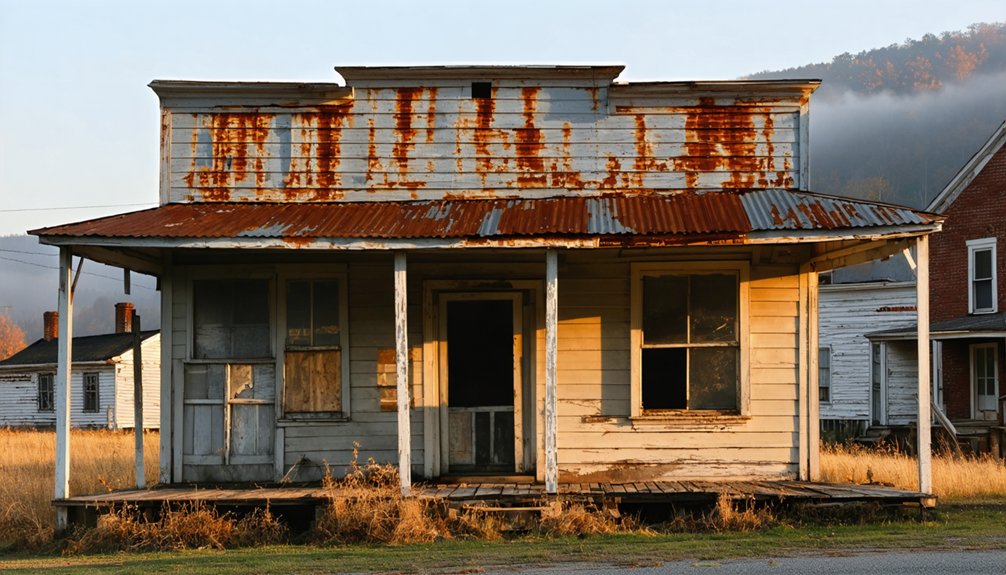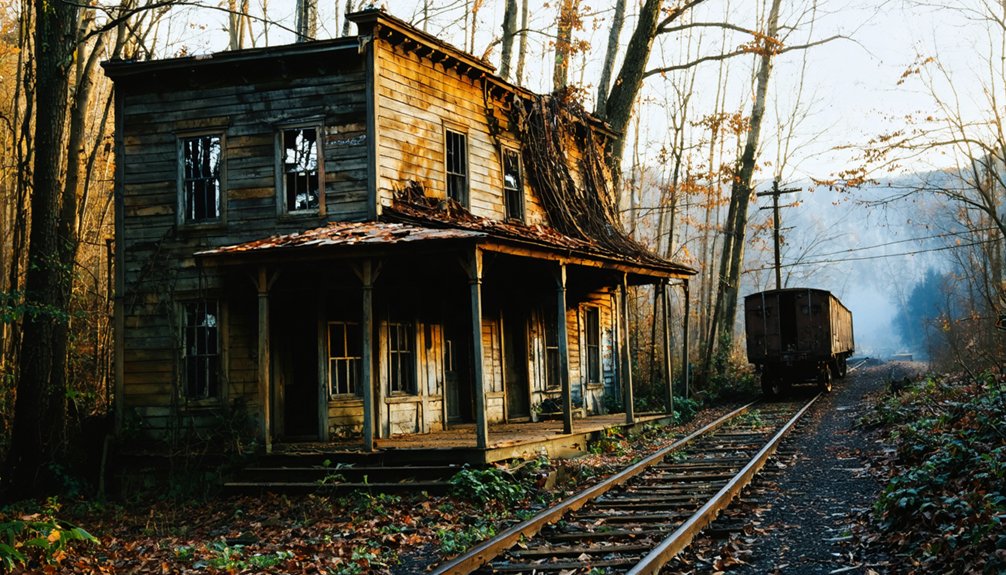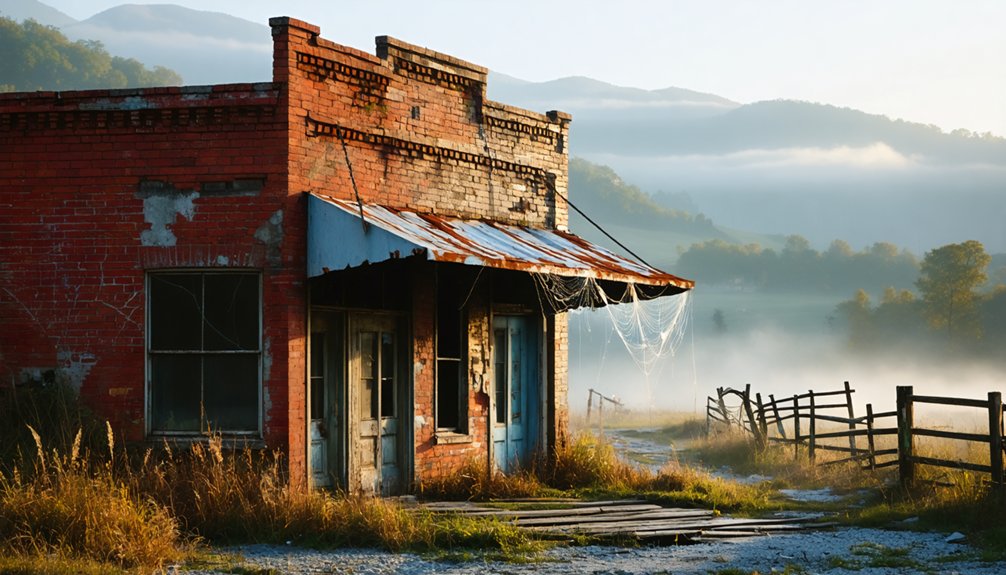
You’ll discover Kentucky’s haunting ghost towns through abandoned mining camps like Blue Heron and Barthell, where company scrip once ruled daily life. The lost town of Paradise, immortalized in John Prine’s ballad, fell to TVA’s power plant expansion, while Bells Mines and Creelsboro showcase the commonwealth’s industrial and river trading past. These forgotten communities, from coal camps to riverside settlements, hold fascinating stories of Kentucky’s economic and cultural transformation. Further exploration reveals even deeper layers of history beneath the ruins.
Key Takeaways
- Blue Heron and Barthell were coal mining company towns established by Stearns Coal & Lumber Company, now preserved as historic sites.
- Paradise, Kentucky was demolished in 1967 for TVA’s power plant construction, leaving only a hilltop cemetery as evidence.
- Bells Mines, established in the 1820s, was a significant coal mining town with extensive operations across 5,000 acres.
- Creelsboro, a historic river settlement, declined after Wolf Creek Dam construction disrupted Cumberland River trade routes.
- Kentucky’s ghost towns are protected through preservation programs, with some successfully transformed into living history educational sites.
Kentucky’s Mining Heritage: Blue Heron and Barthell Coal Camps
The coal mining legacy of Kentucky’s Cumberland Plateau comes alive through the remnants of Blue Heron and Barthell, two significant company towns established by the Stearns Coal & Lumber Company in the early to mid-20th century.
You’ll find that Barthell served as an early hub for regional operations, while Blue Heron, established as Mine 18 in 1937, represented the company’s later expansion.
The community dynamics in these towns centered around company-controlled systems, where you’d have seen workers living in relocatable cottages and using company scrip at the store.
Labor struggles emerged through wildcat strikes as miners fought for better conditions.
Today, Blue Heron’s ghost structures – steel frames marking original building locations – tell the story of a once-thriving mining community that abruptly ended with the mine’s closure in 1962. Visitors can now experience this preserved history through interactive audio buttons that share authentic stories from former residents.
The Stearns Coal empire controlled an impressive 130,000 acres of forest and managed mining operations across 200 square miles of land.
The Lost Town of Paradise: A Cultural Legacy
You’ll find the stark transformation of Paradise, Kentucky, from an early 19th-century trading post to a TVA-demolished ghost town emblematic of coal industry’s impact on rural communities.
The Tennessee Valley Authority’s 1967 buyout and subsequent construction of the Paradise Fossil Plant erased nearly all traces of this once-vibrant riverside settlement, leaving only a hilltop cemetery as proof of its existence.
Singer-songwriter John Prine immortalized Paradise’s demise in his 1971 ballad “Paradise,” which poignantly captures the environmental and cultural toll of strip mining on Kentucky’s landscape and communities.
Originally known as Stoms Landing, the town was named after a local ferry service operator before adopting the name that would later become tragically ironic.
The decision to demolish the town came after residents faced serious health risks from the constant ash fall produced by the nearby coal-burning plant.
Historical Coal Town Origins
Deep in the heart of Muhlenberg County, Paradise emerged from humble beginnings as Stom’s Landing in the early nineteenth century, when Leonard Stom established a ferry service and trading post along the Green River.
You’ll find the town’s early development marked by significant cultural shifts, from its brief stint as Monterey to its mysterious renaming as Paradise. The establishment of the post office in 1852 signaled the town’s growing importance, while the nearby Airdrie Ironworks, founded by Scottish entrepreneur Sir Robert Alexander, brought industrial promise through iron smelting operations. The town’s transformation accelerated when the first commercial mine opened in 1820, setting the stage for Paradise’s coal-driven future.
The area’s rich history extends even further back, with the Indian Knoll site across the Green River revealing ancient Native American settlements. A defining chapter in the town’s story came when the coal-fired plant led to widespread environmental concerns, ultimately forcing many residents to relocate.
TVA’s Environmental Impact
Paradise’s industrial evolution took a dark turn in the 1950s when the Tennessee Valley Authority (TVA) began construction of its massive coal-fired power plant along the Green River.
The small town, which began as Stoms Landing, underwent several transformations before its ultimate demise.
You’d find a stark environmental degradation as the plant’s noxious emissions and ash fallout created hazardous living conditions throughout Muhlenberg County. The health consequences were severe – residents struggled to breathe as toxic ash fell like warm snow, making simple activities like gardening impossible.
The cooling towers of TVA became an ominous landmark, dominating the rural Kentucky landscape.
The situation became so dire that you couldn’t safely remain in the area without risking serious respiratory issues. By 1967, facing government pressure and declining quality of life, townspeople had no choice but to accept TVA’s minimal buyout offers.
The once-vibrant community disappeared, leaving only a small hilltop cemetery as evidence of Paradise’s existence.
John Prine’s Musical Memory
When folk singer John Prine released “Paradise” on his 1971 debut album, he transformed a local Kentucky tragedy into an enduring American ballad. His songwriting influence captured the profound loss of a community displaced by industrial forces, weaving cultural nostalgia with environmental critique. Through the song’s narrative, Paradise‘s story became emblematic of broader societal changes across Appalachia. The once-thriving community along the Green River banks had supported generations of families before its decline.
- The song’s structure created a template for future Americana artists addressing industrial decline and community displacement.
- Cover versions and radio play preserved Paradise’s memory beyond local histories, making it a touchstone for environmental advocacy.
- Paradise Cemetery remains as a physical anchor for the song’s emotional resonance, drawing cultural pilgrims seeking connection to the lost town.
The song continues to serve as a powerful reminder of what’s lost when progress comes at the cost of community.
Remnants of River Trade: Fords Ferry and Kyrock
Two historic river settlements, Fords Ferry and Kyrock, stand as compelling representations to Kentucky’s once-thriving Ohio River trade network.
At Fords Ferry, you’ll find echoes of a bustling 19th-century commerce hub where James Ford’s horse-powered ferry service connected Kentucky to Illinois. The settlement flourished with hotels, stores, and constant river trade until floods and changing transportation routes led to its abandonment.
Once thriving with commerce and river crossings, Fords Ferry stood as a vital gateway between Kentucky and Illinois until nature reclaimed it.
Darker elements of its past emerge in ghost stories about Ford’s secret life as a river pirate, with legends of buried treasure and victims along Fords Ferry Road.
The Kentucky Rock Asphalt Company transformed Kyrock into the world’s largest producer of natural rock asphalt before competition from petroleum-based products led to its closure in the 1950s.
Today, both towns have virtually disappeared – Fords Ferry reduced to fields and woods, while Kyrock’s remnants serve as silent testimonies to Kentucky’s vanished river trade era.
Bells Mines: Traces of Industrial History
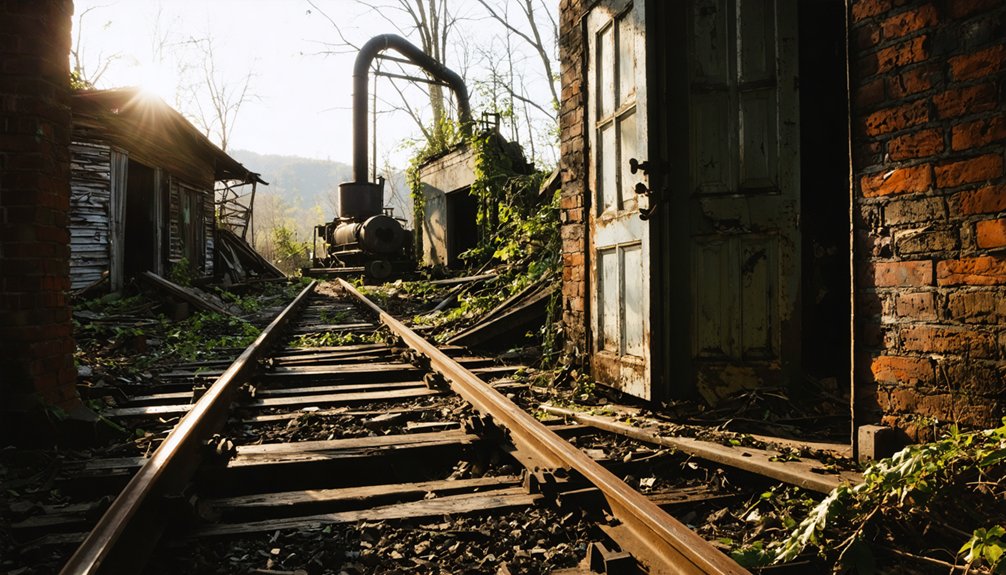
As you explore the historic coal operations of Bells Mines, you’ll find traces of one of Kentucky’s earliest mining endeavors, established by John Bell in the 1820s and renowned for producing some of the state’s highest quality coal.
The site’s industrial significance is evidenced by its extensive 5,000-acre operation purchased in 1922 by Bell Coal and Navigation Company, following a 70-year suspension of mining activities.
Today, the most tangible remnant of this once-thriving community is the Bells Mines Cemetery, established in the mid-19th century, where diverse headstones ranging from simple slabs to ornate marble monuments tell the story of its multicultural workforce from Bavaria, Prussia, Scotland, Ireland, and Wales.
Mining Operations Overview
The discovery of coal in northern Crittenden County sparked John Bell’s purchase of 31 acres near the Tradewater River in 1836, establishing what would become Bells Mines.
You’ll find this operation was at the forefront of mining technology advancements, featuring a 500-horsepower power plant, coal washers, and grinders for coke production by 1922.
Labor migration patterns show diverse workforce development, with European immigrants from Germany, France, and the British Isles arriving in the late 1840s, joining workers from across America.
- Bell’s initial operations relied on trust management and paid agents, with his son John Bell Jr. taking control around 1850.
- W.C. Carvell’s management marked a shift period, eventually acquiring Bell’s interests.
- The 1922 revival by Bell Coal and Navigation Company introduced modern infrastructure, including rail transport to Sturgis.
Cemetery and Archaeological Evidence
Located on elevated ground between Sturgis and Marion, Kentucky, Bells Mines Cemetery serves as a critical archaeological window into the region’s industrial past.
You’ll find cemetery inscriptions that reveal a diverse immigrant workforce, with German, French, and British surnames etched into weathered marble monuments and simple stone slabs dating from the mid-1800s through early 1900s.
The burial demographics tell a compelling story – working-age adults lost to mining hazards rest alongside children and infants, indicating established family settlements rather than just transient workers.
Surface artifacts and landscape features surrounding the cemetery, including mine shaft ruins and boarding house remains, complete the picture of a once-thriving mining community.
While some graves remain unmarked, the cemetery’s layout and mortuary iconography provide essential clues about social hierarchies and family networks within this industrial hamlet.
Hidden Stories: Creelsboro and Golden Pond
Nestled along the north bank of the Cumberland River, Creelsboro emerged in the early 1800s as one of Kentucky’s most promising river settlements. The town’s rich heritage centers around the Rockhouse, a natural arch formed over 300 million years ago that served as both shelter and gathering place.
You’ll find traces of its vibrant past in Campbell’s Creelsboro Country Store, built in 1876, which stands as a symbol of the town’s commercial peak when it was the busiest port between Nashville and Burnside.
- The Rockhouse’s significance extends beyond its natural beauty, harboring stories of Native Americans, longhunters, and even moonshine operations.
- Local oral histories preserve tales of riverside revivals, picnics, and social gatherings that defined community life.
- The town’s decline accelerated after Wolf Creek Dam’s construction altered traditional river dynamics and transportation patterns.
Preserving Kentucky’s Ghost Town Heritage

Recognizing the essential importance of preserving Kentucky’s historic ghost towns, dedicated organizations have established extensive preservation programs that protect these abandoned settlements for future generations.
Ghost towns available in Kentucky offer a unique glimpse into the past, allowing visitors to explore remnants of bygone eras and learn about the history etched into their landscapes. These locations often host special events and tours that enhance the experience, drawing in history enthusiasts and curious travelers alike. By fostering an appreciation for these historical sites, communities can ensure that the stories of these ghost towns remain alive for years to come.
Exploring ghost towns in Kentucky can unveil hidden treasures and fascinating narratives that reflect the state’s rich history. As visitors wander through these forgotten places, they often uncover artifacts and architecture that speak to the lives once lived there. Local historians and tour guides play a crucial role in bringing these stories to life, ensuring that each ghost town remains a vibrant part of Kentucky’s cultural heritage.
You’ll find Kentucky Heritage Council and Preservation Kentucky leading community engagement efforts through strategic partnerships and innovative preservation strategies. Kentucky’s commitment shows in its national rankings – first in Preserve America Initiative designations and fourth in National Register listings.
You can explore successful restoration projects like Barthell, where the Koger family transformed a coal town into a living history site.
These preservation efforts have generated over $2 billion in downtown reinvestment, though challenges remain. To protect these historic treasures, you’re encouraged to support preservation easements, participate in cultural events, and join collective efforts between legislators and citizens.
Exploring Abandoned Communities Safely
Safety precautions must guide any exploration of Kentucky’s abandoned communities, where both legal and physical hazards await the unprepared visitor.
Exercise caution when venturing into Kentucky’s ghost towns – these silent settlements harbor dangers both seen and unseen.
When exploring these historical sites, you’ll need to balance your desire for adventure with ethical exploration practices and vital safety tips. Before visiting locations like Barthell or Blue Heron, obtain necessary permissions and research site-specific regulations to avoid legal troubles.
- Always carry essential gear including GPS devices, sturdy boots, and first-aid supplies – especially when visiting remote locations like Jonkan where cell service is nonexistent.
- Plan your visits during daylight hours and inform others of your itinerary to guarantee help can reach you if needed.
- Follow Leave No Trace principles and avoid disturbing artifacts or structures, preserving these sites for future generations to experience.
Frequently Asked Questions
Are There Any Documented Paranormal Activities in Kentucky’s Ghost Towns?
You’ll discover countless paranormal sightings at Kentucky’s haunted locations, with Blue Heron Mining Community, Portal 31 Coal Mine, and Barthell’s abandoned structures offering documented reports of apparitions, ghostly voices, and unexplained phenomena.
What Valuable Artifacts Have Been Discovered in These Abandoned Towns?
You’ll find lost treasures like Adena artifacts, Civil War relics, 900+ ceramic vessel fragments, mining equipment, and Egyptian artifacts – all holding significant historical significance for Kentucky’s cultural heritage.
Can Metal Detecting Be Used at These Abandoned Town Sites?
Picture yourself standing at an old site – but you’ll need permits and written permissions. Due to metal detecting regulations and historical significance, it’s illegal on public lands without authorization.
Which Ghost Towns Are Completely Underwater Due to Dam Construction?
You’ll find Birmingham under Kentucky Lake, while Rowena, Horseshoe Bottom, Swan Pond Bottom, Lulu, Indian Creek, and Stokes remain completely submerged beneath Lake Cumberland’s waters, marking significant dam history for underwater exploration.
Do Any Descendants of Original Residents Still Claim Property Rights?
You’ll find no active property claims or family legacies in these ghost towns today – records show complete transfers to public entities like TVA and National Park Service without legal disputes.
References
- https://www.onlyinyourstate.com/experiences/kentucky/12-ghost-towns-in-ky
- https://carte-urbex.com/en/blogs/infos/top-10-abandoned-places-in-kentucky
- https://www.youtube.com/watch?v=D9gOmfCuKLs
- https://wbkr.com/visit-these-20-creepy-kentucky-ghost-towns-for-a-halloween-road-trip/
- https://everafterinthewoods.com/abandoned-ghost-towns-in-kentucky-that-still-hold-echoes-of-the-past/
- https://www.youtube.com/watch?v=9SNizgCODHI
- https://www.freakyfoottours.com/us/kentucky/
- https://backyardknoxville.com/blue-heron-kentucky-mining-camp/
- https://www.oklahoman.com/story/news/2009/10/28/ghost-town-in-kentucky-has-a-lively-history/61337332007/
- https://statebystatetravel.com/exploring-blue-heron-mining-camp/