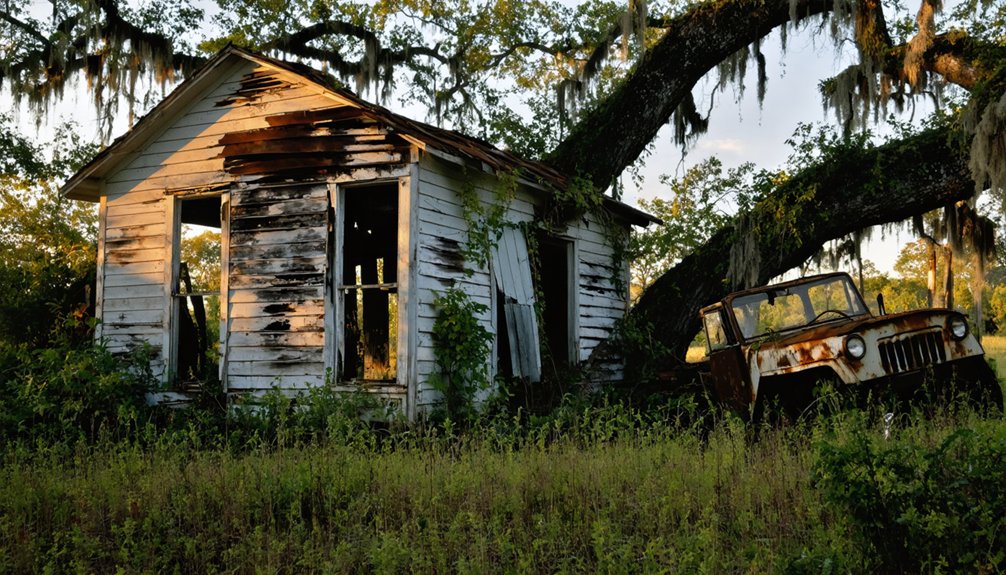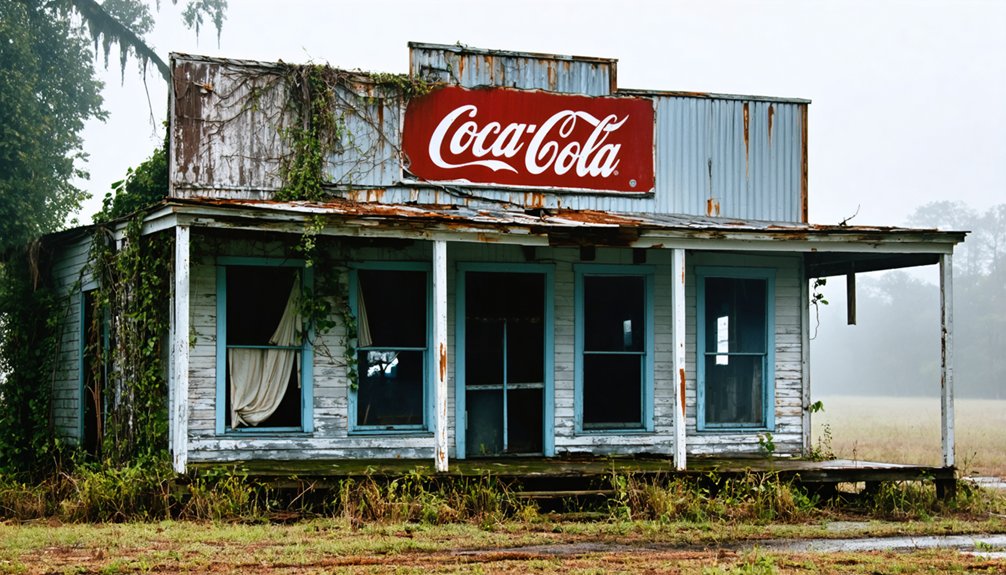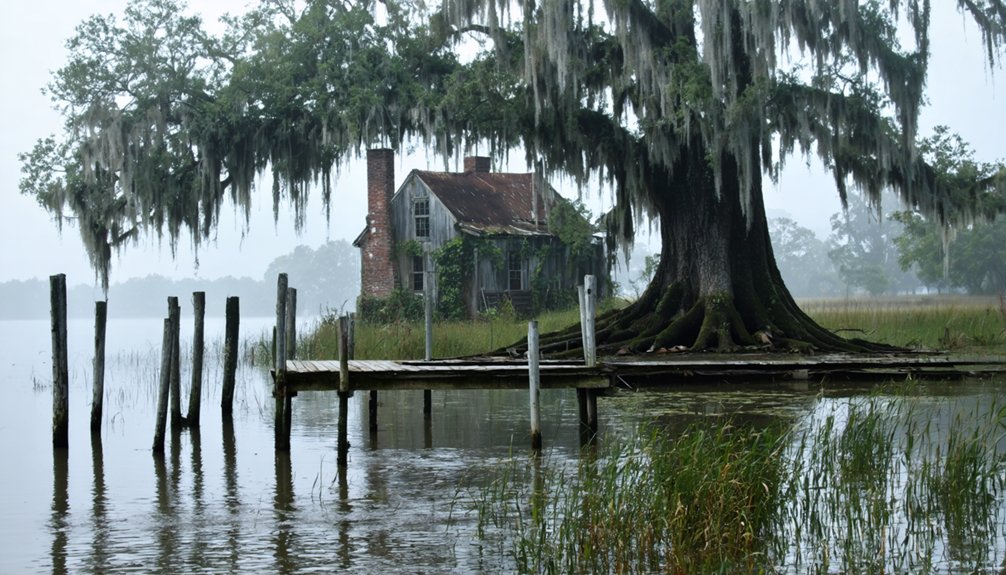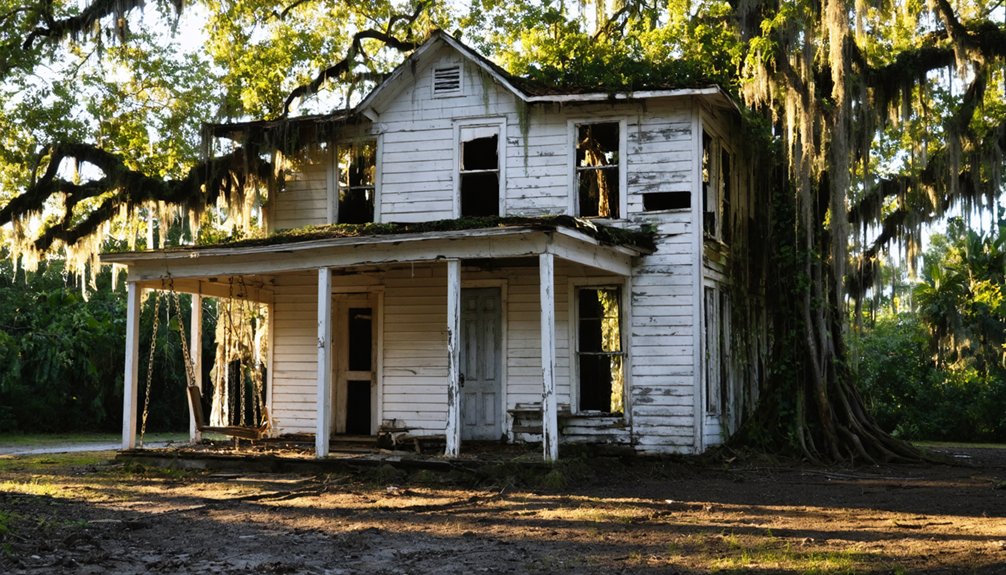
You’ll discover numerous ghost towns scattered across Louisiana’s landscape, from Burrwood’s submerged delta settlement to Laurel Valley’s historic sugar plantation complex. The hurricane-ravaged remains of Ruddock, once a 700-person lumber community built on stilts, and Cheniere Caminada, where 779 of 1,471 residents perished in an 1893 hurricane, stand as evidence of nature’s power. These abandoned settlements, shaped by industrial shifts and environmental challenges, hold fascinating stories of resilience and loss within their weathered foundations.
Key Takeaways
- Burrwood, a former naval base in Plaquemines Parish with 1,000 residents, is now largely submerged due to coastal erosion.
- Laurel Valley features 60 historic structures from its sugar plantation era, including an 1845 brick mill that closed in 1926.
- Ruddock, a lumber settlement of 700 people, was completely destroyed by a Category 4 hurricane in 1915.
- Cheniere Caminada, once a thriving fishing village, was devastated by an 1893 hurricane that killed 779 of its 1,471 residents.
- Natural disasters and coastal erosion have claimed numerous Louisiana towns, with only cemeteries and ruins remaining as evidence.
The Lost Delta Community of Burrwood
While many Louisiana communities have succumbed to environmental pressures over time, few disappearances are as complete as that of Burrwood, a once-thriving delta settlement that stood at the southernmost reach of the Mississippi River in Plaquemines Parish. Today, most of what was once Burrwood lies beneath water due to extensive coastal erosion.
You’ll find Burrwood’s history deeply intertwined with America’s maritime and military past. From its early days as an Army Corps of Engineers outpost to its transformation into a naval base during World War II, the settlement supported up to 1,000 residents. The community faced its first major setback when Hurricane Betsy struck in 1917, foreshadowing the environmental challenges ahead.
The delta erosion that would ultimately claim Burrwood began in the mid-1910s, accelerated by rising sea levels and coastal subsidence. Despite efforts to fortify the shoreline, Hurricane Betsy in 1965 dealt a devastating blow.
Laurel Valley’s Sugar Mill Legacy
Unlike Burrwood’s complete submersion beneath Gulf waters, you can still explore one of Louisiana’s most significant sugar plantation complexes at Laurel Valley.
While Burrwood vanished into the Gulf’s depths, Laurel Valley stands as a living monument to Louisiana’s sugar plantation heritage.
You’ll discover a sprawling 5,000-acre monument to 19th-century sugar production, anchored by an 1845 brick mill that once processed cane via 15 miles of narrow-gauge railroad. A systemic infection devastating the sugar cane fields forced the mill to permanently close its doors in 1926.
The plantation’s architectural legacy includes roughly 60 surviving historic structures, from slave cabins to shotgun houses, preserving the evolution of plantation architecture from antebellum times through the early 20th century. Originally granted to Etienne Boudreaux in 1783, the plantation would go on to become a cornerstone of Louisiana’s sugar industry.
- The site transformed from a modest 500-acre grant to become the region’s largest sugar producer, employing up to 450 workers at its peak.
- An intricate network of 43 miles of canals and drainage systems showcases the engineering prowess required for large-scale cultivation.
- The 1905 general store, now a museum, offers glimpses into the daily lives of plantation workers and technological innovations of the era.
Hurricane-Ravaged Remnants of Ruddock
As you travel along Interstate 55 in Louisiana, you’ll find the haunting remnants of Ruddock, a once-thriving lumber settlement built on stilts amid the swampland of St. John the Baptist Parish.
Before the devastating Category 4 hurricane of 1915, Ruddock boasted wooden sidewalks connecting its homes, church, and school, supporting a bustling community of lumber workers and their families.
The community was originally established by the Ruddock Cypress Company and grew to a population of 700 by 1910.
Today, only an abandoned cemetery and rotting wooden fragments remain visible through the encroaching swamp vegetation, marking where 58 residents lost their lives in that fateful storm. Local historian Wayne Norwood preserves the town’s memory through his Louisiana Treasures Museum, which displays artifacts recovered from the ghost town.
Life Before The Storm
The remote lumber boomtown of Ruddock emerged in the 1890s as a distinctive settlement built entirely on stilts above the black swamp waters of St. John the Baptist Parish.
Life in this isolated community revolved around the lumber industry, with wooden sidewalks connecting buildings and homes. You’d find no roads, cars, or electricity – just a determined population thriving in their unique swamp life environment. The residents grew cabbage as crops to sustain their community.
The Catholic church and school anchored the west side, while residents relied on monthly visits from a New Orleans priest via train.
- Residents adapted to isolation by flagging down trains for essential goods, which engineers would deliver directly to their doorsteps.
- A local midwife handled all births, while mothers became skilled at treating family illnesses.
- Water came from cisterns, and the community depended entirely on the railroad for connections to the outside world.
Remnants Along Interstate 55
Today’s travelers along Interstate 55 might be surprised to find Exit 7 still marked as “Ruddock,” despite no visible trace of the once-thriving lumber town.
If you venture off the interstate onto the Manchac Greenway, you’ll discover nothing but overgrown vegetation where this historic community once stood. The site’s only physical remnants are scattered pieces of rotted wood, now barely distinguishable from the surrounding swampland. Before its demise, the town was built on stilts above water with wooden sidewalks connecting buildings throughout the settlement.
While Ruddock‘s history lives on through state highway maps and exit signs, the devastating 1915 hurricane erased all evidence of its buildings, walkways, and infrastructure.
The former railroad tracks that once served as the town’s lifeline lie abandoned, consumed by nature. You’ll find no structures, roads, or markers commemorating one of Louisiana’s most complete ghost towns – just wilderness reclaiming what the storm destroyed over a century ago.
As you explore these haunting locations, you’ll discover several ghost towns available in Louisiana that tell the stories of those who once thrived there. Each site offers a glimpse into the past, with remnants of homes and businesses that stand as a testament to the lives lived in these now-silent areas. Nature has woven its way through the ruins, creating an eerie beauty that draws adventurers and history enthusiasts alike.
Taft: From Holy Ground to Industrial Zone
Taft was a notorious railroad construction camp that earned the reputation as “the wickedest city” in America during its peak in the early 1900s. The town’s rampant lawlessness included twenty-seven saloons where workers would gather after brutal days of clearing trees and laying track.
The Tragic Tale of Cheniere Caminada
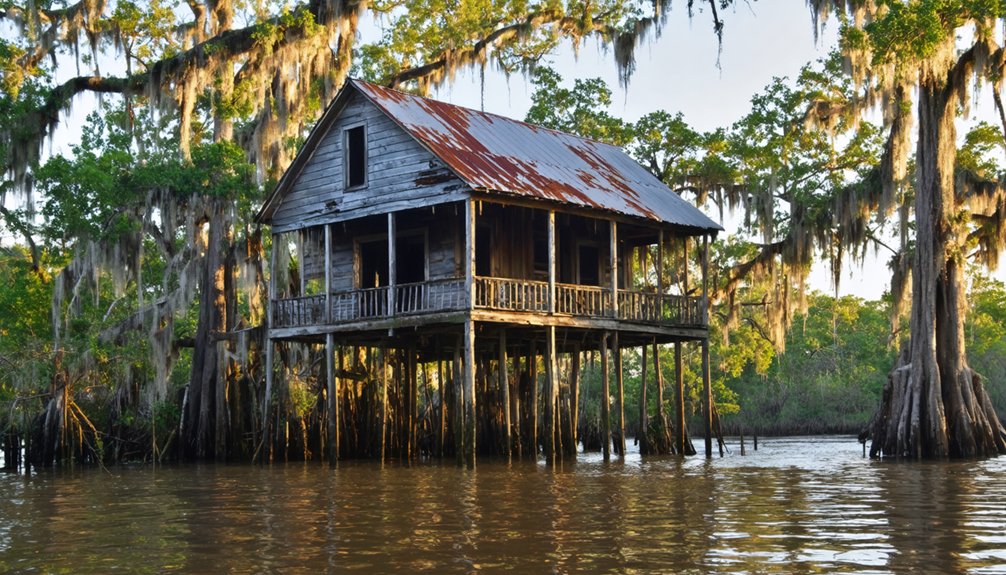
You’ll find few Louisiana ghost towns with a story as tragic as Cheniere Caminada, a thriving fishing village that met its fate during the catastrophic 1893 hurricane.
When the Category 4 storm made landfall on October 2, its 135 mph winds and 18-foot storm surge claimed 779 of the settlement’s 1,471 residents, with children suffering the highest mortality rate.
Today, all that remains of this once-prosperous coastal community is a small cemetery along Louisiana Highway 1, marked by a dead oak tree and crumbling graves that continue to sink into the marshy ground.
Pre-Storm Fishing Village
Nestled along a narrow barrier island in South Louisiana’s Barataria Bay, Cheniere Caminada emerged as the region’s largest coastal fishing village during the late 19th century. You’d find a thriving community of 1,471 residents whose fishing heritage stemmed from Acadian, Native American, and multicultural coastal settlers.
The village’s strategic location near Grand Isle granted access to rich fishing grounds through the bayous, enabling fishermen to supply New Orleans markets with fresh seafood.
- The village’s community resilience manifested in its rapid urbanization, boasting 180 buildings, including a Catholic church with a bell cast from precious metals and pirate treasures.
- Local fishermen navigated through Barataria Basin to Lugger’s Landing, maintaining essential trade routes.
- Beyond maritime commerce, the town featured resorts complete with dining halls, dance venues, and billiard rooms.
Hurricane’s Devastating Impact
On October 1, 1893, a catastrophic Category 4 hurricane bore down on Cheniere Caminada, releasing 130-140 mph winds and a devastating 18-foot storm surge that would claim 779 lives – more than half the village’s population.
The storm’s fury, which began at dusk and peaked around 3 a.m., left only one house standing in its hurricane aftermath.
You’ll find the destruction extended far beyond this fishing village. The hurricane ravaged plantations along the Mississippi River, destroyed church structures in Point Celeste and Tropical Bend, and spawned destructive tornadoes in Pointe-à-la-Hache.
Despite the community resilience that would follow, this remains Louisiana’s deadliest hurricane, causing $5 million in damage across the region and standing as the third deadliest continental U.S. hurricane in recorded history.
Legacy of Lost Community
Before the devastating 1893 hurricane, Cheniere Caminada stood as a vibrant coastal settlement with deep French Creole roots.
Today, you’ll find only traces of this once-thriving community, where cultural resilience manifests through the preservation of artifacts like the historic church bell and maintained cemetery grounds.
The community memory lives on through descendants who relocated inland to places like Cut Off and Golden Meadow, carrying with them rich oral traditions and family histories.
- Survivor narratives and folklore continue to shape the collective memory of the disaster through stories of mass graves, hauntings, and moral lessons.
- Physical remnants, including crumbling brick graves and a lone oak marker, stand as silent witnesses to the lost settlement.
- Commemorative events, like the centennial rededication of Cheniere Cemetery, demonstrate ongoing connections to this vanished community.
Pointe Coupee’s Forgotten Settlements
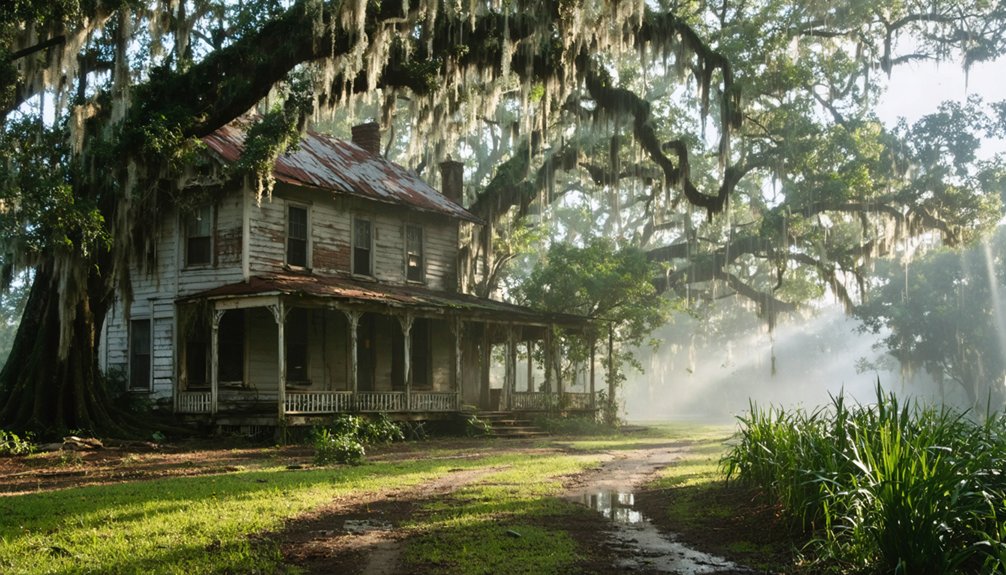
Since its establishment as the oldest settlement on the lower Mississippi in 1708, Pointe Coupee has witnessed the rise and fall of numerous historic communities within its boundaries.
You’ll find nine forgotten settlements scattered across the parish, including the ghost town of Elliot City, located six miles west of Livonia in the 10th Ward.
The parish’s history of abandoned communities began with Post Unzaga’s desertion following the 1795 slave rebellion conspiracy.
Even Alma, once a thriving settlement in the southeastern part of the parish, now exists solely as an industrial site housing one of Louisiana’s eleven remaining sugar mills.
These forgotten settlements tell a compelling story of how floods, social upheaval, and economic changes transformed Pointe Coupee from its early colonial roots into its present form.
Natural Disasters and Louisiana’s Ghost Towns
Natural disasters have repeatedly reshaped Louisiana’s coastal landscape, transforming once-thriving communities into haunting ghost towns.
These ghost towns in Louisiana serve as reminders of the state’s vibrant history and the resilience of its people. Many of these abandoned places are now overgrown with vegetation, standing as silent witnesses to the relentless forces of nature. Exploring these remnants offers a poignant glimpse into the lives that once thrived in these now-desolate areas.
You’ll find stark examples in Cheniere Caminada, devastated by an 1893 hurricane, and the twin towns of Ruddock and Frenier, obliterated by a catastrophic 1915 storm.
As climate change accelerates coastal erosion, these lost settlements serve as sobering reminders of nature’s power. The urban decay is particularly evident in Burrwood, where rising seas and subsidence have submerged a once-bustling port town of 1,000 residents.
- The 1915 hurricane’s 15-foot storm surge left only broken docks and cemetery ruins at Frenier, where legend tells of a folk magician’s deadly prophecy.
- Bayou Chene’s stilted buildings succumbed to repeated flooding, forcing evacuation by the 1940s.
- Multiple disasters, from hurricanes to environmental changes, transformed these vibrant communities into underwater monuments.
Industrial Progress and Abandoned Communities
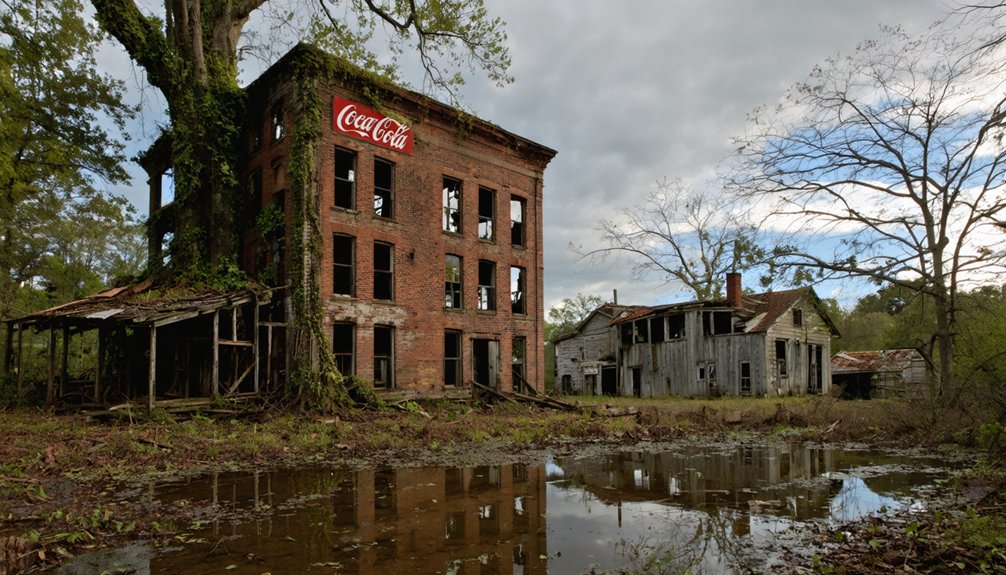
Louisiana’s industrial expansion in the early 20th century left behind a trail of abandoned communities, particularly in the lumber, chemical, and sugar industries.
You’ll find evidence of this industrial evolution in places like Carson, where the Central Coal and Coke Company built an entire town, only to see it fade away when operations ceased.
The chemical industry’s growth led to significant community displacement, as seen in Morrisonville, where Dow Chemical’s pollution forced residents to relocate in 1990.
Similarly, sugar plantations like Laurel Valley, once thriving with worker housing and community facilities, became ghost towns by 1926.
Today, you can explore these remnants of Louisiana’s industrial past, from sawmill cemeteries in Neame to the towering chimney of Braithwaite’s abandoned sugar mill-turned-paper factory.
Preserving the Memory of Lost Louisiana Towns
While industrial ghost towns dot Louisiana’s landscape, dedicated preservation efforts work tirelessly to protect these vanishing pieces of history.
You’ll find organizations like the Louisiana Trust for Historic Preservation maintaining the Most Endangered Places List since 1999, ensuring cultural heritage isn’t forgotten.
Memory preservation takes many forms, from the Foundation for Historical Louisiana’s protection of historic structures to the Louisiana Cemetery Society’s guardianship of above-ground tombs.
- The Peason Ridge Wildlife Management Area preserves Frenier’s church foundations and cemeteries, keeping the town’s memory alive.
- Through EPA intervention, Revilletown Cemetery stands as the sole remnant of its toxic ghost town past.
- Tax credit programs have transformed New Orleans’ abandoned warehouse district, proving that preservation can breathe new life into forgotten spaces.
Frequently Asked Questions
Are Any of These Ghost Towns Accessible to Visitors Today?
You can access Frenier’s remnants seasonally within Peason Ridge WMA, though visitor regulations require permits. The ghost town’s cemeteries and foundations are viewable when military exercises aren’t occurring.
What Happened to the Residents After Their Towns Were Abandoned?
Like scattered seeds finding new soil, you’ll find most residents transplanted to nearby cities, maintaining cultural ties while shifting from rural to urban jobs through resettlement patterns in Baton Rouge, Lafayette, and New Orleans.
Are There Efforts to Protect Remaining Ghost Towns From Further Destruction?
You’ll find active preservation efforts through state agencies and historic trusts, though protection varies. While some sites receive National Register status, others retain only minimal safeguards for their historical significance.
Do Any Former Residents Still Hold Reunions or Commemorative Events?
Like memories preserved in amber, you’ll find ghost town reunions thriving today through Fisher Sawmill Days, Longleaf’s heritage events, and Western Louisiana’s camp meetings where former residents gather to honor their shared past.
What Valuable Artifacts Have Been Recovered From These Abandoned Towns?
You’ll find significant artifacts including 1,400-year-old oyster reefs, 2,000-year-old pottery shards, Native American tools, sugar mill remnants, and church foundations that provide essential historical context about these communities’ daily lives.
References
- https://etsn.fm/ixp/33/p/7-louisiana-ghost-towns/
- https://classicrock1051.com/17-ghost-towns-louisiana/
- https://www.shreveporttimes.com/story/news/2025/09/04/does-louisiana-have-any-ghost-towns-how-many-are-there-where-to-find-abandoned-towns/85972403007/
- https://710keel.com/discover-70-ghost-towns-from-across-louisiana/
- https://jonesswanson.com/mails/louisianas-disappearing-towns-tool-kit/
- https://www.ghosttowns.com/states/la/la.html
- https://www.abandonedspaces.com/towns/natural-disaster-ghost-towns.html
- https://www.eenews.net/articles/5-climate-ghost-towns/
- https://www.lib.lsu.edu/sites/default/files/sc/findaid/5068.pdf
- https://www.laurelvalleyplantation.com/history-of-laurel-valley