You’ll find Maryland’s ghost towns scattered across diverse landscapes, from Garrett County’s forgotten coal communities like Vindex and Kempton to the ruins of Daniels’ textile mill town near Baltimore. The Chesapeake Bay’s rising waters have claimed settlements like Holland Island and Sinepuxent, while abandoned military sites and psychiatric facilities dot the countryside. From crumbling churches to submerged villages, these lost communities tell fascinating stories of Maryland’s industrial and maritime past.
Key Takeaways
- Kempton was a thriving model coal town with 850 residents until 1950, now reduced to buried foundations discovered through LIDAR surveys.
- Daniels, a former textile mill town, was abandoned in 1968 and further devastated by Tropical Storm Agnes in 1972.
- Port Tobacco Village declined from Maryland’s second-largest town to its smallest incorporated community due to environmental changes.
- Holland Island, once home to 360 residents, completely disappeared beneath the Chesapeake Bay due to coastal erosion.
- Marion Station and Tulls Corner exemplify Somerset County’s abandoned settlements resulting from agricultural decline on the Eastern Shore.
Lost Mining Communities of Garrett County
A string of forgotten coal towns once dotted Garrett County’s rugged landscape along the upper Potomac River.
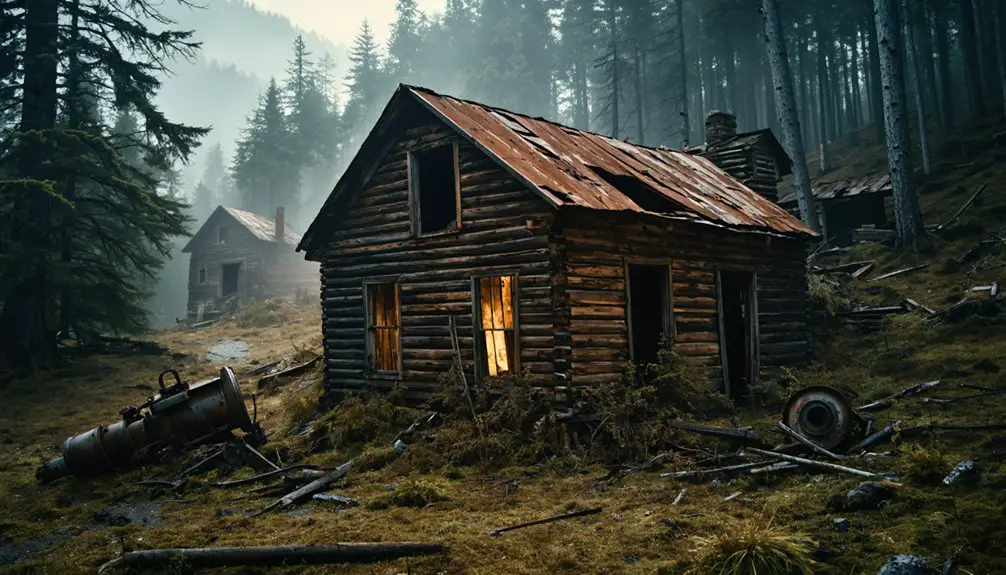
You’ll find traces of these lost communities at Vindex, Dodson, and Gleason, where cement foundations and collapsed coal tipples peek through dense vegetation. The most notable was Kempton, a model company town that flourished until 1950 with nearly 850 residents. The town was established in 1913 by coal operators seeking to create an ideal mining community.
Abandoned coal towns like Kempton still whisper their stories through crumbling foundations and overgrown tipples in Maryland’s forgotten landscapes.
Today, archaeology teams use LIDAR surveys to study Kempton’s buried house foundations, piecing together stories of daily life in these coal mining settlements. The towns thrived on Western Maryland Railways’ branch lines, supporting small-scale mining operations and timber harvesting. Workers in these communities could only use company scrip currency at local stores.
When the mines closed in the 1920s and 1930s, these communities rapidly declined, leaving only scattered ruins and oral histories preserved in local archives.
The Vanishing Mill Town of Daniels
You’ll find a poignant example of Maryland’s industrial decline in Daniels, where a once-thriving textile mill operated from 1810 until its sudden closure in 1968 forced nearly 90 families to abandon their homes.
Nature has steadily reclaimed the 500-acre property since Tropical Storm Agnes devastated the remaining structures in 1972, leaving stone ruins and decaying buildings as silent witnesses to the town’s past. The area was originally known as Ellisville in 1798. Today, adventurous visitors can explore the site by following old footpath trails that wind through the northern ruins.
The historic Saint Stanislaus Kostka Church still stands among the ruins, offering visitors a tangible connection to this former mill town’s vanished community.
Industrial Rise and Fall
Tucked along the Patapsco River, the industrial town of Daniels emerged from humble beginnings as Elysville in 1798 when the Ely family established their first cotton mill.
You’ll find the town’s industrial legacy reflected in its strategic relocation to harness the river’s stronger current and its expansion following the Baltimore and Ohio rail connection in 1831.
The town’s prosperity peaked under the Alberton name, boasting a vibrant community with stores, churches, and recreational facilities.
Four distinct housing areas known as Guilford, Calf Hollow, and both Lower and Upper Brick Rows formed the residential heart of the bustling mill town.
But this economic stability wouldn’t last. By 1929, the Great Depression slashed production to 25% of previous levels, forcing an auction. The mill specialized in producing denim and duck fabrics during its peak operating years.
Though CR Daniels Company’s 1940 purchase briefly revived operations, the mill’s 1968 closure marked the end.
When 279 residents received sudden evacuation orders, followed by Tropical Storm Agnes‘s destruction in 1972, Daniels’ industrial chapter closed forever.
Nature Reclaims Mill Ruins
Nature’s relentless reclamation of Daniels began shortly after Tropical Storm Agnes struck in 1972, washing away the last vestiges of this once-thriving mill town.
You’ll now find stone ruins and decaying wood structures completely overtaken by dense forest along rustic trails, where the Patapsco River flows freely past concrete dam remnants.
The James S. Gary family operated the successful textile mills and maintained the town from 1845 until 1940, when the Daniels Company acquired the property.
Originally known as Elysville in the early 1820s, the settlement grew rapidly as a cotton mill town.
If you venture down Alberton Road today, you’ll discover how nature’s reclamation transformed the landscape.
Low stone walls peek through vegetation, marking where row houses once stood. The mill remnants, including the historic 1833 building, lie scattered in rubble.
Graffiti artists have left their mark on surviving structures like the abandoned Pentecostal Holiness Church, while two centuries of history slowly sink into Maryland’s soil, guarded by “No Trespassing” signs.
Historic Church Still Stands
While most of Daniels’ buildings succumbed to abandonment after 1972’s Hurricane Agnes, three historic churches tell the story of this vanished mill town’s spiritual life.
You’ll find the stone ruins of the Pentecostal Holiness Church beside the old road, while across the river, Gary Memorial Church continues operating as the only surviving building from Daniels’ heyday.
The oldest structure, St. Stanislaus Kostka Catholic Church, met its fate in 1926 when lightning struck its church architecture, though its small graveyard remains with toppled headstones.
These religious landmarks, now protected within Patapsco Valley State Park, represent rare examples of historic preservation from Daniels’ past.
Unlike the valley’s demolished buildings, the churches’ strategic placement on higher ground helped them endure time’s passage.
Researchers exploring the town’s history face challenges, as vital records were lost when the community lacked a local government.
For clearer navigation to information about the historic churches, visitors can access disambiguation pages that list various Daniels-related articles.
Disappearing Settlements of the Chesapeake Bay
As the Chesapeake Bay‘s waters have risen over centuries, they’ve claimed numerous historic settlements along Maryland’s storied coastline.
You’ll find Holland Island‘s story particularly compelling – once home to 360 residents with a thriving community, it succumbed to coastal erosion until its last house collapsed after battling the waves since 1888.
Similar fates befell other Chesapeake settlements.
Port Tobacco Village dwindled from Maryland’s second-largest town to its smallest incorporated community.
Sinepuxent vanished beneath the waves, while St. Mary’s City, the colonial capital, exists now only as a historic site.
Even Mallows Bay tells a tale of abandonment, though its “Ghost Fleet” of WWI-era ships has created an unintended sanctuary, their wooden hulls now home to diverse marine life.
Forgotten Institutional Complexes
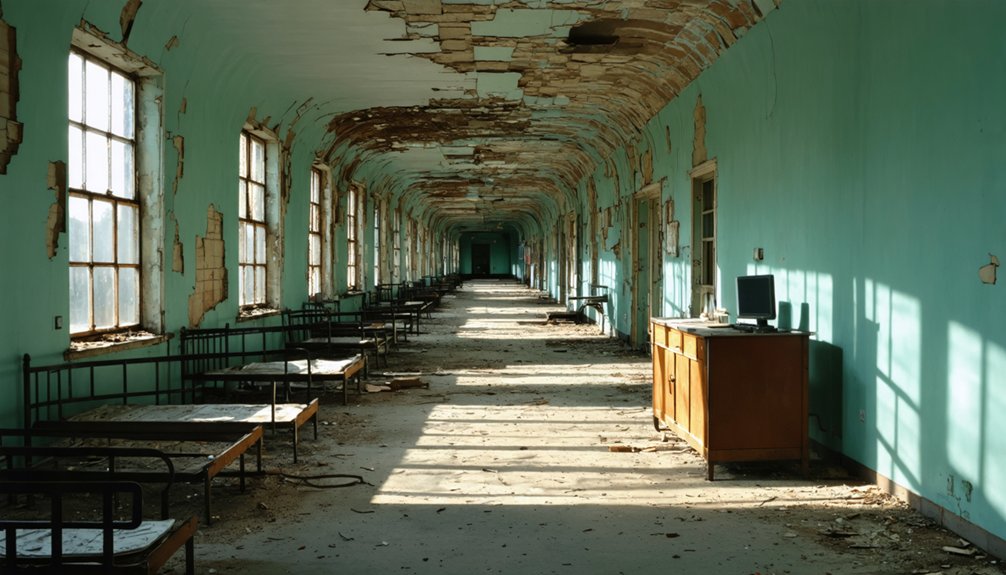
Throughout Maryland’s landscape, abandoned institutional complexes stand as haunting reminders of the state’s complex history in mental health and developmental care.
You’ll find Forest Haven’s decaying Curley Building, where institutional neglect led to unmarked graves and desperate conditions. At Crownsville, forgotten residents once built their own facilities and worked the land before severe overcrowding set in.
Springfield Hospital’s Colonial Revival buildings slowly deteriorate, while Rosewood’s dark history culminated in a suspicious fire and closure. The historic Spring Grove Hospital, America’s second-oldest psychiatric facility, has partially merged with university expansion.
These abandoned complexes tell stories of Maryland’s troubled past, where underfunding and poor conditions plagued facilities meant to care for society’s most vulnerable members.
Abandoned Military and Railway Sites
You’ll find Maryland’s most haunting military ruins at Fort Carroll, an artificial island fortress that’s slowly crumbling into the Patapsco River south of Baltimore.
The state’s Cold War history lives on in abandoned Nike missile sites scattered across the region, while Fort Ritchie’s vacant buildings in the western highlands tell the story of a once-bustling military community.
These forsaken posts, along with ghost towns like Relay that grew and died with the B&O Railroad, showcase Maryland’s rich military and industrial heritage.
Fort Ritchie’s Long Decline
While Fort Ritchie once served as an essential military intelligence hub during World War II, its prominence gradually faded in the decades that followed.
You’ll find that after training over 19,600 intelligence troops, including the renowned Ritchie Boys, the Military Intelligence Training Center was deactivated in 1945.
The site briefly returned to Maryland National Guard control before the Army repurchased it in 1948 to support the Raven Rock underground Pentagon facility.
Though it maintained relevance through communications testing and information systems engineering into the 1970s, Fort Ritchie’s military significance diminished.
By 1995, it landed on the Base Realignment and Closure list, with all federal operations ceasing in 1998.
Today, you can still explore the abandoned stone buildings while watching revival efforts transform this historic military site into a community space.
Railway Ghost Town Relay
As Maryland’s transportation needs evolved in the early 20th century, several prominent railway lines that once connected the state’s cities and towns now stand abandoned.
You’ll find railroad remnants scattered across the landscape, telling stories of bustling transit routes that shaped local communities before falling silent.
- The Chesapeake Beach Railway’s forgotten depots and bridge supports recall its heyday as a popular resort line from DC.
- WB&A’s electric interurban network, which drove suburban growth, left traces beneath modern streets.
- The Ma & Pa Railroad’s rural routes between Baltimore and York now serve as peaceful trails.
- Former stations and rights-of-way stand as silent sentinels, preserving memories of Maryland’s rail heritage.
Today, these abandoned corridors offer glimpses into an era when railways were lifelines connecting Maryland’s communities, before automobiles forever changed the transportation landscape.
Coastal Fortress Ruins Today
Throughout Maryland’s coastal areas, silent sentinels of military history dot the shoreline in the form of abandoned fortifications.
You’ll find Fort Carroll, a hexagonal sea fort on an artificial island, now reclaimed by nature and serving as a waterbird sanctuary.
Fort Armistead’s graffiti-covered tunnels and Fort Howard’s deteriorating structures offer glimpses into Baltimore’s coastal defenses, while Fort Smallwood continues as a recreational park amid its military ruins.
These coastal forts, along with the vanished War of 1812 Peninsula Forts – Look-Out, Babcock, and Covington – represent Maryland’s rich military heritage.
Where German POWs once stood and artillery once defended the harbor, you’ll now discover peaceful parks, fishing spots, and walking paths, though many structures remain abandoned, slowly surrendering to time and nature.
Declining Villages of Maryland’s Eastern Shore
Despite the Eastern Shore’s rich maritime heritage, numerous historic villages across Maryland’s coastal peninsula now stand abandoned or nearly deserted.
You’ll find these haunting remnants of the past scattered throughout Worcester, Somerset, and Queen Anne’s counties, each telling a story of economic decline and rural depopulation.
- Furnace Town’s iron works fell silent, though Sampson Harmon refused to leave until 1896, and now ghostly hauntings draw curious visitors.
- George Island Landing and Broad Creek showcase the fade of once-thriving fishing settlements.
- Marion Station and Tulls Corner reflect the broader agricultural decline that emptied Somerset County.
- Sinepuxent, now mostly submerged, leaves only the haunted Rackliffe Plantation as evidence of its existence.
These historical remnants serve as powerful reminders of the Eastern Shore’s changing fortunes and lost communities.
Frequently Asked Questions
Are There Any Guided Tours Available to Explore Maryland’s Ghost Towns?
You’ll find guided exploration options primarily through historical societies and local tour operators, though they’re not as common as ghost tours. Maryland’s ghost towns hold historical significance but lack regular scheduled visits.
As you wander through these desolate areas, you’ll witness nature’s reclamation of ghost towns, where vines snake through crumbling façades and wildlife reclaims what was once human territory. This transformation serves as a poignant reminder of the passage of time and the resilience of the environment, blending beauty with a hint of melancholy. For those willing to explore, these locations offer not only a glimpse into the past but also a canvas for nature’s artistry in overtaking civilization.
What Paranormal Activity Has Been Reported in Maryland’s Abandoned Towns?
Like shadows slipping through Forest Haven’s halls, you’ll hear tales of ghostly patients, unexplained footsteps at Glenn Dale Hospital, mysterious figures at Old Town Mall, and haunted houses throughout Maryland’s abandoned asylums.
Can I Legally Collect Artifacts From Maryland Ghost Town Sites?
You can’t legally collect artifacts without permits and landowner permission. Maryland’s legal regulations protect ghost town sites for artifact preservation, with violations risking fines and criminal charges.
Exploring ghost town real estate in Maryland can reveal fascinating histories and hidden treasures, but potential buyers should be aware of the tight regulations that govern these properties. Each abandoned site carries a story, often intertwined with local lore, making it essential for interested parties to conduct thorough research before purchasing. Additionally, proper channels must be navigated to ensure compliance with legal requirements, as the preservation of such locations is a priority for the state.
Which Maryland Ghost Towns Are Most Accessible by Public Transportation?
You’ll find Old Town Mall most accessible via Baltimore’s buses and rail, while Daniels and Relay offer easy public transit options. Check ghost town maps for bus routes to these sites.
How Many People Still Live in Maryland’s Semi-Abandoned Towns Today?
While thousands once roamed these streets, you’ll find population trends show only scattered residents remain – ZIP 21217 has 38,596 people and 21223 has 25,127 in these semi-abandoned town demographics.
References
- https://en.wikipedia.org/wiki/List_of_ghost_towns_in_Maryland
- https://kids.kiddle.co/List_of_ghost_towns_in_Maryland
- https://www.youtube.com/watch?v=Obb_sDHYm9A
- https://www.atlasobscura.com/things-to-do/maryland/abandoned
- https://www.tripadvisor.com/Attraction_Review-g41131-d10035193-Reviews-Daniels_Ghost_Town-Ellicott_City_Maryland.html
- https://www.geotab.com/ghost-towns/
- http://www.mountaindiscoveries.com/stories/fw2002/heritagetrail_plain.html
- https://www.frostburg.edu/news/2019/09/ghost-town.php
- https://wildful.wordpress.com/2018/05/16/35-coal-in-western-md-part-two-whatever-happened-to-the-coal-towns-guest-jim-rada/
- https://rsftripreporter.net/ghost-towns-of-the-upper-potomac/