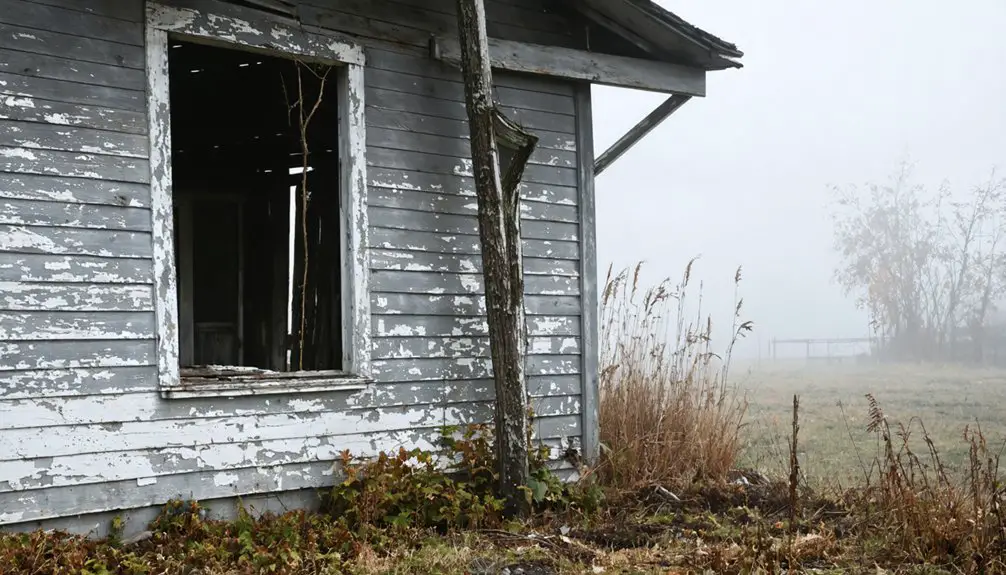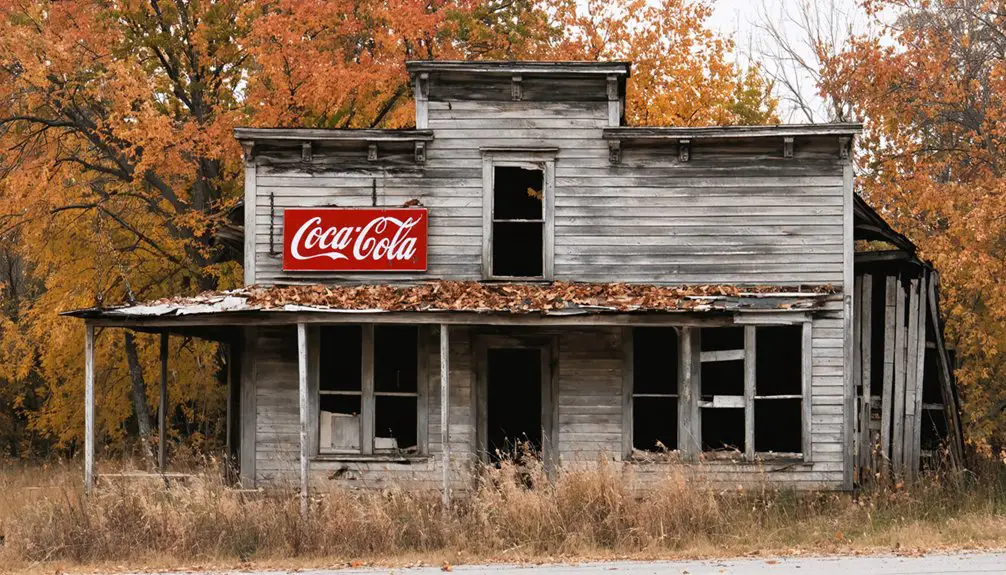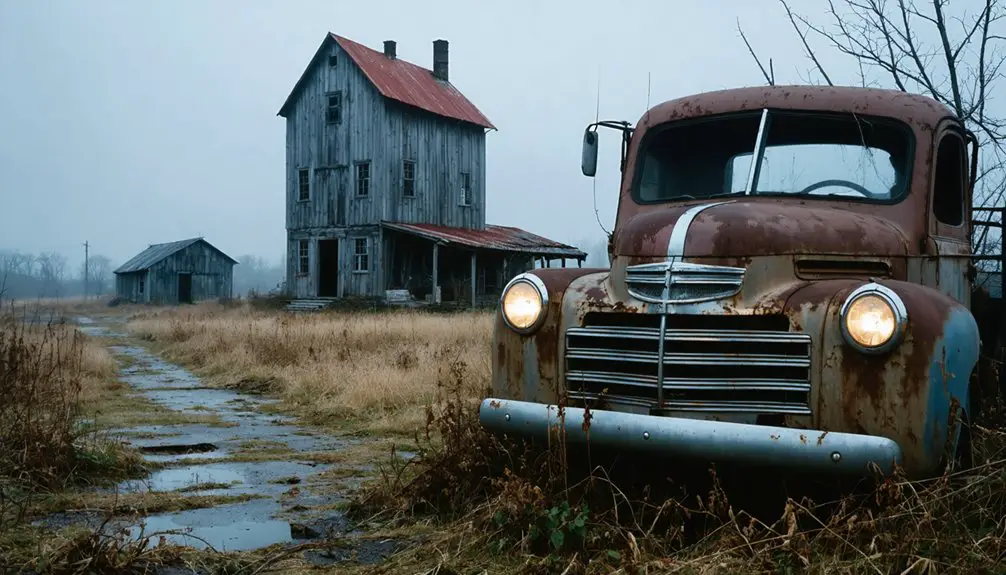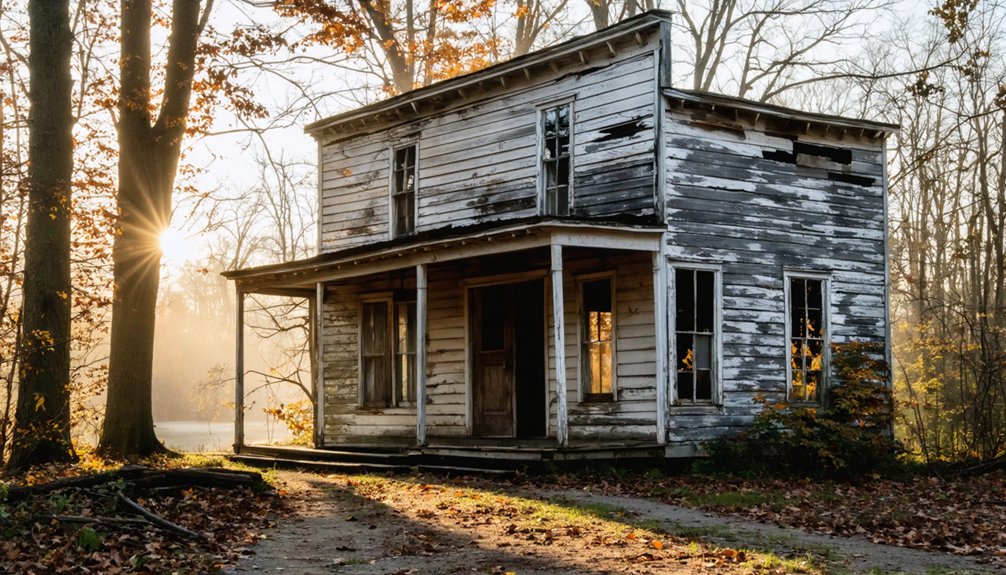
You’ll discover Michigan’s fascinating ghost towns scattered throughout the state, from the copper-rich Keweenaw Peninsula to the shores of Lake Michigan. The Central Mine, which produced 52 million pounds of copper between 1855-1898, now features 13 original houses and walking trails. Along the coast, Glen Haven and Port Oneida showcase preserved 19th-century buildings from the lumber era. These abandoned communities, with their Victorian architecture and industrial remnants, offer glimpses into Michigan’s booming past.
Key Takeaways
- Central Mine in Keweenaw Peninsula operated until 1898, leaving behind 13 original houses and a Methodist church across 38 acres.
- Port Oneida Rural Historic District spans 3,400 acres with 150 historic buildings from 22 abandoned farmsteads within Sleeping Bear Dunes.
- Fiborn was a limestone quarry town operating from 1904-1936, now preserved as Fiborn Karst Preserve with visible foundations.
- Glen Haven, originally Sleeping Bearville, transformed from a maritime hub to ghost town during the Depression before becoming historic site.
- Good Harbor Community’s remnants include scattered foundations throughout Leelanau County, representing Michigan’s lost lumber era settlements.
The Lost Mining Legacy of Keweenaw Peninsula
Deep within Michigan’s Upper Peninsula, the Keweenaw Peninsula holds one of America’s most significant mining legacies, shaped by vast deposits of native copper that drew prospectors and companies in the 1840s.
You’ll find evidence of indigenous practices dating back to 5000 BCE, where ancient peoples first extracted copper from shallow pits across the region.
For over 125 years, commercial copper mining transformed this wilderness into a bustling industrial center. The Central Mining Company became one of the area’s most successful operations, producing an impressive 83,836 pounds of copper in its first year alone. The first mineral boom began in 1843, drawing thousands of prospectors from eastern states.
You’re following in the footsteps of geological pioneers like Douglass Houghton, who triggered a mining rush by identifying rich deposits in the area’s flood basalts.
At its peak, the region’s mines supplied up to 95% of America’s copper needs, creating company towns and extensive infrastructure along the 100-mile mineral belt through Ontonagon, Houghton, and Keweenaw counties.
Exploring the Ruins of Central Mine
When you visit Central Mine today, you’ll find remnants of what was once a bustling copper mining town that produced over 52 million pounds of copper between 1855 and 1898.
You can explore the 38-acre historic site’s remaining structures, including 13 original houses and the distinctive Methodist Episcopal Church with its Cornish-style battlemented tower.
The Visitors Center, open during summer months, offers exhibits chronicling the mine’s prosperous years when the population exceeded 1,200 residents and the town boasted a post office, hotel, blacksmith, and one of the region’s first telephone services. The harsh climate presented significant challenges for residents, who endured an average of 270 inches of snowfall annually. Visitors can now walk two scenic trails that showcase house foundations and the historic schoolhouse site.
History and Peak Years
Five local investors established the Central Mining Company in November 1854 after discovering a promising copper fissure in an ancient Indian mining pit. Within the first year, miners extracted over 40 tons of pure mass copper, making it the fastest profitable venture on Michigan’s Keweenaw Peninsula.
This rich mining heritage sparked rapid growth, and by 1857, a bustling village of 1,200 residents emerged. The yellow wooden visitor center stands today as a testament to this once-thriving community.
The town’s demographics were shaped by British immigrant settlers, particularly those from Cornwall who brought their cultural traditions and work ethic to the region.
You’ll find that Central Mine’s community resilience shone through its peak years, boasting modern amenities like telephone service and telegraph, alongside essential businesses and social institutions. The three-story school and Methodist Episcopal Church, built in distinctive Cornish style, became focal points of town life.
Despite a tragic 1872 mining accident that claimed ten lives, the mine continued producing millions of pounds of copper annually until declining yields led to its closure in 1898.
Walking Tour Highlights
Modern visitors to Central Mine can explore its rich heritage through a well-designed network of walking trails and preserved structures.
You’ll find two scenic paths, opened in 2005, that wind through wooded areas for 1/4 and 1/2 mile lengths, revealing old house foundations and offering stunning valley views from the upper rock pile.
Your guided exploration begins at the Visitor Center, where you’ll discover exhibits on mine history, miners’ families, and local churches. Like the Delaware Mine, this location offers self-guided tours that let visitors explore at their own pace.
Don’t miss House 61’s period kitchen display or the peaceful Memorial Garden across from the center.
While the site’s accessible year-round, you’ll need a map to navigate around private residences.
The area once thrived during America’s first mining boom in 1844, showcasing the region’s remarkable copper mining heritage.
The Visitor Center operates from mid-June through early October, offering self-guided walking tour maps that highlight the site’s historical significance along the Keweenaw Heritage Trail.
Preserved Mining Buildings
Today’s visitors to Central Mine can explore over a dozen meticulously preserved structures spread across 38 acres managed by the Keweenaw County Historical Society since 1996.
You’ll find thirteen restored houses dotting the landscape, with House #8 available for weekly rentals to support ongoing preservation efforts. Many of these homes showcase the neat and modest dwellings typical of the town’s original Cornish miners.
The site’s crown jewel is the 1868 Methodist Episcopal Church, distinguished by its Cornish battlemented tower. This historic sanctuary continues to host the annual Central Reunion each July, maintaining a tradition that dates back to the early 1900s.
As you wander through the abandoned structures, the Visitor Center provides context through exhibits, audio displays, and videos that bring the mining heritage to life.
Walking trails connect you to various house remains and offer stunning views from the former schoolhouse site. During its peak in the mid-1880s, the Central School educated more than 350 students.
Historical Remnants of Fiborn’s Limestone Industry
If you visit Fiborn’s limestone quarry ruins today, you’ll find the preserved remnants of a once-bustling industrial operation that produced high-purity limestone for steelmaking between 1904 and 1936.
The quarry’s infrastructure included crushing facilities, rail lines, and a powerhouse, while the company town featured worker housing, a schoolhouse serving about 20 students, and essential services that supported the mining families.
When Algoma Steel relocated operations to Rogers City in 1936 to capitalize on cheaper maritime transport, both the industrial facilities and the village were swiftly abandoned, leaving behind the archaeological footprint you can explore at today’s Fiborn Karst Preserve.
Quarry Operations and Infrastructure
While exploring the remnants of Fiborn’s once-bustling limestone operation, you’ll find substantial concrete foundations and infrastructure that paint a picture of its industrial past.
At the quarry’s heart, you’ll spot the remains of a railroad house and ore-car loader that were essential to shipping the high-calcium limestone to Algoma Steel in Ontario. The quarry’s infrastructure included a power house and sorting bins, their concrete remnants still visible today.
Along Fiborn Quarry Road, you can trace the foundations of workers’ homes and a boarding house that burned down in 1936.
The quarry’s rail-dependent operations expanded in the late 1920s with new rail cars, though the site would soon face challenges from the Great Depression.
Daily Life Above Ground
Above the bustling quarry operations, Fiborn’s village life revolved around company-provided housing and essential community services that supported the miners and their families.
The village dynamics flourished during the late 1920s as new housing accommodated growing families, creating a tight-knit community centered on daily routines.
Key aspects of Fiborn’s above-ground life included:
- A schoolhouse educating about twenty students through seventh grade
- A crucial post office connecting residents to the outside world
- Company housing situated conveniently near work sites
- Supporting industries like lumber operations enhancing local economy
You’ll find this once-vibrant community didn’t survive the Great Depression, with most structures abandoned by 1936.
Today, only concrete remnants in the Fiborn Karst Preserve hint at the bustling village life that once defined this remote Upper Peninsula settlement.
Glen Haven: A Ghost Town’s Second Life

Before becoming one of Michigan’s most well-preserved historical sites, Glen Haven began as Sleeping Bearville in 1857 when C.C. McCarty established a sawmill and inn along Lake Michigan’s shore.
You’ll find Glen Haven’s history deeply rooted in the Great Lakes maritime trade, serving as an essential wooding station for steamships until D.H. Day transformed it into a thriving commercial hub.
Though the town fell into decline during the Great Depression, its story didn’t end there.
Today, the restored buildings transport you back to the 1920s, with the general store, blacksmith shop, and Sleeping Bear Inn standing as monuments to its heyday.
You can still spot the ruins of the original 1865 dock, with pilings visible in the water – a reminder of Glen Haven’s bustling past as a Lake Michigan port town.
Victorian Architecture of Laurium
Herearus
Hidden Towns of Sleeping Bear Dunes
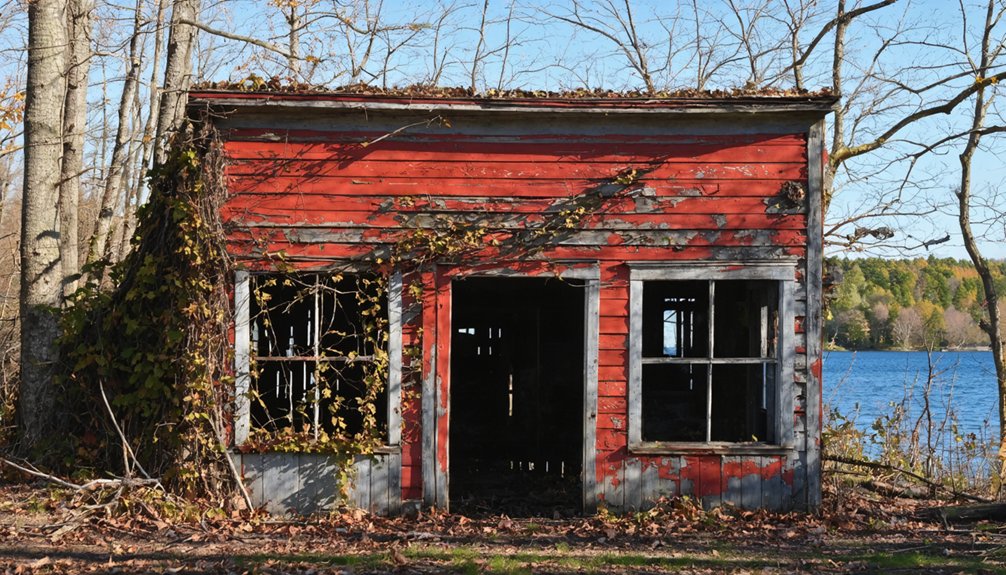
Along the pristine shores of Lake Michigan, within what’s now Sleeping Bear Dunes National Lakeshore, several ghost towns tell the story of Michigan’s lumber era.
As you venture deeper into the wilderness, you’ll come across abandoned towns in Michigan’s wilderness, where remnants of old structures stand as a testament to the past. Nature is gradually reclaiming these areas, intertwining the history of human settlement with the resilience of the forests. Each decaying building holds stories waiting to be uncovered, making them a fascinating destination for adventurers and history enthusiasts alike.
Hidden among Michigan’s majestic dunes, abandoned lumber towns whisper tales of a bygone era along Lake Michigan’s untamed shoreline.
You’ll find ghostly remnants of Aral’s steam-powered sawmill near Otter Creek, where a 90-foot dock once loaded lumber onto waiting ships.
Glen Haven, founded in 1857, served as a bustling refueling port before finding new life through National Park Service restoration.
The hidden history of Good Harbor Community lives on through scattered foundations and the still-active St. Paul’s Lutheran Church.
While many of these logging towns couldn’t survive economic changes, their stories persist in the landscape.
Of the approximately 3,800 ghost towns across America, Leelanau County’s lost villages offer glimpses into a vanished way of life.
Port Oneida: Michigan’s Largest Rural Ghost District
The vast Port Oneida Rural Historic District stands as Michigan’s most extensive ghost settlement, spanning 3,400 acres within Sleeping Bear Dunes National Lakeshore.
You’ll discover the rich agricultural heritage that began with the Burfiend family in 1852, transforming from a bustling lumber port into a close-knit farming community by the early 1900s.
- Thomas Kelderhouse’s 1862 dock turned Port Oneida into a thriving logging settlement.
- When forests depleted in the 1890s, residents adapted to farming despite sandy soil challenges.
- The original port was abandoned by 1908, but farming continued until after World War II.
- Today, you can explore 150 historic buildings across 22 farmsteads, including two schoolhouses and cemeteries.
This preserved landscape tells the story of European settlers who shaped the land through logging, agriculture, and determination.
North Manitou Island’s Forgotten Settlements
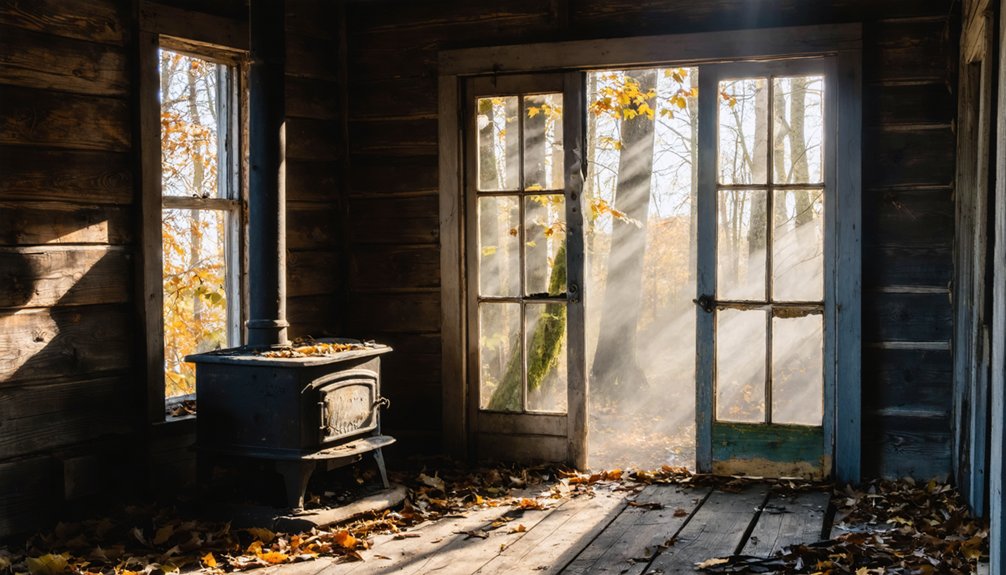
Nestled within Lake Michigan’s pristine waters, North Manitou Island harbors a rich tapestry of forgotten settlements spanning thousands of years.
You’ll find evidence of Native settlements dating back at least 3,000 years, where indigenous peoples established seasonal hunting grounds and participated in extensive trade networks reaching as far as Florida.
Preserving Michigan’s Abandoned Communities
Preserving Michigan’s abandoned communities requires a multi-faceted approach combining legal protections, sustainable funding, and hands-on conservation techniques.
You’ll find various community preservation options through the National Register of Historic Places and Michigan Historic Preservation Network, which provide essential frameworks for protecting these historic sites.
Here’s how you can support funding strategies for ghost town preservation:
- Apply for federal grants through Save America’s Treasures or Historic Preservation Fund
- Generate revenue through adaptive reuse projects like museums and guided tours
- Partner with preservation trades schools to reduce restoration costs
- Utilize conservation easements to protect properties without public ownership
You’re able to contribute to these preservation efforts through volunteer workdays, while technical assistance and matching funds from Michigan’s State Historic Preservation Office guarantee these abandoned communities remain protected for future generations.
Frequently Asked Questions
Are There Guided Ghost Tours Available at Any of These Abandoned Towns?
Ever wondered what lurks in Michigan’s ghost towns? You won’t find official guided ghost tours at these sites, but you can explore Central Mine’s self-guided walking tour or join ranger-led programs at Sleeping Bear Dunes.
For those interested in haunting tales and crumbling architecture, ghost towns available in Michigan offer a fascinating glimpse into the past. Each decaying building tells a story, making these sites perfect for adventurous explorers and history buffs alike. Be sure to pack your camera; you’ll want to capture the eerie beauty that these forgotten places exude.
As you explore haunted sites in Michigan, keep an eye out for the tales that accompany each location. Many visitors report strange sounds and unexplained phenomena, adding to the thrill of discovery. The rich history intertwined with these eerie settings creates an unforgettable experience for those brave enough to venture there.
Can Visitors Legally Collect Artifacts or Souvenirs From These Ghost Towns?
You can’t legally collect artifacts from ghost towns without permits, as state and federal regulations protect these sites. To preserve history, take photos instead of physical souvenirs from these protected locations.
What Safety Precautions Should Visitors Take When Exploring These Abandoned Sites?
Sharp as a tack, you’ll need proper safety gear including boots, gloves, and respirators. Stay wildlife-aware, bring a first-aid kit, avoid unstable structures, and always explore with a buddy.
Are Any of These Ghost Towns Reportedly Haunted or Paranormally Active?
You’ll find significant haunted history at Pere Cheney’s cemetery, Calumet Theatre’s ghost actress, and throughout the Keweenaw Peninsula’s mines, where frequent paranormal sightings include apparitions, mysterious lights, and unexplained voices.
Which Ghost Towns Are Accessible During Winter Months and What Transportation Required?
You’ll need a standard vehicle to reach all four ghost towns in winter. Fayette and Clifton offer the easiest winter access, while Central Mine’s heavy snowfall and Baltic’s private boundaries require extra caution.
References
- https://www.awesomemitten.com/ghost-towns-in-michigan/
- https://www.youtube.com/watch?v=7-vjuqiGWJU
- https://www.nps.gov/slbe/learn/historyculture/ghosttowns.htm
- https://www.visitkeweenaw.com/things-to-do/museums-history/ghost-towns/
- https://99wfmk.com/michigan-ghost-town-gallery/
- https://www.keweenawhistory.org/Central-Mining-Co
- https://www.visitkeweenaw.com/things-to-do/museums-history/copper-mine-tours/
- https://www.nps.gov/kewe/learn/historyculture/copper-mining-timeline.htm
- https://en.wikipedia.org/wiki/Copper_mining_in_Michigan
- https://npshistory.com/publications/kewe/hrs.pdf