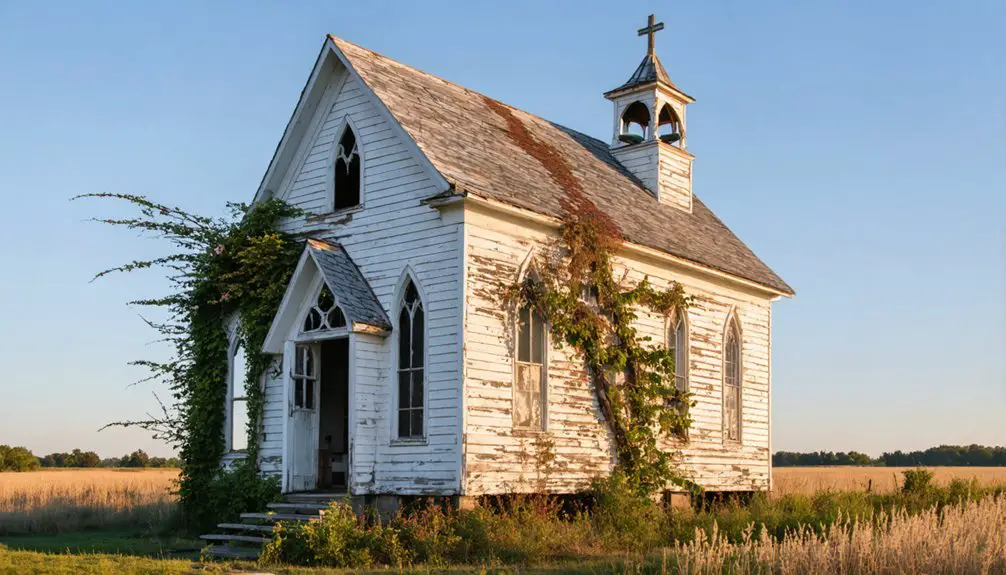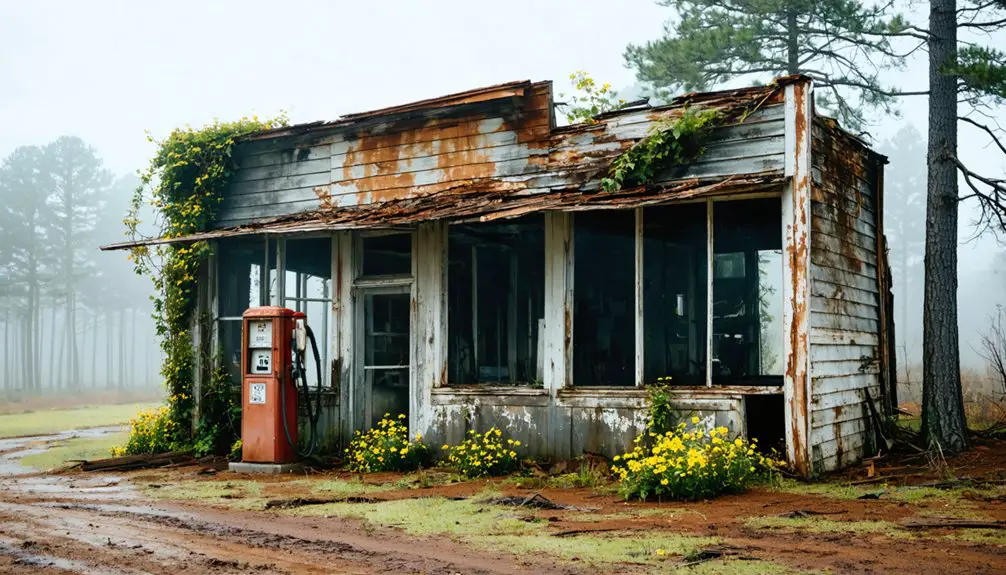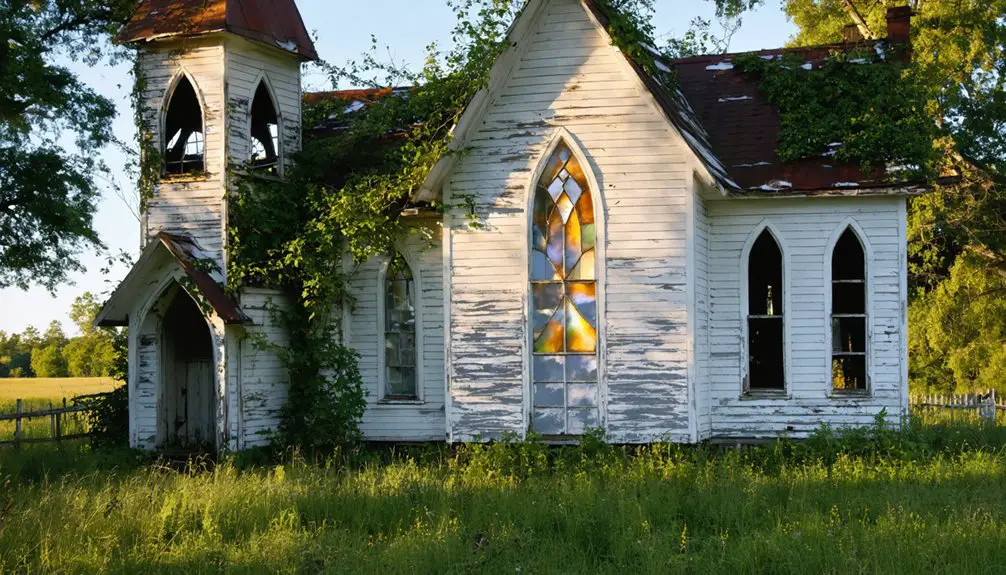
You’ll find Mississippi’s ghost towns scattered along former river trade routes and industrial sites, telling stories of Civil War devastation and economic decline. Once-bustling ports like Rodney and Natchez saw their fortunes rise with steamboat commerce, only to fade as railroads diverted trade. Places like Electric Mills showcase the state’s industrial heritage, while sites like Rocky Springs’ Methodist Church ruins and Rodney Cemetery reveal layers of fascinating historical detail waiting to be discovered.
Key Takeaways
- Rodney, a once-thriving Mississippi river port town, declined after Civil War raids and fires, now featuring only its historic Presbyterian Church.
- Rocky Springs deteriorated following the 1878 yellow fever epidemic, leaving only its 1837 Methodist Church ruins and cemetery.
- Electric Mills flourished as a lumber town before the Great Depression caused its abandonment, highlighting Mississippi’s industrial past.
- Bankston was destroyed by Union soldiers during the Civil War, with its textile industry heritage now marked by scattered remains.
- Westonia completely disappeared when NASA acquired the land, exemplifying how modern development can erase historic settlements.
The Rise and Fall of Mississippi’s River Port Towns
When steamboats revolutionized river transportation in the early 1800s, Mississippi’s port towns exploded with commerce and opportunity.
You’d have witnessed places like Natchez transform into bustling centers of river trade, with grand antebellum mansions like Longwood and Magnolia Hall showcasing the wealth generated from cotton commerce.
The urban migration was staggering – Mississippi’s white population soared from just 5,179 in 1800 to over 353,901 by 1860.
Towns like Vicksburg grew from modest European settlements into thriving commercial hubs.
Many settlers established port towns near Baton Rouge, which was founded by explorer Pierre Le Moyne in 1699.
The Siege of Vicksburg proved a devastating turning point for many river communities during the Civil War.
But the glory days wouldn’t last. As railroads gained prominence after the Civil War, they diverted grain transport from the waterways.
You’ll find that many once-prosperous river ports shifted to local commerce only, their grand dreams of perpetual growth fading as rail lines bypassed the Mississippi’s banks.
Historic Civil War Era Ghost Towns
The Civil War left an indelible mark on Mississippi’s landscape through a collection of haunting ghost towns that bore witness to the conflict’s devastation.
You’ll find Bankston’s remains in Choctaw County, where Union soldiers torched Confederate supply factories under cover of darkness.
In Rodney, the Presbyterian Church still stands as a monument to fierce river battles, complete with a replica cannonball above its doors. The town’s decline accelerated when the Mississippi River changed course, devastating its once-prosperous economy.
While Brewton and Gainesville declined primarily due to economic shifts, they’re now among Mississippi’s documented ghost towns. The old Bolers Inn served as a field hospital during the conflict, treating wounded soldiers from both sides.
The most dramatic Civil War impact occurred in places like Bruinsburg and Rodney, where strategic river positions drew intense military action.
Today, these abandoned settlements offer silent evidence through their cemeteries, church ruins, and courthouse remnants.
Industrial Boom and Bust Communities
Mississippi’s industrial ghost towns paint a compelling portrait of America’s boom-and-bust economic cycles.
You’ll find the lumber legacy etched across places like Electric Mills, which boasted the first fully electric sawmill east of the Mississippi, providing free lighting to its 2,500 residents.
Logtown and Westonia thrived as major logging centers until the Great Depression triggered their decline.
The industrial decline wasn’t limited to lumber towns.
Bankston pioneered the region’s textile industry with its mechanically powered mill, while Moselle built its economy around surface iron mining.
These communities once bustled with hotels, theaters, stores, and schools.
The town’s amenities rivaled larger cities, featuring two hotels, a hospital, movie theater, and various shops.
Like the once-prosperous town of Rodney, which saw its population reach nearly 1,000 residents during its peak as a bustling port in the 1850s, these communities eventually faded away.
But when resources depleted or economic shifts occurred, they couldn’t survive.
Today, these abandoned towns serve as silent reminders of Mississippi’s industrial heritage.
Cemetery Sites and Abandoned Buildings
Haunting remnants of forgotten communities exist within Mississippi’s ghost town cemeteries and abandoned structures.
As interest in the unique appeal of these places grows, many are curious about prices for ghost towns in Mississippi. The allure of owning a piece of history captivates both investors and adventurers alike. Exploring the possibility of revitalizing these towns can offer not only financial opportunities but also a chance to preserve their intriguing stories.
Many aspiring entrepreneurs see the potential in ghost towns in Mississippi as they consider innovative ways to attract tourism. The challenge lies in balancing restoration efforts with the need to maintain the character and history of these once-vibrant communities. Local governments may also play a key role in providing incentives and support to breathe new life into these forgotten places.
Rodney Cemetery’s weathered grave markers dating to 1828 perched above a steep dirt path, while nearby, a silver-domed Baptist Church succumbs to nature’s reclamation. The Presbyterian Church’s bell tower stands more resilient, overlooking the town’s muddy remains.
Along the Natchez Trace Parkway, Rocky Springs tells its own tale of decline through its 1837 Methodist Church ruins and scattered plantation remnants. The devastating yellow fever epidemic in 1878 marked the beginning of the town’s downfall.
Town preservation efforts occasionally spark hope, as seen in Rodney’s 2019 cemetery cleanup that drew 65 volunteers. Yet most sites face abandonment’s slow march – from Logtown’s bulldozed remains to Old Greenville’s solitary cemetery, these grounds silently chronicle Mississippi’s vanished communities. The Department of Archives and History requires site visits before certifying these historic burial grounds.
Notable Lost Towns of Mississippi’s Past
Scattered across rolling hills and forgotten backroads, five once-thriving communities paint a portrait of Mississippi’s lost settlements.
You’ll discover Rodney’s history marked by devastating fires and Civil War raids, while Rocky Springs’ legacy endures only through its haunting cemetery. These towns fell victim to changing times and circumstances, leaving behind remnants of their former glory.
Time swept away these Mississippi towns, leaving only whispers of their glory in abandoned streets and weathered gravestones.
- Rodney transformed from a bustling port to a ghost town when an 1870 sandbar redirected the Mississippi River. The town nearly became Mississippi’s state capital, missing the designation by only three votes. The town’s devastating yellow fever epidemic of 1843 had already caused severe depopulation, with every doctor falling ill and businesses shuttering.
- Rocky Springs succumbed to Union destruction during the Civil War.
- Friars Point’s Minie Ball House stands as evidence to Civil War naval attacks.
- Westonia vanished from its 3,000-person peak after NASA’s development claimed the land.
These settlements remind us how quickly fortunes can change in the face of progress and conflict.
Frequently Asked Questions
Are There Any Laws Against Exploring or Photographing Mississippi Ghost Towns?
Peaceful public paths you’ll find – you can explore and photograph abandoned towns on public land. For private property, you’ll need owner permission. Specific exploration regulations vary by municipality and site location.
What Wildlife Hazards Should Visitors Watch for When Visiting Abandoned Towns?
You’ll need to watch for venomous snakes, especially rattlesnakes and water moccasins, plus aggressive wild hogs. For wildlife safety, wear closed shoes, long pants, and avoid exploring during flood seasons.
How Can Someone Locate Exact Coordinates of Lesser-Known Ghost Towns?
You’ll pinpoint ghost town coordinates by overlaying historical maps onto modern GPS systems, cross-referencing old plat records, and using GIS software to georeference landmarks against current satellite imagery.
Do Any Ghost Towns Host Organized Historical Tours or Scheduled Events?
Though these towns once bustled with life, you’ll find guided tours highlighting their historical significance at Rodney and Rocky Springs through Jackson Ghost Tours, plus special seasonal events at McRaven House.
Which Ghost Towns Are Located on Private Property Requiring Special Permission?
You’ll need special access for Rodney, Mt. Holly, Brewton, and Plymouth – all strictly private property. Don’t explore these historic sites without first obtaining landowner permission for entry.
References
- https://en.wikipedia.org/wiki/List_of_ghost_towns_in_Mississippi
- https://www.onlyinyourstate.com/experiences/mississippi/ms-ghost-towns
- https://mississippifolklife.org/articles/haunted-by-a-ghost-town-the-lure-of-rodney-mississippi
- https://kids.kiddle.co/List_of_ghost_towns_in_Mississippi
- https://www.geotab.com/ghost-towns/
- https://www.tripadvisor.com/Attraction_Review-g28945-d10045204-Reviews-Rodney_Ghost_Town-Mississippi.html
- https://abandonedatlas.com/states/mississippi/
- https://www.americancruiselines.com/why-american/blog/2025/april/mississippi-river-history-through-the-ages
- https://www.rivercruiseyourway.com/rivers/rivers-of-north-america/mississippi-river/mississippi-river-ports/
- http://www.iowapbs.org/iowapathways/mypath/2465/iowas-mississippi-river-towns