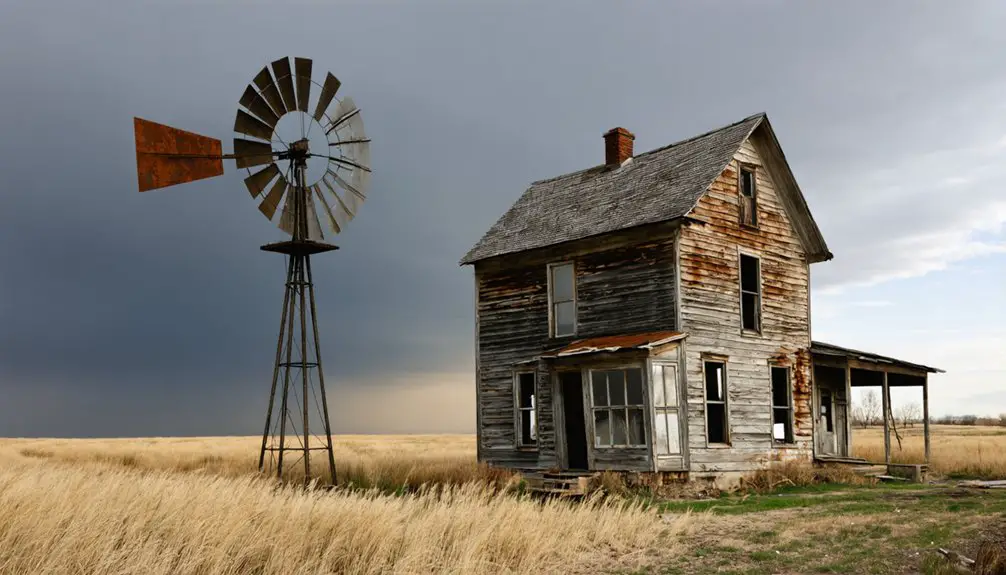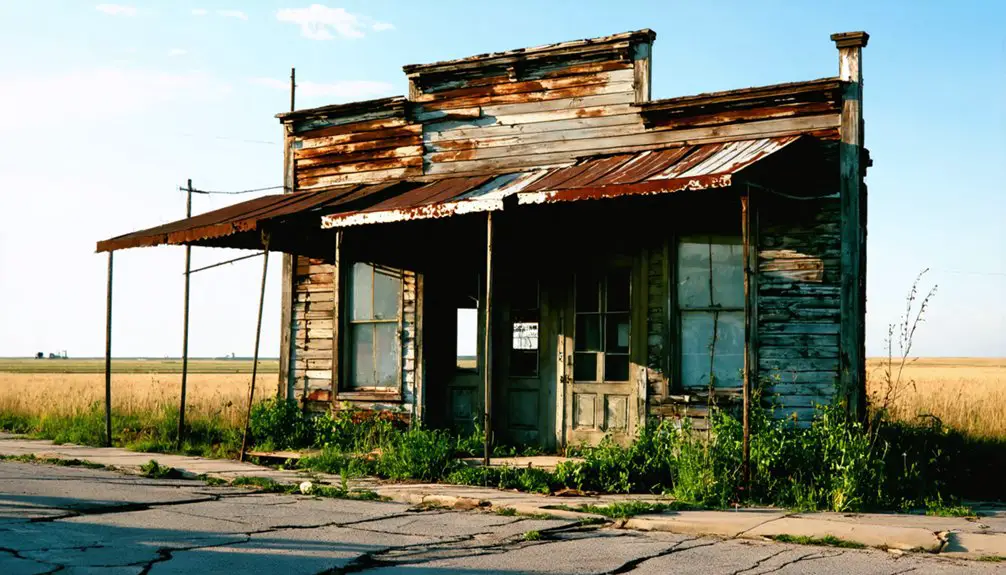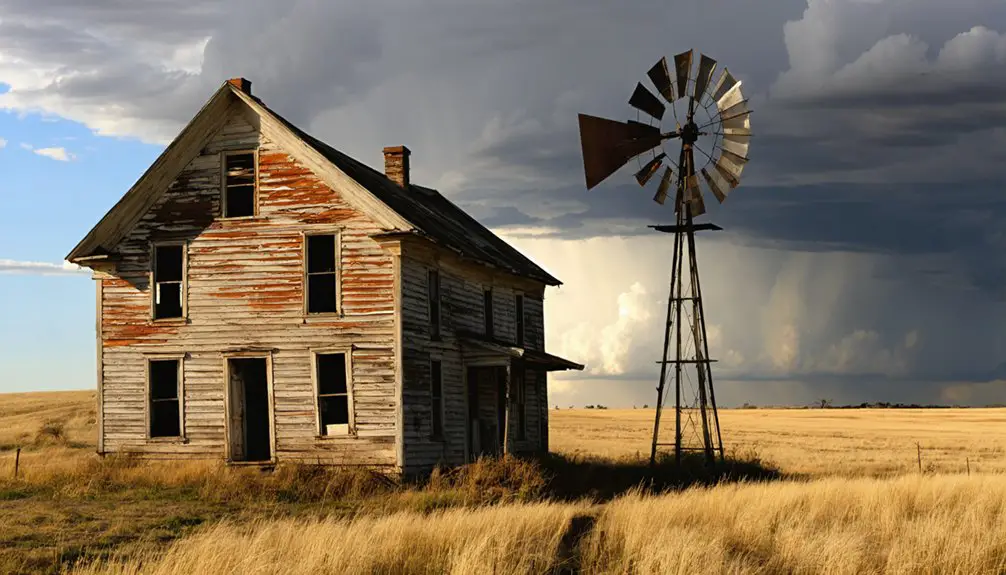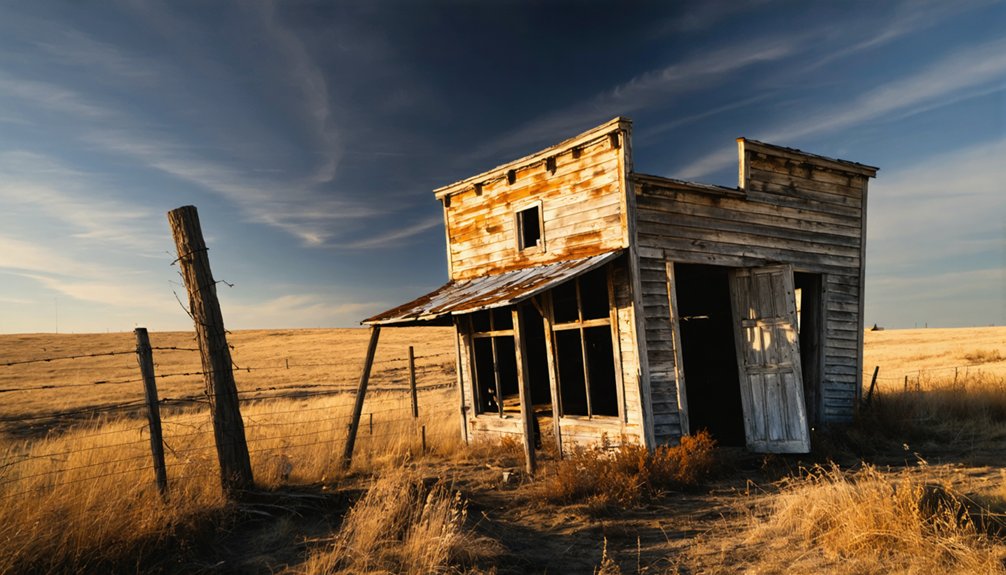
You’ll find Nebraska’s ghost towns scattered across prairies and riverbanks, with many emerging during the 1870-1890 railroad boom. These abandoned settlements tell stories of economic shifts, environmental challenges, and changing transportation patterns. Railroad towns like Steele City retain commercial buildings, while river settlements such as Brownville and St. Deroin faced flooding and shifting watercourses. From grain elevators to abandoned roadbeds, these silent monuments hold fascinating tales of Nebraska’s pioneering past.
Key Takeaways
- Nebraska’s ghost towns primarily emerged during the 1870-1890 railroad expansion, with many communities forming around railroad depots and transportation hubs.
- Steele City stands as a preserved example with surviving commercial buildings, while Dobytown remains are harder to locate.
- The Dust Bowl of the 1930s caused widespread abandonment of farming communities, leading to numerous ghost towns across Nebraska.
- Historic river settlements like Brownville, once bustling with 15 steamers, declined due to flooding, channel migration, and transportation changes.
- Grain elevators throughout Nebraska mark former railroad ghost towns, serving as monuments to the state’s agricultural and transportation history.
The Rise and Fall of Nebraska’s Lost Communities
While Nebraska’s ghost towns may appear as mere remnants today, their rise and fall tells a complex story of economic, social, and technological forces that shaped the state’s settlement patterns.
Historic maps reveal the locations of these long-lost communities that once dotted the landscape.
You’ll find their historical significance tied closely to the railroad expansion of 1870-1890, when new communities sprouted rapidly around depots and grain elevators.
Community resilience was tested as these towns faced multiple challenges. Railroad branch closures stripped crucial economic lifelines, while the agricultural boom-bust cycle, particularly during the 1930s Dust Bowl era, triggered widespread abandonment.
Waves of hardship struck Nebraska’s small towns as railroads vanished and farming fortunes crumbled during the harsh 1930s Dust Bowl.
The fragile Sandhills soil proved unsuitable for farming, forcing many to consolidate into ranches. Early settlers resorted to building sod houses due to the scarcity of trees and other building materials. As highways redirected traffic and younger generations migrated outward, aging populations couldn’t sustain local businesses.
These forces transformed once-thriving communities into the silent landmarks you see today.
Mapping Nebraska’s Ghost Town Legacy
Because documenting Nebraska’s ghost towns requires extensive research across multiple data sources, modern mapping efforts combine historic archives, geospatial technology, and field verification methods.
You’ll find the State Historical Society’s archives particularly valuable, offering historic maps and aerial photographs that reveal landscape traces of forgotten settlements.
To create accurate ghost town mapping, you’ll need to analyze different settlement types: railroad-dependent towns with their distinctive grain elevators, riverine settlements near historic fords, and resource-extraction sites near military installations. The Dust Bowl era contributed significantly to the abandonment of many farming communities in the region.
Using historical overlays in GIS software, you can align 19th-century railroad maps with current imagery to pinpoint precise coordinates. Many towns like Antioch’s potash industry experienced rapid decline after World War I, leaving only scattered ruins to document their existence.
Each site requires detailed metadata, including dates of establishment and abandonment, decline factors, and physical evidence tags that document remaining structures or foundations.
Railroad Towns: From Boom to Bust
You’ll find Nebraska’s landscape dotted with the silent remains of once-bustling railroad towns, where grain elevators still tower above abandoned streets as stark monuments to their former significance.
These settlements, many platted by land companies between 1870-1890, flourished briefly as essential transportation hubs until changing economics and new highways diminished rail traffic. Today, towns like Belvidere retain just fifty residents from their previous population of 500.
The story of towns like Factoryville and Belmont, which rose and fell with railroad fortunes, illustrates how rail transport shaped Nebraska’s settlement patterns before agricultural decline and reduced rail service triggered their abandonment by the 1930s. At Belmont, the tunnel carved through rock served as the town’s lifeline until railroad rerouting led to its eventual demise.
Railroad Impact and Decline
Although Nebraska’s ghost towns have many origins, railroad expansion between 1870-1890 created the most dramatic boom-and-bust cycle in the state’s settlement history.
You’ll find that railroad companies strategically platted towns along proposed lines, shaping town identity through names of railroad officials and investors. The Wabash Depot in Shenandoah represents one of the rare success stories of preservation and adaptive reuse. The devastating economic crisis of 1857 led to numerous railroad bankruptcies that destroyed many promising settlements.
Consider these key factors that influenced Nebraska’s railroad towns:
- Rail junctions and water stops determined town locations, with commercial districts growing around depots
- Agricultural exports and railroad employment created temporary economic booms
- Branch-line abandonment and routing changes triggered rapid population decline
- Infrastructure decay and service consolidation erased many towns’ logistical foundations
Today, you can still spot traces of these forgotten communities through angled grain elevators, graded streets, and abandoned roadbeds that mirror original track alignments.
Grain Elevators Stand Empty
Towering concrete sentinels mark Nebraska’s railroad ghost towns, where abandoned grain elevators stand as stark monuments to economic decline.
You’ll find these architectural giants dotting the landscape, their weathered frames telling stories of Nebraska’s rich agricultural history. Missing siding, rusted bins, and broken windows reveal decades of neglect since their last use.
These elevators once served as essential economic hubs, but when railroads disappeared, so did their viability. The early morning light casts long shadows across the forgotten railway tracks that once brought life to these structures.
Some innovative entrepreneurs have found ways to breathe new life into these structures, transforming them into art galleries and cafés.
You can still trace the old rail lines through remaining spurs and track beds beside these structures. While some elevators have found new life as community spaces or breweries, most continue their slow decay.
Their empty concrete foundations and silo rings remain as permanent reminders of when these prairie towns thrived through grain commerce.
River Settlement Mysteries and Relocations
When Nebraska’s earliest settlers established towns along major waterways like the Missouri, Platte, and Loup rivers in the 1850s and 1860s, they couldn’t have predicted how dramatically these river settlements would transform over time.
You’ll find that river settlements faced intense challenges to community resilience, with many vanishing completely.
Nature and economics conspired against these towns in several ways:
- Channel migration and flooding destroyed infrastructure and valuable riverfront lots
- Depletion of essential timber resources left communities without building materials
- Railroad construction often bypassed river towns, isolating them economically
- Minority communities, like DeWitty along the North Loup River, struggled against both environmental and social pressures
Today, these abandoned townsites tell complex stories of displacement, adaptation, and the harsh realities of frontier settlement patterns.
Notable Ghost Towns Worth Exploring
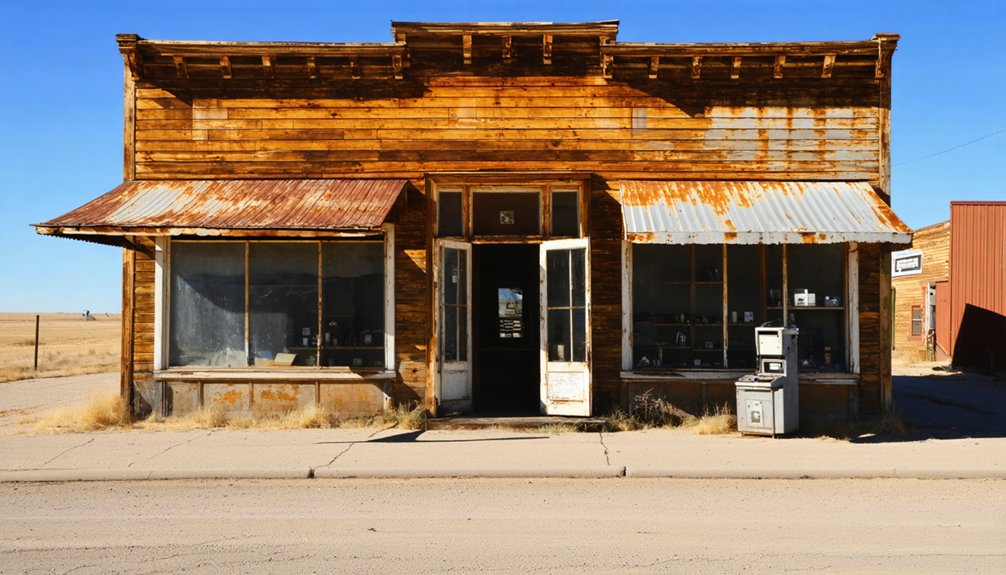
When you explore Nebraska’s ghost towns, you’ll find two distinct categories of abandoned settlements that tell the story of the state’s development: railroad boom towns like Steele City and Pauline with their surviving commercial buildings and depot sites, and early river settlements like Dobytown that served critical ferry crossings.
In addition to these fascinating sites, there are numerous ghost towns available in Nebraska that showcase unique histories and architectural remnants. Visiting these locations offers a glimpse into the lives of those who once called them home, revealing how industrial and economic shifts shaped the region. Each ghost town presents its own story, waiting to be uncovered by adventurous explorers.
While railroad towns often retain visible street patterns and foundations aligned with historic rail corridors, river settlement remnants typically require more detective work to locate due to floods and changing river courses.
These abandoned sites offer tangible evidence of Nebraska’s transportation history, from the grain elevators that mark former rail stops to the subtle landscape signatures that reveal where riverside communities once thrived.
Historic Railroad Settlements
Throughout Nebraska’s railroad era, numerous settlements emerged along strategic rail lines, creating bustling communities that would later become fascinating ghost towns.
These historic railroad settlements showcase unique railroad architecture and community dynamics that shaped Nebraska’s development.
You’ll discover these remarkable remnants of the past:
- Belmont’s iconic rock tunnel, which once served passing trains with saloons and boarding houses
- Factoryville’s flour mill economy, which thrived until losing crucial rail connections
- Steele City’s preserved historical buildings, strategically positioned near the Kansas border
- Belvidere and Roscoe’s main streets, where abandoned structures stand as evidence to the railroad’s influence
Each settlement tells a distinct story of prosperity and decline, shaped by the railroad’s presence and eventual rerouting, leaving behind silent witnesses to Nebraska’s transportation evolution.
River Town Remnants
Moving beyond railroad settlements, Nebraska’s river systems fostered their own collection of vanished communities, each with compelling stories of rise and fall.
You’ll find Brownville’s past glory in its decaying houses and abandoned wharf, where once 15 steamers conducted bustling river trade.
Oreapolis’s ambitious dreams crumbled despite its 8,000-square-foot seminary, while St. Deroin succumbed to relentless flood impact and shifting river courses.
Saratoga’s hopes of rivaling Omaha ended beneath rising waters, leaving only memories of its Sulphur Springs dock.
In Nemaha, you can trace the convergence of three towns – St. George, Sheridan, and Calvert – each marking different chapters of river settlement history.
These ghost towns reveal how the Missouri River both created and destroyed riverside communities.
Traces of the Past: Physical Remains
Time-weathered remnants of Nebraska’s ghost towns paint a detailed portrait of frontier ambition and eventual decline.
You’ll find architectural remnants of historical significance scattered across the landscape, from abandoned railroad infrastructure to preserved business structures.
- Railroad rights-of-way and graded streets from the 1870-1890 expansion remain visible from above, with isolated grain elevators marking former rail routes.
- Brick structures have withstood time better than wooden ones, with some business buildings like boarded-up general stores still maintaining structural integrity.
- Steam-era water towers and stone railroad tunnels stand as silent sentinels of past transportation hubs.
- Natural reclamation has transformed some sites, with only foundation stones and mineral deposits marking failed settlements in places like Mars farmland.
Why Towns Disappeared: Economic and Social Factors

Behind each abandoned Nebraska town lies a complex web of economic and social forces that sealed its fate.
You’ll find that agricultural shifts dealt the first blow – from the 1930s Dust Bowl through the 1980s farm crisis, foreclosures and mechanization hollowed out rural communities. When single employers like mills or packing plants shut down, they took the town’s economic heart with them.
Transportation changes accelerated the decline. As railroads vanished and highways bypassed small towns, residents found themselves cut off from essential commerce.
You’ll notice how improved roads actually worked against small towns – letting people easily drive to larger centers for shopping and services.
Meanwhile, social changes struck hard: young people moved to cities, schools consolidated, and aging populations couldn’t sustain local businesses.
These economic and social pressures created a downward spiral that many towns couldn’t escape.
Preserving Nebraska’s Forgotten Places
While preserving Nebraska’s ghost towns presents unique challenges, several methodologies help locate and document these vanishing sites. Through community engagement and strategic preservation strategies, you’ll find various tools being utilized to protect these historic locations.
One such method involves conducting guided tours of the ghost towns in Nebraska, allowing visitors to experience their rich histories firsthand. Additionally, collaborative projects with local historians can uncover untold stories that breathe new life into these forgotten places. As efforts to document and preserve the ghost towns in Nebraska grow, they serve as a reminder of the state’s vibrant past and the importance of maintaining its heritage.
- Historic maps and aerial photographs reveal hidden foundations and forgotten roadbeds, while county histories and oral accounts provide significant context.
- The state’s preservation plan promotes conservation amid rural decline, with $1.53 billion spent on building rehabilitation between 2001-2005.
- Local historic districts and architectural review boards protect neighborhoods while encouraging tourism and business development.
- You’ll find success stories like relocated schoolhouses and railway-to-trail conversions, though emerging ghost towns often struggle to qualify for preservation grants.
These preservation efforts help maintain Nebraska’s cultural heritage despite ongoing challenges from population decline and aging infrastructure.
Frequently Asked Questions
Are There Any Dangerous or Hazardous Conditions When Visiting Ghost Towns?
You’ll encounter major safety risks including collapsing structures, contaminated water, unstable terrain, and hidden hazards. Take essential safety precautions like avoiding deteriorating buildings and bringing emergency supplies.
Can Visitors Legally Collect Artifacts From Nebraska Ghost Town Sites?
Like footprints in shifting sand, you can’t legally collect artifacts without explicit permission. Legal regulations protect ghost town sites, and artifact preservation laws restrict removal on both public and private land.
What Wildlife Commonly Inhabits Abandoned Nebraska Ghost Towns Today?
You’ll spot ghost town fauna like feral cats, rodents, and songbirds thriving in abandoned buildings, while prairie rattlesnakes, insects, and small mammals claim old foundations, sheds, and overgrown vegetation.
Which Ghost Towns Are Located on Private Property Versus Public Land?
You’ll find most ghost towns on private property with restricted access, though Fort Kearny and Spring Ranch offer public accessibility. Always check ownership and get permission before exploring abandoned sites.
Do Any Nebraska Ghost Towns Have Reported Paranormal or Supernatural Activity?
You’ll find documented paranormal investigations at St. Deroin’s vanishing man, Spring Ranch’s haunted cemetery, and Bailey House’s ghostly piano music – all notable haunted locations with unexplained supernatural occurrences.
References
- https://negenweb.us/knox/stories/ghosttowns.htm
- https://history.nebraska.gov/wp-content/uploads/2017/12/doc_publications_NH1937GhostTowns.pdf
- https://www.ghosttowns.com/states/ne/ne.html
- https://www.onlyinyourstate.com/trip-ideas/nebraska/ne-ghost-towns-road-trip
- https://history.nebraska.gov/finding-nebraskas-ghost-towns/
- https://freepages.rootsweb.com/~gtusa/history/usa/ne.htm
- https://visitnebraska.com/trip-idea/explore-7-authentic-ghost-towns-nebraska
- https://www.legendsofamerica.com/grant-county-nebraska/
- https://dawsonpower.com/2020/10/ghost-towns-a-look-at-our-past/
- https://durhammuseum.org/1878-map-of-douglas-sarpy-counties-neb/