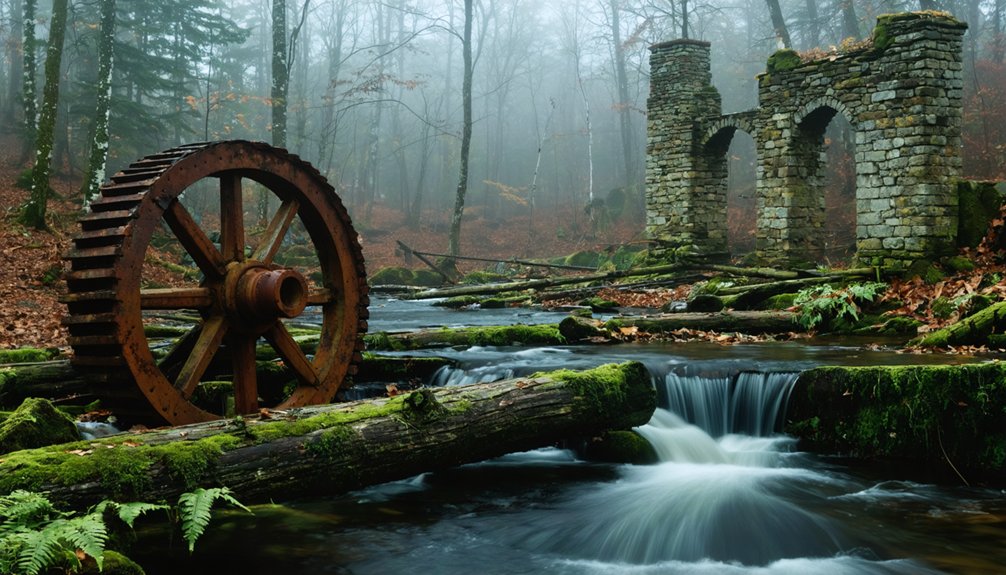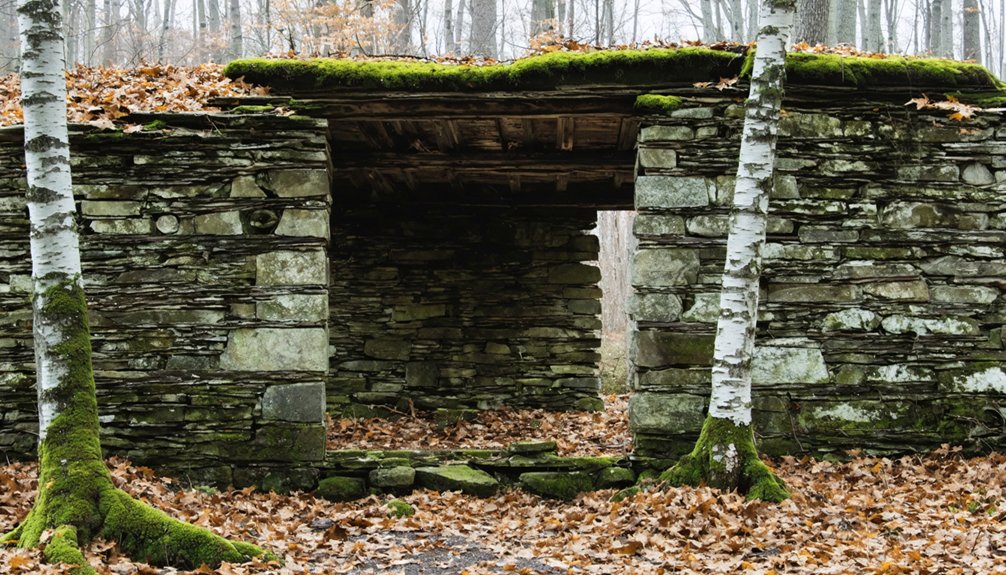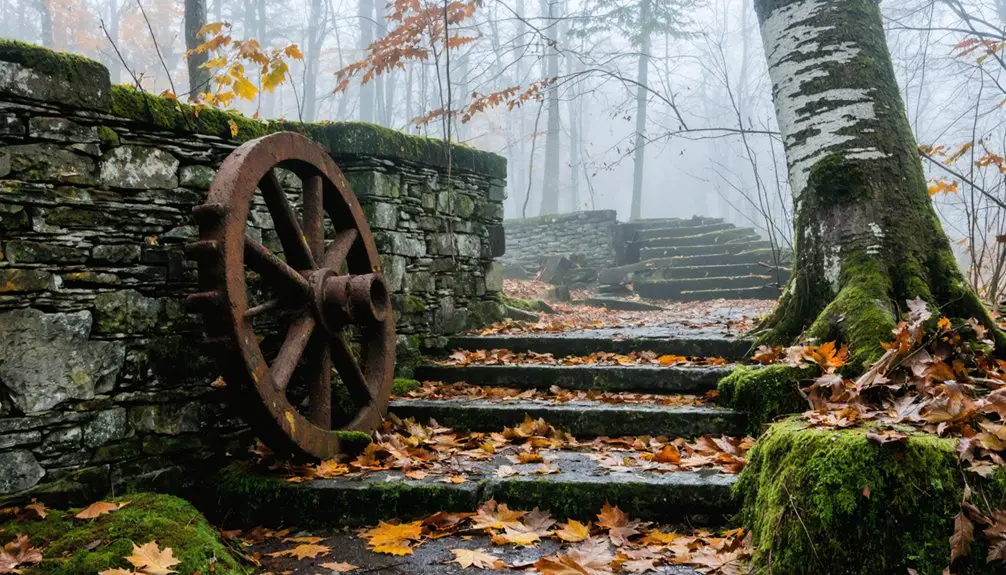
You’ll discover fascinating ghost towns across New Hampshire, each telling unique stories of industrial and social change. Old Hill Village relocated entirely in 1941 for the Franklin Falls Dam, while Livermore, founded in 1876, now claims just two residents. Zealand thrived in the 1870s as a logging settlement before abandonment, and Madame Sherri’s Castle burned in 1962, leaving only stone ruins. The abandoned settlements‘ foundations, railway beds, and stone walls hold countless untold tales of New Hampshire’s past.
Key Takeaways
- Old Hill Village was completely relocated in 1941 for the Franklin Falls Dam project, leaving behind its original location along the Pemigewasset River.
- Livermore, founded in 1876 as a logging town, declined after fires and floods, becoming New Hampshire’s smallest town with just two residents.
- Zealand, established in the 1870s as a logging company town, was abandoned due to clear-cutting practices and forest fires.
- Monson Center, New Hampshire’s first inland colony from the 1730s, transformed from a thriving farming settlement into a ghost town.
- Carrigain, a company-owned logging settlement in the White Mountains, was completely abandoned in 1898, leaving visible foundation ruins.
The Lost Town of Old Hill Village
While many New England towns have endured floods, few faced the fate of Old Hill Village, which relocated entirely in 1941 after the federal government seized the land for the Franklin Falls Dam flood control project.
This lost village once thrived along the Pemigewasset River, with its tree-lined main street, busy railroad depot, and water-powered mills. Using an ingenious system, only 14 buildings were relocated using railway tracks and horse-powered winches to the new site.
The town had experienced devastating floods in 1875, 1916, 1936, 1938, and 1941, making the relocation inevitable.
When faced with displacement, the townspeople demonstrated remarkable community resilience. They formed an association, purchased higher ground, and methodically rebuilt their entire community.
By June 1941, they’d established a new village complete with town hall, school, water system, and 30 houses.
Today, you’ll find the original site at Needleshop Brook Recreation Area, where foundations, mill cellars, and plaques mark where this sacrificed town once stood.
Livermore: A Two-Resident Legacy
Unlike Old Hill Village’s planned relocation, Livermore’s descent into ghost town status came through a series of devastating setbacks. Founded in 1876 by the Saunders family, this logging town once bustled with 200 residents and featured a sawmill, school, post office, and company store. Boston lawyers owned and managed the town’s operations for decades.
You’ll find its ghostly remnants deep in the White Mountains, where fires in 1876, 1909, and 1918 repeatedly destroyed the mill, followed by a catastrophic flood in the late 1920s. Today, the town maintains its place in New Hampshire history as the state’s smallest with just two residents.
Remains of Madame Sherri’s Castle
The crumbling stone staircase of Madame Sherri’s Castle stands as a haunting reminder of the Jazz Age’s extravagance in West Chesterfield, New Hampshire.
In 1930, French-born Madame Sherri built her summer castle without blueprints, featuring a dramatic Roman arch stairway that wrapped around the three-story château. You’ll find traces of her lavish lifestyle in the stone foundation, where she once entertained theatrical friends with wild Prohibition parties amid fur rugs and ornate decor. Local craftsmen found her eccentric demands and scantily clad appearances challenging. Her distinctive custom automobile would often be seen cruising through the local streets, drawing attention wherever she went.
After her fortune vanished post-World War II, the castle fell into disrepair and burned in 1962.
Like many Jazz Age fortunes, Madame Sherri’s wealth evaporated after WWII, leaving her beloved castle to decay and ultimately burn.
Today, you can explore the ruins along the Wantastiquet Mountain Trail, though the iconic staircase’s top collapsed in 2021. The site, now part of Madame Sherri Forest, continues to draw photographers and ghost hunters to its mysterious remains.
Zealand’s Logging Legacy
You’ll find Zealand’s origins in the bustling logging era of the 1870s White Mountains, where J.E. Henry established a company town supporting 80-250 forestry workers.
Henry’s operation included a massive steam-powered sawmill, the Zealand Valley Railroad built in 1884, and essential infrastructure like worker housing, a school, and a company store. The company store’s pricing and credit system often kept workers in a cycle of perpetual debt.
The intensive clear-cutting practices and subsequent forest fires in the early 1900s ultimately led to Zealand’s abandonment, leaving behind a ghost town that marks New Hampshire’s logging heritage. Today, visitors can explore the area via the Zealand Trail, which follows the old railroad’s right-of-way into the White Mountain National Forest.
Logging Operations and Infrastructure
Founded in 1880 by J.E. Henry, Zealand’s logging operations showcased the era’s most advanced timber extraction methods.
At its heart stood a 200-horsepower steam sawmill equipped with multiple specialized saws for processing diverse wood products. You’d have found cutting-edge logging technology throughout the operation, from the mill’s box-making machines to the extensive rail network that transported logs from remote cutting zones.
The Zealand Valley Railroad connected directly to major rail lines like the Boston and Maine, enabling efficient transport of finished lumber to distant markets. During spring thaws, workers would guide timber through log drives downriver to supplement rail transportation. When logging peaked in Zealand, the company operated five charcoal kilns that generated substantial revenue from wood processing.
Henry’s operation demonstrated the period’s industrial ingenuity, sharing assets with other logging companies through equipment leasing and track agreements. This robust infrastructure supported intensive logging until the early 1890s, when resource depletion and devastating fires ultimately led to Zealand’s abandonment.
White Mountains Company Town
While many logging operations dotted New Hampshire’s White Mountains in the 1880s, Zealand stood out as J.E. Henry‘s crown jewel of company towns.
You’ll find Zealand’s history centered on Henry’s expansive landholdings of up to 100,000 acres, where he controlled every aspect of community life. His company town featured a massive steam-powered sawmill, worker housing, and two strategic railroad stations connecting to major lines.
At its peak, Zealand bustled with up to 250 workers who relied entirely on Henry’s infrastructure – from the company store to the schoolhouse run in a private home.
The town’s destiny was tied to timber, and by 1893, intensive clear-cutting had depleted the forests. After two devastating fires consumed the slash-filled valley, Zealand’s brief but impactful chapter in White Mountain history came to an end.
Monson Center’s Agricultural Past
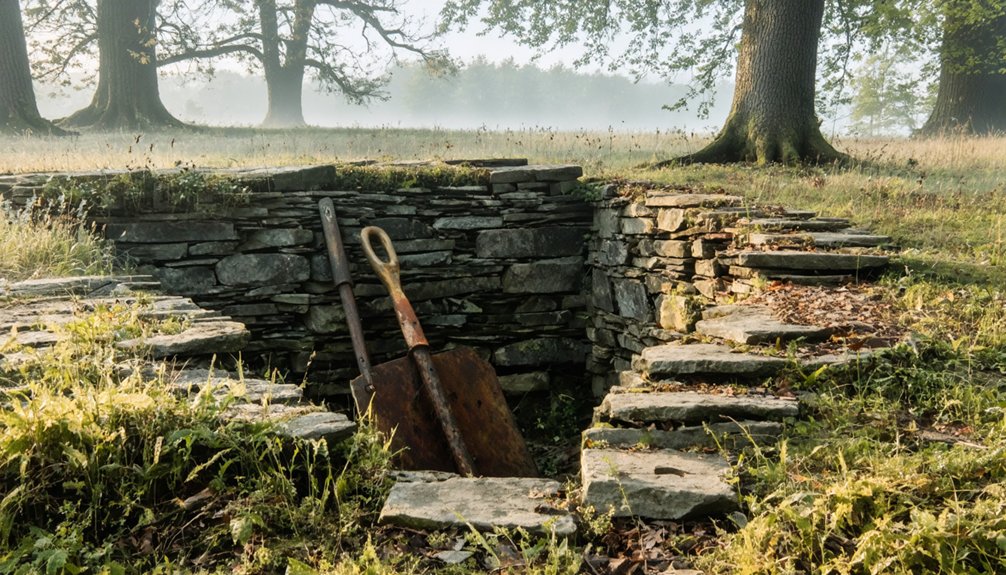
Before becoming one of New Hampshire’s most notable ghost towns, Monson Center thrived as a farming settlement in the early 1700s, earning recognition as the state’s first inland colony by the 1730s.
From humble farming roots in the 1700s to ghostly ruins today, Monson Center marks New Hampshire’s pioneering step into inland settlement.
The agricultural techniques of early settlers centered on sustainable farming, with families trading goods across neighboring communities.
You’ll find evidence of their community dynamics through:
- Stone walls that once bordered thriving crop fields
- Ancient lanes carved between pastures where cows grazed
- Original cellar holes preserved in the surrounding woods
- A livestock pound, the settlement’s only public structure
Though the town disbanded by the 1770s after failing to agree on a meeting house location, you can still explore its 280-acre historic landscape, protected from modern development through conservation efforts led by the Dickermans in 1998.
Carrigain: A Forgotten Lumber Settlement
If you’re exploring New Hampshire’s ghost towns, you’ll find the remnants of Carrigain, a company-owned logging settlement that operated in the White Mountains until its complete abandonment on February 1, 1898.
Your journey through this former lumber town will reveal foundation ruins of worker housing and industrial buildings that supported the region’s thriving 19th-century timber industry.
Following trails near Mount Carrigain today, you can discover the physical traces of this short-lived community where lumber workers once lived, worked, and gathered for social activities before the town’s swift decline when logging operations ceased.
Logging Town’s Brief History
As the railroad networks expanded through New Hampshire’s White Mountains in the 1870s, the logging settlement of Carrigain emerged as a strategic outpost for timber operations near Livermore.
You’ll find this town’s brief but impactful existence defined by its rapid rise and fall during the logging boom of the late 19th century.
The settlement’s key developments included:
- Construction of steam-powered sawmills in the early 1870s
- Development of private railroad networks to transport millions of board feet
- Consolidation of thousands of acres under single ownership
- Complete abandonment by 1891 after resources were depleted
Today, you can still discover foundation remains at the site, while the surrounding landscape stands protected – a reflection of the transient nature of New Hampshire’s logging settlements.
White Mountains Industrial Heritage
The story of Carrigain represents a defining chapter in White Mountains industrial development, shaped by revolutionary changes in land ownership and railroad expansion during the 1860s-1890s.
You’ll find the roots of this industrial expansion in New Hampshire’s 1867 public land sale, when Henry and his relative Isaac Calhoun acquired over 26,000 acres, enabling large-scale logging operations.
The transformation of timber transportation followed, as private railways like the Zealand Valley Railroad replaced traditional river drives.
By constructing steam-powered sawmills deep in the forests, companies established self-contained lumber camps with worker housing.
This industrialization peaked in the late 1880s, but careless harvesting and forest depletion led to Carrigain’s abandonment by 1898, leaving only foundations as evidence of this brief but intense period of logging history.
Remnants of Lumber Life
Once bustling with industrial activity, Carrigain emerged in the late 1880s as a remote lumber settlement tied directly to J.E. Henry’s extensive timber operations in New Hampshire’s White Mountains.
You’ll find evidence of this forgotten town’s lumbering practices through:
- Foundation remains that mark where workers once lived while serving the sawmills
- The abandoned Zealand Valley Railroad bed, which stretched 13-15 miles through the wilderness
- Historic boom islands with exposed rock centers still visible in the Androscoggin River
- Remnants of winter logging camps where workers felled trees for spring river drives
Frequently Asked Questions
Are There Any Guided Tours Available to These Ghost Towns?
You won’t find guided exploration of these ghost towns through organized tours, though you can visit Livermore’s historical significance yourself via the 1.5-mile Sawyer River Trail hike.
What Paranormal Activities Have Been Reported in These Abandoned Locations?
You won’t find official records of ghost sightings or unexplained noises in these locations, except for Old Hill Village, where some speculate about restless spirits due to disturbed gravesites during the 1930s flooding.
Is Camping Allowed Near Any of These Ghost Town Sites?
You’ll need to check specific camping regulations, as rules vary by site. While you can’t camp within historic ruins, you’ll find nearby campsites in White Mountain National Forest with proper permits.
What Items Can Legally Be Collected From These Historical Sites?
You can’t legally collect historical artifacts from these sites. Federal and state collecting regulations strictly prohibit removing any items, even surface objects, from protected ghost town locations and cellar holes.
Which Ghost Towns Are Most Accessible During Winter Months?
You’ll find Old Hill Village most accessible for winter hiking since it allows multiple snow travel options. Monson Center offers good snowshoeing trails when Adams Road parking’s cleared.
References
- https://newenglandwithlove.com/ghost-towns-in-new-hampshire/
- https://wokq.com/ghost-town-of-livermore-new-hampshires-smallest-town/
- https://www.youtube.com/watch?v=ajWEUfuP4g8
- https://vitabrevis.americanancestors.org/2016/11/new-hampshire-ghost-town
- https://www.whitemountainhistory.org/abandoned-towns
- https://www.onlyinyourstate.com/experiences/new-hampshire/ghost-towns-nh
- https://www.visitwhitemountains.com/blog/post/spooky-stories-ghost-towns-and-historic-haunted-spots/
- https://freepages.history.rootsweb.com/~gtusa/usa/nh.htm
- https://1happyhiker.blogspot.com/2014/10/a-visit-to-new-hampshire-historic-place.html
- https://outdoorodyssey.net/2024/11/04/the-old-ghost-town-of-hill-new-hampshire/