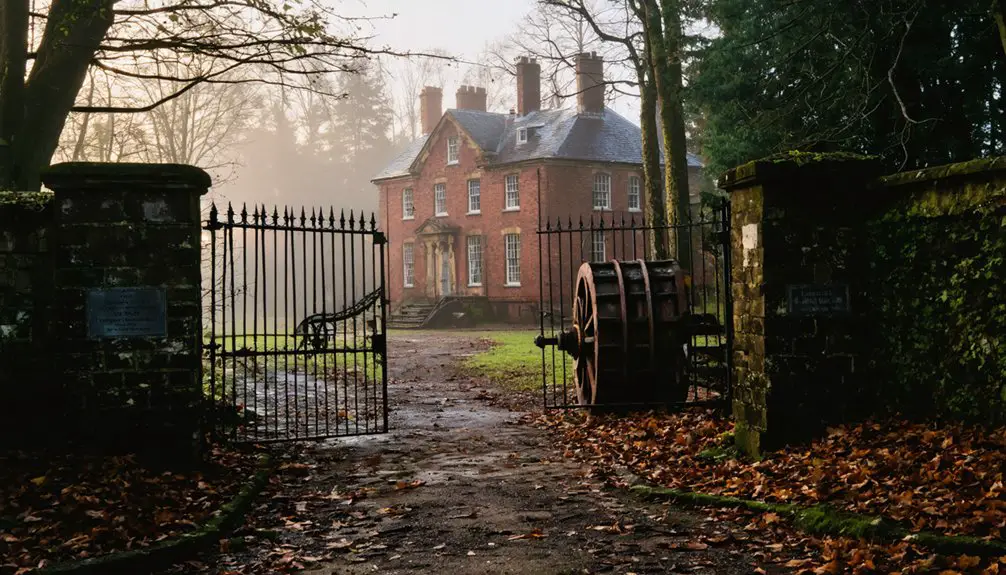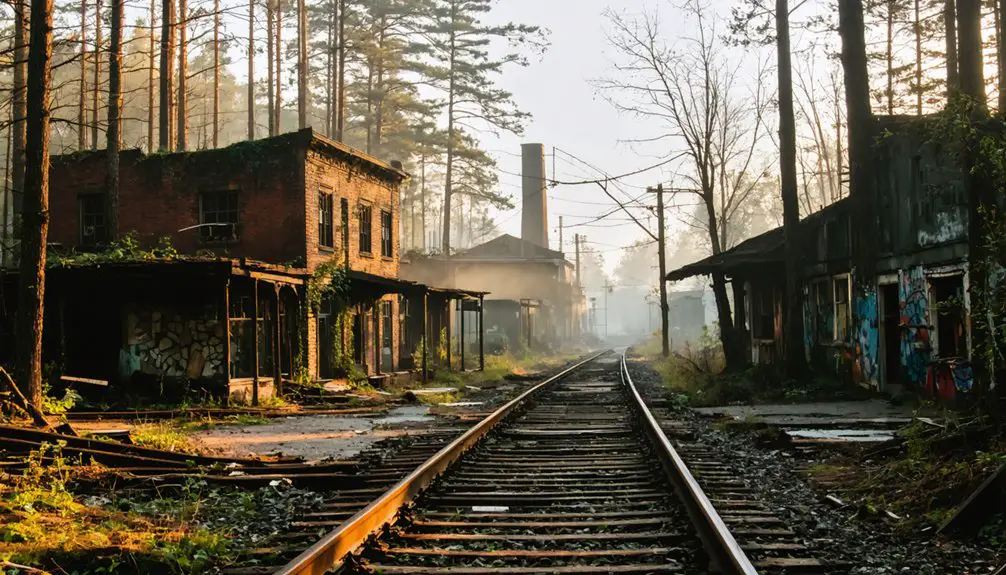
You’ll discover over 30 ghost towns across New Jersey, each telling a unique story of America’s industrial past. From Batsto Village’s Revolutionary War iron furnaces to Waterloo’s bustling canal port, these abandoned settlements showcase the rise and fall of manufacturing, agriculture, and commerce. Explore preserved sites like Allaire Village, where volunteer craftsmen still demonstrate period skills, or venture into the Pine Barrens’ mysterious ruins like Ong’s Hat. These forgotten communities hold countless untold tales within their weathered walls.
Key Takeaways
- Batsto Village preserves 33 historic buildings from its iron-making past, including a working post office and mansion from the Revolutionary War era.
- Waterloo Village features restored 19th-century buildings and canal structures, highlighting its significance as a former Morris Canal transportation hub.
- Whitesbog Village stands as America’s first commercial blueberry cultivation site, with preserved worker cottages and agricultural buildings from the 1900s.
- The Deserted Village of Feltville contains ten remaining buildings from David Felt’s former mill town, now part of New Jersey’s Watchung Reservation.
- Double Trouble Village showcases abandoned cranberry processing facilities and historic buildings that represent New Jersey’s agricultural heritage.
New Jersey’s Historic Industrial Ghost Towns
While New Jersey’s modern landscape bustles with suburban sprawl, its abandoned industrial towns tell a fascinating story of America’s evolving economy.
You’ll discover this rich industrial heritage in places like Batsto Village, where iron furnaces once forged Revolutionary War munitions before shifting to glassmaking.
At Allaire Village, you can explore the remains of the Howell Iron Works, which employed 400 people at its peak before falling victim to changing technologies.
Waterloo Village thrived as a crucial Morris Canal stop until railroads made it obsolete, while the aptly named Deserted Village at Feltville shows how mill towns rose and fell with fluctuating economic winds.
Each ghost town exploration reveals how these communities adapted – or failed to adapt – as industrial progress marched forward.
In the mid-1600s, early settlers established sawmills and gristmills throughout the Pine Barrens, marking the beginning of the region’s industrial era.
Today at Historic Whitesbog Village, visitors can explore the site where Elizabeth White developed the first cultivated blueberries in America.
Exploring the Pine Barrens’ Abandoned Settlements
Deep within New Jersey’s Pine Barrens, a network of abandoned settlements tells the story of forgotten industries and vanished communities that once thrived in this unique ecosystem.
You’ll find Batsto Village, where 33 historic buildings showcase the region’s iron-making heritage, alongside the ruins of paper mills at Harrisville and brick kilns at Brooksbrae.
The settlement history stretches from bustling cranberry operations at Friendship to Elizabeth White’s groundbreaking blueberry cultivation at Whitesbog Village.
Today, you can explore these remnants of the Pine Barrens’ industrial past – from fully restored mansions and gristmills to crumbling foundations reclaimed by forest.
While some sites remain fenced for preservation, many offer glimpses into a time when iron furnaces roared and mill wheels turned in these now-quiet woods.
Workers called colliers carefully stacked wood into cone-shaped piles covered with turf and sand to produce the charcoal needed for iron production.
The area’s decline began when the iron industry vanished in 1869, leading many of these once-prosperous communities to become ghost towns.
Preserved Villages Frozen in Time
Throughout New Jersey, several remarkably intact ghost towns stand as living museums, offering visitors a glimpse into the state’s rich industrial and social history.
You’ll discover Batsto Village’s 40-plus preserved structures, including a magnificent mansion and functional mills that showcase historic preservation at its finest.
At Waterloo Village, you can explore a restored canal town where the Lenape once lived, while Walpack Center’s well-maintained post office and church transport you to a 19th-century community frozen in time.
Allaire Village’s factory ruins and Smith Mansion illuminate the state’s industrial heritage, and Feltville’s connected cottages reveal fascinating social divisions through archaeological artifacts.
These cultural heritage sites aren’t just abandoned relics – they’re carefully maintained windows into New Jersey’s past that you can freely explore and experience firsthand. The National Park Service recognizes many of these sites as crucial for understanding how community resilience shaped the development of modern small towns. Local historians and preservation societies continue to document these sites through detailed photographs and written records for future generations.
Hidden Gems of the Garden State’s Past
Beyond the well-preserved historic sites lie New Jersey’s more enigmatic abandoned settlements, each with its own mysterious allure.
As you venture into the Garden State’s hidden histories, you’ll discover forgotten legacies scattered throughout its dense forests and remote landscapes. Like the National Register listed Deserted Village of Feltville, these abandoned places tell important stories about our past.
- Ong’s Hat beckons with tales of interdimensional portals and Pine Barrens outlaws, where fact and fiction blur into compelling folklore.
- Double Trouble Village’s crumbling walls tell stories of cranberry processing and industrial innovation amid the pines.
- Harrisville’s paper mill ruins stand as silent sentinels, fenced off but visible, marking a community’s sudden collapse.
- Weymouth Furnace showcases the state’s iron heritage with its impressive stack overlooking the Great Egg Harbor River.
- Walpack Center remains frozen since 1965, its handful of residents maintaining vigil over a once-thriving farming community.
The Hampton Furnace base still endures in Wharton State Forest, a testament to New Jersey’s bygone iron-smelting industry.
Walking Through New Jersey’s Deserted Communities
While many historic sites in New Jersey have succumbed to modern development, several preserved ghost towns invite visitors to step back in time through their weathered doorways and along their overgrown paths.
Exploring ghost towns in New Jersey reveals the remnants of once-thriving communities, where stories of the past linger in the crumbling facades. Each abandoned building tells a tale of resilience and change, offering a unique glimpse into the state’s diverse history. Visitors often find themselves captivated by the haunting beauty of these forgotten places, making them a must-visit for any history enthusiast.
For those interested in unique real estate opportunities, there are ghost towns for sale in New Jersey that offer a chance to own a piece of history. These properties not only provide a remarkable investment potential but also a canvas for creative restoration. Whether a cozy retreat or an adventurous project, each ghost town beckons with the promise of revival and exploration.
You’ll discover forgotten landmarks like Feltville’s abandoned structures nestled in Watchung Reservation and Walpack Center’s quiet streets, where only eight residents remain among historic buildings. The Richards family mansion stands as a testament to the 1824 settlement at Atsion.
Follow deserted paths through Waterloo Village, where the Morris Canal’s legacy lives on, or explore Batsto Village’s blacksmith shop and working mills in the heart of the Pine Barrens.
At Allaire Village, you can wander past silent cotton mill remnants and peer into vacant worker houses, each telling stories of New Jersey’s industrial past through their weathered walls and empty windows. Among these historical sites stands the Victorian-style architecture of the Essex County Jail Annex, built in 1873 and abandoned for over five decades.
Living Museums: Yesterday’s Towns Today
Several of New Jersey’s abandoned communities have found new life as living history museums, where the past springs to life through preserved buildings and interactive experiences.
Through dedicated cultural preservation efforts, you’ll discover vibrant destinations that honor the state’s rich industrial heritage.
- Batsto Village welcomes you with 33 historic buildings, including a working post office and the grand Batsto Mansion.
- At Allaire Village, volunteer craftsmen demonstrate period skills while you explore 13 restored homes and shops.
- Waterloo Village celebrates both canal-era industry and Lenape heritage within Allamuchy Mountain State Park.
- The Red Mill Museum Village preserves industrial dreams through its operational blacksmith shop and rotating exhibits.
- Feltville’s transformation into Glenside Park showcases how these communities adapted to changing times.
The Stories Behind New Jersey’s Empty Villages
Each of New Jersey’s ghost towns tells a unique tale of boom and bust, where ambitious dreams collided with harsh economic realities.
You’ll find Feltville’s history embedded in its abandoned printing factory, where David Felt’s industrial vision thrived briefly before fading into skeletal ruins by the 1920s.
At Waterloo, the once-bustling canal stop transformed through restoration from a forgotten village into a living museum.
From abandoned waterway stop to vibrant historical site, Waterloo Village recaptures the spirit of New Jersey’s canal-era past.
Batsto Village’s iron works powered the steam engine revolution until economic forces shuttered its furnaces.
Walpack Center’s quiet streets echo with memories of displaced residents, while deep in Wharton State Forest, Harrisville’s crumbling paper mill stands as a symbol of industrial decline.
These empty villages reveal how quickly fortunes can change, leaving behind only traces of their former glory.
Lost Communities Along Historic Trade Routes
If you venture along New Jersey’s historic transportation corridors, you’ll find the remains of once-bustling canal towns like Waterloo Village, where the Morris Canal’s lock systems and merchant buildings stand as monuments to 19th-century commerce.
In the Pine Barrens, abandoned bog iron communities such as Batsto Village reveal the industrial heritage of a region that produced everything from household items to Revolutionary War ammunition.
The state’s forgotten river landings and maritime ports, now marked by scattered foundations and overgrown wharves, showcase how shifting transportation technologies transformed these essential trade hubs into quiet reminders of New Jersey’s commercial past.
Canal Town Transportation Hubs
Along the winding path of New Jersey’s Morris Canal, once-bustling transportation hubs stood as essential lifelines between Pennsylvania’s coal fields and New York City’s hungry markets.
You’ll find no better example of canal transportation’s historical significance than Waterloo Village, a preserved snapshot of 19th-century life in Stanhope.
- Mule-drawn boats navigated 102 miles of innovative engineering, climbing 900 feet via inclined planes.
- Peak operations in 1866 saw boats carrying 70 tons of coal to power factories, homes, and locomotives.
- A complete village emerged with stone tenant houses, church, gristmill, and blacksmith shop.
- By 1871, faster railroads sealed the canal’s fate, reducing four-day trips to mere hours.
Today, you can walk among the restored buildings where canal workers once lived, worked, and worshipped.
Mountain Pass Trading Posts
Through the rugged mountain passes of New Jersey, trading posts once served as essential waypoints for merchants and travelers traversing the treacherous terrain between colonial settlements.
You’ll find their legacy most prominently in places like the Ramapo Pass, where the Ramapo Nation controlled a crucial trade route they later shared with George Washington’s forces during the Revolution.
One lasting reminder was the Cherokee Trading Post along Route 46, which operated for 73 years until its recent closure. Starting as a humble roadside stand with wares hung on clotheslines, it grew into a beloved landmark with its iconic spinning circles billboard.
Like many mountain pass trading posts before it, changing times and shifting travel patterns led to its transformation from crucial waypoint to cherished memory.
Pinelands Commerce Routes
While mountain trading posts marked New Jersey’s northern passages, the Pinelands’ historic commerce routes tell an equally compelling story of lost communities and forgotten pathways.
You’ll discover a network of sandy trails and busy waterways that once connected thriving villages built on iron, timber, and maritime trades. Along these historic roads, you’ll find traces of an era when the Pinelands trade flourished:
- Shore Road (U.S. Route 9) served as a crucial coastal artery, linking seaside settlements
- Tuckerton Stage Road’s sandy path transported goods between isolated communities
- Crossroad taverns functioned as bustling social hubs and political gathering spots
- Railroad stations transformed quiet hamlets into booming commercial centers
- The legendary Blue Comet train route connected vanished communities from Lakewood to Hammonton
These commerce routes paint a vivid picture of New Jersey’s lost frontier settlements.
Frequently Asked Questions
Are Any of These Ghost Towns Legally Off-Limits to Visitors?
You’ll find legal restrictions at Essex County Jail Annex, Harrisville’s fenced ruins, and Demon’s Alley, while visitor guidelines limit access to archaeological sites like Raritan Landing and South Cape May.
What Paranormal Activity Has Been Reported in These Abandoned Towns?
You’ll find reports of shadowy figures at Feltville’s church, mysterious lights in Demon’s Alley, ghostly mill workers at Harrisville, and paranormal sightings near Atsion’s mansion and cemetery at dusk.
Can Visitors Stay Overnight in Any of These Ghost Towns?
You can’t stay overnight in these ghost towns due to strict camping regulations. While you might crave freedom to explore after dark, no overnight permits are issued to protect historic structures.
Which Ghost Towns Are Accessible During Winter Months?
You’ll find endless winter adventures in all four ghost towns! Feltville, Waterloo Village, and Batsto Village offer unrestricted winter access, while Sea Breeze requires extra caution during cold months.
Do Any Current Residents Still Maintain Homes in These Communities?
You’ll find these towns are largely unpopulated now, with only Walpack Center maintaining a handful of current residents. Most structures serve community preservation efforts through museums and park facilities instead.
References
- https://en.wikipedia.org/wiki/List_of_ghost_towns_in_New_Jersey
- https://www.jerseysbest.com/community/take-a-road-trip-through-n-j-s-spooky-ghost-towns-to-see-peculiar-pieces-of-history/
- https://www.youtube.com/watch?v=ZIp3AYb0ulw
- https://www.atlasobscura.com/things-to-do/new-jersey/abandoned
- https://wobm.com/new-jersey-is-home-to-one-of-americas-spookiest-ghost-towns/
- https://southjerseytrails.org/2017/03/16/six-pine-barrens-ghost-towns-to-explore/
- https://pinelandsalliance.org/learn-about-the-pinelands/pinelands-history-and-culture/ghost-towns-of-the-pine-barrens/
- https://rsftripreporter.net/gone-goner-ghost-towns-new-jersey-pine-barrens-part/
- https://www.journeythroughjersey.com/blog/forgotten-jersey-ghost-towns-and-lost-villages/
- https://jerseydigs.com/ghost-towns-in-nj/