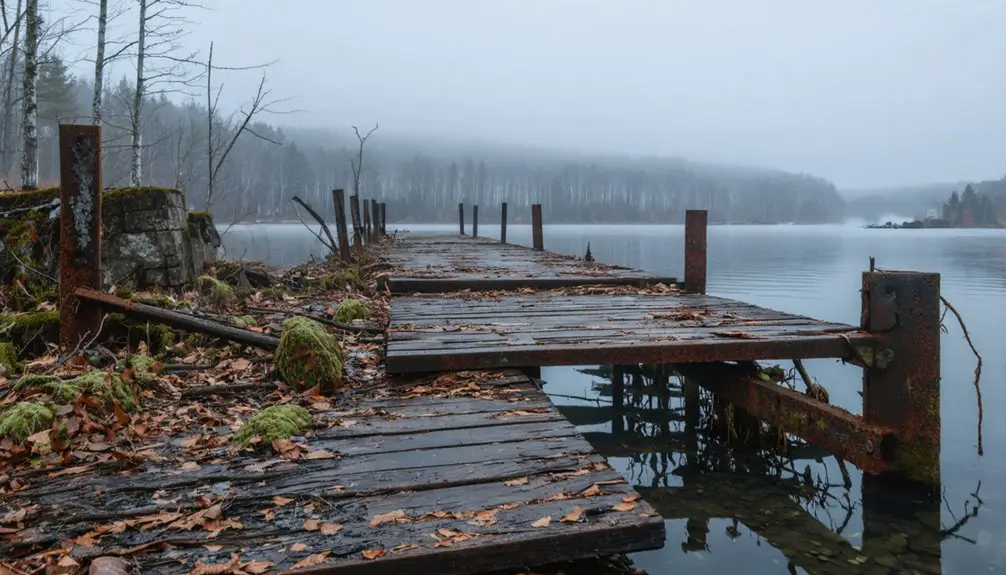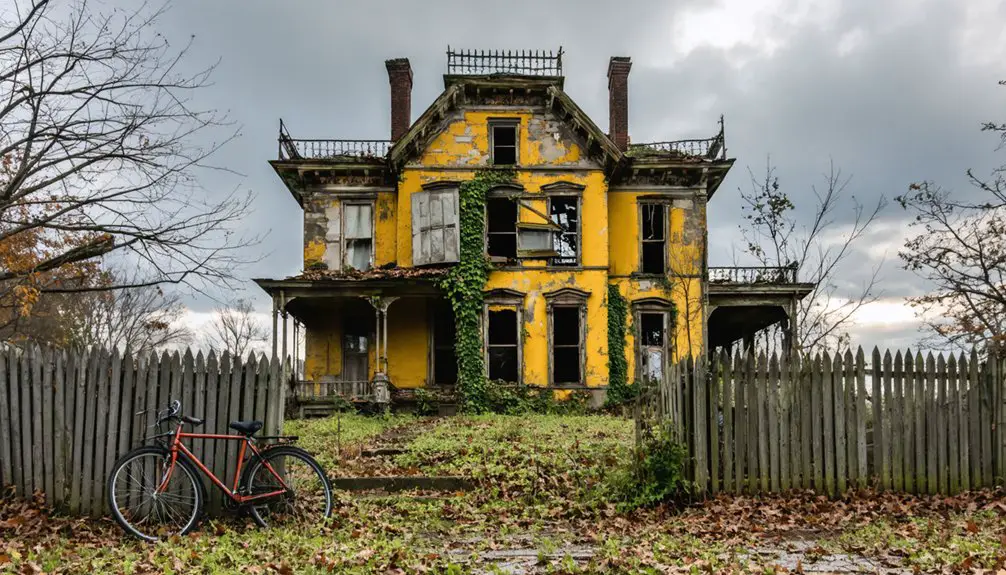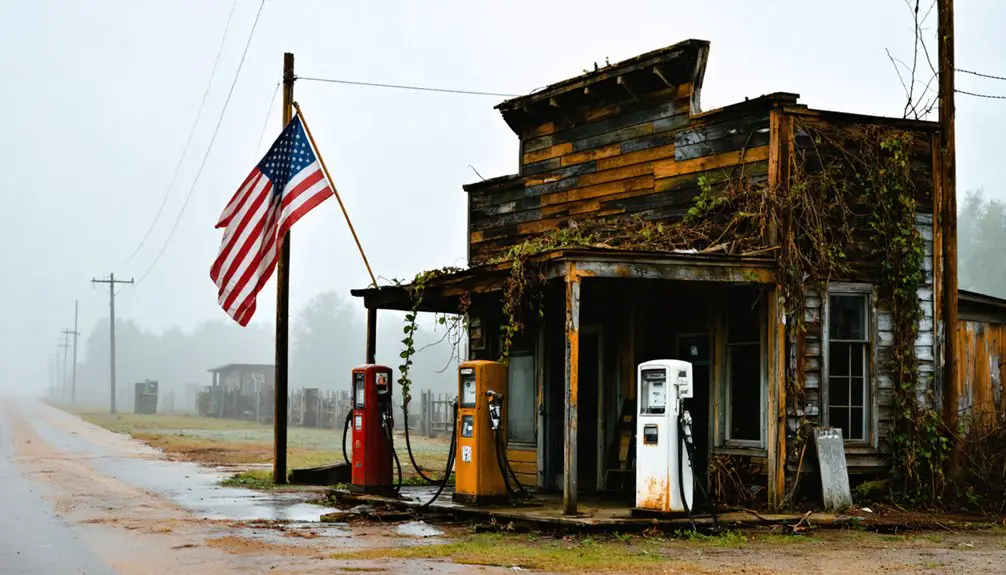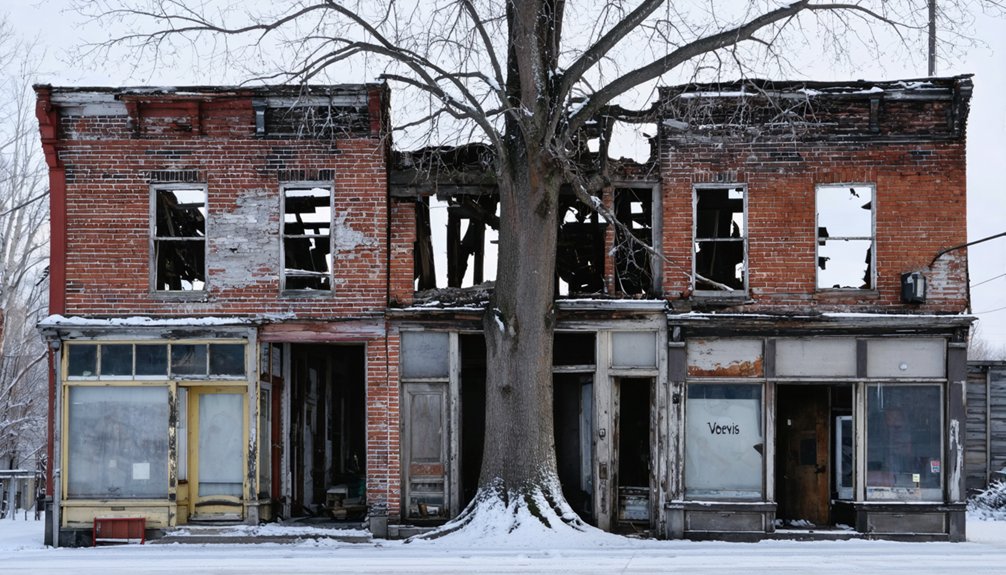
You’ll discover New York’s haunting ghost towns across diverse landscapes, from abandoned mining settlements like Tahawus in the Adirondacks to the contaminated Love Canal near Niagara Falls. These forgotten places include the Bear Mountain community of Doodletown, North Brother Island’s medical complex, and numerous Catskills resorts. Each site tells a unique story of industrial ambition, environmental disaster, or social transformation, with their crumbling structures now slowly returning to nature.
Key Takeaways
- Tahawus and Adirondac, former mining towns, were abandoned after National Lead Industries ceased titanium mining operations in the mid-20th century.
- Doodletown, near Bear Mountain, was forcibly abandoned in 1964 when residents faced state buyouts from the Palisades Interstate Park Commission.
- Love Canal, a residential community near Niagara Falls, was evacuated in 1978 due to severe chemical contamination and environmental hazards.
- Former Catskills resort towns, including parts of Grossinger’s, became abandoned as the region’s tourism industry declined in the late 20th century.
- Historic quarry towns across New York state were deserted after the decline of the stone industry, leaving behind industrial ruins.
The Mining Legacy of Tahawus and Adirondac
While the Adirondacks may seem an unlikely setting for industrial development, the discovery of rich iron ore deposits in 1826 by Abenaki tribe member Lewis Elijah Benedict sparked the creation of Tahawus and Adirondac.
You’ll find the remnants of this industrial heritage in what began as a company town founded by Archibald McIntyre and David Henderson. The community grew into a thousand residents by 1946 during its peak mining years.
Though early iron mining efforts failed due to transportation challenges and titanium-rich ore that proved problematic, the site experienced a dramatic revival during WWII. National Lead Industries transformed it into the world’s largest titanium mining operation, extracting 40 million tons before closing in 1989.
Today, you can explore the historic preservation efforts, including the 1856 blast furnace ruins and interpretative trails through Adirondac village, where Theodore Roosevelt once stayed during his famous midnight ride.
The Mitchell Stone Company continues mining operations at the site today, focusing on selling construction aggregate from the remaining tailings.
Life and Loss in Doodletown’s Bear Mountain Community
Much like the lost industrial towns of the Adirondacks, another forgotten community lies nestled in New York’s Hudson Valley. Doodletown‘s memories trace back to the Munsee peoples, with European settlement beginning when Van Cortlandt purchased the land from Haverstraw Indians in the 1680s.
Today, visitors can follow hiking trails to discover remnants of this once-thriving community. You’ll find the heart of this story in the June family, who established deep roots after purchasing 72 acres in 1762. The town grew into an important Revolutionary War crossroads during battles near Fort Montgomery.
Community resilience defined Doodletown through the 1920s, when it reached its peak with 70 homes and 300 residents. Despite the residents’ fierce resistance to the Palisades Interstate Park Commission‘s expansion, their independence couldn’t withstand the state’s 1964 ultimatum: accept buyouts or face condemnation.
Love Canal’s Environmental Disaster and Mass Exodus
You’ll discover how Love Canal‘s transformation from a chemical dumping ground into a residential community led to one of America’s worst environmental disasters, with over 22,000 tons of toxic waste seeping into homes and schools.
The devastating health impacts – including chemical burns, cancers, and birth defects – forced hundreds of families to abandon their contaminated properties in 1978, turning Love Canal into a modern ghost town. Local residents faced abnormal miscarriage rates and other severe medical conditions.
This environmental catastrophe sparked nationwide outrage, prompting President Carter’s emergency declaration in 1980 and catalyzing both the Superfund program and the environmental justice movement in the United States.
After years of litigation, former residents received a $20 million settlement for their losses and suffering.
Chemical Waste’s Deadly Legacy
In what became one of America’s most notorious environmental disasters, the Love Canal neighborhood‘s toxic legacy began in the 1940s when Hooker Chemical Company used the abandoned canal as a dumping ground for nearly 20,000 metric tonnes of chemical waste.
You’ll find a staggering 248 different chemicals, including 12 known carcinogens, were buried at the site. After heavy rains in the 1970s, these toxins surfaced in residents’ backyards and basements, leading to devastating chemical exposure throughout the community.
The community health impact was severe – children suffered chemical burns, while adults developed cancers, respiratory problems, and blood diseases. President Jimmy Carter declared the first federal state of emergency for a man-made environmental disaster on August 7, 1978.
EPA blood tests in 1980 revealed chromosome damage, confirming increased risks of cancer and genetic disorders. The chemicals’ deadly reach extended beyond homes, contaminating the city’s storm sewers and the Niagara River. Hooker Chemical sold the contaminated land to the school district for one dollar in 1953, despite knowing the dangers that lurked beneath the surface.
Mass Evacuation and Relocation
After discovering the severity of chemical contamination in Love Canal, state and federal authorities launched an unprecedented mass evacuation that would permanently alter the community’s fabric.
President Jimmy Carter approved emergency financial aid to assist with the massive relocation effort.
You’ll find that between 1978 and 1980, over 800 families faced displacement as New York State began purchasing affected properties, starting with 236 homes at a cost of $10 million.
The evacuation impact reached far beyond physical relocation – you’d see the closure of the local elementary school, the demolition of 227 homes by 1982, and the devastating loss of community ties.
The crisis particularly affected working-class residents, who watched their neighborhood transform into a ghost town.
Health studies revealed troubling statistics: women experienced 1.5 times higher miscarriage rates, while at least five children developed birth defects.
The area contained over 21,800 tons of hazardous chemicals buried by Hooker Electrochemical Corporation between 1942 and 1952.
Environmental Justice Movement Begins
Love Canal’s devastating environmental crisis sparked the modern environmental justice movement when resident activist Lois Gibbs discovered the toxic nightmare lurking beneath her community.
You’ll find that her grassroots campaign exposed Hooker Chemical Company’s toxic legacy of over 21,000 tons of hazardous waste, including 12 known carcinogens buried beneath homes and schools.
Community activism reached new heights as residents faced shocking health impacts – elevated rates of cancer, birth defects, and miscarriages.
Scientific evidence mounted when the EPA identified four cancer-causing chemicals in the air, while state agencies confirmed widespread contamination.
Your understanding of environmental disasters changed forever when Love Canal‘s tragedy led to unprecedented action: President Carter’s emergency declaration and the creation of the Superfund program in 1980, establishing a framework for addressing hazardous waste sites nationwide.
North Brother Island’s Abandoned Medical Complex
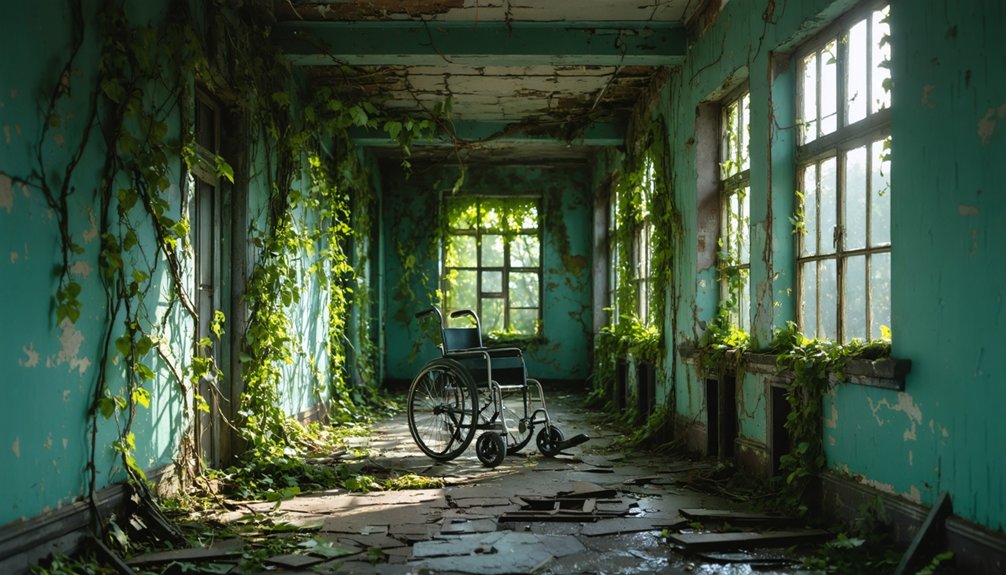
As you explore New York’s abandoned places, you’ll discover North Brother Island‘s haunting medical complex, which operated from 1885 to 1964 as a quarantine facility for patients with infectious diseases like tuberculosis and typhoid fever.
You’ll find the island’s twelve to twenty-five deteriorating buildings, including the crumbling Tuberculosis Pavilion, now overtaken by invasive plants and trees growing through broken windows and collapsed roofs.
The 13-acre island, accessible only by special permission today, serves as a protected habitat for black-crowned night herons, nature’s evidence to how quickly wilderness can reclaim abandoned human structures.
Historic Medical Significance
While many abandoned places hold historical significance, North Brother Island‘s medical complex stands as one of New York’s most compelling monuments to public health history. From its establishment in 1885, the facility played an essential role in the city’s quarantine practices and medical history, treating some of society’s most challenging infectious diseases.
The island’s medical legacy includes:
- Housing Typhoid Mary, the infamous disease carrier who spent nearly two decades in forced isolation.
- Treating patients with smallpox, tuberculosis, typhus, and yellow fever through specialized quarantine protocols.
- Operating the Tuberculosis Pavilion until 1945, when vaccine developments made the facility obsolete.
You’ll find that the complex later evolved beyond its original purpose, serving as veteran housing and eventually becoming New York’s first drug rehabilitation center before its ultimate abandonment.
Nature Reclaims Architecture
Since nature began its relentless takeover in 1964, North Brother Island‘s medical complex has transformed from an orderly medical campus into a haunting urban jungle.
You’ll find dense forest concealing 25 dormant buildings across the 20-acre island, where vines weave through skeletal frames and trees burst through shattered windows.
Nature’s reclamation is most evident in the 1943 Tuberculosis Pavilion, its $1.2 million structure now crumbling beneath aggressive vegetation.
The architectural decay extends throughout the site, with poison ivy conquering dilapidated walls and black-crowned night herons nesting in the ruins.
Fire hydrants and lampposts lie buried beneath the surface, while graffiti from the 1950s drug treatment era remains visible – silent witnesses to humanity’s retreat as wilderness claims this forgotten slice of New York.
The Rise and Fall of Catskills Resort Towns
When the first settlers established Homestead Farm in Margaretville during 1819, they couldn’t have predicted how the Catskills would transform from a remote wilderness into one of America’s premier resort destinations.
The region’s resort nostalgia traces back to the early 20th century, when tourism evolution sparked a remarkable transformation of this once-industrial area.
You’ll discover how the Catskills became a powerhouse of tourism through:
- Railway expansions that brought millions of visitors to over 500 resorts
- Jewish-owned farms that evolved into world-class destinations like Grossinger’s
- Spanish and Puerto Rican entrepreneurs who established thriving villa communities in Plattekill
Frontier Town: From Wild West to Wild Nature
As mid-century Americans embraced the romance of TV westerns, Arthur Bensen transformed a quiet corner of New York’s Adirondacks into an unlikely frontier fantasy.
Opening on July 4, 1952, Frontier Town captured the nation’s frontier nostalgia with staged gunfights, can-can dancers, and steam train robberies.
You’d find authentically costumed performers churning butter in Pioneer Village or demonstrating Native American customs in the Indian Village.
Industrial Ruins Along New York’s Rail Corridors
Throughout New York State’s extensive rail network, abandoned industrial complexes stand as haunting monuments to America’s railroad golden age.
These decaying remnants of railroad heritage tell stories of innovation and industry, from the massive West Albany Yard that once employed 6,000 workers to the architectural grandeur of the Glenwood Power Station.
You’ll discover fascinating examples of urban decay across the state:
- The West Albany Yard’s sprawling 350-acre complex, where the legendary Engine 999 was constructed in 1893
- Glenwood Power Station’s turbine hall, with its towering glass roof now shattered and walls crumbling
- Rochester’s underground trolley network, featuring a two-mile tunnel beneath Broad Street Bridge, now adorned with graffiti
These industrial ruins serve as stark reminders of New York’s transformed transportation landscape.
Forgotten Hospital Complexes Across the State
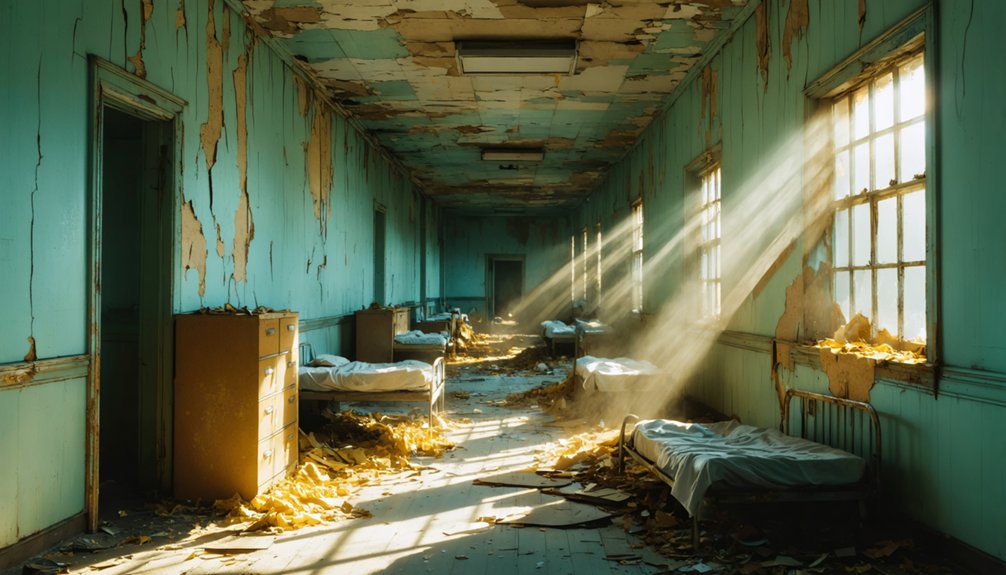
While New York’s abandoned tuberculosis sanatoriums stand as stark reminders of a bygone medical era, you’ll find these haunting facilities scattered across upstate’s remote hillsides and forested valleys.
The state’s forgotten island medical complexes, including psychiatric hospitals that once housed thousands, now crumble in isolation as nature slowly reclaims their grounds.
These massive healthcare complexes, with their imposing Kirkbride-designed buildings and sprawling campuses, represent some of the largest abandoned institutional properties in the American Northeast.
Tuberculosis Sanatoriums Left Behind
Several abandoned tuberculosis sanatoriums stand as silent monuments across New York State, marking the state’s historic battle against the “White Plague.”
These medical complexes emerged following the 1909 state mandate requiring counties to establish tuberculosis treatment facilities, leading to a network of specialized hospitals designed around the fresh-air cure method.
Today, you’ll find these haunting histories scattered throughout the region:
- Saratoga County Homestead’s grand 1936 expansion, with its marble columns and decorative moldings, now offers paranormal tours.
- Trudeau Sanatorium in Saranac Lake, the nation’s first public TB facility, partially survives as a historic landmark.
- J.N. Adam Memorial Hospital in Perrysburg, chosen for its pure lake breezes, moulders in abandoned architecture, its future uncertain.
These complexes represent a bygone era of medical isolation and natural healing methods.
Island Medical Complexes Decay
As New York State’s healthcare landscape evolved through the twentieth century, numerous hospital complexes emerged as isolated medical cities, only to face abandonment in recent decades.
You’ll find these institutional remnants scattered across the state, from Rockland Psychiatric Center’s once-bustling 600-acre campus to Hudson River State Hospital’s deteriorating Gothic architecture.
These abandoned hospitals tell a stark story of shifting medical priorities. The Bronx State Hospital highrises, built with state-of-the-art facilities in 1964, now stand silent and stripped by scrappers.
Letchworth Village’s decaying grounds remain partially accessible, while Mary McClellan Hospital’s isolation amplifies its neglected state.
The institutional decay reflects broader changes: deinstitutionalization in the 1970s emptied psychiatric facilities, while modern healthcare demands transformed or shuttered aging complexes.
Many now await demolition or redevelopment, their empty corridors evidence to healthcare’s evolution.
The Nevele Grand’s Decline From Luxury to Abandonment
Once a crown jewel of the Borscht Belt resorts, the Nevele Grand Resort‘s journey from luxury to abandonment mirrors the broader decline of the Catskills’ golden era.
From its humble beginnings as Nevele Falls Farm House in 1901, it transformed into a premier destination where Nevele nostalgia still lingers in the memories of its lavish amenities.
Resort mismanagement led to its ultimate downfall, marked by:
- A bitter ownership dispute between Wolff and Hoffman, ending in court battles
- Devastating maintenance costs that crippled operations by the early 2000s
- Two destructive fires, with the latest in 2025 ravaging the main building
Today, you’ll find only crumbling structures behind security fences, with nature reclaiming what was once a thriving resort paradise.
The abandoned golf courses and empty corridors stand as haunting reminders of its former glory.
Quarry Towns: The Remnants of Stone Industry
The historic quarry towns of New York tell a compelling story of industrial might through their weathered remains and abandoned workings.
You’ll find remarkable stone heritage across sites like Mohegan Quarry, which supplied granite for New York’s grandest buildings, including the Cathedral of Saint John the Divine.
In Union Springs, the quarries that paved Wall Street operated for nearly a century, while Split Rock’s limestone operation transformed into a WWI munitions factory before a tragic explosion claimed 50 lives.
The quarry architecture remains visible in places like Yonkers, where the Valentine Family’s excavations provided stone for iconic NYC churches.
From Cobleskill’s limestone pits that once employed 450 men to Thornwood’s marble quarries, these abandoned industrial sites stand as evidence of New York’s pivotal role in America’s stone industry.
Frequently Asked Questions
Are There Guided Tours Available to Visit These Abandoned Locations?
You won’t find official ghost town tours at these historically significant locations. Instead, you’ll need to explore most sites independently through hiking trails, though North Brother Island remains completely off-limits.
The allure of ghost towns in New York is often overshadowed by the vibrant cities nearby. However, those who venture out to these abandoned places will discover the haunting beauty of history frozen in time. Each site tells a story of what once was, inviting exploration and reflection in the midst of nature reclaiming its space.
For those interested in urban exploration, there are countless abandoned properties for sale in New York that offer unique opportunities for renovation or restoration. These hidden gems provide a glimpse into the past, showcasing architecture that has weathered the test of time. With a bit of imagination, these properties could be transformed into stunning homes or creative spaces, blending history with modern life.
What Wildlife Species Now Inhabit These Abandoned Ghost Towns?
Like nature’s revenge, you’ll find thriving populations of ducks, muskrats, possums, and raccoons demonstrating remarkable wildlife adaptation. Their ecological impact transforms abandoned structures into vibrant habitats across these locations.
Have Any Paranormal Activities Been Reported in These Locations?
While paranormal investigations and ghost hunting occur in these locations, there’s no documented evidence of supernatural activity, except for Pottersville where the tragic murder-suicide history draws significant investigator interest.
Which Ghost Towns Are Legally Accessible for Photography and Exploration?
You can legally photograph and explore Tahawus, Camp Santanoni, and Doodletown without exploration permits. They’re managed by state agencies and open to public access through designated park trails and pathways.
How Many People Still Live Near These Abandoned Communities Today?
You’ll find current residents scattered near these sites, with nearby towns housing roughly 38,000 people around Buffalo, while other declining communities maintain small populations between 5,000-15,000 inhabitants.
References
- https://www.thetravel.com/abandoned-towns-in-upstate-new-york/
- https://www.onlyinyourstate.com/experiences/new-york/ghost-towns-ny
- https://www.atlasobscura.com/things-to-do/new-york-state/abandoned
- https://943litefm.com/abandoned-ghost-towns-new-york/
- https://www.treasurenet.com/threads/list-of-ghost-towns-in-ny.60915/
- https://visitadirondacks.com/fall/abandoned-places-ghost-towns
- https://www.adirondackhub.com/story/2018/tahawas-an-adirondack-mining-town
- https://www.untappedcities.com/the-history-of-tahawus-once-a-thriving-mining-community-now-an-adirondack-ghost-town/
- https://www.youtube.com/watch?v=E7r0gxbKZUA
- https://www.openspaceinstitute.org/places/tahawus