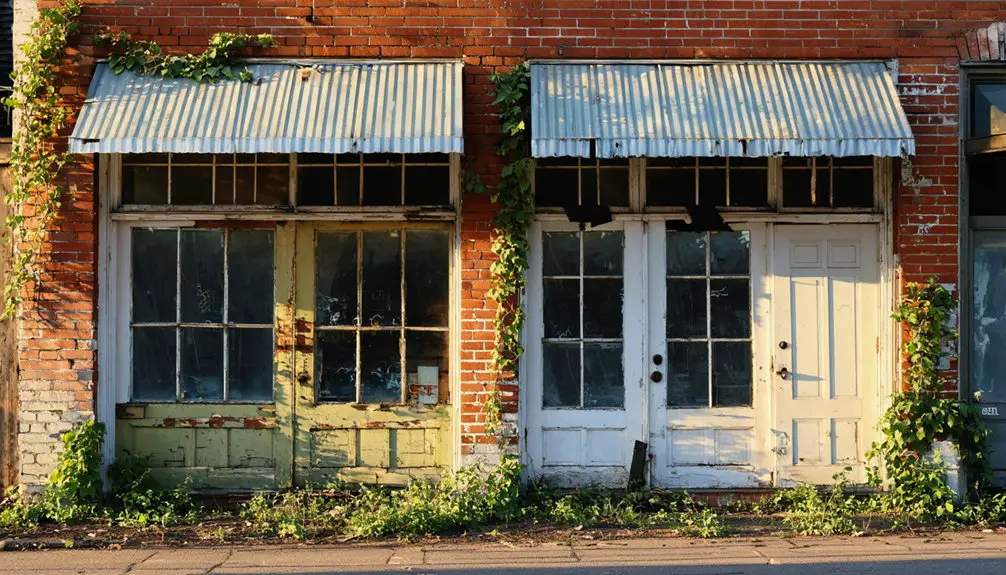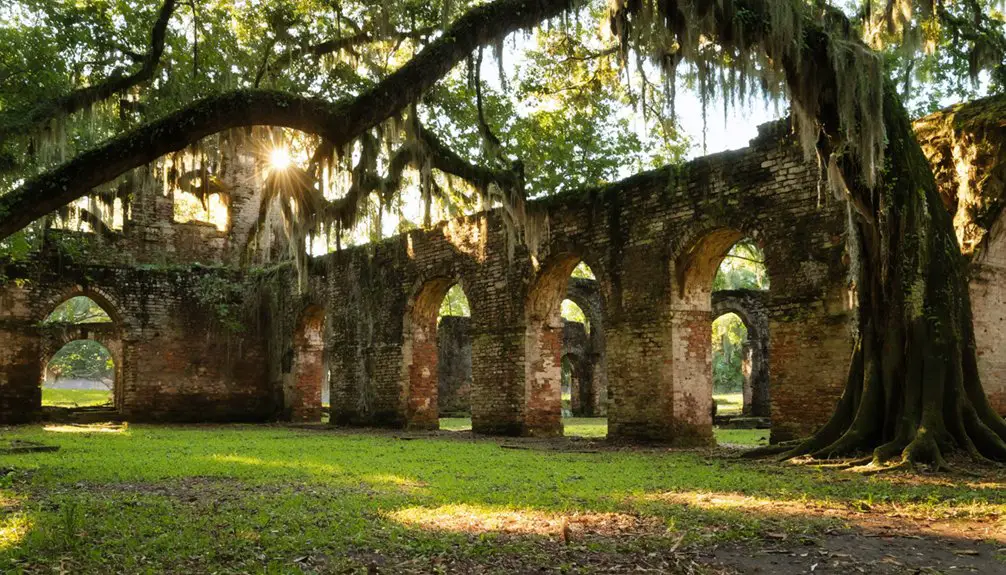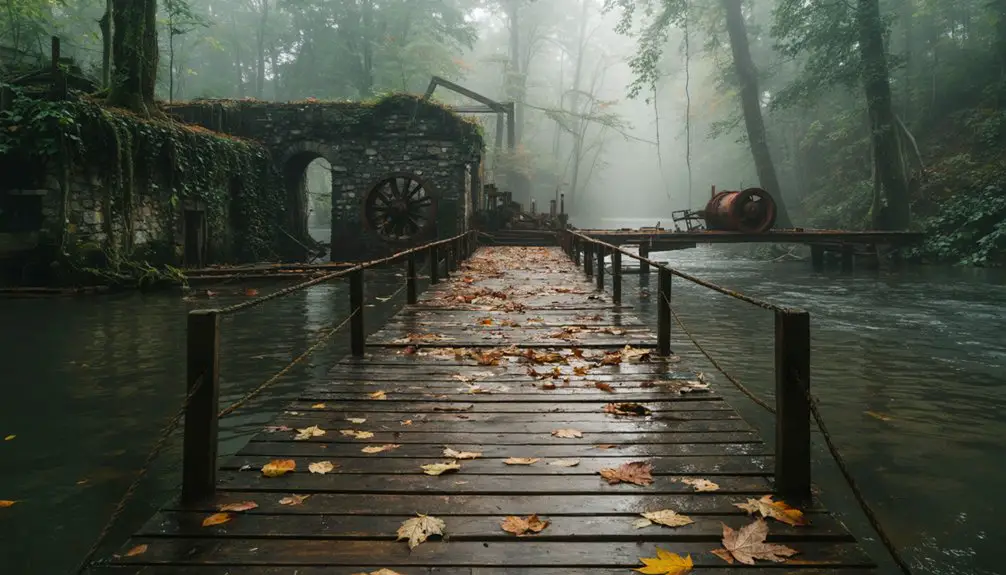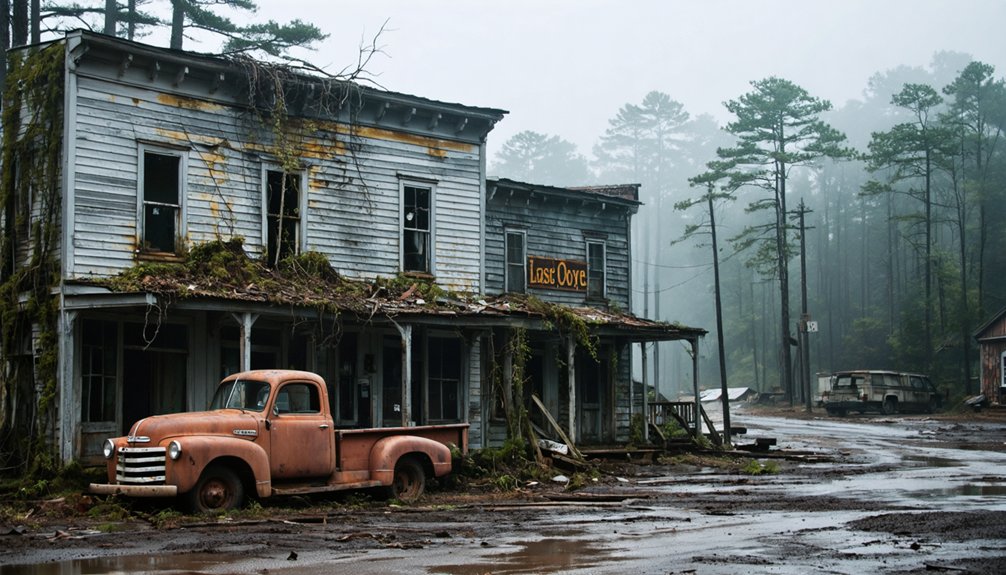
You’ll find fascinating ghost towns scattered across North Carolina, from coastal settlements to mountain communities. Brunswick Town offers colonial-era ruins along the Cape Fear River, while Henry River Mill Village showcases the state’s textile heritage and even appeared in The Hunger Games. Portsmouth Village preserves maritime history on the Outer Banks, and Lost Cove holds mysteries of Appalachian moonshining. Some communities now rest beneath lake waters, their foundations emerging only during extreme droughts.
Key Takeaways
- Brunswick Town was a major colonial port destroyed by British forces in 1776, now preserved as a historic landmark with archaeological ruins.
- Portsmouth Village features 20 historic structures from its heyday as a bustling maritime community before declining in the mid-1800s.
- Henry River Mill Village stands as an abandoned textile town, featuring worker houses and a company store made famous in The Hunger Games.
- Lost Cove, known for moonshining operations, was abandoned in 1958 and contains stone chimneys and building foundations from its century-long history.
- Several ghost towns lie submerged beneath Fontana Lake, including Judson and Proctor, which were flooded during 1940s dam construction.
The Colonial Ruins of Brunswick Town
Though largely forgotten today, Brunswick Town once stood as a prominent colonial settlement along North Carolina’s Cape Fear River. Founded in the 1720s by Roger Moore, this 360-acre planned community thrived as a regional political and commercial hub, exporting naval stores to Europe and the British West Indies.
Recent archaeological findings have revealed fascinating glimpses into colonial life, including a 400-square-foot tavern site and the foundations of St. Philip’s Church. An archaeology student made headlines after discovering the previously unknown tavern structure using ground-penetrating radar.
Archaeologists unearthed colonial treasures at Brunswick Town, from tavern foundations to the historic St. Philip’s Church ruins.
You’ll find remnants of colonial architecture preserved beneath Confederate Fort Anderson’s earthworks, which were built atop the town ruins in 1862.
While British forces destroyed Brunswick Town in 1776 during the Revolutionary War, the site now serves as a protected historic landmark where you can explore interpretive trails and witness ongoing excavations that continue to uncover secrets of this once-bustling colonial port. The town’s residents had earlier demonstrated their revolutionary spirit when they successfully prevented British ships from unloading stamps during the Stamp Act protests of 1765.
Henry River Mill: A Textile Ghost Town
A forgotten tribute to North Carolina’s textile history, Henry River Mill Village began in 1905 when the Aderholdt and Rudisill families established a 1,500-acre manufacturing complex along the Henry River.
The self-contained community included 35 worker houses, a company store that doubled as a church, and a three-story mill built from sun-baked mud bricks. Workers earned “doogaloo” coins, spendable only at the company store, while producing cotton yarn for embroidery and fine lace.
Today, this ghost town stands as a monument to America’s industrial past, with twenty worker cottages still lining the gorge. In 1977, a devastating lightning strike completely destroyed the mill building. The property, spanning 72 scenic acres, is currently listed for sale at over $1 million.
You’ll recognize some buildings from their appearance in The Hunger Games film, where they served as District 12 sets.
Though largely abandoned, the site now offers guided tours and paranormal investigations, preserving its rich textile heritage.
Portsmouth Village: An Outer Banks Time Capsule
Tucked away on North Core Banks along North Carolina’s Outer Banks, Portsmouth Village stands frozen in time as one of America’s most intriguing maritime ghost towns.
You’ll find a remarkable preservation of maritime history in this former thriving port community, established in 1753. At its peak in the 1860s, over 1,400 vessels passed through annually, while 505 residents called it home.
The village residents earned their living through fishing and lightering, serving as a crucial cargo transfer point for North Carolina’s exports.
After the opening of Hatteras and Oregon Inlets in 1846, followed by Civil War disruptions, the village began its slow decline. The last residents departed in 1971, but preservation efforts by the National Park Service have maintained about 20 historic structures, including the Methodist Church, schoolhouse, and Life-Saving Station.
The Friends of Portsmouth Island, formed in 1989, continues to champion the village’s preservation and historical legacy.
Today, you can explore this time capsule through seasonal walking tours, viewing furnished interiors through windows of abandoned homes.
Lost Cove: Secrets of the Appalachian Mountains
You’ll find Lost Cove’s most intriguing secrets in its moonshining legacy, where residents used the town’s jurisdictional ambiguity and remote location to sustain a profitable underground economy from the late 1800s through the 1950s.
The settlers maintained a close-knit community centered around their church and school, surviving through subsistence farming and later incorporating railroad and timber work into their daily routines. Today, stone chimneys and building foundations remain as visible remnants of this once-thriving community.
Theresa A. Lloyd chaired the comprehensive study of Lost Cove that documented its transformation from a thriving settlement to an abandoned ghost town.
Mountain Moonshine Legacy
Deep within the Nolichucky Gorge, Lost Cove’s moonshine legacy began in 1898 when early settlers like the Tiptons and Millers discovered an ideal haven for illicit distilling.
You’ll find that boundary disputes between North Carolina and Tennessee created a perfect jurisdictional void, protecting moonshiners from revenue agents.
Moonshine production thrived in small, hidden stills where families used corn-based processes, while clandestine distribution relied heavily on the CC & O Railroad.
You could spot barrels being loaded into tank containers during strategic train stops, feeding northern syndicate networks.
This profitable enterprise sustained Lost Cove’s population of 100 until 1957, alongside timber and agriculture.
The settlement’s story began when Morgan Bailey traded a shotgun and ten dollars to acquire the initial land from Native Americans.
When passenger trains ceased operations and timber depleted in the 1950s, the community’s lifeline vanished.
The last family departed on January 1, 1958, leaving only memories and century-old graves.
Today, visitors can find two remaining structures of the original settlement hidden in the mountains.
Settlers’ Daily Lives
While Morgan Bailey’s purchase of Lost Cove for $10 and a shotgun marked its official founding during the Civil War era, the settlement’s origins may trace back to two pioneering families from Daniel Boone’s expedition.
You’d find these resilient settlers carving out lives of true independence in remote cabins scattered across 400 acres of fertile mountain soil.
Daily routines revolved around three primary activities:
- Working the land to maintain complete food independence through intensive farming
- Gathering resources from the Nolichucky River and four tributary streams
- Participating in community gatherings that strengthened bonds between neighbors
Until the railroad’s arrival in 1910, you’d witness a completely self-sustaining society where daily tasks centered on agricultural production and mutual support, reflecting the settlers’ fierce commitment to freedom and self-reliance.
Final Exodus Causes
Although Lost Cove thrived as a self-sustaining community for nearly a century, its ultimate decline stemmed from a perfect storm of economic and infrastructural challenges in the mid-1900s.
Despite the community’s resilience, you’ll find that several factors converged to force the final exodus: the depletion of timber resources eliminated significant jobs, while the railroad’s reduced service cut essential supply lines and transportation options.
The settlement’s economic shifts proved insurmountable as moonshining activities drew unwanted federal attention, and isolation intensified when repeated requests for road access were denied.
You’ll understand how the remote location between state lines complicated access to necessary services, while the rugged Nolichucky Gorge terrain prevented alternative development.
Submerged Towns Beneath North Carolina Lakes
Several North Carolina towns lie forever frozen in time beneath the waters of Fontana Lake, submerged during the construction of Fontana Dam in the 1940s.
These lost legacies include once-thriving communities like Judson, Proctor, Bushnell, and Forney, where families lived, worked, and built their dreams. The submerged history becomes visible during extreme low water levels, revealing foundations and remnants of a bygone era.
- Judson’s elementary school, barber shop, and sawmill now rest beneath the lake’s surface, along with the Tennessee River that once sustained its 600 residents.
- Proctor’s bustling lumber operations and homes disappeared when Fontana Lake flooded the area for wartime power generation.
- The controversial “Road to Nowhere” stands as a reminder of broken promises to provide access to family cemeteries, finally settled with a $52 million payment in 2018.
The Rise and Fall of Mountain Communities

You’ll discover that North Carolina’s mountain communities rose rapidly around timber operations in the late 1800s, only to witness their own destruction as aggressive logging practices destabilized the watershed and led to catastrophic flooding.
The extreme geographic isolation of these settlements, tucked away in high-elevation hollows, severely limited their ability to diversify beyond single-industry economies when timber resources were depleted.
While some mountain communities maintained a defiant independence through moonshine production during Prohibition, this cultural practice eventually faded as younger generations sought opportunities in urban areas, leaving behind aging populations in increasingly unsustainable towns.
Timber Industry’s Fatal Impact
While North Carolina’s mountain communities initially flourished during the timber boom of 1900-1920, the industry’s voracious appetite for lumber would ultimately lead to their downfall.
You’ll find the timber decline devastating not only to local economies but also to the very fabric of mountain life.
The ecological destruction was staggering:
- By 1920, companies had stripped 90% of mature Southern forests, leaving only brush and dead tops.
- The chestnut blight of 1920 decimated Champion Fibre’s primary pulp source, forcing major operational changes.
- Severe erosion and flooding destroyed small farms, while industrial runoff poisoned local streams.
These changes proved fatal for many mountain communities.
Once-thriving company towns like Sunburst vanished, leaving behind abandoned settlements as silent testimonies to the industry’s unsustainable practices.
High Isolation Takes Toll
Beyond the timber industry’s devastating impact, geographic isolation proved to be a formidable challenge that ultimately sealed the fate of North Carolina’s remote mountain communities.
You’ll find stark examples in places like Lost Cove, nestled deep within the Nolichucky Gorge, where geographic challenges made daily life increasingly difficult. Without electricity or modern infrastructure, these settlements relied entirely on self-sufficiency until external pressures made their lifestyle unsustainable.
The creation of Fontana Lake in the 1940s further heightened isolation, submerging towns like Proctor and severing vital access routes.
Highway 288’s destruction left communities cut off, while the unfinished “Road to Nowhere” stands as evidence to broken promises. These economic viability issues forced younger generations to seek opportunities elsewhere, leaving behind ghost towns that now serve as haunting reminders of mountain life’s harsh realities.
Moonshine Culture Fades Away
Although North Carolina earned its reputation as the “Old Moonshine State” in the late 1800s, the practice traces its roots to the 1600s when settlers in Albemarle Sound first began distilling spirits.
The moonshine history flourished during Prohibition, with Wilkes County becoming the self-proclaimed “moonshine capital of the world,” generating millions in revenue by the 1950s.
The cultural significance of moonshining left an indelible mark on the region:
- It birthed NASCAR legends like Junior Johnson, who honed their driving skills running whiskey.
- The Mountain Dew brand originated as a moonshine mixer before PepsiCo’s acquisition.
- Traditional terms like “white lightning” and “blockade” became part of local vocabulary.
Today, legal distilleries like Piedmont have replaced the dangerous backwoods operations, though the mountain spirit of independence lives on through regulated craft production.
Forgotten Tourist Attractions and Historic Sites
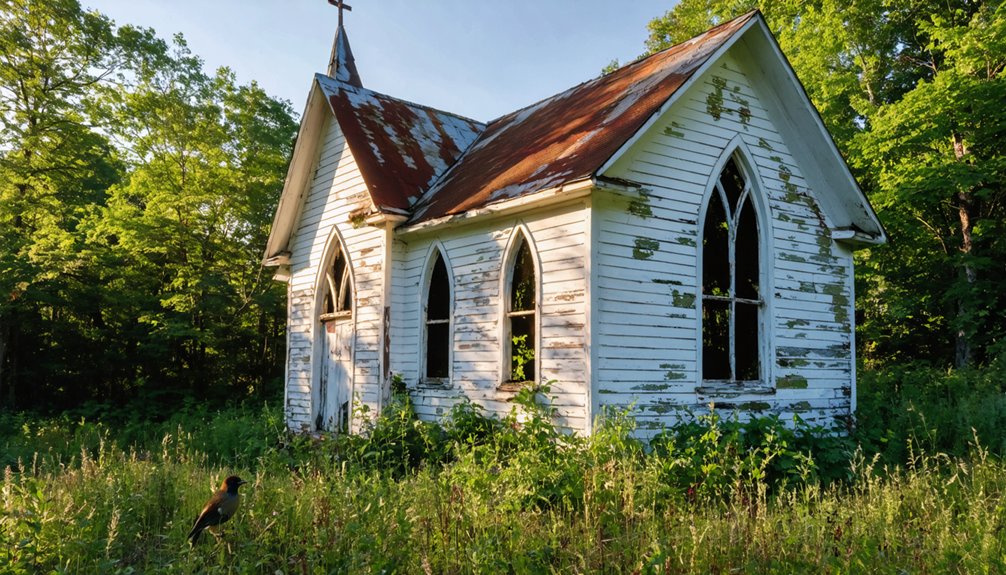
Since the mid-20th century, North Carolina’s forgotten tourist attractions and historic sites have revealed fascinating stories of economic shifts, cultural changes, and societal transformation.
You’ll find Portsmouth Village‘s 21 standing buildings preserving coastal heritage without modern amenities, while Henry River Mill Village stands as a symbol to the textile industry’s rise and fall, recently gaining fame as a film location.
Lost Cove’s abandoned foundations tell tales of timber depletion and rural exodus, hidden in Appalachia’s remote ridges. Beneath Fontana Lake and Lake Glenville, submerged towns like Judson, Proctor, and Glenville rest as underwater monuments to hydroelectric progress.
These ghost towns offer you glimpses into North Carolina’s cultural heritage, from company towns to displaced communities, each site marking distinct chapters in the state’s evolving landscape.
Exploring the ghost towns available in North Carolina can provide a unique perspective on the historical shifts that have shaped the region. Many of these towns are now relics of a bygone era, offering rich stories about the lives that once thrived there. Visitors can walk through the remnants of these communities and connect with the past in a way that feels almost haunting yet profoundly illuminating.
As you journey through the ghost towns in North Carolina, you’ll encounter intriguing remnants of architecture and artifacts that tell vivid stories of their former inhabitants. Each abandoned building and overgrown street serves as a poignant reminder of the dreams and challenges faced by those who once called these places home. It’s an experience that immerses you in the state’s history, evoking a sense of nostalgia and curiosity about the lives that once filled these now-silent spaces.
Frequently Asked Questions
Are There Any Haunted Ghost Towns in North Carolina?
You’ll find haunted legends at Portsmouth Village, Henry River Mill Village, Ghost Town Village, and Brunswick Town, where visitors report eerie experiences among abandoned structures and historic ruins.
What Survival Gear Should I Bring When Exploring Abandoned Towns?
You’ll need survival essentials: GPS, first-aid kit, respirator, sturdy boots, flashlights, water, protective gear, emergency beacon, and communication devices. Don’t forget maps and tools for exploration safety.
Can Metal Detectors Be Used at These Abandoned Sites?
You can’t legally use metal detectors at abandoned sites – it’s prohibited by state and federal laws. You’ll face hefty fines, equipment seizure, and potential jail time for treasure hunting there.
Which Ghost Towns Are Closest to Major North Carolina Cities?
You’ll find Brunswick Town closest to Wilmington’s urban area, while Henry River Mill Village’s historic significance draws urban exploration enthusiasts near Charlotte. Bethel’s accessible from Pitt County’s major cities.
Do Any Ghost Towns Still Have Active Residents Living There?
You’ll find some ghost towns maintain small active communities, with a handful of residents preserving historical buildings and properties. These places aren’t completely abandoned, though they’ve lost most original services and population.
References
- https://www.uncorkedasheville.com/abandoned-places-in-north-carolina/
- https://kids.kiddle.co/List_of_ghost_towns_in_North_Carolina
- https://www.visitnc.com/list/ncs-mysterious-disappearances-and-abandoned-places
- http://www.onlyinyourstate.com/experiences/north-carolina/nc-ghost-towns
- https://www.atlasobscura.com/things-to-do/north-carolina/ghost-towns
- https://www.heritagedaily.com/2021/03/brunswick-town-the-abandoned-colonial-town-in-north-carolina/138101
- https://www.livescience.com/65734-brunswick-town-colonial-tavern-maybe-brothel.html
- https://en.wikipedia.org/wiki/Brunswick_Town
- https://oak-islandnc.com/old-brunswick-town/
- https://historicsites.nc.gov/all-sites/brunswick-town-and-fort-anderson/history/end-brunswick-town