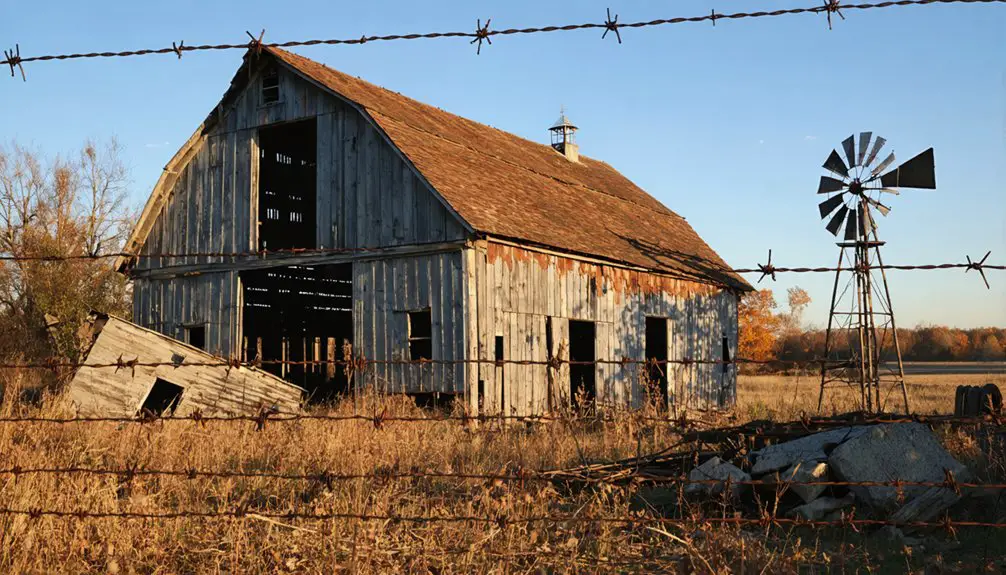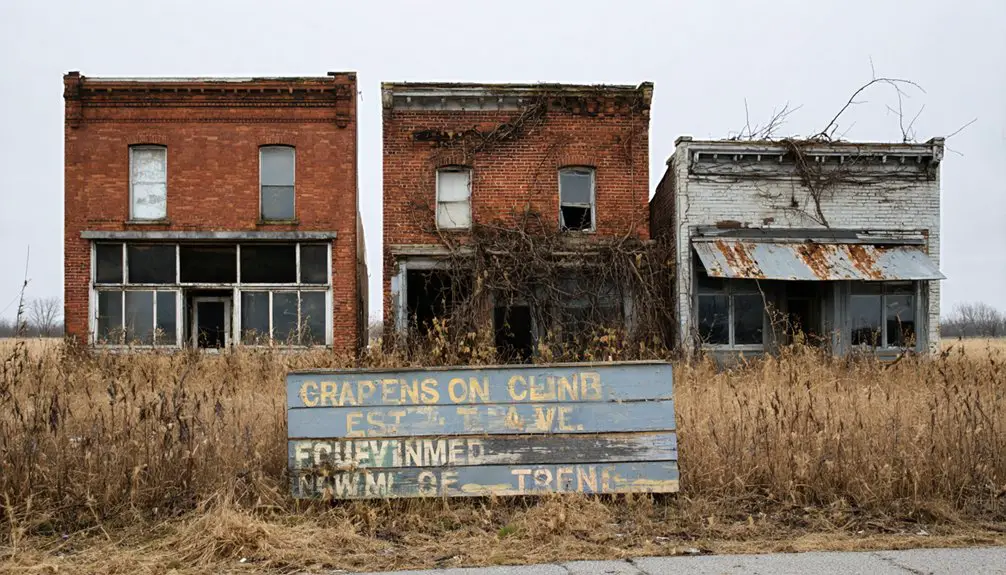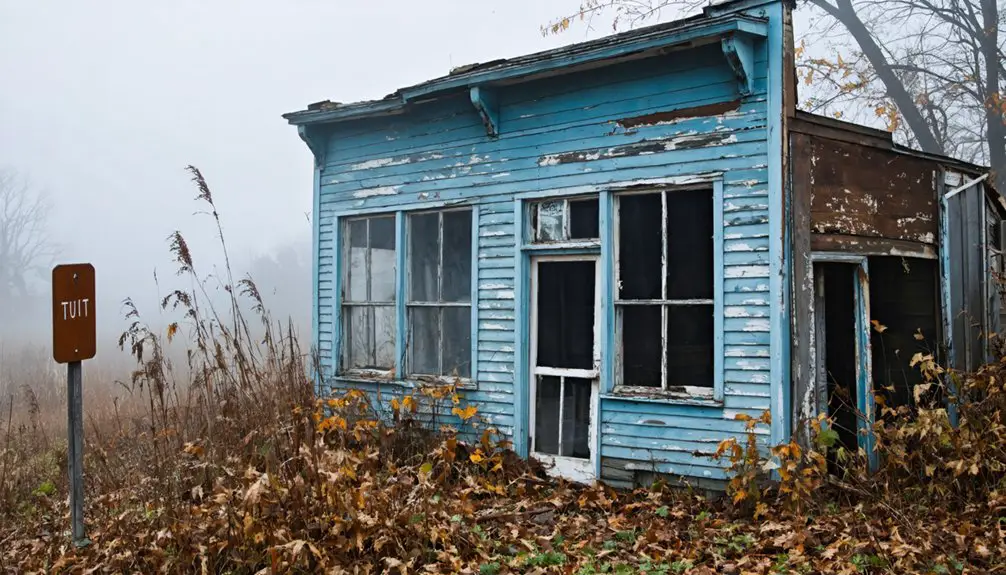
You’ll discover numerous abandoned ghost towns across Ohio, with Moonville, Sprucevale, Vinton Furnace, Fallsville, and Oreton among the most notable. These former communities showcase the state’s industrial and agricultural heritage through preserved structures, including Moonville’s railway tunnel, Sprucevale’s Gaston’s Mill, and Vinton’s Belgian coke ovens. While some sites feature marked trails and historical markers, others require careful navigation and proper safety equipment to explore their fascinating remains.
Key Takeaways
- Moonville, established in 1856, features a haunted tunnel, cemetery, and schoolhouse foundation, with over 21 documented deaths along its railway.
- Sprucevale, founded in 1835, contains the preserved Gaston’s Mill and was once a thriving canal town until its decline in 1852.
- Vinton Furnace, built in 1853, houses the world’s only surviving Belgian coke ovens and produced 3,100 tons of iron at peak operation.
- Fallsville reached 2,000 residents by 1872 and retains a preserved 1891 church, declining after missing crucial railroad connections.
- Oreton peaked at 900 residents during the early 1900s mining boom before declining in the 1950s when coal mines were depleted.
The Haunting Legacy of Moonville
While many ghost towns scatter Ohio’s landscape, few capture the imagination quite like Moonville, a former mining settlement established in 1856 when the Marietta and Cincinnati Railroad laid tracks across Samuel Coe’s property.
The haunted history of this remote outpost stems from over 21 documented deaths along its treacherous single-track railway. You’ll find Moonville legends centered around four distinct specters, including Theodore Lawhead’s lantern-wielding ghost from an 1880s collision and the mysterious brakeman from 1859.
At its peak in 1870, nearly 100 residents called this dangerous railway town home, but by 1947, the last family departed as coal mining declined. The Coes maintained a thriving lumber mill that served as a vital economic hub for the community.
Today, only the tunnel, cemetery, and schoolhouse foundation remain, drawing visitors to explore its ghostly remnants along the Moonville Tunnel Rail Trail. The eerie atmosphere is enhanced by reports of phantom trainmen waving lanterns on the abandoned tracks.
Exploring the Lost Canal Town of Sprucevale
Although the Sandy & Beaver Canal‘s promise of prosperity initially drew settlers to Sprucevale in 1835, this once-thriving canal town now stands as one of Ohio’s most intriguing ghost towns.
The Hambleton brothers established the settlement around a grist mill, and soon the town flourished with businesses including a wool factory, blacksmith shop, and general store.
From a single grist mill, the Hambleton brothers built Sprucevale into a bustling hub of commerce and industry.
You’ll find Sprucevale’s rich history reflected in the roles of James Hambleton, who operated the mill and served on the canal board, and Charles Hambleton, who ran the general store and post office.
When the canal suffered a devastating reservoir break in 1852, the town’s fate was sealed.
Today, ghostly legends surround the abandoned site, including tales of Gretchen, who supposedly died during lock construction, and mysterious Esther, whose stories still echo through Beaver Creek State Park.
The town’s historic Gaston’s Mill remains a preserved landmark that visitors can still explore today.
The detailed history of this fascinating canal town has been preserved in R. Max Gard’s book, published by the East Liverpool Historical Society in 1952.
Remnants of Industry: Vinton Furnace’s Story
Deep in Madison Township’s Vinton Furnace State Experimental Forest stands one of Ohio’s most significant industrial relics. Built in 1853 by Clark, Culbertson and Company, this blast furnace represents an essential piece of America’s industrial heritage.
During its peak operational period in 1857, the furnace demonstrated remarkable efficiency by producing 3,100 tons of iron in just 47 weeks.
You’ll find the world’s only surviving Belgian coke ovens here, constructed from numbered bricks shipped as a kit from Belgium. The ovens required thirty-six hours to complete the coal-to-coke conversion process.
The furnace’s evolution mirrors Ohio’s industrial growth, shifting from charcoal to coke fuel in 1875. At its peak, it produced 20 tons of metal daily, employing immigrants from Ellis Island alongside local women workers.
Though the Jay Cooke crash and subsequent panic of 1879-1880 contributed to its demise, the site’s historic preservation allows you to witness remarkable technological innovations, including water cooling systems and specialized charging devices.
Fallsville: A Forgotten Agricultural Community
Nestled within what’s now the Fallsville Wildlife Area, the forgotten town of Fallsville emerged when John W. Timberlake platted the settlement in 1848, centering it around a grist mill and stone house near Clear Creek’s waterfall.
You’ll find Fallsville’s history closely tied to agriculture, with Simon Clouser’s mill serving as the economic hub for surrounding farms. The population grew steadily until reaching two thousand residents by 1872.
While the town initially thrived with institutions like the Auburn Methodist Church, its fate was sealed by the absence of railroad connections. The town’s original eight houses never expanded due to limited transportation options.
By 1893, after Andrew Payton’s death marked the town’s abandonment, Fallsville’s legacy lived on through intriguing folklore. Tales of buried Native American treasure and the Christmas Eve ghost continue to captivate visitors.
Today, you can explore the site’s remnants, including the preserved 1891 church building and traces of old pathways within the wildlife area.
The Rise and Fall of Oreton
A tribute to Ohio’s industrial heritage, Oreton Station emerged in 1853 as an essential company town serving the region’s coal, railroad, and iron furnace operations.
You’ll find this Brown Township settlement reached its peak during the early 1900s mining boom, joining over 70 thriving mining communities across southeast Ohio. The town’s prosperity centered around the historic Richland Furnace, now commemorated by Ohio Historical Marker #1-82. The Eagle Furnace ruins remain partially visible among the scattered remnants of the town.
Today, you can explore Oreton’s remains, where only the brick safe from the general store stands among scattered foundations and rubble. At its height, the bustling community boasted a population of 800-900 residents.
The town’s decline followed the depletion of coal mines by the 1950s, leading to its eventual abandonment. While most structures have vanished, you can still trace Oreton’s history through the remnants of the furnace, Richland Tunnel, and building ruins.
Helltown: Myths and Mysteries
While many ghost towns fade quietly into history, Boston Township’s transformation into “Helltown” stands as one of Ohio’s most intriguing cases of folklore evolution.
When federal land acquisitions in the 1970s led to widespread property buyouts, the resulting landscape of boarded-up homes and burned buildings became fertile ground for supernatural speculation.
Helltown legends flourished around compelling focal points: an allegedly satanic church with Gothic architecture, a mysterious abandoned school bus, and the infamous Crybaby Bridge.
Helltown’s geography played a vital role in myth-making – closed roads created maze-like corridors, while dense forests and scattered ruins provided the perfect backdrop for tales of mutants and hidden cults.
You’ll find these stories preserved and amplified through various media, from paranormal blogs to YouTube documentaries, cementing Helltown‘s reputation in American folklore.
Preserving Ohio’s Ghost Town Heritage

Beyond the haunting legends and mysterious tales, Ohio’s ghost towns represent invaluable historical treasures requiring dedicated preservation efforts.
Among these intriguing sites, the ghost towns available in Ohio offer a glimpse into the state’s rich past, showcasing abandoned structures and forgotten communities. The stories etched into the walls of these towns serve as reminders of the lives that once thrived there, inviting exploration and reflection. Efforts to restore and promote these locations not only preserve history but also attract tourists keen to experience the eerie allure of Ohio’s forgotten landscapes.
As visitors wander through ghost towns in Ohio’s landscape, they encounter remnants of vibrant communities that once buzzed with life. Each building and pathway tells a story of resilience and change, evoking curiosity about the people who shaped these environments. By engaging with these sites, we not only honor their past but also promote a deeper understanding of Ohio’s varied history.
You’ll find organizations like the Moonville Rail Trail Association and Friends of White Water Shaker Village leading vital restoration projects that protect these cultural landmarks. The historical significance of sites like White Water’s 1827 Meeting House – America’s last brick Shaker meeting house – demands careful stewardship for future generations.
At Beaver Creek State Park, you can explore meticulously restored structures like Gaston’s Mill, while the Ohio Ghost Town Exploration Co. documents and maps these historic locations.
Through groups like Preservation Ohio and Heritage Ohio, you’re witnessing a coordinated effort to save threatened buildings, from the relocation of the Jagger House to the preservation of the Aten Log Barn.
Planning Your Ghost Town Adventure
When you’re planning to explore Ohio’s ghost towns, you’ll need to carefully consider essential safety measures like bringing GPS devices, maps, and first aid supplies while avoiding dangerous areas after dark.
The best times to visit these abandoned sites are during spring and fall when vegetation is moderate and temperatures are mild, though you should check weather forecasts and road conditions in advance.
Your adventure pack should include sturdy hiking boots, protective clothing, a camera, plenty of water, and documentation showing which locations are publicly accessible.
Safety First When Exploring
Although exploring abandoned ghost towns offers a fascinating glimpse into Ohio’s past, proper safety planning remains crucial to prevent injuries and legal complications.
Before visiting, you’ll need to verify land ownership, obtain necessary permissions, and research documented hazards through local records and databases.
Implement core safety protocols by equipping yourself with protective gear: hard-soled boots, puncture-resistant gloves, and appropriate respiratory protection.
You’ll also want reliable lighting, navigation tools, and emergency medical supplies. Always explore in groups of three or more, establishing clear roles and emergency plans.
Share your detailed itinerary with an off-site contact and maintain communication protocols throughout your visit. This methodical approach to emergency planning helps guarantee you can freely explore while remaining prepared for potential challenges.
Best Seasons To Visit
Selecting the right season for ghost town exploration in Ohio can dramatically impact both access and experience quality.
Fall (September-November) offers peak conditions with stable weather and stunning seasonal photography opportunities, though you’ll need to watch for hunters in rural areas.
Late spring through early summer provides excellent wildlife observation chances while maintaining good site access as roads dry out from the spring thaw.
Winter exploration reveals hidden structural features through snow cover but requires serious preparation and winter-ready vehicles.
You’ll find specific timing sweet spots depending on the site type – railroad tunnels are best explored in dry conditions, while canal towns are most accessible during low water periods in late summer.
Match your visit to both seasonal conditions and the ghost town’s unique characteristics for ideal results.
Essential Gear To Pack
Proper gear preparation stands between success and failure when exploring Ohio’s abandoned settlements. Your packing checklist should prioritize safety and documentation while maintaining mobility.
Start with a 45L waterproof backpack that’ll protect your gear essentials from the elements and debris you’ll encounter.
For protection, you’ll need durable boots, knee pads, and tactical gloves to navigate hazardous terrain. Don’t forget your high-lumen torch and head lamp for dark interiors, plus backup batteries. A proper respirator and N95 mask are non-negotiable for avoiding harmful particles.
Your smartphone and camera will document discoveries, while offline maps guarantee you won’t get lost. Pack a thorough first aid kit, multi-tool, and water with energy snacks to maintain stamina throughout your expedition.
Frequently Asked Questions
Are There Any Guided Tours Available to These Ghost Towns?
You’ll find guided exploration through Ohio Ghost Town Exploration Co., though they focus on research rather than regular tours. Local history societies occasionally offer special access to specific abandoned settlements.
What’s the Best Season to Visit Ohio’s Abandoned Towns?
With 70% clearer sightlines to historic structures, fall’s your best time to explore. You’ll find comfortable 50-65°F days, stunning foliage, and fewer seasonal restrictions between late September and November.
Can Metal Detecting Be Done at These Ghost Town Sites?
You’ll need written permission for metal detecting due to strict regulations. Most ghost town sites are private property, and historical artifacts are protected by federal laws including the Antiquities Act.
Are Camping Facilities Available Near Any of These Locations?
Like stars dotting a forest night, you’ll find camping options scattered nearby. You can choose developed sites at Lake Hope State Park, primitive spots in Zaleski Forest, or backcountry camping following local regulations.
Do You Need Special Permits to Photograph These Abandoned Sites?
You’ll need permits for commercial photography at most abandoned sites due to their historical significance. Check local regulations, obtain property owner permission, and secure municipal permits before documenting these locations.
References
- https://kids.kiddle.co/List_of_ghost_towns_in_Ohio
- https://ohioghosttowns.org/top-10-ghost-towns/
- https://wrkr.com/ohio-ghost-towns/
- https://www.atlasobscura.com/things-to-do/ohio/abandoned
- https://www.youtube.com/watch?v=QWTtG6njIDs
- https://ohiohome.org/news/blog/october-2022/ghosttowns.aspx
- https://ohioghosttowns.org
- https://www.ohiotraveler.com/moonville-its-a-ghost-town/
- https://www.moonvilletunnel.net/Moonville_History.htm
- https://www.ravenwoodcastle.com/2015/07/14/legends-lore-moonville-tunnel/