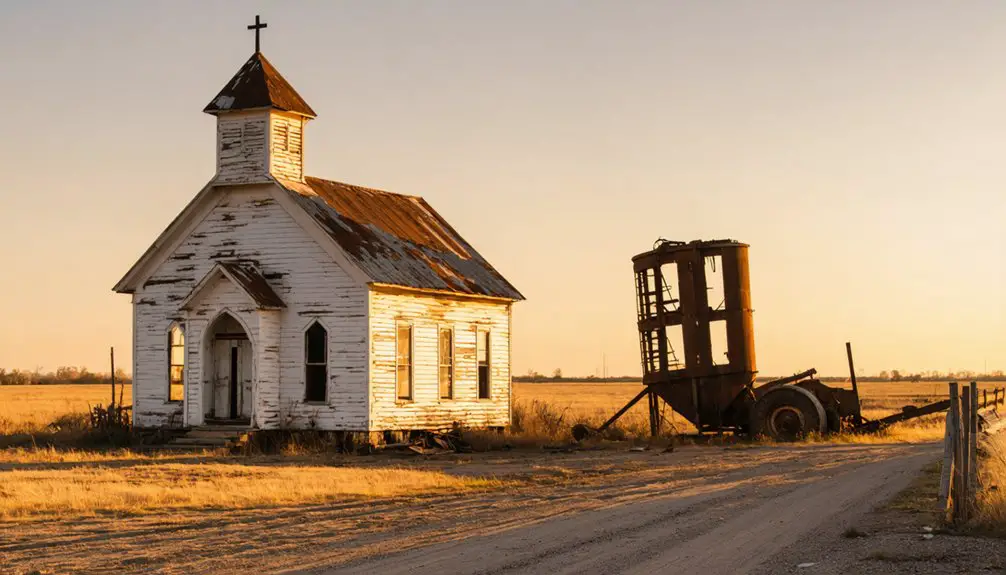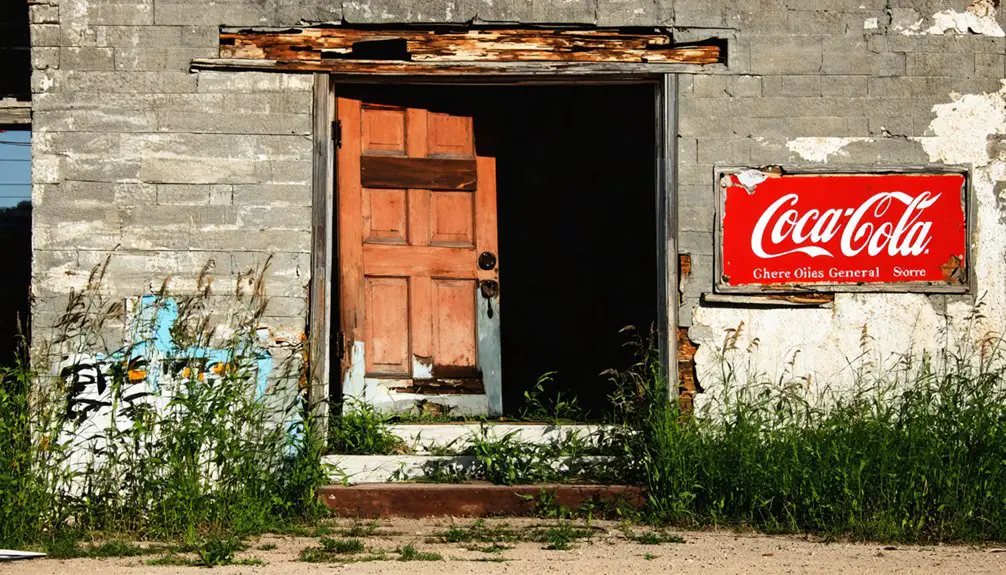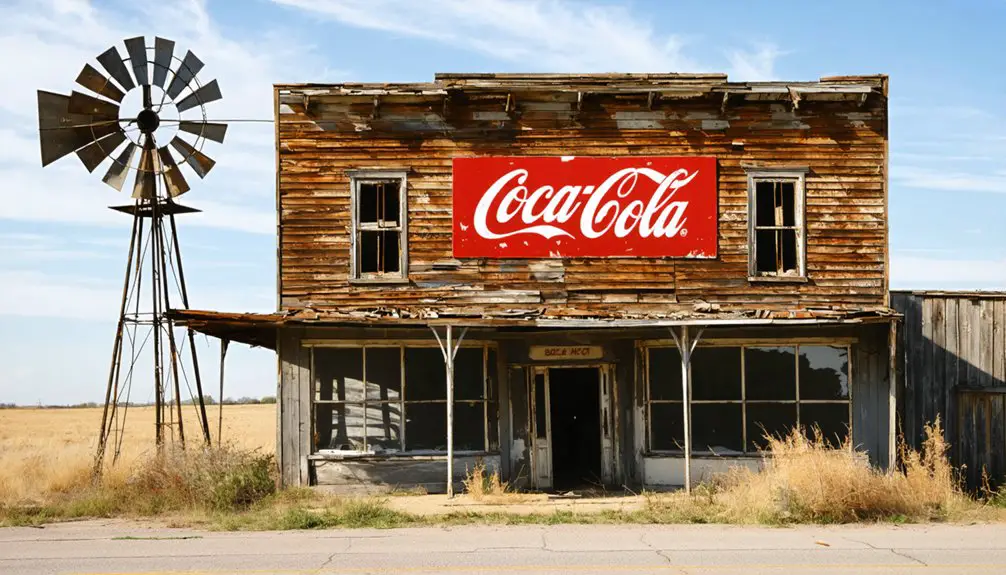
You’ll find Oklahoma’s ghost towns scattered across landscapes that once buzzed with coal mining activity from 1872 and oil boom prosperity in the 1920s. These abandoned settlements, from toxic Picher to the lawless Whizbang, tell stories of rapid growth and equally swift decline. The Great Depression forced nearly half a million residents to flee, leaving behind empty streets and crumbling structures. Today, nearly 2,000 ghost towns hold secrets of Oklahoma’s dramatic past, waiting for careful explorers to uncover their tales.
Key Takeaways
- Oklahoma has nearly 2,000 documented ghost towns, primarily arising from mining operations, oil booms, and railroad development since 1872.
- Picher, a former mining town, was abandoned due to toxic contamination from lead mining, creating severe environmental and health hazards.
- The historic town of Ingalls preserves the legacy of the Doolin-Dalton Gang and offers visitors glimpses into Oklahoma’s frontier past.
- Railroad decisions significantly impacted town survival, with communities like Boggy Depot and Parkersburg becoming ghost towns after being bypassed.
- The Great Depression caused massive population decline, with nearly half a million residents leaving Oklahoma’s towns and communities.
The Rise and Fall of Oklahoma’s Mining Towns
While Oklahoma’s landscape today bears little resemblance to its bustling mining past, the state’s rich mineral deposits once spawned dozens of thriving communities throughout its eastern and northeastern regions.
You’ll find the mining town origins trace back to 1872, when the Osage Coal and Mining Company first established operations in Indian Territory. These settlements rapidly expanded across 12,000 square miles, with powerhouse districts like McAlester and Coalgate leading the charge. By 1900, a comprehensive rail network system connected these mining communities.
The company town dynamics shaped early life, as mining operators controlled everything from housing to retail stores, paying workers in scrip rather than cash. Oklahoma’s coal industry experienced remarkable growth, reaching production of nearly 6 million tons by 1981.
Oklahoma’s Oil Boom Ghost Towns: A Legacy of Black Gold
As Oklahoma’s mining towns faded into history, a new wave of boomtowns emerged with the discovery of oil in the 1920s.
You’ll find the most notorious example in Whizbang, which sprang up overnight after E.W. Marland’s successful oil discovery yielded 600 barrels daily. The town quickly gained notoriety for its lawless atmosphere and dangerous boomtown culture. In its peak, the town featured over 300 businesses and rapid development. At Little Chief Creek, the area’s bustling community contributed to the region’s oil legacy during this era.
These oil communities followed a familiar pattern: rapid growth followed by swift decline.
Carter Nine, a company town with 300 houses, vanished by the 1950s. Slick’s population plummeted from 5,000 to under 500 in just a decade.
As automation increased and independent workers departed, once-bustling communities like Shamrock, Foraker, and Grainola dwindled to mere shadows of their former glory, leaving behind empty streets where black gold once promised endless prosperity.
Railroad-Era Ghost Towns and Their Stories
You’ll find Oklahoma’s railroad-era ghost towns scattered along the iron rails that once promised prosperity and connection to distant markets.
The Missouri, Kansas and Texas Railroad’s strategic routing decisions in 1872 determined which communities would thrive and which would fade, as demonstrated by Boggy Depot’s decline after being bypassed and Parkersburg’s complete abandonment when rail lines intersected in nearby Clinton.
Economic competition between towns intensified as rival town promoters fought to establish dominance, often leading one community to prosper while others disappeared entirely.
From thriving railroad stations to silent ruins, these forgotten communities tell the story of how rail placement could transform a bustling town of 700 residents into empty streets within just a few years. Many towns were ultimately deserted after being bypassed by highways, leading to significant population loss as commerce shifted to more accessible locations.
Life Along Rail Lines
During Oklahoma’s railroad era, the placement of rail lines wielded extraordinary power over a town’s fate, creating and destroying communities with the stroke of a surveyor’s pen.
You’ll find that railway expansion dramatically shaped population migration, as settlers flocked to new stations while abandoning bypassed settlements. When the Missouri, Kansas and Texas Railroad bypassed towns like Boggy Depot in 1872, you could watch these once-thriving communities wither away.
Railroad tycoons strategically planned routes through the Cherokee Outlet to capitalize on cattle markets, while their subsidiaries established new towns for freight and land sales profits. Corporate land schemes often involved railroads building entirely new towns instead of working with existing settlements.
The stark reality of this transformation becomes clear when you consider places like Parkersburg, which boasted 700 residents in 1901 but became a ghost town by 1904 after railroads chose Clinton instead. This pattern of decline continued into modern times, as seen in Gage where the population dropped from nearly 1,000 residents in 1910 to just 433 today.
Ghost Stations Today
Railroad-era ghost towns scatter across Oklahoma’s landscape like fading echoes of the past, their abandoned structures telling stories of rapid rise and decline.
Today, you’ll find ghost station remnants throughout the state, from Kenton’s preserved museum to Kosoma’s weathered buildings. Oil boom discoveries fueled the establishment of many of these towns before their eventual abandonment. While some communities like Gage have managed modest economic resurgence, maintaining 433 residents from a peak of 1,000, others have vanished entirely.
You can explore Skedee’s abandoned structures in Pawnee County or witness Lehigh’s remaining buildings in Coal County. The railroad’s impact remains visible in places like Parkersburg, where an entire town relocated when rail lines favored Clinton just three miles away.
These silent sentinels serve as reminders of how railroad routing decisions shaped Oklahoma’s development and decline.
Lost Towns Beneath Oklahoma’s Lakes
As you explore Oklahoma’s submerged communities, you’ll find Lake Texoma’s waters concealing once-vibrant towns like Woodville, which had 360 residents before its 1944 inundation.
Oklahoma’s major reservoirs, including Lakes Eufaula, Keystone, and Sardis, have transformed numerous historic settlements into underwater archaeological sites, preserving their foundations, farm implements, and structural remains. The town of Ringo met a similar fate when its remaining structures, including a historic hotel, disappeared beneath Lake Sardis.
When drought conditions lower water levels, you can glimpse the remnants of these lost communities, such as Uncas’ building foundations and Lugert’s storm-ravaged ruins, offering rare windows into Oklahoma’s past.
Lake Texoma’s Submerged Communities
When the Denison Dam’s construction reached completion in 1944, Lake Texoma‘s waters submerged multiple thriving communities in Oklahoma’s Washita Valley.
You’ll find the submerged heritage of towns like Finchtown, Woodville, and Aylesworth now lying silent beneath the lake’s surface. Woodville, once home to 360 residents and named after prominent Chickasaw citizen Judge L. Lipscomb Wood, represents one of the forgotten legacies lost to progress.
The flooding displaced countless families who received inadequate compensation for their lands.
When water levels drop during droughts, you can glimpse remnants of these communities through exposed gravestones, foundations, and artifacts.
Even today, as boats glide across Lake Texoma’s waters, few realize they’re passing over the remnants of vibrant towns where schools, farms, and businesses once flourished.
Historic Ruins Under Water
Throughout Oklahoma’s vast network of man-made lakes, numerous ghost towns lie submerged beneath the waters, sharing a common fate with Lake Texoma’s lost communities.
You’ll find Lugert’s foundations emerging during severe droughts when Lake Altus-Lugert drops to critical levels, offering rare glimpses into this submerged history. The remnants of Uncas rest peacefully under Kaw Lake, where farming tools and building foundations await underwater exploration.
North Fork Town, site of the historic 1842 Grand Council between tribal nations, now slumbers beneath Lake Eufaula’s depths. When drought conditions reveal these lost towns, you can walk where residents once lived their daily lives, touching tangible connections to Oklahoma’s past.
Each reservoir holds stories of communities that sacrificed their homes for regional water security.
Mapping Drowned Oklahoma Towns
Oklahoma’s vast network of reservoirs conceals dozens of submerged communities, each with its own compelling story of displacement and sacrifice.
You’ll find drowned landmarks beneath Kaw Lake, where the streets of Kaw City, Uncas, and Washunga still trace their original paths underwater.
At Lake Texoma, you can map the locations of Woodville, Preston, and Cedar Mills – once-thriving communities now hidden beneath the surface.
The submerged history continues at Lake Eufaula, where North Fork Town’s Gold Rush-era crossroads and Adamson’s coal mining legacy rest in silence.
Keystone Reservoir claimed its namesake town of 500 residents, while other lakes like Altus-Lugert and Sardis harbor their own sunken settlements.
Today, these underwater ghost towns serve as silent monuments to Oklahoma’s transformed landscape.
Environmental Hazards and Abandoned Communities
Beneath the surface of abandoned Oklahoma mining towns lies a toxic legacy of environmental contamination that continues to threaten human health and safety.
You’ll find vast chat piles laden with lead, zinc, and cadmium towering over former communities like Picher, where contaminated dust carries toxic particles into the air you breathe and the water you drink.
The threat isn’t just theoretical – studies from the 1990s revealed that one-third of Picher’s children suffered from lead poisoning, leading to cognitive deficits and developmental delays.
Wind and rain continuously spread these hazards, while unstable mine shafts create sinkholes that can swallow buildings whole.
Despite remediation efforts, the sheer scale of contamination means some of these toxic landscapes will remain dangerous for generations to come.
Notable Ghost Towns Worth Exploring

Several fascinating ghost towns dot Oklahoma’s landscape, offering glimpses into the state’s Wild West heritage and boom-and-bust cycles.
These ghost towns in Oklahoma tell stories of prosperity and decline, with remnants of old buildings and rusted machinery serving as reminders of the past. Some of these sites have become popular spots for adventurous travelers and history enthusiasts looking to explore the state’s intriguing narrative. Each visit provides an opportunity to reflect on the lives that once filled these now-silent streets.
For those intrigued by these remnants of history, there are numerous ghost towns for sale in Oklahoma, providing a unique opportunity for investment or renovation projects. Imagine owning a piece of history as you breathe new life into these forgotten places, turning them into vibrant destinations for future generations. With the right vision, these towns can transform into more than just memories of the past; they could become thriving hubs of creativity and community.
Among the most notable ghost town discoveries, you’ll find Ingalls, where the infamous Doolin-Dalton Gang once roamed and a dramatic 1893 shootout unfolded at the Old Ingalls Hotel. You can still explore the Wilson General Store and R.M. Saloon remnants that witnessed this historical significance.
While towns like Marena and Lawrie have largely vanished except for their cemeteries, Pleasant Valley’s old schoolhouse stands as a silent sentinel to its past.
For a more substantial experience, visit Lovell near Roxana, where preserved structures continue to showcase the region’s oil field heritage, offering a tangible connection to Oklahoma’s frontier days.
The Great Depression’s Impact on Oklahoma Towns
If you’d visited Oklahoma towns during the Great Depression, you’d have witnessed a dramatic population exodus as nearly half a million residents fled devastating economic conditions, with unemployment affecting 300,000 out of 800,000 urban dwellers.
The economic collapse hit particularly hard in agriculture-based communities, where farm income plummeted 64 percent and crop prices fell 30 percent in the first two years alone.
Many towns became shells of their former selves as businesses shuttered, farms were abandoned, and desperate residents established makeshift settlements like Oklahoma City’s fifty-square-mile Hooverville, where displaced people lived in wooden crates and old car bodies.
Population Exodus Patterns
During the harrowing 1930s, Oklahoma’s rural communities experienced an unprecedented population exodus that would permanently alter the state’s demographic landscape.
You’ll find the most dramatic migration influences in western counties, where population losses exceeded 25%, driven primarily by farming families and agricultural laborers fleeing the devastation of the Dust Bowl.
The demographic shifts weren’t uniform across the state. While western and panhandle regions saw their communities dissolve, urban areas like Oklahoma City and Tulsa remained relatively stable.
You’ll notice that younger adults and working-age males led the exodus, mainly heading to California’s promise of opportunity.
Railroad routes and established “Okie” networks heavily influenced migration patterns, with western Oklahoma residents typically moving further west while eastern residents gravitated toward nearby urban centers.
Economic Activity Collapses
The catastrophic economic collapse that struck Oklahoma in the 1930s devastated both rural and urban communities, creating a ripple effect that would transform entire towns into ghost settlements.
You’d have witnessed an unprecedented economic decline as farm income plunged 64%, forcing hundreds of thousands of tenant farmers from their land. The oil industry’s collapse, with barrel prices falling to just twenty-two cents, intensified the crisis.
Community displacement reached staggering levels when unemployment soared to 38% in urban areas, affecting 300,000 of the 800,000 urban residents.
The combined impact of plummeting crop prices, oil industry layoffs, and widespread farm foreclosures emptied entire communities.
Despite Governor Murray’s efforts to provide relief through martial law and seed distribution, many towns couldn’t sustain their populations as residents fled in search of economic survival.
Preserving Oklahoma’s Ghost Town History

As Oklahoma’s ghost towns fade into distant memory, dedicated preservationists and historians work tirelessly to document these abandoned places before they vanish completely.
You’ll find their cultural preservation efforts scattered across nearly 2,000 ghost towns, where faded signs and stone foundations tell stories of boom-and-bust cycles, natural disasters, and economic shifts that shaped the state’s history.
The No Man’s Land Museum and former Picher Mining Museum have played essential roles in historical documentation, safeguarding artifacts and narratives for future generations.
While some buildings, like the Picher museum, have been lost to time, their collections live on in other institutions.
You can still explore these forgotten places through detailed books, photographs, and oral histories, while a small number of dedicated residents maintain their ancestral properties, serving as living links to Oklahoma’s vanishing past.
Hidden Remnants: What Survives Today
Modern remnants of Oklahoma’s ghost towns paint a diverse picture of abandonment across the state’s landscape. For urban exploration enthusiasts, hidden treasures await in these forgotten places, from Picher’s toxic-laden streets to the limestone ruins of eastern Oklahoma.
Oklahoma’s ghost towns stand as eerie monuments to forgotten dreams, where adventurous souls discover stories buried in abandoned streets and decaying ruins.
You’ll find varying degrees of preservation, with some towns completely reverting to farmland while others maintain small communities among their abandoned structures.
- Picher’s grid system remains visible, though hazardous sinkholes and mining waste make exploration dangerous.
- Historic all-Black towns showcase deteriorating infrastructure with unpaved roads and crumbling bridges.
- Eastern Oklahoma holds the densest concentration of remnants, including Pushmataha County’s 13 ghost towns.
- Southwestern communities like Hollister and Gotebo offer accessible ruins and abandoned buildings for exploration.
Safety and Legal Considerations for Ghost Town Visits
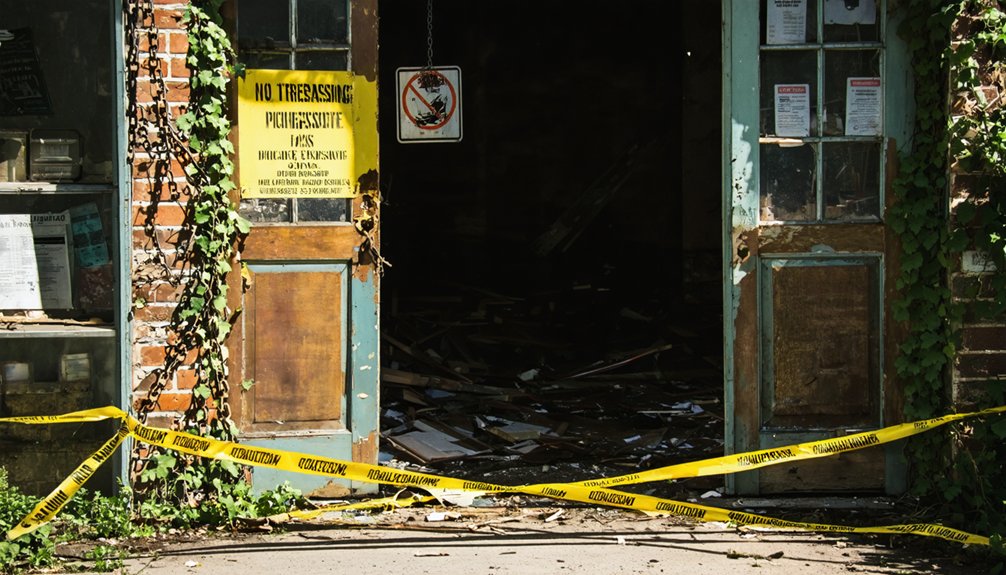
Exploring Oklahoma’s ghost towns comes with significant legal and safety challenges that require careful preparation.
You’ll need to navigate complex trespass laws by securing proper permissions from private owners, municipalities, or federal authorities before visiting these sites. Many properties remain privately owned, and unauthorized entry could result in prosecution.
Environmental risks pose serious health threats at abandoned locations. You’ll encounter toxic chat piles, lead contamination, and hazardous building materials like asbestos, particularly in former mining towns like Picher.
Structural hazards include unstable buildings, hidden sinkholes, and underground mine subsidence. To protect yourself, wear appropriate PPE including respirators and sturdy boots, maintain safe distances from marked structures, and stay on designated paths.
Always check county records and EPA guidance before visiting, and respect posted warnings and access restrictions.
Frequently Asked Questions
Are There Any Ghost Towns in Oklahoma That Are Still Partially Inhabited?
With 25 families still residing there, you’ll find Blackburn stands as a partially inhabited ghost town, while Kenton, Knowles, and Lost City maintain historical significance through operational post offices.
What Paranormal Activity Has Been Reported in Oklahoma’s Ghost Towns?
You’ll find haunted locations throughout Oklahoma’s ghost towns, with reports of shadowy figures, unexplained footsteps, mysterious voices, cold spots, and ghostly encounters near abandoned buildings, lakes, and historic downtown areas.
Exploring the hidden gems in Oklahoma Panhandle reveals more than just eerie tales; you’ll also encounter stunning landscapes and unique cultural sites that are often overlooked. The region is home to vibrant art installations, historical markers, and natural wonders that invite exploration and appreciation. Whether you’re hiking through picturesque terrains or visiting local artisan shops, there’s an adventure waiting at every turn.
How Many Ghost Towns Were Native American Settlements Before Becoming Abandoned?
Through mist-shrouded plains and ancient trails, you’ll find at least seven confirmed Native settlements that became ghost towns – including Hochatown, Gray Horse, and several Potawatomi communities of historical significance.
Which Oklahoma Ghost Towns Have Been Used as Movie Filming Locations?
You’ll find notable ghost town films shot in Pawhuska and Fairfax for “Killers of the Flower Moon,” while Cogar served as a filming location for “Rain Man.” Picher’s toxic ruins appear in several documentaries.
Can Metal Detecting Be Legally Done in Oklahoma’s Ghost Towns?
While you might want to explore freely, you’ll need proper permits and permissions. Metal detecting laws protect historical preservation in ghost towns, whether they’re on private, state, or federal land.
References
- https://en.wikipedia.org/wiki/List_of_ghost_towns_in_Oklahoma
- https://kids.kiddle.co/List_of_ghost_towns_in_Oklahoma
- http://sites.rootsweb.com/~oktttp/ghost_towns/ghost_towns.htm
- https://www.youtube.com/watch?v=5d-wHDTIbb0
- https://pocketsights.com/tours/tour/Shamrock-Oklahoma-Ghost-Towns-Creek-Lincoln-Payne-and-Pawnee-Counties-2749
- https://abandonedok.com/class/disappearing-town/
- https://www.okhistory.org/publications/enc/entry?entry=GH002
- https://www.okhistory.org/publications/enc/entry?entry=MI042
- https://www.okhistory.org/publications/enc/entry?entry=CO001
- https://en.wikipedia.org/wiki/History_of_Oklahoma