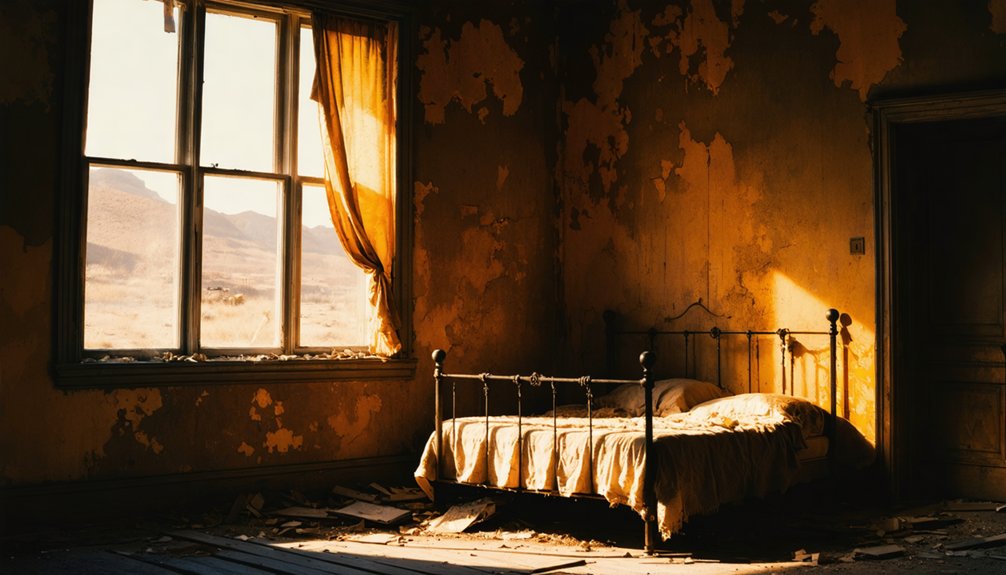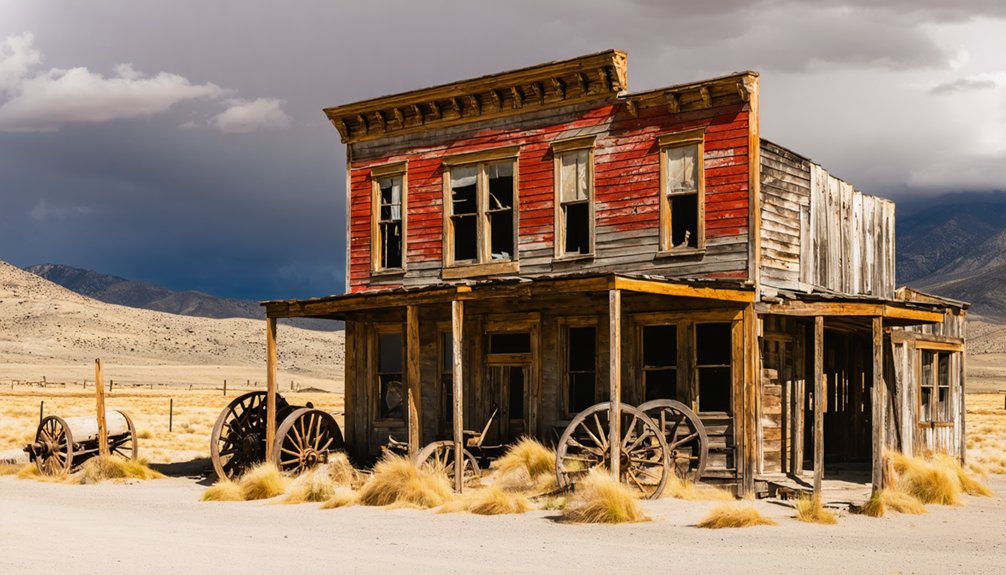
You’ll find over 200 ghost towns scattered across Ontario, each telling unique stories of boom-and-bust cycles. From Balaclava’s million-board-feet sawmill empire to Cobalt’s silver mining heritage that produced 420 million ounces, these abandoned communities showcase the province’s rich resource history. While some towns like Burchell Lake remain perfectly preserved, others are transforming into tourism destinations. Ontario’s forgotten settlements hold fascinating tales of industry, innovation, and the communities that once called them home.
Key Takeaways
- Ontario contains over 200 ghost towns, with Burchell Lake recognized as the most complete abandoned settlement in the province.
- Balaclava’s abandoned sawmill empire once produced one million board feet of lumber weekly before closing in 1959.
- Mining ghost towns like Cobalt and Elliot Lake emerged during resource booms but declined when minerals were depleted.
- Greater Sudbury region contains 123 abandoned communities, primarily resulting from historical mining operations.
- Many ghost towns are now tourist attractions, with some historic structures converted into hotels or short-term rental properties.
The Rise and Fall of Balaclava’s Sawmill Empire
While many ghost towns across Ontario faded into obscurity, Balaclava’s rise and fall stands as a monument to Upper Canada’s booming timber industry. The town’s sawmill history began between 1855 and 1861 when Duncan Ferguson and Donald Cameron built their operation on the Madawaska River near Constant Lake.
You’ll find the roots of this once-thriving community in the rich coniferous forests that drew European settlers seeking their fortune. William Hunter constructed a gristmill downstream, setting the stage for future environmental concerns. A historic pollution lawsuit between 1904-1909 forced the Richards family to install Ontario’s first sawdust burner.
At its peak, the sawmill churned out an impressive million board feet per week, with trees falling by the hundreds daily. The Richards family’s 89-year ownership marked the town’s golden age, complete with hotels, a general store, and a blacksmith shop.
But like many timber industry towns, Balaclava couldn’t sustain its prosperity. By 1959, the sawmill closed, leaving only crumbling remnants of its former glory.
Forgotten Railway Communities Along Ontario’s Routes
The Central Ontario Railway‘s arrival in the 1880s carved new life into Ontario’s rugged landscape, creating a network of bustling communities that now stand frozen in time.
Along these forgotten railways, you’ll discover ghostly remnants of a once-thriving era, where ambitious settlers built their dreams around the rhythm of passing trains.
- Millbridge’s grand Hogan’s Hotel still peers through the woods near Highway 62, a brick sentinel from the 1860s.
- Bannockburn, once known as Mumby’s Mills, rode the waves of an 1889 gold rush before fading into history.
- Eldorado, home to Ontario’s first gold mine, drew fortune seekers to its railway-connected frontier.
- Deloro and Malone served as industrial lifelines, their raised platforms and mining heritage now quiet witnesses to the railway’s decline.
Like the defunct railways that once connected these communities, many of these ghost towns were eventually absorbed by larger entities or abandoned entirely.
The discovery of rich mineral deposits prompted William Coe to establish Coe Hill station, which shipped its first load of ore on June 2, 1884.
Mining Settlements Lost to Time
You’ll find Ontario’s mining ghost towns scattered across the landscape as a testament to the dramatic boom-and-bust cycles that shaped the province’s resource frontier.
From Cobalt’s silver rush that drew 10,000 people to Ramsey’s brief golden era, these settlements once bustled with miners, merchants, and families who built churches, schools, and community halls.
Today, only fragments remain – abandoned mineshafts, crumbling foundations, and quiet gravesites – marking where prosperous communities rose and fell with the fortunes of Ontario’s mining industry.
Greater Sudbury stands as the capital of ghost towns, with 123 abandoned communities dotting its landscape.
One such example is Cobalt, which produced an astounding 420 million ounces of silver during its peak mining years.
Resource Boom and Bust
Throughout Ontario’s rugged Canadian Shield, countless mining settlements experienced dramatic cycles of prosperity and decline during the late 19th and 20th centuries.
Resource extraction defined the region’s economic cycles, with communities rising and falling based on mineral wealth.
You’ll find these boom-and-bust patterns reflected in settlements like:
- Craigmont, where 1860s iron ore discoveries sparked rapid growth until deposits ran dry
- Sudbury’s company town, which flourished with nickel-copper mining before becoming unprofitable
- Elliot Lake’s planned uranium community that boomed in the 1950s but collapsed by the 1990s
- Cardiff’s Bicroft mine settlement that thrived briefly until resource depletion forced closure
These towns share a common fate – when mining operations ceased, nature reclaimed the land, leaving behind empty streets and abandoned dreams.
On Lake Superior, Silver Eyelet faced similar challenges as mining profitability issues led to its rapid decline by the 1880s.
The Heritage Silver Trail in Cobalt offers visitors a glimpse into this mining legacy through self-guided tours of abandoned headframes and equipment.
Ruins of Mining Glory
Scattered across Ontario’s landscape, abandoned mining settlements tell haunting stories of industrial prosperity turned to decay. You’ll find these cultural remnants in places like Creighton Mine, where a once-thriving community of 2,200 people vanished after infrastructure costs forced relocation in the late 1980s, leaving only cellar holes and ruins behind. The mine’s Number 9 shaft reached an impressive depth of 7,137 feet, making it the deepest continuous mining shaft in the Western Hemisphere by 1969.
Throughout the region, mining relics stand as silent witnesses to boom-and-bust cycles. In Cobalt’s silver district, weathered headframes and rusting equipment mark where fortunes were made and lost. The town of Eldorado emerged during Ontario’s first gold rush in 1866, transforming the region before its mines were ultimately abandoned.
At sites like Ross Mine, abandoned mill complexes and tailings areas create stark monuments to industrial decline. These ghost towns now pose modern challenges – from arsenic contamination and unstable ground to dangerous open shafts – while their crumbling infrastructure serves as a sobering reminder of mining’s impermanent nature.
Hidden Gems of Renfrew County
Deep within Renfrew County’s rugged landscape lie two of Ontario’s most intriguing ghost towns – Balaclava and Newfoundout.
These hidden histories reveal tales of ambitious settlers and failed dreams among the wilderness.
- Balaclava’s deteriorating sawmill, surrounded by rotting logs and rusty machinery, stands as the centerpiece of Ontario’s most famous ghost town.
- Newfoundout’s remnants tell a stark story of 13 families who battled poor soil and harsh conditions before abandoning their settlement in 1948.
- You’ll find Balaclava along Constant Creek, where urban exploration enthusiasts photograph its crumbling remains.
- Navigate the winding Scott Bush Road to discover these sites, but remember they’re on private property.
To protect these historic treasures, always secure permission from property owners before visiting – their preservation depends on respectful exploration.
Northeastern Ontario’s Vanished Villages
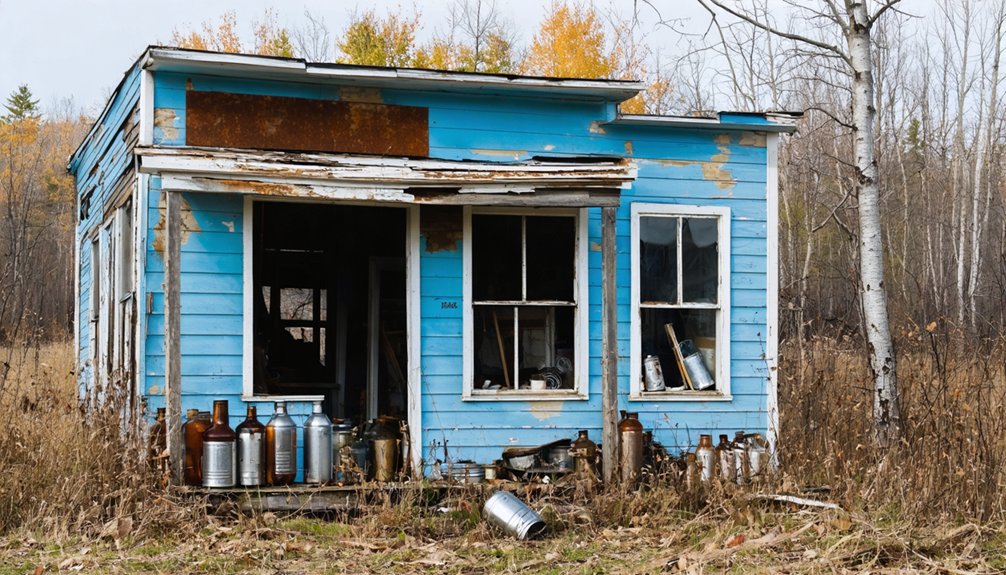
While Renfrew County’s ghost towns tell tales of abandoned lumber dreams, the northeastern reaches of Ontario harbor an even richer collection of vanished settlements.
You’ll find Desaulniers history preserved along a quiet country laneway, where weathered buildings and an old boarding house stand as silent witnesses to a once-bustling rail community.
North of Sturgeon Falls, the solitary Milberta church remains as the sole survivor of a devastating fire that erased an entire village.
Along the historic Nipissing Road, you can explore a dozen ghosted settlements, with Dufferin Methodist Cemetery marking where pioneers once carved out their lives.
Perhaps most striking is Burchell Lake, which stands as Ontario’s most complete ghost town, its abandoned structures frozen in time since 1967.
Preserving Ontario’s Ghost Town Heritage
Despite housing over 200 ghost towns, Ontario faces significant challenges in preserving these historic sites.
Heritage challenges include private ownership conflicts, deteriorating structures, and weak preservation standards that leave historic buildings vulnerable to decay and demolition.
Ontario’s historic structures remain at risk due to ownership disputes, physical decline and inadequate preservation laws.
You’ll find preservation efforts across the province attempting to protect these valuable remnants of Ontario’s past:
- Provincial parks like Spanish River protect old-growth forests and logging camp remains
- White Otter Castle stands preserved as a three-storey log structure from 1915
- Fort George maintains original War of 1812 structures through active reconstruction
- St. Raphael’s ruins showcase carefully maintained stonework despite fire damage
When you visit these sites, you’ll need to respect private property rights and seek permission, as many locations like Balaclava’s sawmill remain under individual ownership and face demolition risks from trespassing.
Life After Abandonment: Current State of Historic Sites
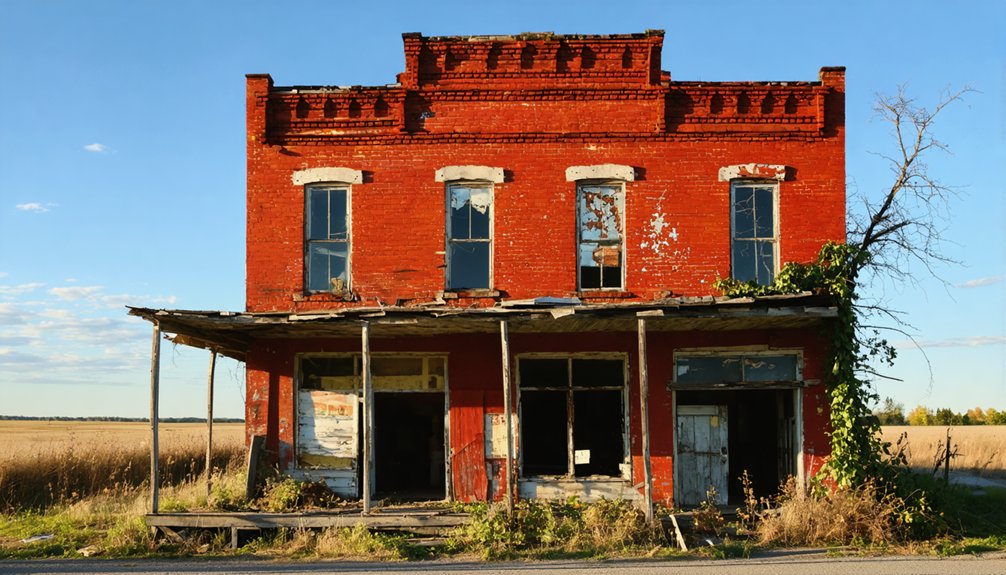
When you visit Ontario’s ghost towns today, you’ll find a complex balance between preservation efforts and nature’s reclamation, as evident in Victoria Mines where historic streets have transformed into forest paths while Silver Islet maintains its preserved general store.
Private owners have reimagined some abandoned properties, like Eldorado’s historic gas station-turned-hotel, while others face rapid decay without intervention.
Tourism interest shapes the fate of these sites, with some communities like Thunder Bay experiencing gradual population loss while maintaining public access to their historic structures and landscapes.
Preservation Versus Natural Decay
As Ontario’s ghost towns slip into abandonment, a complex battle unfolds between preservation efforts and nature’s relentless reclamation process. Heritage preservation advocates work tirelessly against natural forces that continuously reshape these historic sites.
You’ll witness this ongoing tension through:
- Early-succession plants and wildlife rapidly colonizing abandoned structures, transforming them into unique ecosystems.
- Physical deterioration from moisture, frost, and biological agents steadily weakening original construction materials.
- Community-led stewardship efforts implementing “arrested decay” approaches to maintain authentic character while preventing total loss.
- Volunteer groups establishing protected heritage sites, creating interpretive trails, and documenting history before it’s lost forever.
This delicate balance between letting nature take its course and preserving our cultural heritage presents both challenges and opportunities for these forgotten communities.
Private Property Conversion Today
The transformation of Ontario’s ghost towns into short-term rental properties has created a new form of abandonment across the province.
You’ll find once-vibrant communities like Tilsonburg and Thunder Bay facing declining populations while their properties shift to investor-owned “ghost hotels” that sit empty between weekend rentals.
Property investment trends have reshaped traditional cottage communities, particularly in places like Tiny Township, where absentee landlords convert family homes into short-term rental operations.
While rental regulations attempt to control this transformation through zoning by-laws, legal battles continue as municipalities like Oro-Medonte struggle to maintain local control.
The impact is clear: entire neighborhoods now alternate between brief bursts of visitor activity and long stretches of emptiness, fundamentally changing the character of these historic communities while property values and local businesses suffer.
Tourism Impact on Ruins
Beyond the challenges of private property conversion, Ontario’s abandoned communities have found new life through strategic tourism initiatives. The cultural heritage of these forgotten places now drives regional tourism revival, especially within 320 kilometers of major population centers.
You’ll discover that these once-forgotten sites are transforming through:
- Festival-driven branding that showcases unique local qualities
- TikTok-fueled exploration of hidden gems leading to advance bookings
- Resource-based tourism that bridges mining-scarred landscapes
- Community-wide benefits from regional tourism networks
While some northern minetowns remain abandoned, many have successfully integrated into larger municipalities.
Tourism marketing has proven particularly effective in areas where cultural preservation meets adventure tourism, creating sustainable economic opportunities for communities that might otherwise fade into history.
Tales From the Little Claybelt Region

Located northwest of Lake Temiskaming, Ontario’s Little Claybelt region represents a fascinating chapter in Canadian settlement history where fertile soil amid harsh Canadian Shield terrain drew waves of hopeful homesteaders in the late 19th century.
Among the Little Claybelt Legends, you’ll find stories like Milberta, where Samuel Hogg named his settlement after combining his sawmill and wife Alberta’s name.
The Settlement Struggles were intense – settlers battled through seven months of snow, brief summers, and relentless insects.
While some communities like Desaulniers flourished with the arrival of the Canadian Northern Railway in 1913, others slowly faded away.
Today, places like the Little Claybelt Homesteaders Museum in New Liskeard preserve these tales of determination, showcasing how hardy farmers carved out lives in this challenging frontier.
Exploring Ontario’s Most Mysterious Ruins
Scattered across Ontario’s vast landscape, four remarkable ghost towns stand as haunting memorials to the province’s industrial and settlement history.
For those seeking urban exploration and photographic opportunities, these mysterious ruins offer glimpses into the past:
- Balaclava’s iconic water-powered sawmill remains a photographer’s paradise, though its structure faces imminent collapse after producing millions of board feet during the lumber boom.
- Depot Harbour’s collapsed docks and overgrown street grid reveal its former glory as a bustling railway terminus and port.
- Craigmont’s scattered mining remnants tell the story of northern Ontario’s iron ore heritage.
- Lemieux presents a unique case – deliberately abandoned due to unstable Leda clay, it now serves as a controlled study site for geohazard management.
Frequently Asked Questions
Are Ontario’s Ghost Towns Legally Accessible to the Public for Exploration?
You’ll need to follow ghost town regulations and obtain proper permissions, though some sites offer public access through guided tours, historic designations, or community centers like Swords’ 1904 schoolhouse.
What Wildlife Dangers Should Visitors Be Aware of When Exploring Abandoned Sites?
You’ll face a million wildlife encounters, from bears and cougars to disease-carrying rodents. Take safety precautions: carry bear spray, avoid feeding animals, and never enter enclosed spaces without proper ventilation.
Do Any Ghost Towns in Ontario Have Reported Paranormal Activity?
You’ll find numerous haunted locations across Ontario’s ghost towns, with Victoria Mines offering ghostly figures and mysterious sounds, while Skeleton Park’s dark history generates frequent ghost stories and supernatural encounters.
Which Ghost Towns Are Best Preserved and Most Suitable for Photography?
You’ll find the best photography tips at Burchell Lake and Foymount – they’re well-preserved with intact structures. Burchell’s complete mining remnants and Foymount’s elevated radar base offer exceptional shooting locations.
Can Artifacts or Items Be Legally Collected From Ontario Ghost Towns?
No, you can’t legally collect artifacts from ghost towns. For artifact preservation and legal considerations, you must leave items undisturbed and report finds to archaeology@ontario.ca instead.
References
- https://curiocity.com/ghost-towns-ontario/
- https://www.ghosttowns.com/canada/ontario/ontario.html
- https://www.readersdigest.ca/travel/canada/balaclava-ghost-town-ontario/
- https://northernontario.travel/northeastern-ontario/ghost-towns-northeastern-ontario
- https://www.youtube.com/watch?v=q0kIKlKw1k0
- https://www.atlasobscura.com/things-to-do/ontario/abandoned
- https://abandonedexplorers.wordpress.com/2015/08/10/balaclava-ghosts-and-skeletons-of-ontarios-first-green-community/
- https://www.abandonedspaces.com/uncategorized/abandoned-8.html
- https://toosquaretobehip.com/balaclava-ontarios-best-kept-ghost-town/
- https://www.youtube.com/watch?v=6yj3mr6xgjQ