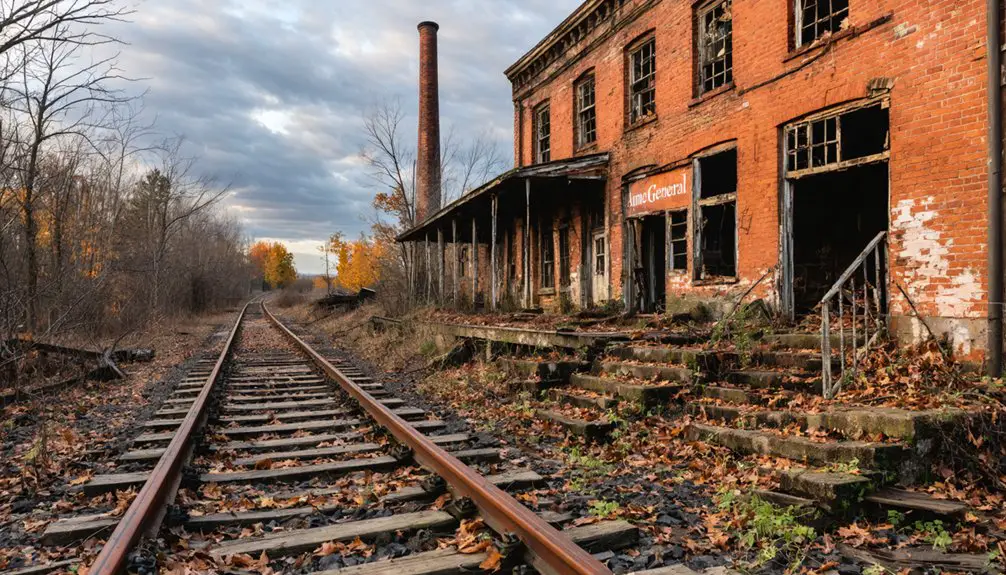
You’ll find fascinating abandoned towns scattered across Pennsylvania, each telling a unique story of industrial decline. From Centralia’s eternal underground mine fire to Pithole’s meteoric rise and fall as an oil boomtown, these ghost towns capture America’s industrial heritage. Notable sites include Frick’s Lock Village near the Schuylkill Canal, the experimental concrete housing at Nanticoke’s Concrete City, and the coal mining remnants of Rausch Gap. These forgotten places hold countless untold stories beneath their weathered surfaces.
Key Takeaways
- Centralia remains Pennsylvania’s most famous ghost town, abandoned due to an underground mine fire burning since 1962.
- Pithole experienced dramatic boom-and-bust, growing to 20,000 residents in 1865 before declining to 237 by 1870.
- Frick’s Lock Village became a ghost town after Limerick Nuclear Power Plant construction forced residents to relocate.
- Concrete City, abandoned in 1924, showcases experimental concrete housing with 20 duplex units still standing today.
- Yellow Dog Village declined after mine closures in the 1950s, while Rausch Gap transformed into wilderness after 1945.
The Underground Inferno: Centralia’s Toxic Legacy
While many ghost towns fade slowly into history, Centralia’s transformation was sparked by a single catastrophic event in 1962 – an underground mine fire that continues to burn today. Attempts to control the blaze using wet sand barriers proved futile.
You’ll find this inferno raging beneath roughly 3,700 acres, advancing about 75 feet yearly through abandoned coal seams up to 300 feet deep. The toxic emissions forced out nearly all residents, dropping the population from 1,400 to just a handful of stubborn holdouts. The fire burns at temperatures reaching over 1,000 degrees Fahrenheit.
You can still see steam and smoke rising from ground fissures, marking where the fire lurks below.
In 1981, the dangers became horrifyingly clear when a 12-year-old boy nearly fell into an 80-foot sinkhole that opened without warning. This toxic legacy is expected to burn for at least 250 more years.
Pithole: Rise and Fall of America’s First Oil Boomtown
When oil erupted from the Frazier Well on January 7, 1865, no one could have predicted how quickly Pithole would transform from empty farmland into America’s first major oil boomtown.
You’d have witnessed an unprecedented oil exploration frenzy as production soared from 250 to 1,200 barrels daily within months. The economic impact was staggering – within a year, 20,000 people called Pithole home, with 57 hotels, theaters, and Pennsylvania’s third-busiest post office serving their needs. Civil War veterans flocked to the area, seeking fortune in the booming oil industry.
But you couldn’t hold onto black gold forever. By 1866, plummeting oil prices, devastating fires, and declining production spelled doom for this instant city. The innovative Van Syckel oil pipeline revolutionized transport by moving 80 barrels per hour, though it sparked fierce resistance from displaced teamsters.
The population dwindled to just 237 by 1870. Today, you’ll find only mown streets marking where this 500-day wonder once stood, a reflection of fortune’s fleeting nature.
The Forgotten Village of Frick’s Lock
You’ll find the once-bustling village of Frick’s Lock frozen in time along the Schuylkill Canal, where 18th and 19th-century buildings stand as silent witnesses to Pennsylvania’s industrial past.
What began as a crucial hub for coal transport and canal commerce now sits largely abandoned, its Victorian-era structures preserved behind security fences since the construction of the nearby Limerick Nuclear Power Plant. By the 1850s, over 1 million tons of coal were being transported through this vital waterway.
The village experienced its ultimate decline when local residents departed as the nuclear facility expanded across the river.
While most of the historic buildings remain off-limits to the public, you can still glimpse this architectural time capsule during special guided tours organized by local historical groups.
Historic Canal Trading Hub
Deep in the heart of Pennsylvania lies the forgotten village of Frick’s Lock, once a bustling hub along the Schuylkill Navigation System.
You’ll find remnants of locks #54 and #55, where canal commerce thrived during the 1800s as boats transported coal and agricultural goods to Philadelphia. The lock structures, built on John Frick’s former farmland, witnessed roughly 1,400 vessels annually during peak operations.
As you explore the historic district, you’ll discover buildings dating back to the Revolutionary War era, alongside 19th-century canal structures that tell the story of America’s transportation evolution. The construction of the Limerick Nuclear Power Station in the 1960s led to the village’s complete abandonment.
The village flourished until the Pennsylvania Schuylkill Valley Railroad‘s arrival sparked its gradual decline. By 1930, following devastating floods and the canal’s closure, this once-vital trading post began its transformation into the ghost town you see today. Urban explorers have reported strange noises while investigating the abandoned properties.
Nuclear Plant’s Silent Neighbor
The construction of Limerick Nuclear Power Plant in the early 1980s forced the final exodus of Frick’s Lock’s remaining residents, transforming this historic village into a restricted ghost town.
Today, you’ll find eerie reminders of the village’s rich past, with buildings dating back to the 1700s standing frozen in time since the nuclear evacuation.
While you can’t freely explore this abandoned heritage site most of the year, the East Coventry Historical Commission offers rare guided tours that let you glimpse into the village’s fascinating story.
As you walk among the empty structures, you’re walking through layers of American history – from its early days as a family farm to its heyday as a bustling canal town, right up to its abrupt end as the nuclear plant’s silent neighbor.
Preserved Victorian Architecture
Walking through Frick’s Lock today, you’ll discover a remarkable collection of Victorian-era architecture frozen in time since the mid-20th century.
You can spot the telltale signs of Victorian craftsmanship in the gabled roofs and stone masonry walls of these surviving structures, which range from humble lockkeeper’s houses to local workshops.
While some buildings have fallen into disrepair, many remain standing as evidence of the village’s canal-era prosperity.
The architectural preservation efforts, though limited by restricted access, have maintained several key structures that showcase the evolution from Federal to Victorian styles typical of rural Pennsylvania villages.
A newly developed public park area provides visitors a safe vantage point to admire these historic buildings from designated viewing spots.
If you’re lucky enough to join one of the guided tours organized by the East Coventry Historical Commission, you’ll get an up-close look at these historic buildings that once housed a thriving canal community.
Industrial Heritage at Concrete City

If you’re exploring Pennsylvania’s industrial heritage, you won’t want to miss Concrete City, a 1911 experiment in workers’ housing built by the Delaware, Lackawanna & Western Railroad.
You’ll find twenty concrete duplexes arranged around a central green space, complete with former recreational amenities that once included a swimming pool, tennis court, and baseball field.
Though abandoned since 1924 due to moisture problems and lack of proper sewage, the site’s remarkably durable concrete structures still stand today as a symbol of early 20th-century railroad company towns. Attempts to demolish the buildings using dynamite were unsuccessful, leaving the structures intact for modern visitors to explore.
Early Workers’ Housing Design
Built in 1911 as an innovative experiment in workers’ housing, Concrete City emerged as a groundbreaking residential development near Nanticoke, Pennsylvania. The Delaware, Lackawanna & Western Railroad designed this “Garden City of the Anthracite Region” to address workers’ health concerns through architectural innovation, featuring rapid-pour concrete construction and modern amenities.
- Each duplex unit was cast in a single day using revolutionary hinged steel molds.
- The complex included 20-22 two-family buildings arranged around a central courtyard.
- Residents enjoyed modern features like electric street lights and recreational facilities.
While marketed as a model community, Concrete City’s housing was restricted to elite workers who spoke English.
Despite its innovative design, the development struggled with dampness and poor insulation. The experiment ended in 1924 when the company refused to install proper sewage infrastructure, leading to its abandonment.
Preserved Industrial Architecture Today
Despite failed demolition attempts in 1924, Concrete City’s ruins stand as a tribute to early 20th-century industrial innovation in Luzerne County.
You’ll find the ghostly remains of twenty duplex buildings arranged in a U-shape, showcasing an early example of International Style architecture that emphasized geometric simplicity and functionality.
When you visit today, you’re witnessing remarkable industrial preservation – even 100 sticks of dynamite couldn’t destroy these robust concrete structures.
The site’s architectural innovation is evident in the flat roofs, uniform grid patterns, and minimal ornamentation that defined this “Garden City of the Anthracite Region.”
While now overgrown and swampy, with some buildings slowly sinking into the earth, these burned-out shells continue to demonstrate the lasting legacy of reinforced concrete construction in Pennsylvania’s industrial heritage.
Railroad Company Town Legacy
Anyone exploring Pennsylvania’s industrial heritage will find Concrete City’s story deeply intertwined with the Delaware, Lackawanna & Western Railroad’s ambitious social experiment.
Built in 1911, this pioneering company housing project showcased 20 concrete duplexes arranged around a central green space, but it also revealed the stark social divisions of the era through immigrant exclusion and selective residency policies.
- You’ll discover how DL&W’s experiment in concrete construction produced buildings so durable that even explosives couldn’t destroy them.
- You can trace the class distinctions that reserved these homes for English-speaking, management-level employees while excluding immigrant laborers.
- You’ll witness how the company’s refusal to upgrade basic sewage infrastructure led to Concrete City’s eventual abandonment in 1924.
Life Frozen in Time: Yellow Dog Village
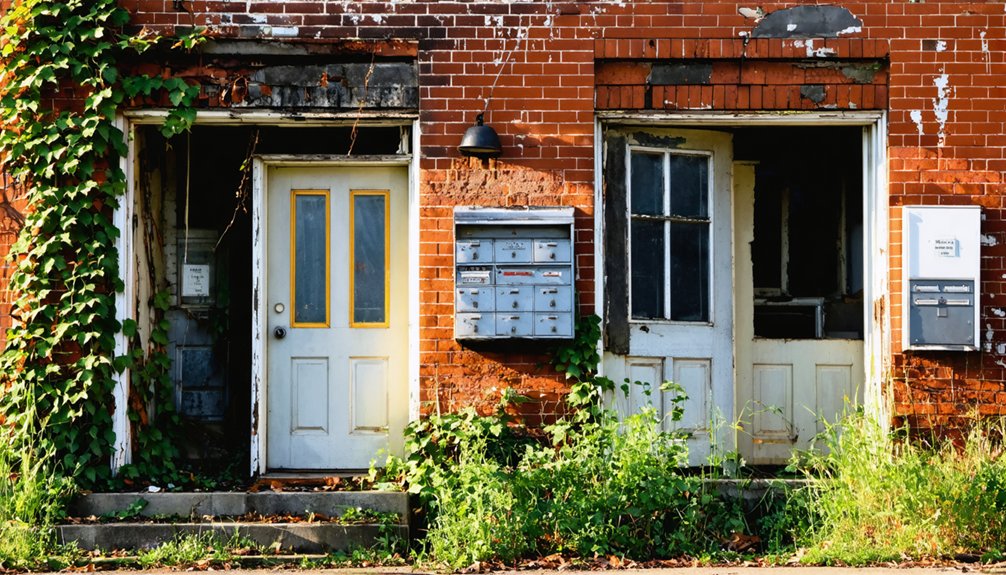
Despite its controversial origins, the village fostered remarkable community engagement. Families thrived here, with children biking through streets, exploring caves, and playing baseball near Buffalo Creek.
The village store, playground, and communal spaces created a tight-knit atmosphere that lasted decades.
After the mines closed in the 1950s, the town’s decline led to eventual abandonment by 2010.
Today, historical preservation efforts continue under new ownership, with paid tours offering glimpses into early 20th-century company town life. You can explore original homes, complete with vintage appliances and basement pantries.
Stories From St. Anthony’s Wilderness: Rausch Gap
While many Pennsylvania ghost towns faded quietly into history, Rausch Gap’s story began boldly in 1828 when Dr. Benjamin Kugler transformed this slice of St. Anthony’s Wilderness into a thriving coal mining settlement.
In 1828, Dr. Kugler dared to carve a coal mining town from Pennsylvania’s untamed wilderness, creating Rausch Gap from virgin forest.
You’ll find this testimony to Pennsylvania’s Coal Heritage along today’s Stony Valley Rail-Trail, where echoes of its industrial past still linger.
- Hidden foundations peek through the wilderness, marking where miners’ homes once stood
- Abandoned wells dot the landscape, silent witnesses to the community’s former liveliness
- Railroad ties and coal fragments still surface after heavy rains
What you’re walking through isn’t just any ghost town – it’s a place where generations of coal miners and railroad workers built their lives until 1910.
After the tracks were pulled up in 1945 and the valley flooded, Rausch Gap returned to wilderness.
Preserving Pennsylvania’s Ghost Town History
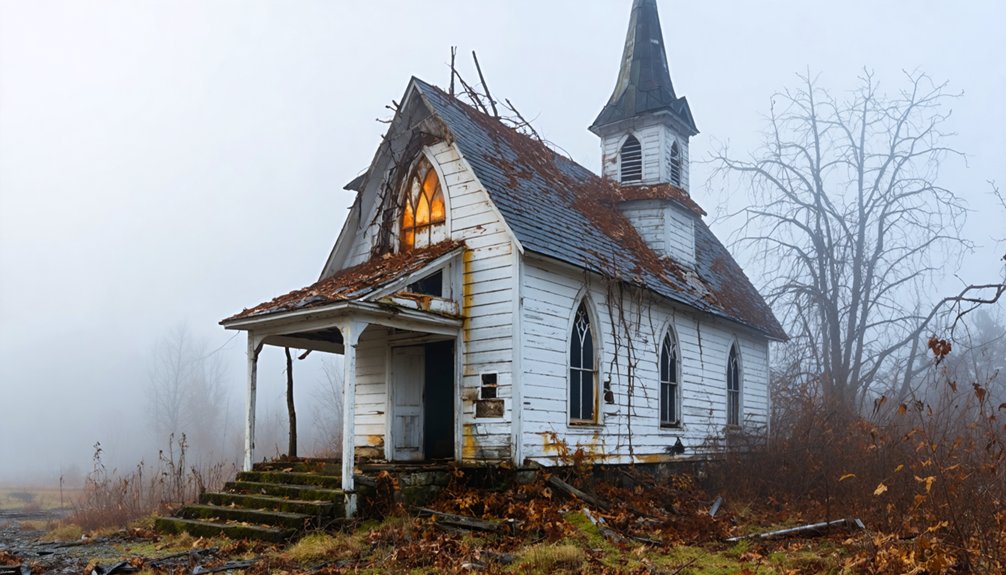
As Pennsylvania’s ghost towns face mounting threats from development and decay, several organizations have stepped up to protect these invaluable historic sites.
Across the state, numerous abandoned towns in Pennsylvania are rich with stories of the past, providing a glimpse into the lives of those who once called them home. Efforts to restore these sites not only preserve history but also promote tourism, turning forgotten buildings into points of interest for visitors. This revitalization can breathe new life into surrounding communities, encouraging appreciation for Pennsylvania’s unique heritage.
You’ll find the Pennsylvania Historical and Museum Commission leading preservation efforts at Eckley Miners’ Village, where 200 structures tell the story of anthracite coal mining and immigrant labor.
Ghost town preservation takes different forms across the state – from Eastern State Penitentiary’s successful transformation into a major tourist attraction to Yellow Dog Village’s eerie maintained state.
The historical significance of these sites hasn’t been lost on preservation groups. They’re using various strategies like arrested decay, strategic planning, and adaptive reuse to save threatened properties.
Whether it’s protecting archaeological sites through private acquisition or rallying community support to prevent demolition, they’re ensuring Pennsylvania’s ghost town heritage endures for future generations.
Frequently Asked Questions
Are There Any Paranormal Investigations Allowed in These Ghost Towns?
While 38 abandoned sites welcome visitors, you’ll need special permission for paranormal activities. Most ghost hunting isn’t officially sanctioned, though Yellow Dog Village occasionally allows organized investigations by request.
What Survival Gear Should Visitors Bring When Exploring These Locations?
You’ll need survival essentials like water, first-aid kit, flashlights, maps, and weather protection. Don’t forget your phone, GPS, sturdy boots, and basic tools for safety precautions during explorations.
Can Metal Detectors Be Used to Search These Abandoned Sites?
You’ll need permits for public sites and permission for private land. Metal detecting regulations restrict digging tools and require reporting historical artifacts. Natural Areas and archaeological sites are off-limits entirely.
Which Ghost Towns Are Most Accessible During Winter Months?
You’ll find Corydon most accessible in winter when the reservoir’s low, making it great for winter photography. Scotia’s year-round trail access works well too, while Yellow Dog’s guided tours operate regardless of season.
Do Any of These Locations Offer Guided Night Tours?
Like moths drawn to flame, you’ll find guided night tours at Gettysburg’s battlefields, Pennhurst Asylum’s haunting halls, Philadelphia’s historic district, and charming Lancaster County towns. Most guided explorations run year-round after sunset.
References
- https://uncoveringpa.com/ghost-towns-in-pa
- https://pabucketlist.com/pa-abandoned-places/
- https://www.atlasobscura.com/things-to-do/pennsylvania/ghost-towns
- https://www.youtube.com/watch?v=yxFuqGq-FJ8
- https://www.youtube.com/watch?v=0jxNCcpVW2o
- https://www.youtube.com/playlist?list=PLb2rClZ11NBnoG5PjgXmkXYrCXR4UScej
- https://kids.kiddle.co/List_of_ghost_towns_in_Pennsylvania
- https://en.wikipedia.org/wiki/Centralia_mine_fire
- https://www.britannica.com/video/coal-mine-fire-Pennsylvania-Centralia/-207717
- https://www.environmentandsociety.org/tools/keywords/centralia-mine-fire