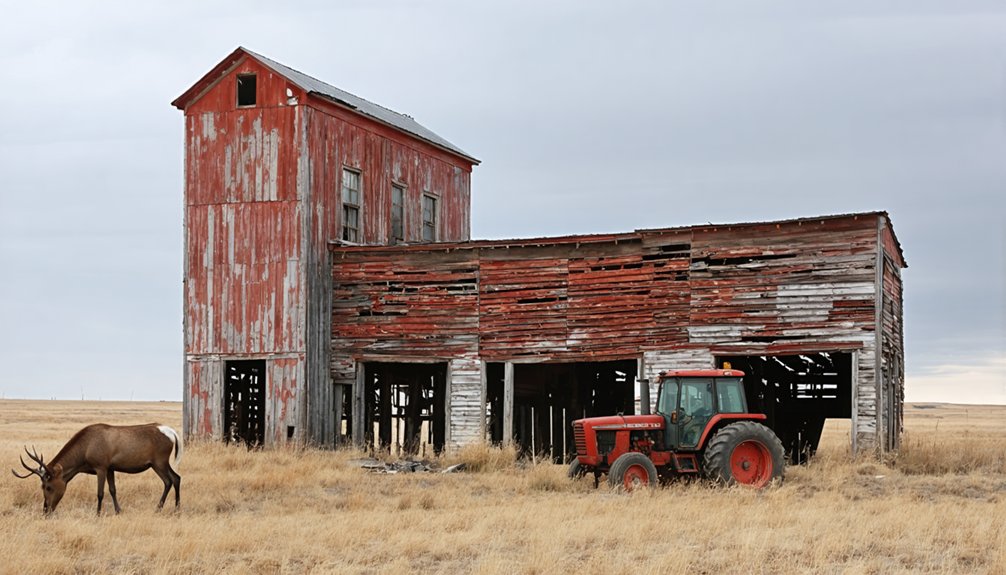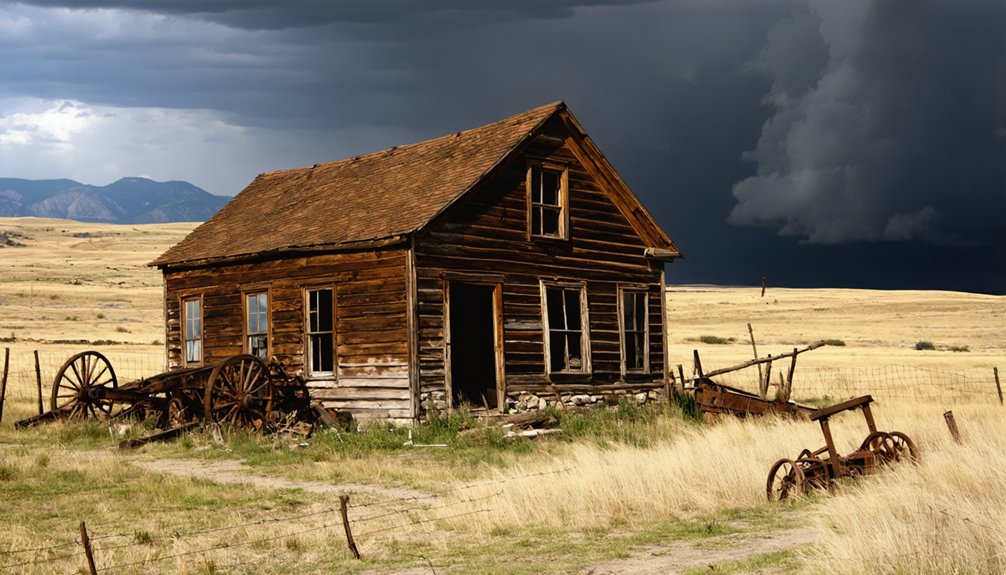
You’ll find South Dakota’s ghost towns scattered throughout the Black Hills, where the 1874 gold rush transformed wilderness camps into booming settlements like Deadwood and Lead. From 1874-1876, thousands of prospectors established mining operations, with towns rising and falling based on mineral fortunes and railroad access. Today, you can explore abandoned sites like Spokane and Bugtown, where crumbling structures tell tales of boom-and-bust cycles that shaped the region’s fascinating frontier history.
Key Takeaways
- Deadwood and Lead emerged from the 1874 Black Hills gold rush, transforming from mining camps into significant frontier towns.
- Spokane exemplifies the boom-and-bust cycle of mining towns, rising quickly with mineral discoveries before being abandoned.
- Railroad towns like Okaton and Capa became ghost towns after transport shifted from rail to trucks.
- South Dakota’s ghost towns face preservation challenges from harsh winters and mining contamination, requiring coordinated institutional support.
- The best time to visit ghost towns is late spring through early fall, with proper safety gear and respect for property boundaries.
The Rise and Fall of Mining Towns
When gold was discovered in the Black Hills between 1874 and 1876, prospectors flooded into the Dakota Territory, establishing mining camps that would evolve into towns like Deadwood and Lead.
The region’s mining history took off when Moses and Fred Manuel located the Homestake claim near Lead, selling it to George Hearst who formed the Homestake Mining Company.
The Manuel brothers struck it rich with the Homestake claim, but Hearst’s deep pockets transformed Lead into a mining powerhouse.
You’ll find these towns grew explosively – Lead’s town demographics skyrocketed from a few cabins to over 8,000 residents by 1910.
Star and Bullock Hardware opened in August 1876, becoming a crucial supplier of mining equipment and lumber for the growing settlements.
The introduction of the cyanide process in 1901 revolutionized gold extraction methods at these mining operations.
But their prosperity hinged on external factors. Deep-shaft mining required massive capital investment, while profits often flowed to out-of-state investors.
When gold prices dropped and ore quality declined, these single-industry towns couldn’t sustain themselves. Technical challenges, including mine fires and flooding, dealt additional blows that ultimately led to their abandonment.
Agricultural and Railroad Decline
As technological advances swept across South Dakota’s agricultural landscape in the 1930s, the rapid adoption of tractors transformed the state’s farming communities.
You’ll find that agricultural mechanization drove dramatic changes, with tractor usage jumping from 37% to 55% between 1930 and 1940, leading to a 13% decline in farm numbers. Average farm size expanded from 438 to 545 acres as smaller operations vanished.
Meanwhile, railroad abandonment dealt another blow to rural towns. When rail lines consolidated and ceased passenger service, many communities lost their economic lifeline. Today, family-owned operations represent 83% of farms in the state.
The shift to truck transport bypassed smaller towns, forcing grain elevators and stockyards to close. By the 21st century, you’d see just 29,968 farms averaging 1,443 acres, while recurring market shocks and trade disruptions continue to challenge the surviving agricultural communities. Today, agriculture remains vital to the state’s economy, contributing 7.8% of GDP through farming, forestry, fishing, and hunting activities.
Notable Ghost Towns Worth Exploring
You’ll discover South Dakota’s ghost towns were shaped by two major economic forces – the mining industry’s dramatic boom-and-bust cycle of the late 1800s and the railroad’s strategic expansion across the prairie in the early 1900s.
While mining towns like Spokane near Hermosa rose and fell with mineral fortunes, railroad stops such as Okaton and Capa thrived briefly as essential transit points before being abandoned when rail traffic declined. Today, Capa’s crumbling structures dot the prairie landscape, slowly deteriorating with each passing season.
Some mining settlements yielded significant wealth, as evidenced by Mr. Allen who extracted gold worth $2,000 through his diligent efforts.
These weathered settlements now stand frozen in time, with their crumbling structures telling stories of both the mineral wealth that drew thousands to the Black Hills and the iron rails that once connected isolated prairie communities.
Mining Boom to Bust
Throughout the late 1870s and early 1880s, South Dakota’s Black Hills region transformed into a patchwork of bustling mining communities that would later become fascinating ghost towns. Fur trading posts originally dotted the landscape before the mining rush began.
You’ll find Rochford’s swift rise, where gold discoveries led to a 1,000-person boom town within two years. The town’s 40-stamp Standby Mill proved crucial to early mining operations. Mining innovations shaped places like Cambria, where beehive ovens produced coal for locomotives, and Etta, which evolved from tin mining to lithium production.
Economic shifts eventually emptied these once-thriving settlements. Pactola now lies beneath 150 feet of lake water, while Rockerville’s million-dollar Mystic Reduction Mill failed when ore solidified in its tanks.
Only fragments remain today – Cambria’s manager’s house overlooks ruins, Etta’s mine structures stand abandoned, and a solitary cabin marks Pactola’s watery grave.
Railroads Shape Ghost Towns
While mining towns dotted the Black Hills, railroads carved an equally dramatic legacy across South Dakota’s landscape between 1880-1920.
You’ll find that railroad influences created three distinct types of ghost towns: railroad-founded settlements, temporary construction camps, and logging line communities.
Nearly half of South Dakota’s new towns during this era were platted directly by rail companies.
White Rock emerged when the Fargo and Southern Railroad established the town in 1883.
Towns like Detroit faced quick dissolution after losing rail access to Claremont in 1886.
Places like Stratford boomed when the Minneapolis & St. Louis Railroad arrived in 1908, establishing depots, grain elevators, and hotels.
But when rail routes shifted, many towns faced extinction.
You can explore abandoned narrow-gauge logging settlements with their steep grades and forgotten trestles, or visit sites like Castleton, where construction crews once based their operations.
These ghost towns tell the story of how railroad expansion – and eventual abandonment – shaped South Dakota’s settlement patterns.
Black Hills Mining District Legacy
The discovery of gold in the Black Hills during Custer’s 1874 expedition sparked an unstoppable wave of non-Native American settlement that would transform the region.
By late 1875, you’d have found 4,000 prospectors illegally seeking their fortune in this mineral-rich territory.
The evolution of mining techniques shaped the region’s economic impact through four distinct phases:
The Black Hills mining saga unfolded in four transformative phases, each bringing new methods and economic possibilities to the frontier landscape.
- Initial placer mining boom (1874-1880) creating instant settlements
- Shift to hard rock mining, dominated by Homestake Mine’s 126-year reign
- Development of advanced extraction methods like chlorization and smelting in the 1890s
- Diversification into other minerals including silver, mica, feldspar, and tin
Today, you’ll find ghost towns scattered throughout the Black Hills, silent testimonies to both successful and failed mining ventures that shaped South Dakota’s destiny.
Preservation Efforts and Challenges

Preserving South Dakota’s ghost towns presents complex challenges that demand coordinated institutional support and sustainable funding.
You’ll find the State Historic Preservation Office working alongside about 20 Certified Local Government commissions to implement preservation techniques across abandoned sites. These efforts face significant hurdles, from harsh winter damage to mining contamination that requires costly remediation.
Community involvement through public-private partnerships has become essential, as limited state and federal grants can’t cover the full costs of stabilization and interpretation.
You’ll see volunteer groups and local historical societies providing vital support through documentation and labor. While some sites benefit from heritage tourism development, many remote locations struggle with vandalism and structural deterioration, requiring creative approaches to secure long-term protection through conservation easements and local ordinances.
Safety and Access Guidelines
Exploring South Dakota’s ghost towns requires careful preparation and strict adherence to safety protocols due to numerous structural and environmental hazards.
Visitors must take serious precautions when exploring South Dakota’s abandoned settlements, as hazardous conditions abound in these historic sites.
When venturing into these remote locations, you’ll need to equip yourself properly and stay alert to wildlife dangers, from rattlesnakes to mountain lions that frequently inhabit abandoned structures.
For your safety, follow these essential guidelines:
- Drive high-clearance vehicles with recovery gear, especially during dry seasons.
- Wear sturdy boots and carry flashlights to navigate unstable buildings and uneven terrain.
- Pack emergency supplies including first aid kits, water, and wildlife deterrents.
- Stay outside deteriorating structures to avoid rotting floors and structural hazards.
Historical Documentation and Records

Rich historical documentation of South Dakota’s ghost towns exists across multiple archival repositories, with detailed records dating back to the state’s territorial period.
You’ll find extensive research materials at South Dakota State University, which houses site cards for 245 abandoned settlements, complete with settlement dates and abandonment factors.
Through archival research at the State Historical Society Research Center, you can access regional articles and vintage pamphlets detailing mining town remains.
For precise location data, you’ll want to examine U.S. Geological Survey maps and NARA’s federal records, including post office registers and census data.
The record preservation efforts of county courthouses provide essential land records and plats, while mining production records and railroad construction documents offer vital insights into the boom-bust cycles that shaped these forgotten communities.
Ghost Town Photography Tips
While historical records document South Dakota’s ghost towns, capturing their haunting beauty requires specific photographic techniques and careful planning. When photographing abandoned structures, you’ll want to maximize natural lighting and dramatic shadows while maintaining strict attention to photographic composition.
- Time your visits during golden hour after sunrise or pre-dawn to catch dramatic light rays piercing through broken windows and minimize crowds.
- Pack essential gear including a wide-angle lens for sweeping architectural shots, tripod for low-light stability, and headlamps for dark interiors.
- Focus on key buildings like jails, saloons, and churches while incorporating details such as weathered signs, rusty door handles, and forgotten artifacts.
- Consider creative enhancements like long exposures for cloud movement, black and white processing to emphasize texture, and strategic positioning of human elements for scale.
Planning Your Ghost Town Adventure
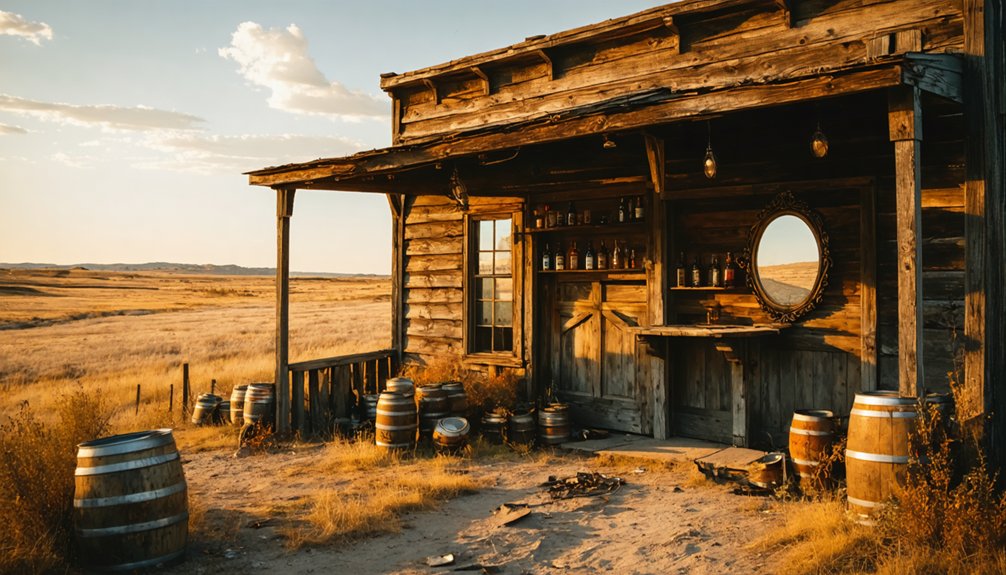
You’ll want to explore South Dakota’s ghost towns during the late spring through early fall when Forest Service roads are most accessible and daylight hours are longest.
These ghost towns in South Dakota offer a glimpse into the past, showcasing abandoned buildings and remnants of settlements that once thrived. As you wander through the dilapidated structures, you’ll encounter fascinating stories of those who lived there and the circumstances that led to their decline. Make sure to bring a camera, as the haunting beauty of these sites against the vast South Dakota landscape is truly captivating.
Among the ghost towns available in South Dakota, you’ll find unique spots like Bodie and Lead, each with distinct histories and charming remains. These locations not only provide a scenic adventure but also a chance to delve deeper into the rich tapestry of the state’s mining past. As you explore, keep an eye out for local wildlife that often inhabits these deserted areas, adding another layer of intrigue to your visit.
Before heading to sites like Spokane or Bugtown, make sure you’ve got detailed GPS coordinates, proper hiking gear, and have notified someone of your planned route since cell service can be spotty in the Black Hills region.
When visiting historical locations, it’s essential to park only in designated areas like the Spokane Creek Campground or marked Forest Service access points, stay alert for hazards like old mining shafts, and respect all private property boundaries you encounter.
Safety Tips First
Before setting out to explore South Dakota’s fascinating ghost towns, thorough preparation and safety planning are essential for an enjoyable adventure. The remote nature of these sites demands careful attention to safety gear and awareness of wildlife hazards you’ll encounter along the way.
- Check land ownership records and secure necessary permits before visiting sites, as many are on private or protected federal lands.
- Pack essential safety gear including a first-aid kit, sturdy boots, multiple light sources, and emergency signaling devices.
- Stay alert for structural hazards like unstable buildings, hidden mine shafts, and contaminated areas from historic mining operations.
- Use high-clearance vehicles when recommended, share your route with a trusted contact, and monitor weather forecasts for dangerous conditions.
Best Seasonal Visit Times
Since each season in South Dakota offers unique ghost town exploring experiences, careful timing can dramatically enhance your visit.
Spring explorations bring fewer crowds and roaring waterfalls in Spearfish Canyon, while summer adventures peak in June with ideal 70s temperatures and full site access.
You’ll find the best overall experience during late September’s fall foliage, when temperatures remain mild and crowds thin out post-Labor Day.
For winter solitude, snow-dusted peaks create serene backdrops around Black Hills ghost towns.
Plan for late May to early June to enjoy comfortable temperatures and minimal crowds, particularly around Mount Rushmore-area ghost town trails.
Avoid early August during the Sturgis Rally near Deadwood, and note that many services close before Memorial Day.
Frequently Asked Questions
Are There Any Ghost Towns in South Dakota That Are Still Inhabited?
You’ll find several inhabited locations within South Dakota’s ghost town history, including Rockerville with periodic residents, Cottonwood maintaining about 11 people, and Awanka with its single full-time resident and edge dwellers.
Can I Legally Remove Artifacts or Items From Ghost Town Sites?
You can’t legally remove artifacts without proper permits and landowner permission. Legal restrictions protect ghost town sites regardless of land status, and artifact preservation laws carry serious penalties for violations.
Which Ghost Towns Have Reported Paranormal or Supernatural Activity?
You’ll find reported ghost sightings at Deadwood’s Bullock Hotel, Mystic’s abandoned railroad buildings, Rochford’s mining ruins, and haunted locations throughout Forestville. The Lucky Nugget Casino claims frequent paranormal encounters.
Do Any Ghost Towns Host Special Events or Reenactments?
Step back in time at Deadwood’s daily Wild West shootouts and ghost tours. You’ll find scheduled reenactments at 1880 Town, while smaller ghost towns offer occasional heritage festivals and guided history walks.
What Are the Best Seasons to Visit South Dakota Ghost Towns?
You’ll find ideal conditions during spring visits (late May-June) and fall explorations (September-October), when you’ll enjoy milder temperatures, open roads, fewer crowds, and great photography opportunities.
References
- https://en.wikipedia.org/wiki/List_of_ghost_towns_in_South_Dakota
- https://www.atlasobscura.com/things-to-do/south-dakota/ghost-towns
- https://www.youtube.com/watch?v=_0WNYsFLSLA
- https://www.sdpb.org/rural-life-and-history/2023-08-21/some-black-hills-ghost-towns-and-their-origins
- https://www.blackhillshikingbikingandmore.com/old-mining-ghost-towns
- https://kxrb.com/the-creepiest-ghost-towns-in-all-of-south-dakota/
- https://www.tripadvisor.com/Attractions-g28962-Activities-c47-t14-South_Dakota.html
- https://www.travelsouthdakota.com/trip-ideas/abandoned-beauty-ghost-towns-structures-south-dakota
- https://westernmininghistory.com/towns/south-dakota/lead/
- https://www.deadwood.com/history/history-timeline/