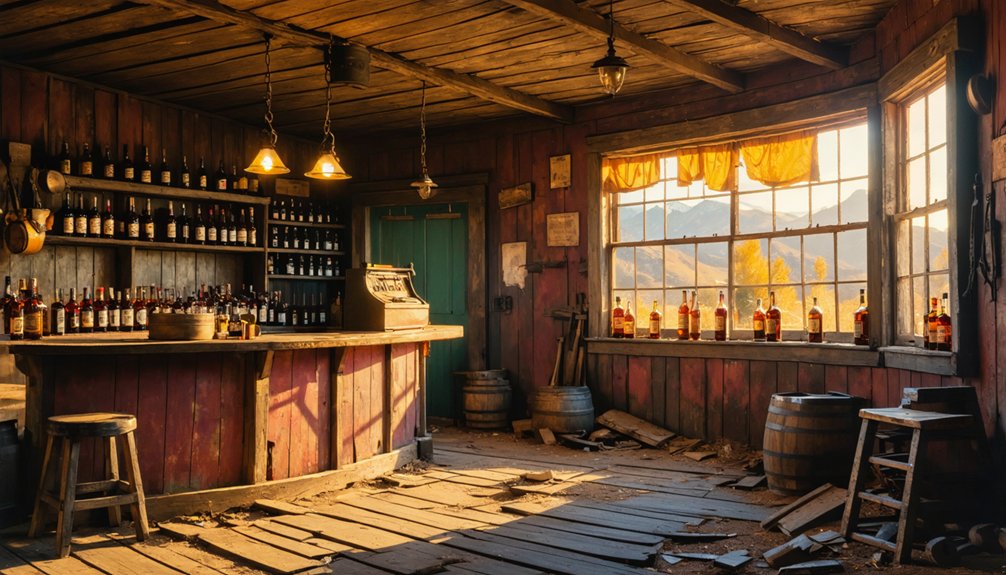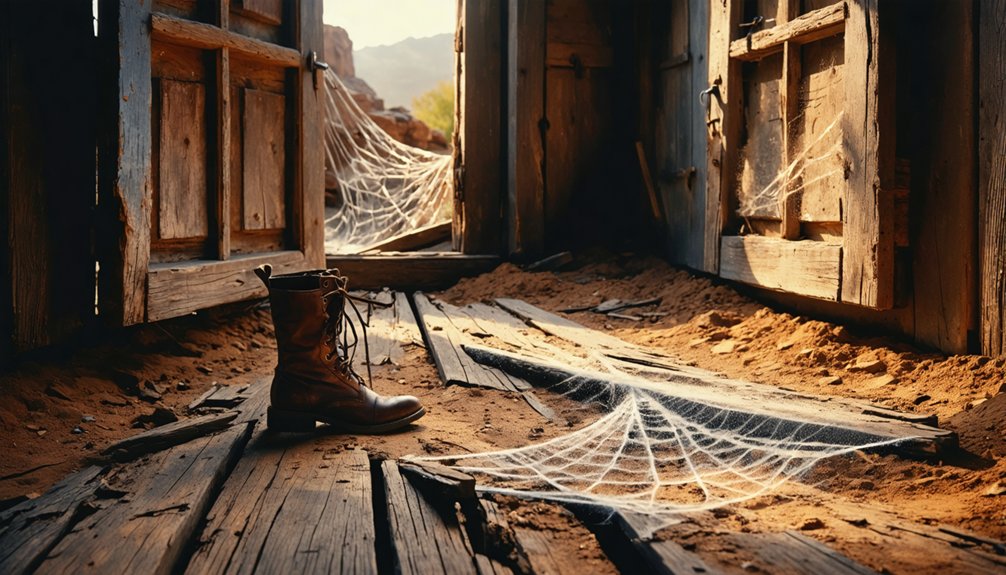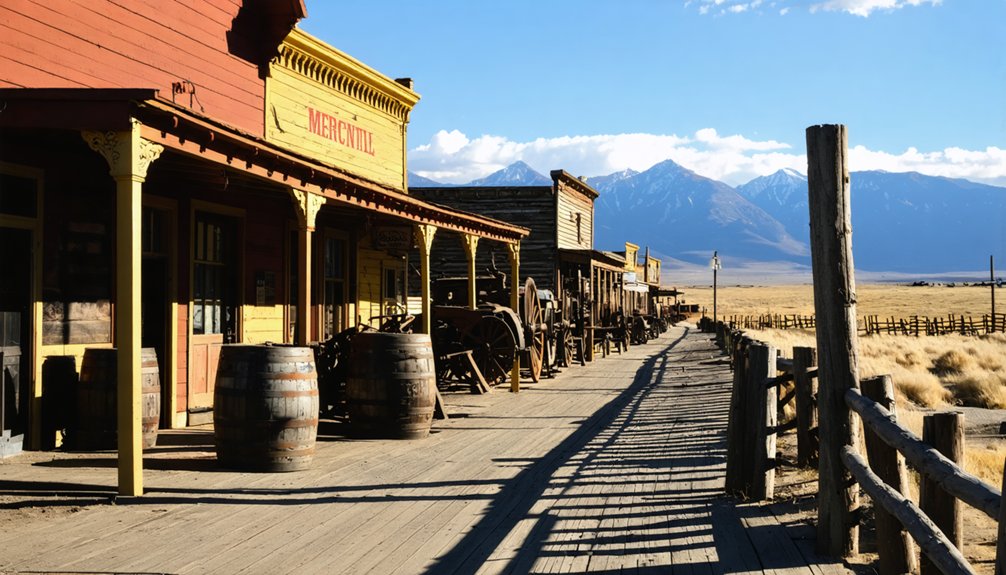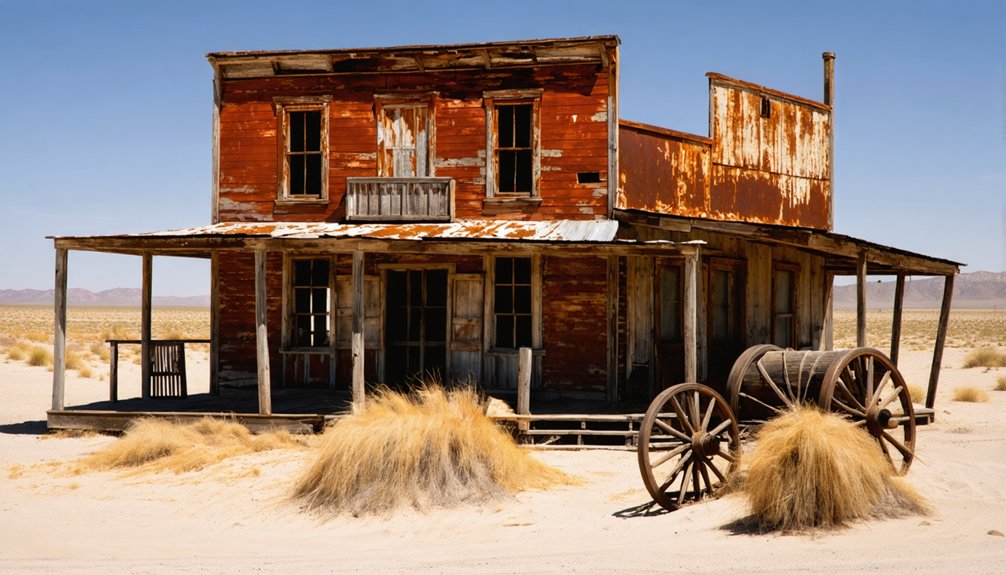
You’ll find several well-preserved ghost towns scattered across Southern California’s desert landscape, including the iconic Calico Ghost Town, where $20 million in silver was extracted during the 1880s. Don’t miss Randsburg’s historic wooden storefronts, Amboy’s Route 66-era Roy’s Motel, or the haunting remains of Bombay Beach along the Salton Sea. These abandoned settlements showcase authentic mining equipment, period architecture, and cultural artifacts that tell compelling stories of California’s frontier past.
Key Takeaways
- Calico Ghost Town, once home to 3,000 residents during the Silver Rush, is now a preserved tourist attraction designated as California’s official Silver Rush Ghost Town.
- Randsburg thrived during the 1895 Gold Rush with the Yellow Aster mine, and still maintains historic wooden storefronts and stamp mill ruins.
- Amboy, featuring the iconic Roy’s Motel and Cafe along Route 66, declined after Interstate 40’s completion but preserves authentic mid-century architecture.
- Bombay Beach, established in 1929, transformed from a popular Salton Sea resort destination to an abandoned community due to ecological deterioration.
- Ghost towns often feature 19th-century wood-frame construction, local stone foundations, and industrial timber structures affected by harsh desert conditions.
The Silver Legacy of Calico Ghost Town
Three remarkable decades defined Calico’s transformation from an untamed stretch of the Mojave Desert into California’s most productive silver mining settlement of the 1880s.
After prospectors discovered the Silver King Mine in April 1881, the town exploded with activity, drawing up to 3,000 residents and spawning over 500 mines across the district.
You’ll find evidence of this prosperity in the $20 million worth of silver extracted during its heyday.
But when silver prices plummeted in the 1890s, Calico’s fortune vanished. By 1907, the once-bustling ghost town stood abandoned until Walter Knott’s 1950s restoration breathed new life into its streets.
In recognition of its historical importance, Governor Arnold Schwarzenegger designated it as California’s Silver Rush Ghost Town in 2005.
Today, you can explore five original 1880s buildings, venture into the Maggie Mine’s tunnels, and witness how this California Historical Landmark preserves its rich mining heritage. The Maggie Mine alone produced an impressive $13 million in silver ore throughout its operation.
Randsburg: Where Gold Rush Dreams Live On
While the California Gold Rush of 1849 had long subsided, Randsburg’s golden chapter began in 1895 when prospectors discovered rich deposits on Rand Mountain. The Yellow Aster mine quickly emerged as the district’s cornerstone, spurring rapid growth that transformed a tent city into a bustling frontier town of 1,500 residents by 1896. The first mill in town could process 10 tons daily of valuable ore.
You’ll find remnants of Randsburg history scattered throughout this living ghost town, from the wooden storefronts of its gold mining heyday to the ruins of massive stamp mills that once processed $60 million worth of ore. Despite suffering two major fires in 1898 that devastated much of the settlement, the resilient town rebuilt and continued to thrive.
The Santa Fe Railway’s abandoned grade still traces the path where trains once hauled precious cargo to Barstow’s reduction works. Though large-scale operations ceased after World War I, the town’s well-preserved artifacts and structures offer a tangible connection to California’s last great gold rush.
Amboy’s Route 66 Time Capsule
You’ll find Amboy’s legacy frozen in time along Historic Route 66, where Roy’s Motel and Cafe stands as a monument to mid-century Americana.
The iconic neon sign, erected in 1959, represents the town’s golden age when travelers could find gas, food, and lodging at this desert oasis between Barstow and Kingman.
Today, Albert Okura’s restoration efforts preserve Amboy’s atomic-age architecture and roadside kitsch, preparing the site for Route 66’s centennial celebration in 2026.
The town’s earliest beginnings trace back to salt mining operations in 1858, long before it became a popular motorist stop.
The town saw its decline after the completion of Interstate 40 in 1972, which diverted traffic away from the once-bustling stop.
Historic Route 66 Legacy
Along historic Route 66, the ghost town of Amboy stands as a remarkable time capsule of America’s golden age of automobile travel.
You’ll find pristine examples of mid-century roadside architecture preserved in Roy’s Motel & Café, with its original signage and storefronts frozen in time since the 1940s.
The town’s transformation from a humble railroad stop to a bustling Route 66 destination reflects the rise of America’s car culture, while its subsequent decline following Interstate 40’s construction tells a bittersweet tale of progress.
Today, preservation efforts led by Albert Okura focus on maintaining Amboy’s authentic character rather than modern redevelopment, with plans to complete renovations by the Route 66 centennial in 2026.
The isolated Mojave Desert setting, complete with Amboy Crater backdrop, creates an unmatched historical atmosphere that transports you back to Route 66’s heyday.
From its establishment in 1883 by Lewis Kingman, Amboy has remained an enduring symbol of the American Southwest’s railroad and automotive heritage.
Roy’s Motel Today
Roy’s Motel & Café stands as the crown jewel of Amboy’s preserved Route 66 heritage since Albert Okura acquired the 950-acre property in 2005 for $425,000.
You’ll find the iconic 50-foot “boomerang” neon sign dominating the desert landscape, embodying the classic Googie-style architecture that defined America’s Mother Road.
While Roy’s Restoration efforts focus on maintaining the authentic Route Aesthetic rather than modern redevelopment, you’ll notice the challenges of desert exposure on the original structures. The lack of potable water continues to prevent the motel’s reopening despite preservation efforts.
The complex includes vintage gas station canopies, motel cabins, and café buildings that showcase typical roadside materials from the 1940s-50s. The site’s history dates back to 1938 when Roy and Velma first opened it as a gas and service station.
Though not fully operational, the site serves as a popular filming location and photo destination.
VisitAmboy coordinates periodic events, including neon sign relighting ceremonies that draw Route 66 enthusiasts worldwide.
Desert Kitsch Preservation
Since its glory days as a Route 66 boomtown, Amboy has evolved into a living museum of mid-century Americana, preserved through both intention and isolation.
You’ll find authentic roadside attractions that capture the kitsch nostalgia of the Atomic Age, including mysterious white marble guardian lions weighing thousands of pounds.
The town’s historic infrastructure remains partially functional, with the original post office relocated to a motel cabin after a 1946 fire.
The surrounding landscape features the striking Amboy Salt Flats, part of Bristol Dry Lake, where food-grade calcium chloride is still mined today.
While storms and time have taken their toll, preservation efforts continue under Albert Okura’s ownership, with major restorations planned for Route 66’s centennial in 2026.
The Rise and Fall of Bombay Beach
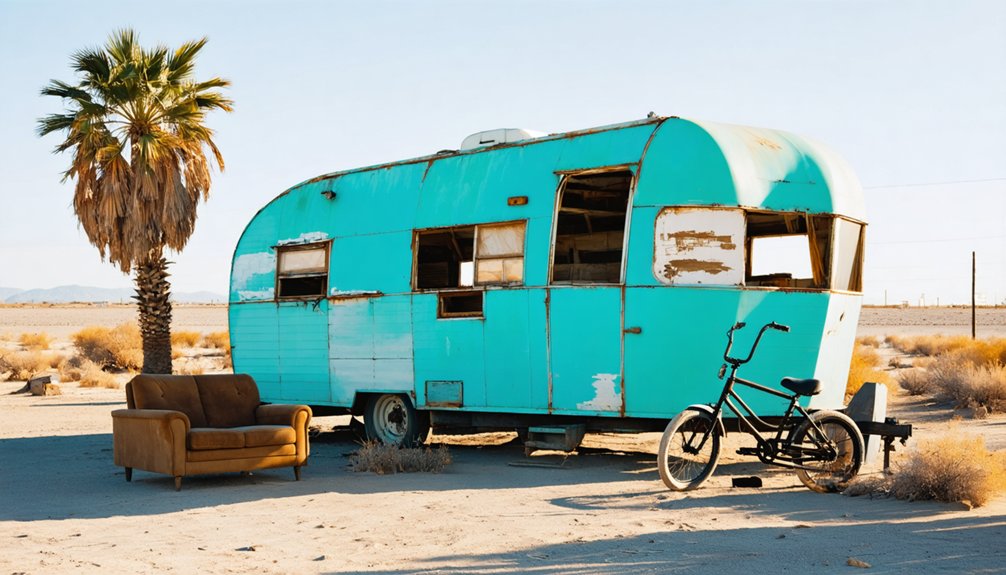
Established in 1929 by R.E. Gilligan, Bombay Beach emerged as a reflection of ambitious desert development along the accidentally-formed Salton Sea.
Located 223 feet below sea level, the town’s exotic name reflected developers’ grand vision of creating California’s own Bombay.
Bombay Beach’s allure peaked in the 1950s and ’60s when you’d find Hollywood elite like Frank Sinatra and the Beach Boys frequenting its shores.
The town flourished with two marinas, multiple bars, and recreational facilities, drawing 1.5 million annual visitors to what became known as the “Salton Riviera.”
However, ecological challenges proved insurmountable. Rising salinity levels killed marine life, while Hurricane Kathleen’s 1976 flooding devastated the community.
By the early 1980s, most residents had abandoned their homes.
Today, you’ll find a haunting artistic haven where corroded structures tell tales of paradise lost.
Willow Springs: Desert Oasis Lost to Time
Deep in California’s Antelope Valley, Willow Springs emerged as an essential desert oasis that first caught historical attention in 1776 when Padre Francesco Garces documented its life-giving springs.
The site’s historical significance grew as it transformed from a Native American water source into a bustling stagecoach station during the 1860s silver rush.
From sacred Native waters to silver rush stopover, Willow Springs evolved into a vital hub of frontier commerce.
You’ll discover Willow Springs’ rich mining heritage through these surviving remnants:
- Stone ruins of Ezra Hamilton’s ambitious 1904 resort complex
- Fragments of the original Ward adobe station walls
- Natural springs that sustained countless travelers and miners
The town’s destiny shifted with each era – from serving as a refuge for lost 49ers to becoming a $40,000 resort investment, until the 1952 Tehachapi earthquake ultimately accelerated its descent into ghost town status.
Red Mountain’s Mining and Bootlegging Past
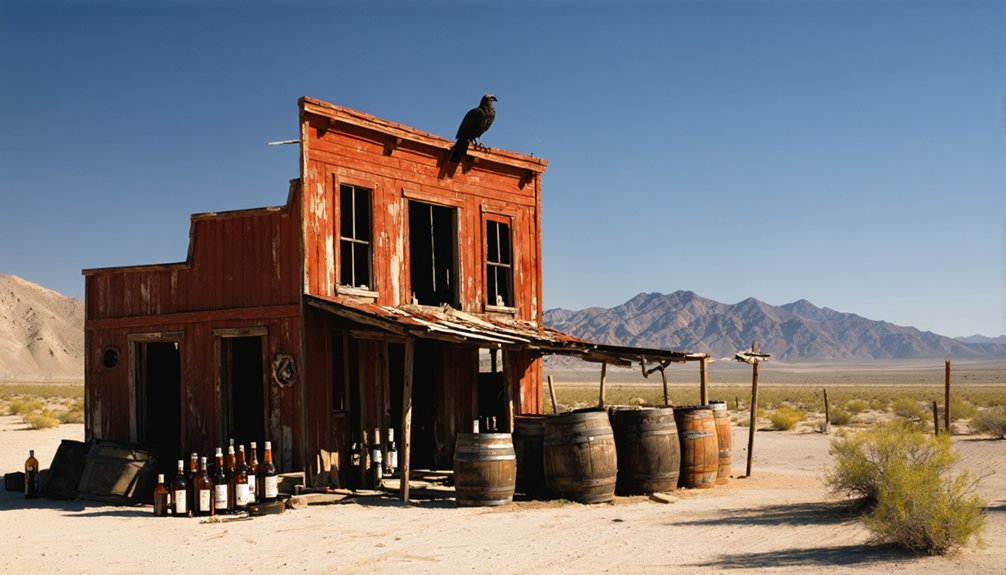
A fateful silver strike in 1919 by prospectors Jack Noser and W. Williams transformed this slice of the Mojave Desert into Red Mountain, a symbol of California’s rich mining history.
The California Rand Silver Mine anchored the town’s economy, while over 30 saloons and brothels catered to thrill-seeking Los Angeles visitors during Prohibition.
You’ll find the remnants of this bootlegging culture in the original buildings that still dot the landscape.
The town’s evolution from Osdick to Red Mountain involved a fierce naming dispute, finally settled by the Postal Service in 1929.
Today, you can explore the historic mining cabins, church, and general store along Highway 395, where a small population maintains life in this nearly abandoned ghost town at 3,600 feet elevation, alongside the echoes of its silver mining and speakeasy past.
Exploring Southern California’s Mining Heritage
While California’s famous 1848 Gold Rush brought international attention to the northern Sierra Nevada, southern California’s mining heritage stretches back even further, with gold discoveries east of Los Angeles in 1842.
The abandoned settlements of California gold rush offer a glimpse into a once-thriving era where adventurers sought fortune in the hills. Many of these ghost towns now serve as historical sites, attracting tourists eager to learn about the lives and struggles of early miners. As nature reclaims these areas, remnants of the past stand as silent witnesses to the dreams and heartbreaks of those who ventured into the unknown.
You’ll find evidence of various mining techniques across the region, from early placer mining to advanced dredging operations that dominated from 1900 to the 1960s.
Historical artifacts reveal the region’s diverse mineral wealth:
From pink tourmaline to silver and gold, Southern California’s rich mineral deposits shaped the region’s destiny and growth.
- Pink tourmaline mines that supplied 120 tons to Imperial China
- Rich silver deposits at Calico that sparked a population boom in 1882
- Gold-bearing quartz veins in the Providence Mountains that attracted hard-rock miners
The evolution of mining technology transformed these operations, as prospectors adopted electricity, steel cables, and diamond bit drilling during the “Second Gold Rush” of 1880-1905.
Desert Architecture and Preservation
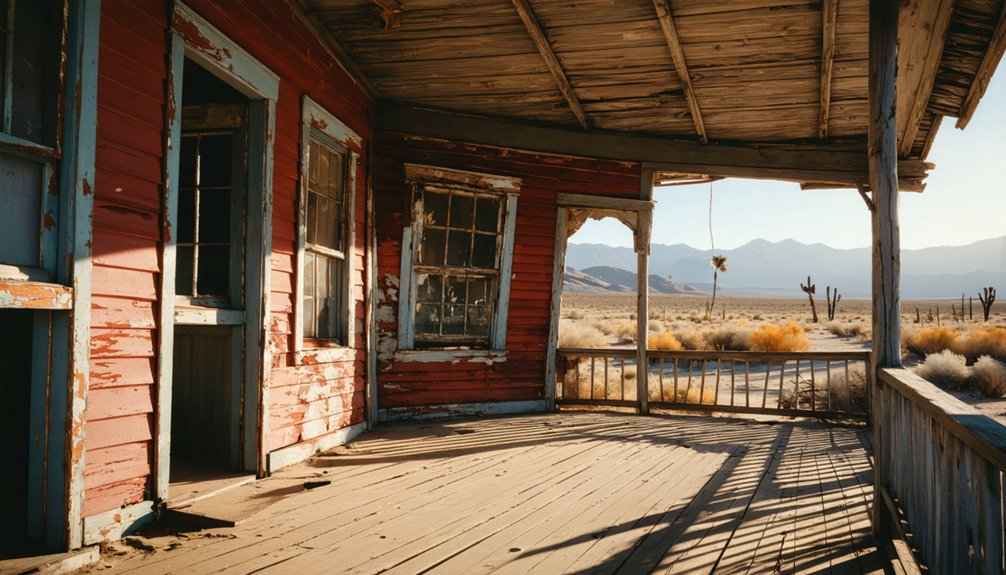
Southern California’s ghost towns showcase distinctive architectural adaptations that enabled human settlement in harsh desert environments.
You’ll find wood-frame construction dominated 19th-century mining towns, while rammed-earth walls provided thermal protection in select settlements. Desert architecture evolved through necessity, incorporating local stone for foundations and industrial-scale timber for processing plants.
The harsh desert climate continually threatens these historic structures. Extreme temperature swings cause wood warping and mortar failure, while wind-driven sand erodes exposed surfaces.
To combat deterioration, preservation techniques range from stabilization-in-place to selective reconstruction. You’ll see this at sites like Calico Ghost Town, where controlled management includes moisture prevention and structural bracing.
These preservation efforts help maintain authentic connections to Southern California’s mining past while protecting against further decay.
Photography Tips for Ghost Town Adventures
When photographing ghost towns, you’ll need a versatile camera setup that includes wide-angle and prime lenses to capture both sweeping architectural views and intimate artifact details.
A sturdy tripod becomes essential for low-light situations inside abandoned buildings, while flashlights and headlamps help you illuminate dark corners and discover hidden features.
The ideal lighting conditions occur during golden hour just after sunrise, when dramatic shafts of light pierce through broken windows and doorways, creating compelling contrasts that emphasize architectural textures and decay.
Essential Camera Gear
To capture the haunting beauty of abandoned ghost towns, you’ll need specialized camera equipment that can handle challenging lighting conditions and harsh desert environments. Your lens selection should prioritize versatility, with a 24-70mm f/2.8 serving as your primary glass, while a wide-angle zoom like the 16-35mm f/2.8 will emphasize architectural elements.
- Mount your camera on a robust tripod for long exposures up to 30 seconds, essential for low-light conditions and bracketing sequences.
- Pack a Coast Polysteel 600 Lumens flashlight and off-camera flash with wireless remote for creative lighting techniques.
- Equip neutral density and circular polarizing filters to control exposure in harsh desert light.
For ideal results, consider full-frame bodies like the Nikon D750 or Sony Alpha 7R III, though crop-sensor alternatives remain viable for ghost town photography.
Best Light Conditions
With the right camera gear in hand, mastering light conditions becomes your next photography challenge in ghost town exploration.
You’ll find the best light conditions during full moons, when natural illumination bathes abandoned structures in ethereal light. Set your white balance to 4000K to maintain the night scene’s authenticity, or lower it for cooler moonlight tones.
For capturing the Milky Way backdrop, wait for moonless nights and shoot at ISO 6400 with 30-second maximum exposures.
The blue hour after storms offers ideal shooting opportunities, especially in high desert locations.
Consider light painting techniques during pre-dawn hours, using LED tube lights through windows and doorways to create dramatic interior glows.
Morning sunlight streaming through deteriorated walls presents unique opportunities – expose for the sky visible through holes while preserving wood textures in shadow areas.
Planning Your Ghost Town Road Trip
Successful ghost town exploration in Southern California requires careful advance planning across four key areas: route design, safety preparations, legal compliance, and vehicle readiness.
For ideal route optimization, focus on sites within a single region like the Mojave Desert to minimize drive times. You’ll need to schedule visits outside peak summer months when temperatures soar above 100°F, and always carry essential safety precautions including water and satellite communications.
- Map your journey around service towns like Barstow or Ridgecrest for fuel stops.
- Pack a high-clearance vehicle with emergency supplies for remote desert travel.
- Research site permissions, as some locations like Drawbridge are strictly off-limits.
Remember to verify public access rights, obtain necessary permits, and respect artifact preservation laws that protect these historic sites.
Frequently Asked Questions
Are There Any Reported Paranormal Activities in These Ghost Towns?
While thousands of paranormal investigations have combed these towns, you won’t find official records of ghostly activity. Local legends exist, but historical documents focus purely on mining and settlement facts.
What Safety Precautions Should Visitors Take When Exploring Abandoned Buildings?
Always check building stability before entering, wear protective gear, bring a buddy, watch for wildlife hazards, maintain constant communication, and carry a flashlight plus first-aid supplies for safe exploration.
Can Visitors Take Artifacts or Souvenirs From Ghost Town Sites?
You can’t legally remove artifacts or souvenirs from ghost towns – it’s prohibited by state and federal regulations. Doing so damages historic sites and violates preservation ethics. Leave everything as you find it.
Which Ghost Towns Are Accessible During Winter Months?
You’ll find Randsburg and Calico accessible year-round in mild desert weather conditions. While Bodie requires skis or snowmobiles in winter, Cerro Gordo’s challenging travel tips include traversing snow-covered mountain roads.
Are Overnight Camping or Ghost Tours Available at Any Locations?
You won’t find official camping regulations or ghost tour options at these locations. None offer sanctioned overnight stays, and organized paranormal tours aren’t currently available at any of these historic sites.
References
- https://www.onlyinyourstate.com/experiences/california/creepy-ghost-towns-in-southern-ca
- https://en.wikipedia.org/wiki/List_of_ghost_towns_in_California
- https://la.curbed.com/2018/2/13/16968220/ghost-towns-desert-california-city-calico
- https://www.visitcalifornia.com/road-trips/ghost-towns/
- https://www.tripadvisor.com/Attractions-g28926-Activities-c47-t14-California.html
- https://www.geotab.com/ghost-towns/
- https://www.youtube.com/watch?v=cr3jaq8nR3o
- https://dornsife.usc.edu/magazine/echoes-in-the-dust/
- https://www.legendsofamerica.com/ca-calico/
- https://parks.sbcounty.gov/opinion-beyers-byways-a-brief-history-of-calico-ghost-town/