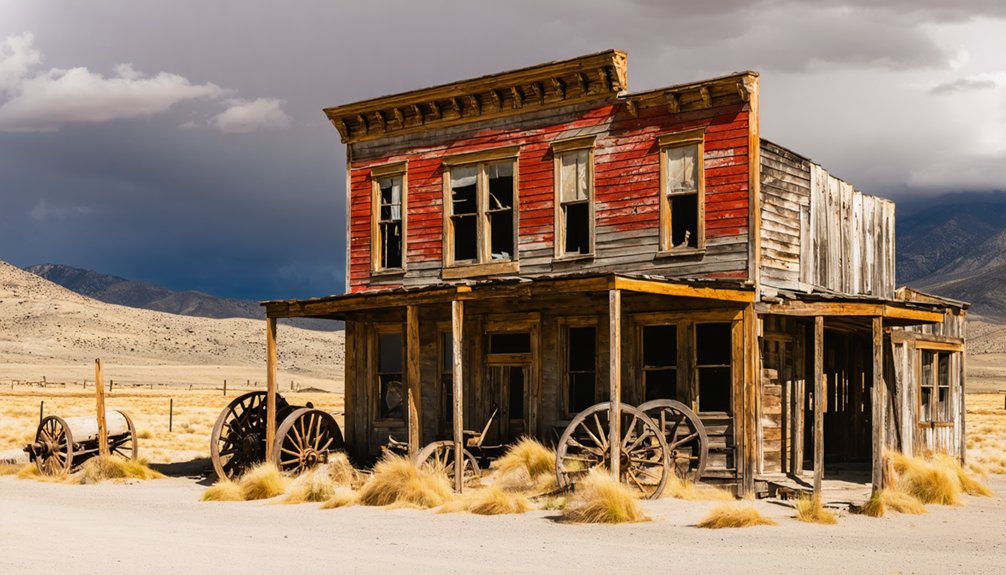
You’ll find over 3,800 documented ghost towns across America, with Texas leading at 511 locations, followed by California’s 346 abandoned settlements. These remnants of frontier expansion cluster mainly in the Western Mining Belt, where places like Bodie, California, once housed 10,000 residents and 65 saloons. Today, many sites showcase preserved architecture in “arrested decay,” while others face environmental challenges or urban decline. These forgotten places hold countless stories of America’s dynamic past, waiting to be discovered.
Key Takeaways
- Texas leads the nation with 511 documented ghost towns, while California follows with 346, primarily concentrated in mining regions.
- Bodie, California exemplifies preserved ghost towns with 110 original buildings maintained in “arrested decay” for historical authenticity.
- Resource dependency, particularly in mining and oil industries, was the primary cause of town abandonment across America.
- Environmental factors, including mining pollution and natural hazards, forced evacuations and contributed to community abandonment.
- Many ghost towns now serve as heritage tourism destinations, with some transformed into living museums or resort destinations.
The Rise and Fall of Historic Mining Towns
During the late 19th century, America’s mining towns experienced dramatic cycles of prosperity and abandonment, driven by the discovery of precious minerals and subsequent resource depletion.
You’ll find this mining heritage reflected in places like Bodie, California, which boomed after 1870s gold discoveries, and St. Elmo, Colorado, where 2,000 residents once enjoyed saloons and dance halls. These towns exemplified the era’s rapid growth, with some becoming major cities practically overnight. Today, approximately 110 structures remain in Bodie as a testament to its former glory. The town was eventually forced to close when non-essential gold mines were shut down during World War II.
Mining boomtowns like Bodie and St. Elmo sprang up rapidly, transforming remote outposts into bustling hubs of gold rush prosperity.
Ghost town legends emerged as these settlements faced inevitable decline. Kennecott, Alaska, processed $200 million in copper before emptying post-1938, while Gilman, Colorado, yielded 10 million tons of various ores before environmental concerns forced evacuation.
The pattern repeated across the West – prospectors would establish camps, extract available resources, then abandon their settlements when mines played out.
Preserved Architecture and Structural Ruins
Across America’s ghost towns, remarkable architectural remnants stand frozen in time, offering windows into the nation’s pioneering past.
You’ll find diverse architectural styles preserved in locations like Bodie, California, where over 110 original buildings maintain their structural integrity in a state of arrested decay. In Montana’s Garnet, authentic log cabins and period-specific commercial buildings showcase raw frontier construction techniques. The Jerome Grand Hotel stands as one of the most impressive examples of mining-era architecture.
The most striking examples include Rhyolite’s three-story bank walls and innovative Bottle House, while St. Elmo’s main street presents a perfectly preserved row of mountain town structures. Kennecott’s historic buildings offer glimpses into early industrial development through their cliffside mill structures.
Even Centralia’s abandoned infrastructure tells a unique story through its empty streets and sidewalks. These sites represent different regional building approaches, from Nevada’s sophisticated urban planning with concrete sidewalks to Colorado’s rustic Rocky Mountain design elements.
Notable Ghost Towns Across the American West
The American West’s most compelling ghost towns emerged during the mineral rushes of the 19th century, leaving behind remarkable reminders to boom-and-bust cycles.
You’ll find mining heritage preserved in towns like Bodie, California, where 110 structures stand frozen in “arrested decay” from its 10,000-resident heyday of 65 saloons and gambling halls.
Ghost town legends live on in Saint Elmo, Colorado, one of America’s best-preserved abandoned settlements, where rail service ended in 1922. Montana’s Bannack, once a thriving community of ten thousand residents, showcases over 60 preserved structures from its gold rush era. Today, visitors can explore the town through guided building tours, including its historic jail, church, and school.
The copper-rich Kennecott, Alaska, funded by J.P. Morgan’s investments, thrived until its mines emptied in 1938.
Lake Valley, New Mexico, showcases its silver mining past through a restored schoolhouse, while Belmont, Nevada’s proximity to the infamous Clown Motel adds an extra layer of intrigue to its silver rush history.
Geographic Distribution and Regional Patterns
You’ll find distinct ghost town clustering patterns across the American landscape, with Texas leading at 511 abandoned settlements and California following at 346, primarily due to boom-and-bust cycles in mining and oil industries.
The Western Mining Belt shows particularly dense concentrations, exemplified by Kern County, California’s 113 ghost towns and Lawrence County, South Dakota’s 93 abandoned settlements. Heritage tourism offers economic revival opportunities for many of these historic locations. Users can now explore these abandoned towns through interactive mapping tools that showcase their historical significance.
Texas’s ghost town clusters especially expanded after the 1901 Spindletop oil discovery, while desert conditions in states like Arizona and Nevada have helped preserve many abandoned settlements in their original state.
Western Mining Belt Concentrations
Throughout America’s Western mining belt, distinct geographic clusters of ghost towns emerged from the late 1800s to early 1900s, creating identifiable regional patterns tied to specific mineral deposits.
You’ll find Nevada’s northwest showcased supply centers like Pine Grove and Rockland, while Montana’s southwest revealed dense concentrations around Garnet and Virginia City. Nevada now contains over three hundred ghost towns scattered across its rugged landscape.
Colorado’s mining heritage centered in high-grade districts like St. Elmo, where economic resilience proved fleeting as ore quality deteriorated. The discovery of silver in 1859 sparked massive underground mining operations and transformed numerous settlements.
California’s Sierra Nevada hosted enduring settlements like Bodie and Columbia, though most placer camps vanished after brief booms.
Texas Ghost Town Clusters
Leading all states with 511 documented ghost towns, Texas showcases distinct geographic clusters that emerged during westward expansion and subsequent oil booms.
You’ll find these historical settlements concentrated in key regions, each telling a unique story of Texas’s development.
In North Texas, you’ll discover abandoned farming communities like Hagerman in Grayson County, while Central Texas features railway-impacted sites such as Belle Plain in Callahan County.
West Texas holds mining clusters, with Shafter in Presidio County representing the silver rush era.
The East Texas ghost towns, including New Birmingham in Rusk County, reflect the state’s industrial past, while South Texas features scattered settlements like St. Mary’s, which merged with Bayside in 1909.
These Texas ghost towns mark critical turning points in the state’s economic and social transformation.
Desert Preservation Patterns
While Texas claims the highest count of ghost towns nationally, the American desert states collectively showcase distinctive preservation patterns across their arid landscapes.
You’ll find California leading with 346 ghost towns, followed by Utah’s 136 and Arizona’s 131 sites. Ghost town preservation efforts concentrate heavily in the Mojave Desert, where Bodie and Calico stand as premier examples of desert heritage conservation.
You can explore well-preserved mining sites along former rail corridors, with Kelso Depot exemplifying successful restoration initiatives.
While many locations remain in ruins, strategic preservation focuses on sites with tourism potential. The pattern varies by state: California emphasizes state park designations, Nevada clusters protection near Death Valley, and Arizona maintains historically significant locations like Oatman in the Black Mountains.
Economic Factors Behind Town Abandonment
A complex interplay of economic forces has historically driven the abandonment of American towns, with resource dependency emerging as a primary catalyst.
You’ll find that economic sustainability often hinged on single-industry reliance, particularly in mining or oil towns, where population dynamics followed boom-and-bust cycles. When resources depleted, these communities faced rapid decline.
- Mining booms created temporary wealth but left little sustainable local capital, with merchants briefly profiting while miners struggled.
- Transportation changes, like railroad rerouting, isolated towns from essential trade flows.
- Capital flight triggered devastating fiscal spirals as tax bases shrank and public services deteriorated.
- Housing market collapses, especially during the subprime crisis, created modern ghost towns through foreclosures and widespread abandonment.
These economic factors worked in concert, making recovery increasingly difficult for affected communities.
Modern Urban Decline and Vacant Cities
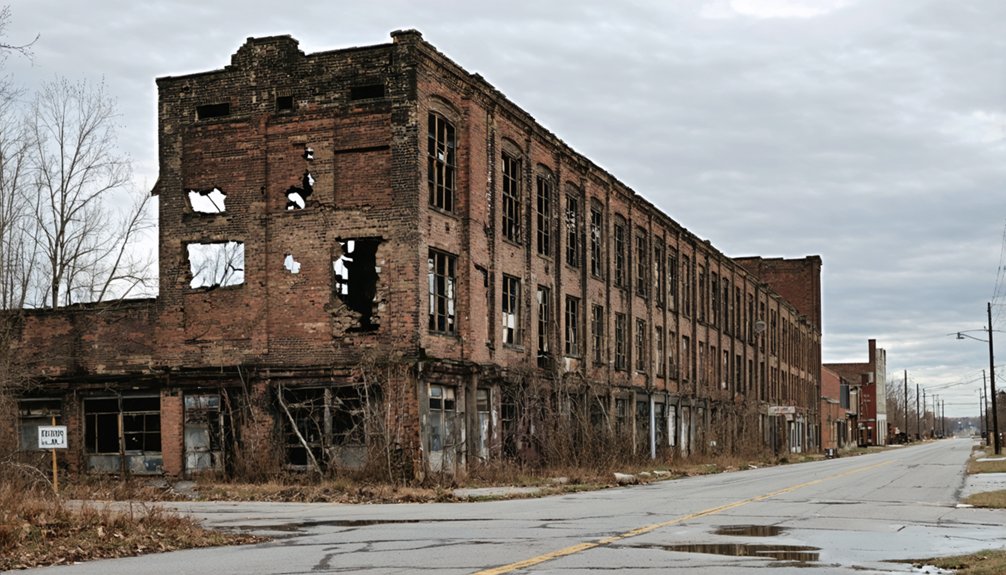
You’ll find stark evidence of modern urban decline in America’s largest cities, where places like New York City lost over 123,000 residents in 2021-2022 and St. Louis saw its metro population plummet from 857,000 in 1950 to just 282,000 by 2020.
The exodus has hit young families particularly hard, with major urban counties experiencing an 8% drop in their under-five population since April 2020 – twice the national average decline.
This urban flight has created concentrated areas of vacancy, particularly in historically Black neighborhoods where gentrification has displaced hundreds of thousands of residents across cities like Washington DC, Philadelphia, and Atlanta.
Vacant Housing Crisis Statistics
Modern housing vacancy trends reveal a complex paradox: despite 3.4 million vacant homes across the United States in 2023, the nation faces an estimated shortfall of 4.7 million housing units.
This vacancy impact varies greatly by region, with severe housing affordability challenges concentrated in the Southeast, industrial Midwest, and parts of the Southwest.
- Rental vacancy rates hover around 7.1%, while homeowner vacancy has dropped to a concerning 1.1%
- Investor-owned properties account for 882,300 vacant houses, creating geographic clusters of empty homes
- Extremely low-income renters face a staggering shortage of 7.1 million affordable units
- While some states like Alaska and North Dakota show modest surpluses, most metropolitan areas struggle with considerable housing deficits when analyzed through local vacancy indicators
Urban Population Exodus Patterns
While economic shifts and demographic changes have reshaped America’s urban landscape since the 1970s, several distinct patterns characterize the ongoing exodus from U.S. cities.
You’ll find the most severe urban migration concentrated in Rust Belt metros, where deindustrialization has triggered sustained population decline through factory closures and job losses. This outflow creates a destructive cycle: as working-age residents depart, tax bases shrink, forcing cuts to public services that accelerate decay.
Meanwhile, aging demographics in smaller cities create another exodus pattern.
You’re seeing natural population decrease as deaths exceed births, while younger residents relocate to coastal and Sun Belt regions offering tech and service sector opportunities. This youth departure further depletes these communities, leading to school closures and housing vacancies that make recovery increasingly difficult.
Environmental Impact on Ghost Town Formation
Throughout America’s history, environmental factors have played a decisive role in transforming thriving communities into ghost towns through five primary mechanisms: mining pollution, coastal erosion, industrial contamination, natural disasters, and resource depletion.
You’ll find that environmental hazards have decimated communities like Centralia, Pennsylvania, where an underground coal fire has burned since 1962, and Picher, Oklahoma, where pollution effects from lead mining poisoned residents.
Coastal towns face their own battles, as climate change accelerates erosion and threatens stability.
- Mining waste contamination led to EPA-mandated evacuations
- Underground fires created unstable ground and toxic gas emissions
- Lead poisoning affected 34% of children in mining communities
- Industrial toxins forced complete town abandonment and demolition
Tourism and Heritage Preservation Efforts

Despite their abandoned status, many American ghost towns have found new life as heritage tourism destinations, with preservation efforts transforming these historic sites into living museums of the American frontier.
You’ll find diverse approaches to preservation, from Bodie’s “arrested decay” philosophy that maintains authentic weathering to Calico’s reconstructed attractions complete with staged gunfights.
Park City exemplifies successful transformation, evolving from a declining mining town into a world-class resort destination.
Park City’s evolution from fading silver town to premier ski resort shows how ghost towns can reinvent themselves while preserving their heritage.
Other sites like St. Elmo and Rhyolite face ongoing preservation challenges while maintaining their historical integrity.
Through careful management, these ghost towns balance tourism accessibility with historical authenticity.
Whether you’re exploring Bodie’s haunting original structures or experiencing Calico’s immersive reenactments, these sites offer unique windows into America’s frontier past.
Digital Mapping and Documentation Methods
In recent years, digital mapping technologies have revolutionized the documentation of America’s ghost towns, with multiple platforms offering unprecedented access to these historic sites.
You’ll find sophisticated digital mapping tools that enable detailed exploration and documentation of these abandoned settlements across the nation.
- ClimateViewer Maps catalogs over 125 ghost towns through satellite imagery, with Wikipedia links providing historical context.
- ArcGIS Pro projects digitize abandoned infrastructure, including rail lines and structures, using georeferenced historical maps.
- BatchGeo’s interactive platform tracks 4,530+ ghost towns, categorizing them by status and revealing density patterns.
- Global mapping initiatives like Forgotten Lands combine location data with historical records, allowing you to contribute site discoveries and access downloadable datasets through Earth Data Analysis Center.
Frequently Asked Questions
Are There Any Completely Underwater Ghost Towns Still Visible to Divers?
You’ll find remarkable underwater exploration opportunities at Proctor in Fontana Lake, where clear waters reveal well-preserved structures, while diving tourism thrives at Old Bluffton during Lake Buchanan’s low-water periods.
What Happens to Unclaimed Property and Artifacts Found in Ghost Towns?
You’ll find unclaimed artifacts legally belong to the property owner – whether private, state, or federal. You must obtain permits and landowner permission before collecting or removing any items.
Do Any Ghost Towns Still Have Active Post Offices?
You’ll find most ghost towns don’t maintain active post offices today – they’ve closed as populations dwindled. However, Ochopee, Florida stands out, operating America’s smallest post office despite its near-ghost town status.
How Many Ghost Towns Have Year-Round Residents Serving as Caretakers?
You’ll find at least 171 caretakers dwelling in ghost towns year-round, based on combined data from residual population counts (102) and semi-abandoned sites (69) where caretaker roles maintain these historic settlements.
Can People Legally Purchase and Restore Buildings in Abandoned Towns?
You can legally purchase and restore ghost town buildings if property rights are clear, but you’ll face significant restoration challenges regarding utilities, permits, historic preservation requirements, and infrastructure development costs.
References
- https://themortgagepoint.com/2024/10/25/americas-new-ghost-towns/
- https://blog.batchgeo.com/ghost-towns/
- https://247wallst.com/housing/2024/04/11/americas-modern-ghost-towns-2/
- https://www.youtube.com/watch?v=aTbMdOZRZO4&vl=en
- https://www.geotab.com/ghost-towns/
- https://en.wikipedia.org/wiki/Lists_of_ghost_towns_in_the_United_States
- https://joybird.com/blog/top-ghost-towns-in-america/
- https://worldpopulationreview.com/world-city-rankings/abandoned-cities
- https://www.wideopencountry.com/the-10-eeriest-ghost-towns-in-america/
- https://www.islands.com/2046803/gilman-colorado-once-thriving-abandoned-mining-town-between-grand-junction-denver/