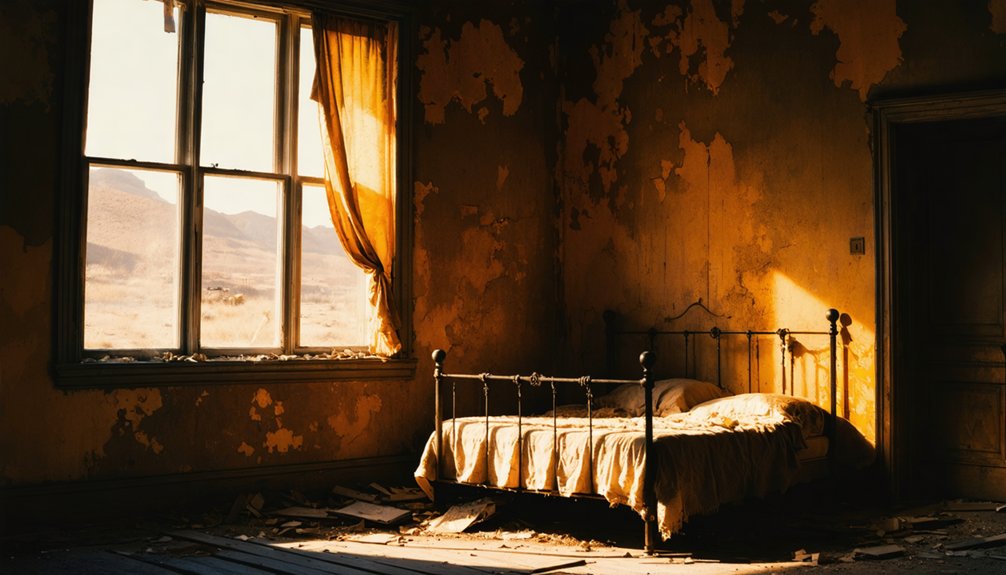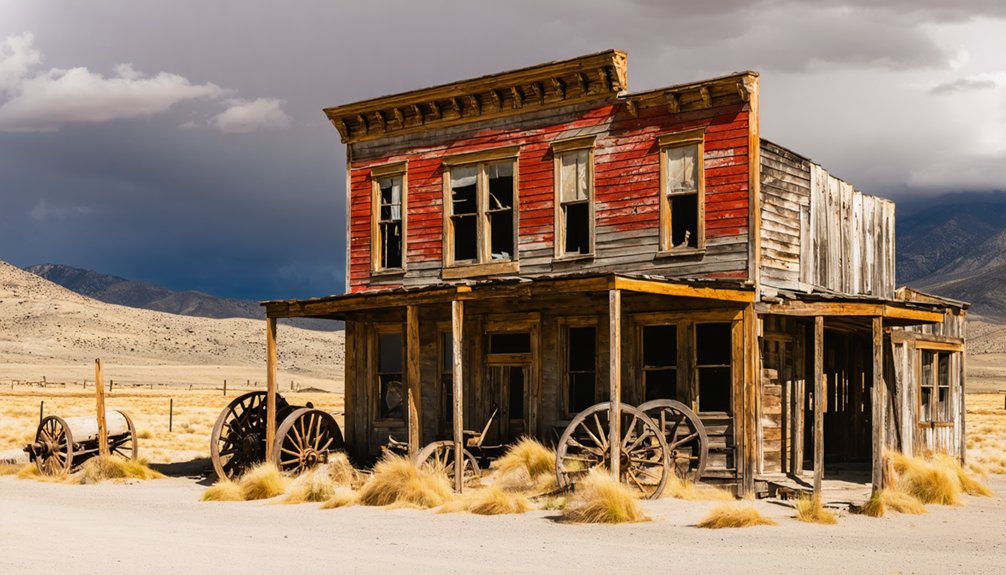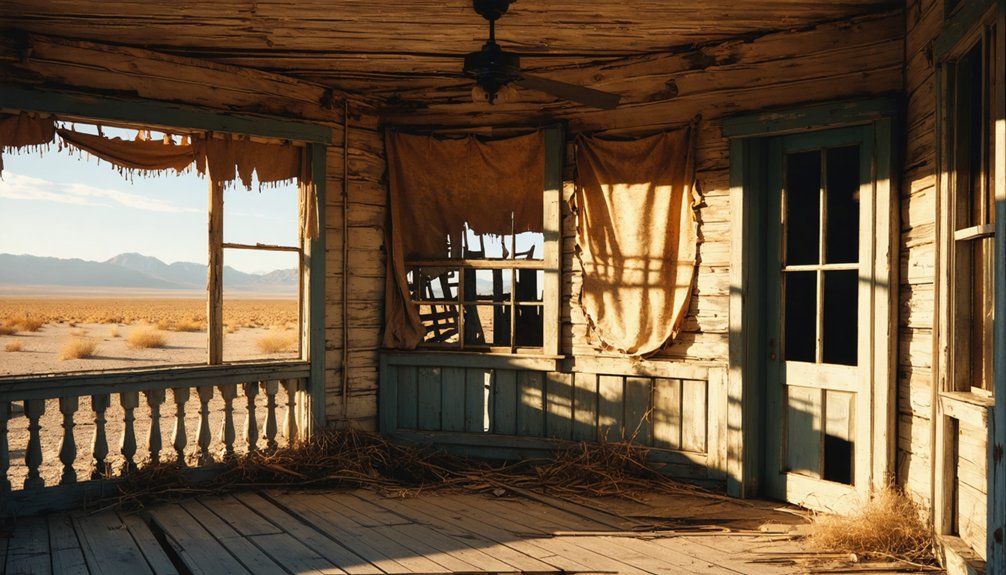
You’ll find over 3,800 abandoned ghost towns scattered across the American West, remnants of the region’s mining boom era. The most well-preserved sites include California’s Bodie with 110 original structures, Nevada’s Virginia City, and Arizona’s Tombstone. These settlements typically flourished between the 1850s and early 1900s before declining due to resource depletion, railroad changes, or natural disasters. Their preserved structures and artifacts offer fascinating glimpses into frontier life’s complex social and economic dynamics.
Key Takeaways
- Bodie, California stands as one of the best-preserved ghost towns, featuring 110 original structures from the 1870s gold rush era.
- Ghost towns emerged primarily due to mining booms and declined when mineral resources were depleted or economic conditions changed.
- Most accessible visiting times are between May and October, with desert locations better suited for winter exploration.
- Texas and California have the highest concentration of ghost towns, stemming from their historic mining and oil industries.
- Preservation efforts combine government protection, private investment, and community engagement to maintain these historic sites for future generations.
The Rise and Fall of Western Mining Towns
As prospectors discovered rich mineral deposits across the American West in the mid-1800s, mining towns sprouted rapidly from California to Colorado, creating a distinctive pattern of boom-and-bust development that would define the region’s settlement.
You’ll find that mine expansion followed a predictable cycle: initial placer mining gave way to more complex lode operations, requiring technological advancements in extraction and processing.
Economic fluctuations, particularly in silver and coal prices, determined these towns’ fates, while infrastructure development through railroads and telegraph lines transformed isolated camps into regional hubs.
Labor dynamics shaped social tensions as immigrant workers filled the mines, creating ethnic enclaves and class hierarchies. The Matewan Massacre of 1920 exemplified the violent labor conflicts that erupted between mine workers and coal companies.
Environmental impacts were severe, with deforestation, pollution, and landscape alterations that still affect these areas today. The extensive gold rush migration brought over 300,000 miners to California, forever changing the region’s demographic makeup.
Demographic changes were equally dramatic, as populations swelled from zero to thousands within months.
Top Ghost Towns Worth Exploring
When you explore the American West’s best-preserved ghost towns, you’ll encounter remarkable mining camps like Bodie, California’s frozen-in-time structures and Kennecott, Alaska’s rare Arctic copper operations.
These preserved sites offer windows into distinct periods of frontier development, from Tombstone’s 1880s gunslinger era to Saint Elmo’s railroad-linked mining heyday of the late nineteenth century. Today, visitors can explore more than sixty historic buildings at Bannack, Montana’s first territorial capital. Once thriving with 10,000 residents, Bodie stands as one of the largest ghost towns in the country.
Your ideal visit requires strategic timing, as seasonal conditions affect accessibility – summer months typically provide the most reliable access to these high-elevation locations, though winter’s stark beauty draws photographers to sites like Bodie’s snowbound buildings.
Preserved Mining Camp Wonders
While many ghost towns across the American West have succumbed to decay, several remarkably preserved mining camps offer visitors an authentic glimpse into the region’s boom-and-bust heritage.
You’ll discover ghost town legends at Bodie, California, where over 100 original structures stand frozen in “arrested decay,” including remnants of saloons and brothels from its 1870s gold rush peak. At its height, the town supported a population of 7,000 to 8,000 residents before mineral wealth depletion led to its abandonment.
In Alaska’s remote Kennecott, you can explore intact copper mining infrastructure, while Cerro Gordo’s silver camp perches high in California’s Inyo Mountains with its carefully restored buildings. The historic Moonshine Gulch Saloon in Rochford still welcomes visitors today, preserving a authentic piece of Black Hills mining culture.
Each site tells compelling mining camp stories through different preservation approaches – from Bodie’s untouched abandonment to Cerro Gordo’s adaptive reuse.
These living museums let you step directly into the rugged world of Western frontier life.
History Behind Ghost Sites
The complex interplay of economic, environmental, and sociopolitical forces shaped the rise and fall of countless Western ghost towns during the 19th and early 20th centuries.
You’ll find these settlements tell a compelling story of America’s resource-driven expansion and the cultural significance of frontier life.
States like Texas and California experienced the highest concentration of ghost towns across the nation due to their rich mining and oil industries.
The economic impact of single-industry dependence left many towns vulnerable when:
- Precious metal prices plummeted or ore deposits ran dry
- Railroad routes changed, isolating communities from essential supply lines
- Wars redirected resources and labor away from mining operations
- Environmental disasters struck, from devastating fires to catastrophic floods
These ghost towns now stand as proof of the boom-bust cycles that defined Western expansion, where fortunes were made and lost, and communities rose and fell based on the whims of market forces and nature’s challenges. Today, sites like St. Elmo showcase best-preserved ghost towns with dozens of original structures still standing.
Best Times To Visit
Planning a successful ghost town visit demands strategic timing to maximize both accessibility and experience quality. For ideal seasonal accessibility and visitor comfort, schedule your Western ghost town explorations between late spring and early fall (May-October) when roads are clear and facilities are open.
Desert locations like Calico prove exceptions, best visited during winter to avoid intense heat. Visitors can enjoy exploring restored historic buildings including the General Store and Lil’s Saloon.
Consider regional variations carefully. Sierra and Northern Rockies sites offer comfortable conditions from May through September but watch for afternoon thunderstorms. Garnet ghost town visitors can enjoy special activities during Garnet Day in mid-June, which features authentic gold panning demonstrations and period treats.
Desert locations require early morning starts or winter visits to escape dangerous heat. Time your visit with local heritage events like Bannack Days for enhanced experiences, but plan weekday explorations during shoulder seasons (March-May, September-November) to avoid crowds.
Always check road conditions and facility operating hours before remote site visits.
Preserving America’s Abandoned History
When you explore America’s ghost towns, you’ll encounter both well-preserved historical sites and structures in critical need of protection from environmental damage and vandalism.
State park systems have implemented extensive maintenance programs that include structural stabilization, artifact cataloging, and controlled tourism management to safeguard these irreplaceable locations.
Local communities are increasingly partnering with preservation organizations to restore significant buildings and create heritage centers that tell the stories of these abandoned settlements through careful documentation and interpretation.
Protecting Historical Building Sites
Preserving America’s abandoned ghost towns requires coordinated efforts between government agencies, private investors, and local communities to safeguard these invaluable historical assets.
Heritage conservation demands strict adherence to legal frameworks while balancing development with preservation.
You’ll find several critical protection measures in place:
- Thorough title searches and environmental assessments before restoration
- Federal and state oversight of significant historical structures
- Implementation of preservation ordinances restricting alterations
- Public-private partnerships enabling sustainable tourism initiatives
When you’re exploring these historical treasures, you’ll notice the impact of successful preservation efforts, from Bodie’s 200,000 annual visitors to Eastern State Penitentiary’s remarkable transformation.
The challenges are substantial, including environmental cleanup costs and structural stabilization, but the preservation of these sites guarantees future generations can experience America’s rich mining heritage firsthand.
State Park Maintenance Systems
State park maintenance systems form the backbone of ghost town preservation, employing sophisticated methods to protect these historical treasures.
You’ll find a complex network of funding sources, including state allocations, entrance fees, and federal grants, working together to address preservation challenges. Parks utilize cutting-edge technology like drone photogrammetry and 3D modeling to monitor structural changes, while systematic inventories track each building’s condition.
To maximize limited ghost town funding, parks combine professional expertise with volunteer support and follow strict “arrested decay” protocols.
They’re implementing strategic visitor management through designated pathways and viewing platforms, ensuring these historic sites remain accessible while protecting fragile structures.
Digital databases shared across agencies help coordinate preservation efforts, creating a thorough approach to maintaining these irreplaceable pieces of American history.
Community Heritage Restoration Efforts
Beyond official park systems, grassroots heritage organizations and private investors have sparked remarkable restoration campaigns across America’s ghost towns.
You’ll find community engagement thriving in projects like the Ghost Town Club of Colorado’s Preston restoration and Cerro Gordo’s ambitious revival, where heritage education meets hands-on preservation.
Notable community-driven success stories include:
- Friends of Sutro Tunnel’s 3.88-mile restoration connecting Dayton to Virginia City
- Collaborative drone mapping of Old Hundred buildings in Howardsville
- Local volunteers rebuilding Cerro Gordo’s American Hotel after the 2020 fire
- San Juan County’s partnership efforts in architectural preservation
These initiatives demonstrate how private investment and grassroots support can transform abandoned sites into living history.
You’re witnessing a new era where community dedication and entrepreneurial vision converge to save America’s forgotten treasures.
Most Well-Preserved Ghost Towns by State
Five Western states stand out for hosting America’s most intact ghost towns, each offering unique glimpses into the region’s mining heritage.
In California, Bodie’s ghost town economics are evident in its 110 original buildings, while Nevada’s Virginia City preserves the wealth of Comstock Lode with its historic wooden sidewalks and operational saloons.
Arizona’s Tombstone maintains its Wild West charm with the legendary OK Corral, and Jerome showcases abandoned structures from its mining heyday.
Colorado’s St. Elmo, nestled in the Rockies, retains its 1880s character with preserved log cabins and a general store, while Montana’s Bannack and Garnet exemplify authentic 19th-century mining settlements.
These towns remain frozen in time, allowing you to experience the raw energy of America’s frontier mining boom through their remarkably preserved architecture and artifacts.
Life in the Old Western Boom Towns
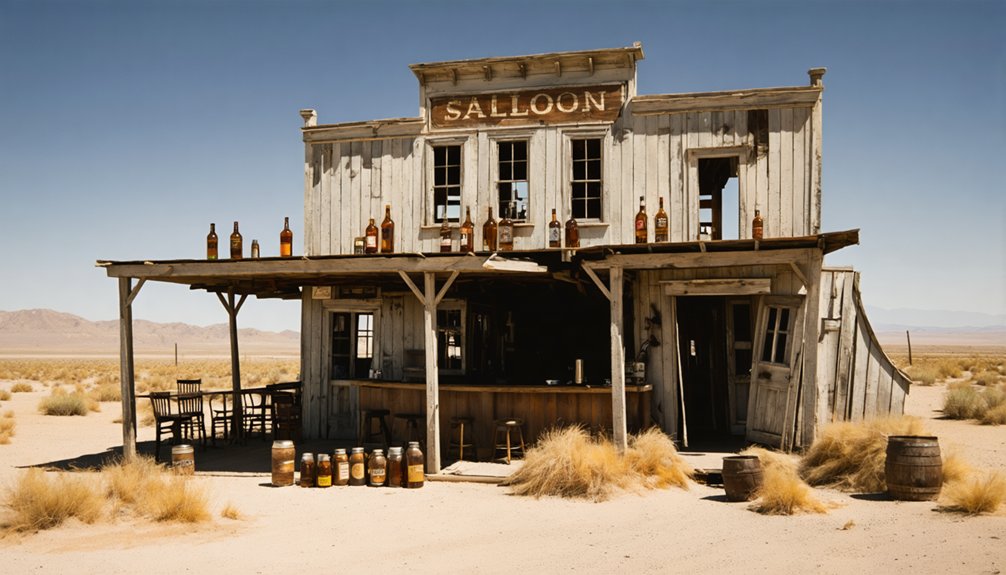
Life in Western boom towns surged with the discovery of rich mineral deposits across Colorado, Nevada, and South Dakota, transforming empty landscapes into bustling centers of commerce and chaos.
You’d have found yourself amid a stark reality of mining hardships, where exhausting physical labor often yielded minimal rewards. The saloon culture dominated daily life, with establishments serving multiple purposes:
- Post office and grocery services alongside whiskey
- Warmth and respite from grueling mine work
- Meeting places for planning ventures
- Centers for gambling and entertainment
Disease, violence, and lawlessness plagued these communities where brothels and gambling halls outnumbered churches.
While some settlers struck it rich, most faced brutal conditions in makeshift tent cities until towns stabilized with proper infrastructure, bringing organized law enforcement and essential services.
What Caused These Towns to Empty
While the rapid rise of Western boom towns captivated America’s imagination, their decline often proved equally dramatic as multiple forces conspired to empty these once-bustling settlements.
You’ll find economic shifts played a pivotal role, as exhausted mines, depleted resources, and plummeting commodity prices transformed thriving communities into virtual ghost towns overnight.
When railroads rerouted or newer highways bypassed established routes, you’d see entire towns wither as commerce dried up.
Environmental impacts struck decisive blows too – from catastrophic fires and floods to contaminated water supplies and depleted aquifers.
The final nails often came from government interventions, like eminent domain seizures for reservoirs or military bases, while industrial consolidation and mechanization steadily drained the workforce.
Competition from larger urban centers simply accelerated the inevitable exodus.
Ghost Town Architecture and Structures
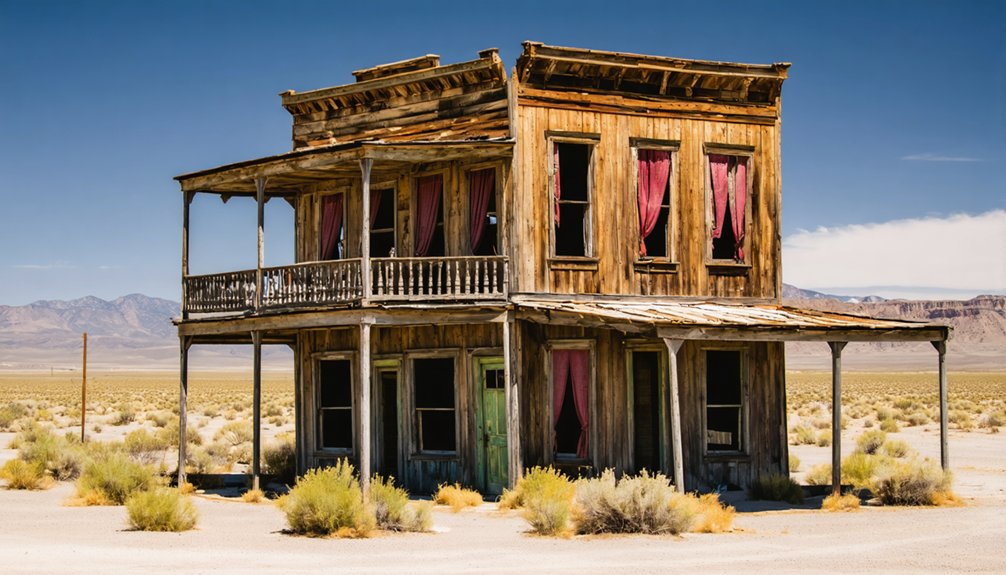
You’ll find Western ghost towns dominated by distinctive architectural elements including false-fronted commercial buildings, industrial mining structures, and simple wood-frame houses that reflect the era’s rapid settlement patterns.
The buildings’ construction materials – primarily local timber, stone, and corrugated metal – have weathered differently over time, with masonry structures often outlasting their wooden counterparts.
The architectural legacy reveals itself through surviving features like covered boardwalks, ore chutes, water management systems, and defensive elements that showcase both the practical needs and ambitious spirit of frontier towns.
Building Materials and Methods
Despite harsh frontier conditions, ghost towns across the American West showcased remarkable architectural ingenuity through diverse building materials and construction methods.
You’ll find adobe foundations reinforced with local rocks in Terlingua, while Rhyolite’s structures featured fireproof concrete and innovative materials like bottle glass construction.
The resourcefulness of frontier builders is evident in their creative use of materials:
- Adobe structures with rock foundations provided durability in harsh desert conditions
- Concrete buildings incorporated modern amenities like plumbing and fire protection systems
- Salvaged wooden materials found new life when relocated to neighboring towns
- Glass bottles transformed into walls when traditional lumber was scarce
This adaptability extended to metal elements, with tin roofs serving dual purposes for shelter and water catchment in revival constructions throughout these remarkable settlements.
Preservation of Historic Structures
As ghost towns face ongoing threats from weathering and vandalism, extensive preservation strategies have emerged to protect these invaluable historic structures.
You’ll find that historic preservation efforts often begin with legal protections, including National Register listings and local historic district designations, which reveal essential funding opportunities through tax credits and grants.
Structural stabilization is paramount in ghost town preservation, requiring emergency measures like shoring and bracing to prevent collapse.
You’ll need to secure hazardous features such as mine shafts and implement reversible interventions that protect historic fabric while stopping decay.
Public-private partnerships and preservation organizations can help you access various funding mechanisms, from federal tax credits to crowdfunding campaigns, ensuring these remarkable sites remain standing for future generations to explore and experience.
Architectural Styles Across Towns
When exploring ghost towns of the American West, distinct architectural styles emerge that reveal the economic and social fabric of these abandoned communities.
You’ll find architectural influences ranging from simple wood-frame structures to more elaborate commercial buildings, each reflecting the town’s prosperity and permanence.
Design variations showcase the hierarchy of these settlements, from basic worker housing to impressive civic buildings.
- Western falsefront architecture dominates commercial districts, featuring tall facades that mask simpler rooflines.
- Industrial structures like stamp mills and headframes demonstrate robust timber framing and stone foundations.
- Residential buildings span from modest one-room cabins to substantial merchant homes with stylistic touches.
- Civic and ecclesiastical buildings often display more permanent materials, with courthouses and churches built of brick or stone to assert community stability.
Notable Mining Communities That Vanished
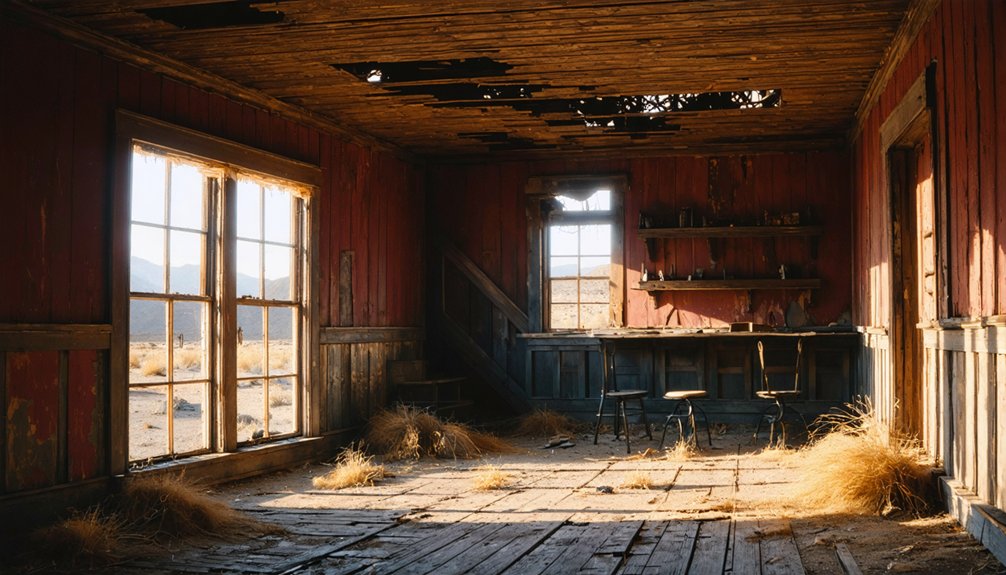
The American West’s most fascinating ghost towns emerged from the remnants of once-prosperous mining communities that vanished after their mineral wealth ran dry.
You’ll discover striking examples like Goldfield, Nevada, which rose to become the state’s largest city before floods and fires left only abandoned structures behind.
In Bodie, California, preserved mining artifacts tell tales of gambling halls and brothels from its 1800s heyday.
Kennecott’s red mill buildings still stand against Alaska’s dramatic mountain backdrop, while St. Elmo, Colorado, maintains its original log cabins along a quiet main street.
Perhaps most iconic is Calico, California, where 500 silver mines once fueled a classic frontier outpost that now serves as a monument to the West’s boom-and-bust legacy.
The Legacy of Western Ghost Towns Today
Modern ghost towns of the American West serve multiple roles as cultural heritage sites, economic engines, and complex management challenges for their stewards. Their cultural significance extends beyond tourism, offering essential insights into frontier life through preserved structures and artifacts.
You’ll find these sites managed through “arrested decay,” maintaining authenticity while protecting historical value.
The economic impact of ghost towns manifests through:
- Heritage tourism revenue from entrance fees and guided tours
- Employment opportunities in nearby communities
- Film industry location rentals
- Historical research and educational programs
Today’s preservation efforts balance public access with conservation, employing digital documentation and incorporating previously overlooked narratives.
You’ll encounter sophisticated management strategies that address environmental hazards, liability concerns, and land-use regulations while ensuring these remarkable sites continue telling their stories for future generations.
Planning Your Ghost Town Adventure
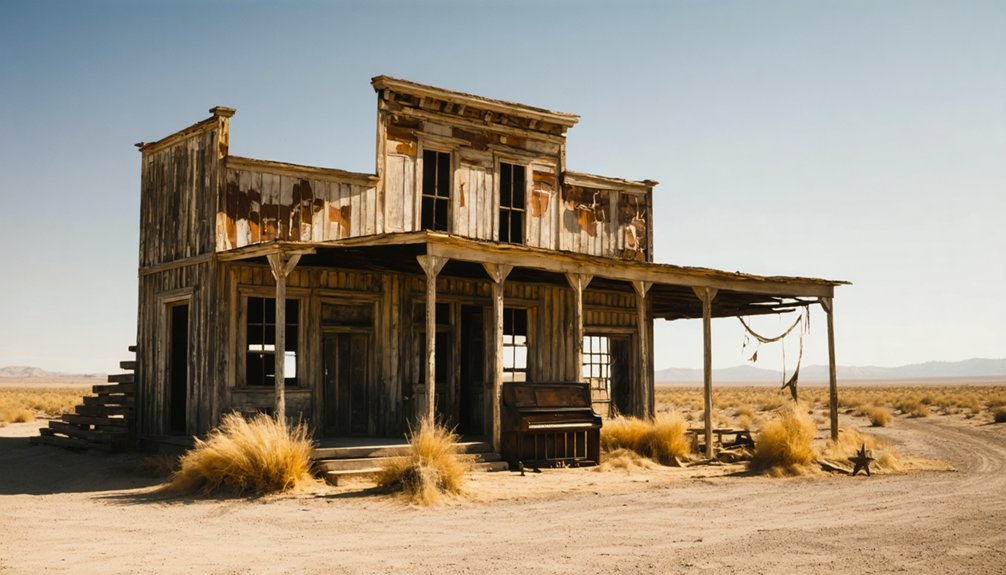
Planning a successful ghost town expedition requires careful consideration of multiple factors, from sustainable tourism practices to critical safety protocols.
Your ghost town logistics should begin with thorough research of access routes and road conditions, particularly for remote locations like Nevada’s desert sites. Pack essential survival supplies for three days, including water, food, and recovery gear.
For adventure preparation, you’ll want to travel with companions when possible and share detailed route plans with trusted contacts. Support local economies during your visit by purchasing handmade crafts and dining in town restaurants.
You’ll need to adhere to preservation guidelines and leave-no-trace principles while exploring historical structures. Consider visiting well-preserved destinations like Bodie, California, or Jerome, Arizona, where you can experience guided tours and authentic Western heritage.
Frequently Asked Questions
Are There Any Reported Paranormal Activities in These Ghost Towns?
Like whispers echoing through time, you’ll encounter ghost sightings in all four haunted locations – from Bodie’s cursed artifacts to St. Elmo’s Annabelle Stark, Frisco’s spectral miners, and Goldfield’s mysterious cowboy.
Can You Legally Take Artifacts Found in Ghost Town Locations?
You can’t legally remove artifacts from ghost towns without proper permits. Artifact preservation laws carry serious legal implications, including fines and jail time, whether on federal, state, or private land.
Do Any Ghost Towns Still Have Active Post Offices?
Like flickering lanterns in forgotten towns, you’ll find active post offices still operating in Calico, California and Lincoln, New Mexico, where they preserve ghost town history while serving modern-day postal needs.
Which Ghost Towns Are Accessible During Winter Months?
You’ll find winter accessibility at Bodie, California; Kennecott, Alaska; Bannack, Montana; South Pass City, Wyoming; and Rhyolite, Nevada. These locations offer year-round seasonal exploration, though services may be limited.
How Many Ghost Towns Have Been Completely Destroyed by Natural Disasters?
You’ll find exact natural disaster impact numbers remain debated, but records indicate over 100 ghost towns were completely destroyed, with poor ghost town preservation limiting our ability to document precise figures.
References
- https://themortgagepoint.com/2024/10/25/americas-new-ghost-towns/
- https://www.loveexploring.com/gallerylist/188219/the-us-state-with-the-most-ghost-towns-revealed
- https://literaryfictions.com/articles/ghost-towns-in-the-american-west/
- https://explorethearchive.com/western-ghost-towns
- https://www.youtube.com/watch?v=aTbMdOZRZO4&vl=en
- https://www.lovemoney.com/gallerylist/86648/americas-empty-ghost-towns-and-why-theyre-abandoned-today
- https://www.mentalfloss.com/geography/american-ghost-towns-can-still-walk-through
- https://www.geotab.com/ghost-towns/
- https://en.wikipedia.org/wiki/Lists_of_ghost_towns_in_the_United_States
- https://minesafety.wv.gov/historical-statistical-data/mining-in-west-virginia-a-capsule-history/