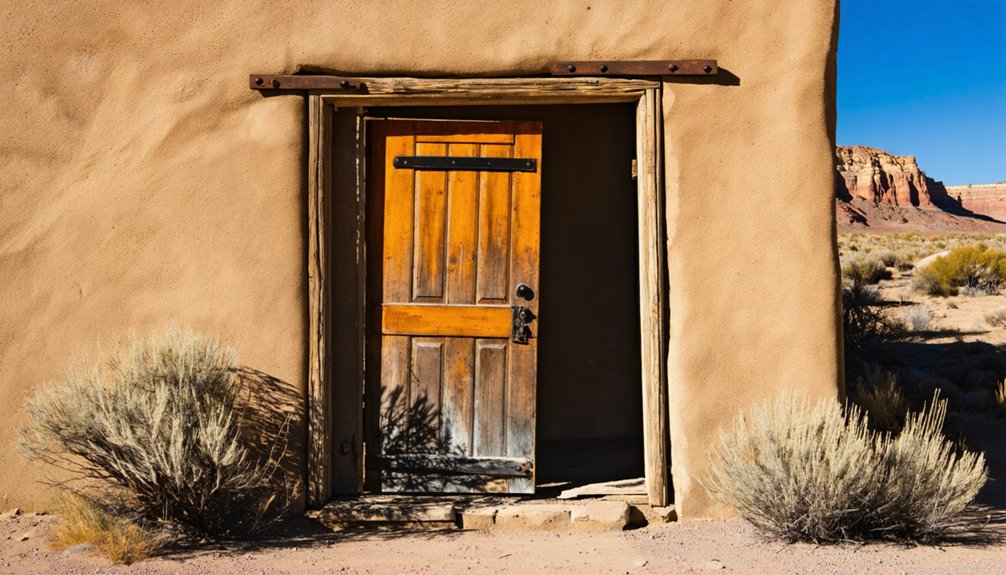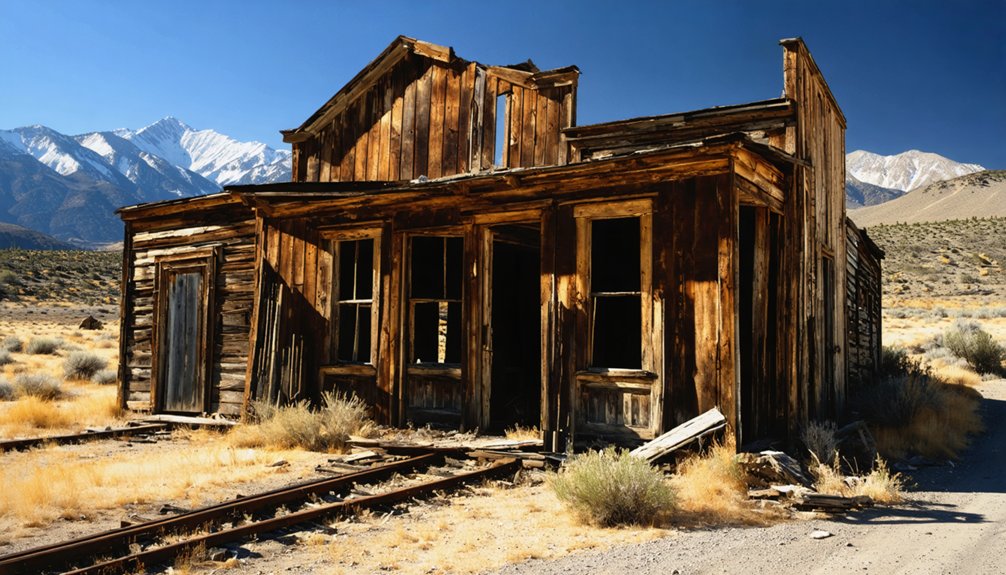
You’ll discover over 100 ghost towns across Utah, from well-preserved settlements like Grafton near Zion National Park to mining camps in Little Cottonwood Canyon that yielded 11 million ounces of silver. These abandoned sites showcase weathered buildings, historic cemeteries, and artifacts from Utah’s mining, religious, and railroad heritage. When exploring these cultural treasures, stick to marked paths and avoid climbing structures. The stories behind these forgotten towns reveal fascinating chapters of western expansion.
Key Takeaways
- Grafton is Utah’s most well-preserved ghost town, featuring restored buildings and a historic cemetery near Zion National Park.
- Silver Reef was a unique silver mining town with sandstone deposits and a preserved Wells Fargo Building.
- Utah has 105 documented ghost towns, primarily abandoned due to mining industry decline and railroad rerouting.
- Many ghost towns originated from mining operations extracting silver, copper, coal, lead, zinc, and tungsten.
- Railroad boom towns like Terrace and Promontory flourished during the Transcontinental Railroad era before being abandoned.
The Mining Legacy of Utah’s Ghost Towns
While Utah’s landscape is dotted with abandoned settlements today, these ghost towns once bustled with the fervent activity of mining operations that extracted valuable minerals including silver, copper, coal, lead, zinc, and tungsten.
Many of these sites are considered Class 3 ghost towns, featuring numerous structural ruins, roofless buildings, and historic cemeteries that paint a picture of their former glory.
You’ll find some of the most impressive mining legacies in places like Frisco, where the Horn Silver Mine‘s advanced mining techniques yielded over $20 million in ore during the 1880s alone, with total production exceeding $60 million. The devastating mine collapse in 1885 marked the beginning of the town’s decline into abandonment.
Little Cottonwood Canyon’s mines extracted an astounding 11 million fine ounces of silver between 1865 and the mid-1920s. These operations rode dramatic economic cycles, from spectacular booms to devastating busts.
The industry’s footprint remains visible in the 105 studied ghost towns across Utah, where you’ll discover remnants of an era when mining drove the state’s development and shaped its territorial expansion.
Southern Utah’s Most Preserved Ghost Town Sites
Southern Utah harbors some of the state’s most historically significant and well-preserved ghost towns, each offering unique glimpses into 19th-century frontier life.
Among the rugged landscapes, ghost towns in Utah’s wilderness stand timeless, drawing in adventurers and history buffs alike. Visitors can explore remnants of mining operations and abandoned structures that tell stories of the pioneers who once thrived there. Each town, shrouded in tales of fortunes gained and lost, invites exploration and reflection on the resilience of those who came before.
You’ll discover the remarkable Grafton restoration near Zion National Park, where the Heritage Partnership Project has meticulously revived the schoolhouse, church, and cemetery since 1997. Silver Reef‘s history stands out with its unique sandstone silver deposits, featuring the iconic Wells Fargo Building on the National Historic Register. The town reached its peak with 2,000 residents by 1879 before declining after a devastating fire.
While exploring these sites, you’ll encounter Old Iron Town‘s preserved beehive oven west of Cedar City, Osiris’s impressive mill structures near Bryce Canyon, and Sego Canyon’s weathered buildings near Moab. Ancient rock art petroglyphs can be viewed along the route to Sego Canyon, adding a prehistoric dimension to the site’s historical appeal.
Each location tells a distinct story of pioneer determination, from cotton farming and silver mining to iron production, preserving Utah’s frontier heritage through careful conservation efforts.
Religious Settlements and Cultural Heritage
As the Church of Jesus Christ of Latter-day Saints expanded its presence across Utah Territory, religious settlements emerged through organized colonization efforts that distinctly shaped the region’s ghost town landscape.
You’ll find these communities were established for various purposes – from cotton missions and agricultural endeavors to missionary outposts among Indigenous peoples.
The abandonment of these religious communities often stemmed from church-directed consolidation, environmental challenges, and demographic shifts.
Today, you can explore their rich cultural heritage through surviving adobe structures, historic cemeteries, and remnants of irrigation systems.
These sites offer invaluable insights into 19th-century Mormon settlement patterns and communal life.
While many structures have deteriorated, careful cultural preservation efforts maintain tangible connections to Utah’s unique religious colonization history through remaining schoolhouses, chapels, and documented oral histories.
Annual reunions at these abandoned sites help preserve the memories and traditions of former residents and their descendants.
The establishment of 500 Mormon villages between 1847 and 1900 demonstrated the ambitious self-sufficiency goals of these western settlements.
Railroad Boom Towns of the Great Basin
The completion of the Transcontinental Railroad in 1869 transformed Utah’s Great Basin into a dynamic network of railroad boom towns, fundamentally reshaping the region’s settlement patterns beyond its religious foundations.
You’ll find remnants of once-thriving communities like Promontory, where the golden spike ceremony marked railroad history, and Terrace, which boasted nearly 1,000 residents, including many uncounted Chinese workers. These towns featured impressive amenities – opera houses, hotels, and public baths.
Railroad expansion sparked settlements like Corinne, Utah’s “Gentile capitol,” and mining-centered Frisco, where silver strikes drew over 6,000 people. Union Pacific lines connected these settlements from Evanston, Wyoming, establishing vital trade routes through the territory.
While ghost town preservation efforts continue, many sites succumbed to abandonment after the Great Salt Lake causeway reroute and Interstate 80’s construction, leaving only weathered interpretive signs to mark their existence. Similar to Colorado’s mining settlements of the 1880s, these towns experienced rapid growth during the silver boom era but eventually declined as resources depleted.
Ghost Towns for First-Time Explorers
Keen to explore Utah’s ghost towns but unsure where to begin? Start with Grafton, where well-preserved structures and a historic cemetery offer family friendly exploration just minutes from Zion National Park.
You’ll find interpretive signage and easy parking, making it perfect for a one-hour visit. The site’s location along the Virgin River provides a scenic backdrop to this historic Mormon settlement.
Consider Silver Reef near St. George, where you can tour the Wells Fargo museum and follow self guided tours through the remnants of a unique silver mining operation.
For a distinctive experience, visit Old Iron Town’s beehive-shaped kiln and settler ruins via short trails. The historic site once produced iron for pioneers as part of Brigham Young’s Iron Mission.
If you’re ready to venture further, Sego and Thompson Canyon provide accessible desert adventures with rock art panels and mining remains.
Each site demands respect for preservation, so stick to marked paths and avoid climbing on historic structures.
Frequently Asked Questions
Are Camping or Overnight Stays Allowed in Any Utah Ghost Towns?
You’ll need to verify camping regulations for each ghost town’s jurisdiction, as overnight restrictions vary – BLM and Forest Service lands typically allow camping, while private property requires explicit permission.
What Safety Precautions Should Visitors Take When Exploring These Abandoned Sites?
Don’t be a careless thrill-seeker – your life’s worth more than a cool photo. Bring safety gear: water, first-aid kit, sturdy boots, and flashlights. Follow proper exploring etiquette and never enter unstable structures.
Do You Need Special Permits to Metal Detect in Utah Ghost Towns?
You’ll need permits for ghost towns on state/federal lands due to metal detecting regulations. Private property requires owner permission, while historic preservation laws restrict artifact collection over 100 years old.
Which Ghost Towns Are Accessible During Winter Months With Heavy Snowfall?
While you’d expect snow to block access, Grafton, Thistle, Silver Reef, and Old Irontown remain surprisingly reachable. Their southern locations and maintained roads guarantee winter access despite heavy snow conditions.
Are There Guided Tours Available to Any of These Ghost Towns?
You’ll find guided exploration options at Grafton, including a 2-hour ghost tour and Harry Potter-themed experience. St. George, Salt Lake City, and Park City offer historical significance through guided ghost walks.
References
- https://www.valleyjournals.com/2024/10/02/507818/exploring-utah-s-ghost-towns-seven-abandoned-settlements-with-fascinating-histories
- https://435locals.com/ghost-towns-near-zion/
- https://www.atlasobscura.com/things-to-do/utah/ghost-towns
- https://www.visitutah.com/things-to-do/history-culture/ghost-towns
- https://www.familysearch.org/en/wiki/Utah_Ghost_Towns
- https://www.grandcountyutah.net/388/Ghost-Towns-Communities
- https://history.utah.gov/wp-content/uploads/2018/08/Maps-GhostTowns.pdf
- https://www.ksl.com/article/51362209/how-the-past-lingers-in-these-utah-ghost-towns
- https://www.youtube.com/watch?v=2r8LY_bl_go
- https://figshare.le.ac.uk/articles/thesis/The_Archaeology_of_Abandonment_Ghost_Towns_of_the_American_West/10120007