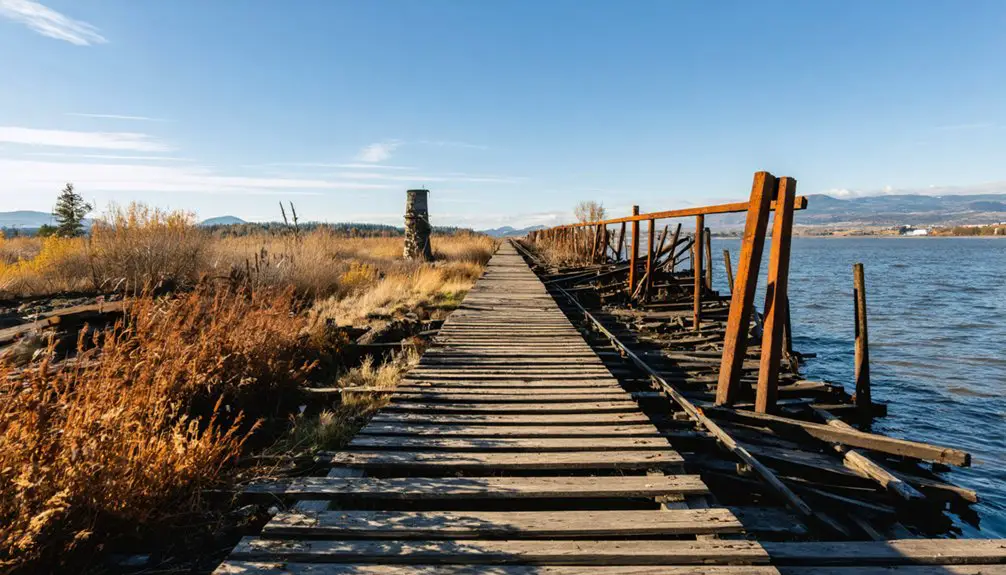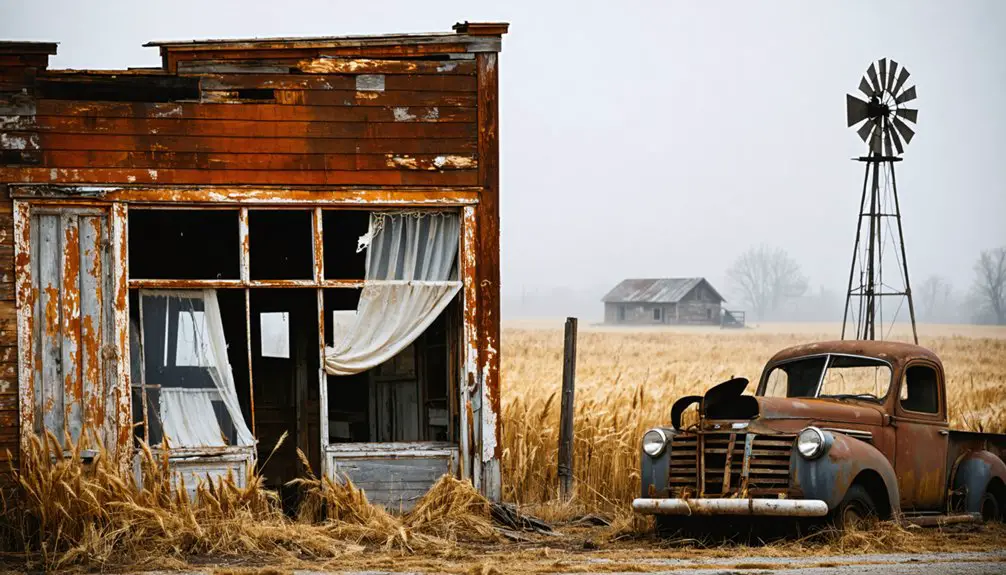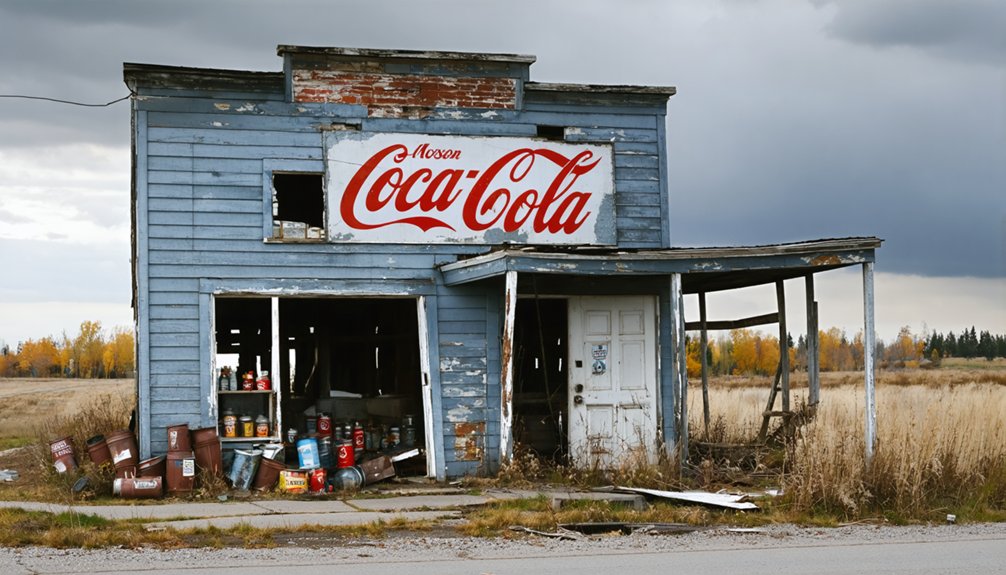
You’ll find over 100 abandoned ghost towns across Washington state, remnants of the region’s mining, lumber, and railroad booms from the 1880s through early 1900s. These sites include mining settlements like Monte Cristo and Liberty, railroad towns such as Lester and Selleck, and lumber communities like Claquato. Many feature preserved buildings, mine shafts, and historic trails that tell stories of dramatic economic cycles and pioneer determination. The deeper you explore, the more secrets these forgotten places reveal.
Key Takeaways
- Monte Cristo flourished during the 1890s mining boom but was abandoned due to declining mineral yields and harsh weather conditions.
- Liberty preserves rare crystalline wire gold mining heritage with remaining historic buildings and mining infrastructure from its prospecting era.
- Lester, a former railroad town along Stampede Pass, declined after diesel engines replaced steam locomotives in the mid-20th century.
- Port Gamble operated as a lumber mill town for 142 years until 1995, leaving behind well-preserved buildings and industrial artifacts.
- Franklin’s coal mining ruins showcase industrial heritage with remaining mining equipment, building foundations, and historical artifacts.
The Legacy of Washington’s Mining Boom Towns
The rugged landscapes of Washington state hold the remnants of countless mining settlements that once bustled with activity during the state’s mineral rush era.
From the 1880s through the 1910s, you’ll find evidence of ambitious mining techniques that transformed places like Monte Cristo, Molson, and Copper City into vibrant communities. One notable example started when James T “Cap” Simmons filed the first mine claim in 1889. These towns sprung up rapidly as prospectors sought gold, silver, copper, and coal.
The economic impacts of these boom towns were dramatic but often short-lived. When ore quality declined or commodity prices dropped, these single-industry communities couldn’t sustain themselves. The town of Liberty stands out for its rare crystalline wire gold deposits that drew prospectors to the region.
Mining towns lived and died by the minerals they chased, creating fleeting fortunes that vanished when resources ran dry.
Despite significant infrastructure investments in mills, railways, and processing facilities, many towns collapsed when mines became unprofitable.
Today, you’ll discover their legacy in preserved buildings, mine shafts, tailings piles, and historic trails that tell the story of Washington’s mining heritage.
Railroad Towns: Rise and Fall Along the Tracks
Washington’s railroad communities like Lester and Selleck thrived in the early 1900s as vital transportation hubs servicing the steam engine era‘s timber and mining operations.
You’ll find these towns shared common features: company-owned structures, extensive rail infrastructure, and tight-knit worker communities that formed around railroad maintenance and logging activities.
When diesel engines replaced steam power and automobiles became prevalent by mid-century, these once-bustling rail stops lost their fundamental purpose, leading to their eventual abandonment and transformation into ghost towns.
The railroad town of Alpine exemplifies this pattern, as the Nippon Lumber Company dominated both employment and daily life until the community’s demolition around 1930.
The town of Corfu followed a similar trajectory, reaching its peak of 131 residents in the 1920s before declining sharply as highway systems developed.
Lester’s Steam Engine Legacy
Founded in 1891 along the western slopes of Stampede Pass, Lester emerged as an essential railroad stop that would shape Washington’s transportation history for nearly a century.
You’ll find steam engine innovations at every turn, from the massive six-stall roundhouse to the powerful 2-10-0 Decapod locomotives that conquered the steep 5.6% grades. These mechanical marvels, built by Baldwin, were among the heaviest steam engines of their time. Following industry trends, the locomotives incorporated higher steam pressure to increase their hauling capacity.
The railroad community dynamics created a thriving town where telegraph operators, foremen, and signal workers raised their families alongside the tracks. Together, they kept the helper engines running day and night, pushing heavy trains over the summit. The route’s challenging 2.2% grade made it one of the most demanding mountain passes in the region.
This bustling operation continued until diesel power arrived in the 1940s, marking the beginning of Lester’s eventual decline.
Selleck’s Timber Company Heritage
Along the foothills of southeast King County, a pioneering lumber venture gave birth to Selleck in 1908 when Pacific States Lumber Company established what would become one of Washington’s most enduring company towns.
Selleck’s innovations included the world’s highest railway trestle, stretching 204 feet above the Cedar River, while its community dynamics flourished through diverse workforce integration.
You’ll find evidence of this multicultural heritage in the town’s recruitment of Japanese workers following the 1923 Tokyo earthquake.
At its peak in 1916, nearly 900 residents enjoyed modern amenities like a hospital, hotels, and weekly dances in the community hall.
Unlike other abandoned mill towns, Selleck’s preserved bungalow-style structures still stand today as a reflection of the 1910-1940 timber industry, earning recognition as a King County landmark. The town’s remaining two-story brick school serves as a prominent reminder of its prosperous past.
Shifting Transportation Priorities Impact
Railroads transformed Washington’s landscape in the late 1800s, giving birth to numerous towns that flourished briefly before fading into obscurity.
You’ll find the echoes of this era in places like Corfu and Wellington, where transportation shifts dramatically altered their destinies. These rail corridor communities once thrived serving steam locomotives with coal, water, and provisions. The devastating 1910 avalanche disaster at Wellington claimed 96 lives and led to the town being renamed Tye. The Central Washington Railway established Govan in 1889, marking its early promise as a railroad hub.
As new highways emerged and diesel engines replaced steam power, many railroad towns lost their purpose.
Govan’s decline paralleled Highway 2’s construction, while Melmont’s fate was sealed when trains no longer needed coal stops.
By the 1940s, numerous stations were abandoned or submerged, leaving only scattered ruins.
Today, you can explore these ghost towns’ remnants – from Wellington’s haunting snowsheds to Melmont’s foundation stones – each telling a story of progress’s double-edged nature.
Lumber Industry Ghost Towns and Mill Sites
During Washington’s early development, lumber towns and mill sites emerged as essential economic centers, only to later join the state’s collection of ghost towns.
The story of Claquato exemplifies the lumber town decline, where a thriving community dissolved after its founder’s fatal mill accident in 1864 and the railroad’s decision to bypass the settlement. The town experienced its final abandonment when the railroad chose an alternative route approximately ten years after the founder’s death.
Today, you’ll find these reminders of Washington’s logging heritage:
- Remote logging camps scattered throughout Western Washington, marked by concrete fragments and old trestle remains
- Mill site remnants near abandoned railroad lines that once transported timber from forest to market
- Historic structures like Claquato’s Methodist church, standing as the state’s oldest, surrounded by a cemetery that tells the community’s story
These sites serve as windows into the state’s rugged pioneering spirit and industrial heritage.
Agricultural Communities Lost to Time
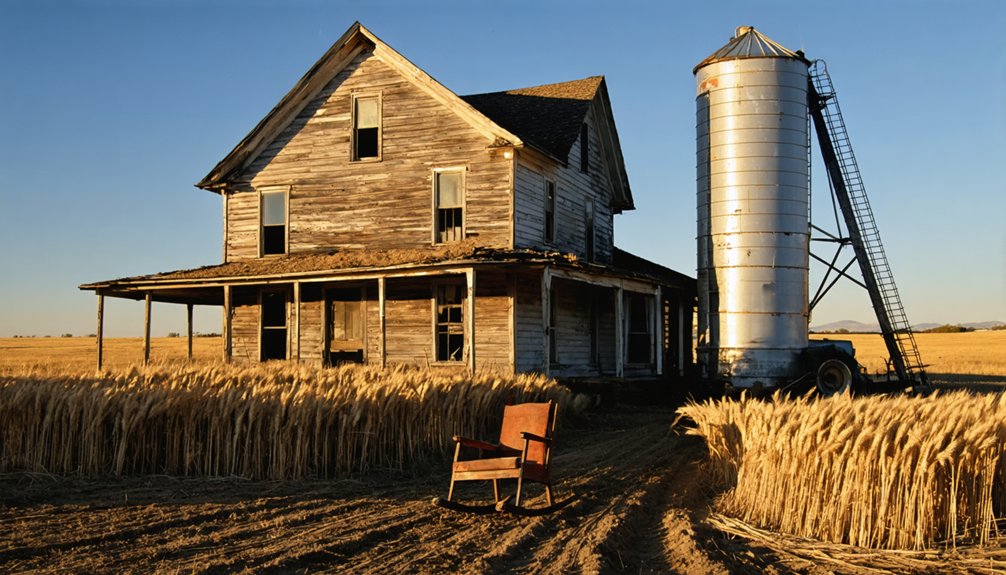
While Washington’s early farmers dreamed of agricultural prosperity, many ambitious farming communities succumbed to harsh realities in the early 20th century.
You’ll find evidence of these lost dreams in places like Cloverland, where abandoned orchards and a solitary garage tell the story of failed irrigation schemes that once supported 400 residents. Rural homesteads, established with high hopes, now exist only as weathered foundations and rusting machinery along forgotten roads.
When irrigation projects underperformed and markets shifted, small-holder farmers couldn’t survive. Only those who could afford larger acreages for livestock persisted.
Towns like Goodnoe Hill, with its lonely schoolhouse, stand as silent witnesses to this agricultural exodus. Today, these remnants – packing sheds, cold storage foundations, and general stores – preserve the history of Washington’s vanished farming communities.
Historic Company Towns of the Pacific Northwest
As you explore Washington’s historic company towns, you’ll find remnants of once-thriving timber and mining communities where workers lived in company-owned houses and relied on company stores for their daily needs.
Mill operations formed the economic backbone of these towns, with facilities like Port Gamble’s lumber mill running continuously for 142 years until 1995.
The legacy of these company towns lives on through preserved historic districts, converted communities like Ryderwood, and countless ghost towns that dot the Pacific Northwest landscape.
Life in Company Housing
Life in Pacific Northwest company towns centered around basic but practical housing structures that companies built to support their operations.
You’d find yourself living in company housing near rivers, where accessibility was key for trade and transportation. Housing conditions varied based on your status – from shared bunkhouses and tent houses for laborers to nicer accommodations on “Silk Stocking Row” for higher-ranking employees.
Your daily company life revolved around these key elements:
- Access to essential resources like timber for building and game for food
- Proximity to fishing, farming, and grazing lands for sustenance
- Central location near trading posts that served as commercial and social hubs
The settlements became vibrant communities where you’d find a mix of traders, laborers, and local tribal populations all participating in the region’s economic development.
Mill Operations and Economy
Pacific Northwest mill towns sprang up around massive timber operations that shaped the region’s economic landscape from the mid-1800s through the 20th century.
You’d find massive sawmills dominating the waterfront, where logs floated in on tides before steam power and railways expanded operations inland. Companies like Weyerhaeuser controlled entire communities, owning not just the mills but the stores, churches, and utilities that served their workers.
The mills ran intensively until nearby old-growth timber was exhausted, leading to inevitable mill closures that devastated local economies.
Workers faced challenging conditions, with labor struggles emerging as the industry matured. While skilled sawyers and millwrights formed the backbone of operations, most workers provided unskilled labor, often paid in company scrip redeemable only at company-owned stores.
Legacy of Timber Towns
During the early twentieth century, over thirty-five company towns dotted Oregon’s landscape alone, marking a transformative period in the Pacific Northwest’s timber industry.
This timber town heritage shaped the region’s identity, with logging providing 55% of Northwest payrolls by 1914.
You’ll find the lasting impact of these logging community identities reflected in three key ways:
- Former boom towns like Aberdeen and Shelton evolved from wild lumber centers into quieter economies.
- Communities like Coos Bay and Lebanon maintained strong cultural ties to their forest product roots.
- Historical preservation efforts, such as Shelton’s “Tollie” locomotive display, celebrate the railroad’s role in timber history.
Today’s residents inherit a complex legacy where communal bonds, forged in the heyday of timber operations, continue to influence local culture.
Preserved Ruins and Accessible Ghost Town Sites
Washington’s abandoned ghost towns offer remarkably preserved glimpses into the state’s mining, timber, and pioneer history.
These ghost towns in Washington state serve as time capsules, showcasing the resilience of communities that once thrived in the region. Visitors can explore historic buildings and learn about the stories of those who lived and worked there. Each site tells a unique tale, reflecting the challenges and triumphs of the past.
You’ll find accessible ruins across diverse landscapes, from Liberty’s Gold Rush remnants in the Cascades to Franklin’s coal mining artifacts along the Green River. Historical preservation efforts have protected significant sites like Claquato’s pioneer-era church and Monte Cristo’s mining equipment.
For ghost town exploration, you can wander Northern State’s pastoral grounds to discover the remains of Washington’s largest mental hospital, or trek the gentle trail to Monte Cristo’s abandoned buildings.
Each site tells a unique story: Liberty showcases gold mining heritage, Franklin reveals coal industry roots, and Claquato preserves pioneer settlement history.
These well-maintained locations let you step back in time while exploring at your own pace.
Notable Mining Districts of Northern Washington
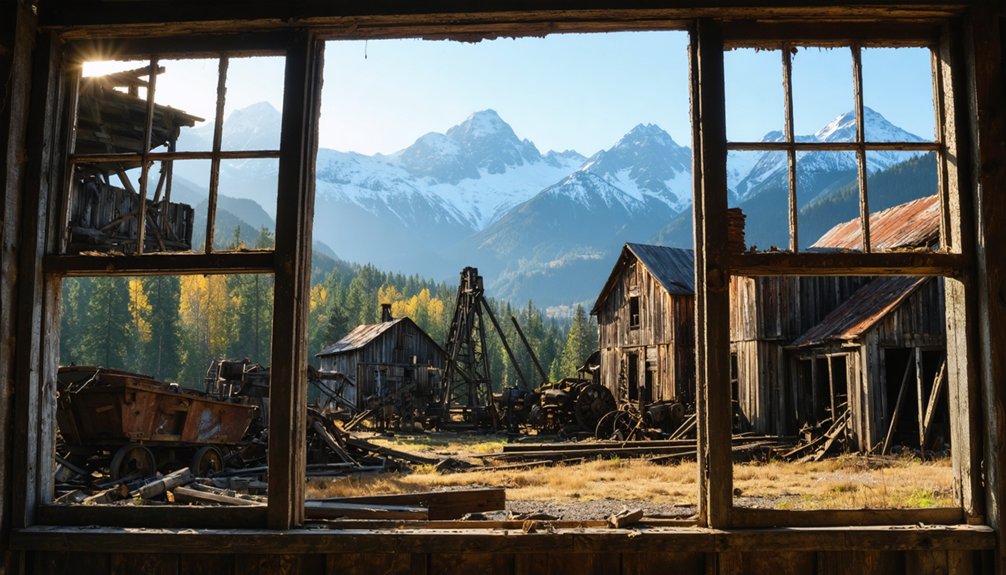
While many ghost towns stand as silent witnesses to the past, the rich mining districts of northern Washington tell an even more compelling story of mineral wealth and human ambition.
Ghost towns echo tales of the past, but northern Washington’s mines reveal grander stories of fortune-seekers and untold riches.
As you explore the rugged Cascades Mining region, you’ll discover a legacy of determination stretching from the Methow Valley to the remote peaks of Thunder Creek.
Notable discoveries shaped these districts:
- The Bear Mountain gold strike of 1897 triggered intensive prospecting across the North Fork.
- Ruby Creek’s late 1870s Gold Discoveries sparked one of the area’s first major rushes.
- The China Ditch project along the Methow River stands as a testament to early Chinese miners’ ingenuity.
From Horseshoe Basin to the Slate Creek district, these mining areas challenged prospectors with harsh winters, treacherous terrain, and limited access – yet the promise of riches drove them onward.
Ghost Towns Around Mount Rainier
At the base of Mount Rainier’s majestic slopes, several ghost towns tell the story of Pierce County’s industrial heritage, with Melmont and Fairfax standing as prominent examples of the region’s coal mining past.
Melmont history dates back to 1900 when the Northwest Improvement Company established a thriving community that once produced 4% of Pierce County’s coal. You’ll find the remnants along Highway 165, where a 6-mile roundtrip hike reveals old foundations, rusted vehicles, and a historic wagon bridge abutment.
Fairfax importance lies in its role as a essential mining community northwest of the mountain, though most structures were demolished after 1991.
Both towns declined as railroads switched to diesel power, with Melmont suffering a devastating forest fire in the early 1920s that sealed its fate.
Frequently Asked Questions
Are There Any Ghost Towns in Washington That Are Completely Underwater?
You’ll find several submerged settlements beneath Washington’s lakes: Moncton under Rattlesnake Lake, Marcus under Lake Roosevelt, and Alder under Alder Lake. These sites offer fascinating underwater exploration opportunities.
What Paranormal Activity Has Been Reported in Washington’s Abandoned Towns?
You’ll find ghost sightings and haunted locations throughout Washington’s deserted towns, from miners’ spirits in Black Diamond to unexplained voices at Northern State Hospital and shadowy figures at Port Gamble’s Walker-Ames House.
Can I Legally Remove Artifacts From Washington Ghost Town Sites?
No, you can’t legally remove artifacts without permits. State and federal legal regulations protect ghost town sites for artifact preservation. Violating these laws can result in serious criminal penalties.
Which Ghost Towns Still Have Year-Round Residents Living There Today?
Like tiny beacons in time, you’ll find current residents keeping town histories alive in Liberty (12 people), Curlew (100+), and scattered inhabitants in Molson, Claquato, Govan, Bodie, and Sherman.
Are Metal Detectors Allowed When Visiting Washington’s Ghost Town Sites?
You’ll need explicit permission and must follow metal detecting regulations. Most ghost town policies prohibit disturbing historic structures or removing artifacts. Many sites restrict detecting due to archaeological protection laws.
References
- https://www.onlyinyourstate.com/experiences/washington/ghost-towns-in-wa
- https://stateofwatourism.com/ghost-towns-of-washington-state/
- https://www.seattlepi.com/local/seattlenews/article/exploring-ghost-towns-in-washington-state-16095136.php
- https://www.wta.org/go-outside/seasonal-hikes/fall-destinations/hidden-history-ghost-town-hikes
- https://www.ghosttowns.com/states/wa/waalpha.html
- https://www.ghosttownsofwashington.com
- https://www.wta.org/go-hiking/hikes/copper-city-ghost-town
- https://www.opb.org/article/2023/10/29/washington-only-living-ghost-town-history-lingering-residents/
- https://www.islands.com/1988063/washington-off-radar-abandoned-mining-ghost-town-molson-free-visit-history/
- http://www.ghosttownsusa.com/bttales50.htm