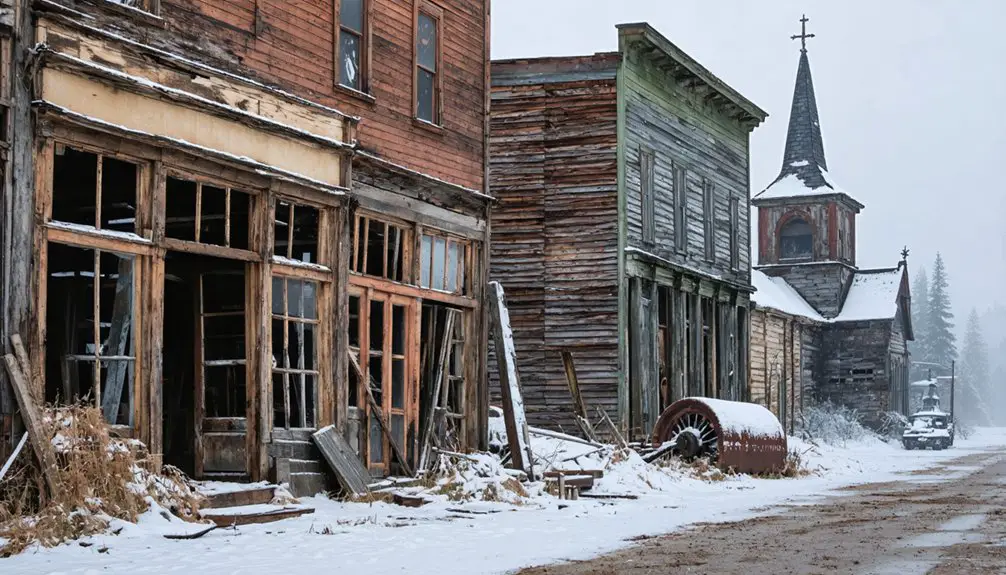
You’ll find dozens of haunting ghost towns throughout West Virginia’s New River Gorge, where abandoned mining communities like Nuttallburg and Kaymoor showcase preserved coal tipples, coke ovens, and rusting machinery. Don’t miss Thurmond’s restored railroad depot, which once handled more coal freight than Cincinnati. In Summersville Lake, the submerged town of Gad reveals its foundations and roadways when water levels drop. These forgotten communities hold countless stories of America’s industrial past.
Key Takeaways
- Thurmond, a well-preserved railroad town, features a restored C&O Railway depot and commercial buildings that once rivaled Cincinnati’s freight operations.
- Nuttallburg contains one of Appalachia’s most complete coal mining complexes, including 80 preserved coke ovens and historic mining structures.
- Kaymoor’s abandoned mining site includes a rusting tipple, mining equipment, and an 821-step stairway descending the New River Gorge.
- Gad, a former farming community, lies submerged beneath Summersville Lake, with remnants visible during low water levels.
- Fayette County holds over 60 abandoned coal towns along New River Gorge, preserving remnants of West Virginia’s industrial past.
The Legacy of Coal Mining Communities in McDowell County
When coal reserves were discovered in southern West Virginia during the late nineteenth century, McDowell County transformed from a quiet agrarian region into an industrial powerhouse.
You’ll find mining family legacies intertwined with the explosive growth, as coal output skyrocketed from 246,000 tons in 1889 to an astounding 12 million tons by 1910. The economic impacts reshaped the landscape with over 100,000 residents calling McDowell home by the 1950s. The area’s prosperity earned it the nickname “Little New York” during this period.
But mechanization dealt a crushing blow to these thriving communities. The invention of the continuous miner eliminated thousands of jobs, and when U.S. Steel closed all McDowell mines, it terminated over 1,200 positions. The county’s devastating decline continued as poverty rates soared to 37.7% by 1990.
Today, you’ll discover abandoned company stores, the silent Switchback High School, and other remnants of once-bustling coal camps throughout the county.
Historic Towns Along the New River Gorge
As you explore the historic towns along West Virginia’s New River Gorge, you’ll find Thurmond’s preserved railroad depot and commercial buildings that once handled more coal freight than Cincinnati.
At Nuttallburg, you can examine one of Appalachia’s most complete mine complexes, featuring intact coke ovens and conveyor structures that showcase early 20th-century industrial engineering. The historic site is easily accessible via a scenic drive that leads visitors past numerous building foundations with interpretive signage.
The dramatic ruins of Kaymoor’s vertical mining operation, with its towering tipple and 821 steps descending the gorge face, demonstrate how mining companies adapted their operations to the region’s challenging topography. Today, the National Park Service owns approximately 80% of these historic structures, ensuring their preservation for future generations.
Railroad Town Heritage
The construction of the Chesapeake & Ohio Railroad mainline through West Virginia’s New River Gorge between 1869-1872 transformed this remote wilderness into a bustling industrial corridor. Freed African-American slaves and Irish immigrants carved rail beds through challenging terrain, blasting tunnels and erecting bridges to enable railroad expansion throughout the region.
You’ll find evidence of this rail heritage in towns like Nuttallburg, which began shipping coal in 1873, and Thurmond, where banks once ranked among West Virginia’s wealthiest during the peak coal transportation era. The John Nuttall’s vision helped establish one of the earliest successful mining operations in the gorge. Visitors can experience annual celebrations during Railroad Days festivals that highlight the region’s rich transportation history.
The Prince Depot, still an active Amtrak station, stands as a monument to this industrial past. Today, you can explore these abandoned communities along rail trails, crossing historic trestle bridges and passing iconic structures like the Nuttallburg tipple, all reminders of the region’s railroad boom years.
Preserved Mining Infrastructure
Over 60 coal mines once operated along a 14-mile stretch of New River Gorge, leaving behind an impressive array of preserved industrial artifacts.
You’ll find hulking tipples, sealed mine portals, and stone foundations scattered throughout the landscape, evidence of the region’s rich mining heritage. The most intact preserved structures can be found at Nuttallburg, which the National Park Service acquired in 1998 and stabilized in 2011. Henry Ford leased these mines in the 1920s as part of his vertical integration strategy.
At nearby Kaymoor, you can explore remnants of innovative mining technology, including the monitor system that once propelled coal cars up and down the mountain. The gravity-fed system could transport up to 30 loaded coal cars per hour along the mountainside.
The site’s technological evolution is evident in its preserved structures, from early Harrison Compressed Air Mining Machines to the wooden conveyor systems that transported coal until the 1920s.
These industrial relics offer you direct connection to West Virginia’s coal mining past.
Community Life Remnants
Moving beyond the industrial remnants, rich stories of community life emerge from over 50 mining towns that once dotted the New River Gorge landscape.
You’ll find traces of vibrant social gatherings in places like Thurmond, where the bustling railway town handled more coal than Cincinnati in the 1920s.
Community traditions live on in Winona’s still-active church and former pool hall, where residents once gathered after long days in the mines.
In Nuttallburg, you can explore the foundations of 100 original homes and 40 surviving coke ovens that tell tales of daily life. A historic Roebling suspension bridge still stands as a testament to the town’s engineering achievements. The town reached its peak production of 1.5 million tons of coal by 1888.
At Kaymoor Bottom, you’ll discover where 110 families made their homes along the railroad, though most structures succumbed to a devastating 1960 fire.
These towns, now preserved by the National Park Service, stand as evidence of the region’s coal-mining heritage.
Lost Towns Beneath West Virginia Waters
As you gaze across Summersville Lake‘s crystal waters today, you’ll find no trace of Gad’s once-thriving farming community that flourished there from the 1800s until 1960.
The U.S. Army Corps of Engineers purchased and cleared the entire town, relocating six family graveyards and demolishing structures before flooding the valley to create West Virginia’s largest reservoir.
When the lake’s water levels drop for repairs, you can still spot old roadways, foundations, and rock carvings from the submerged community that sacrificed its existence for regional flood control.
Gad’s Watery Grave
Deep beneath the waters of Summersville Lake lies the submerged community of Gad, West Virginia, a once-thriving farming settlement established in 1889 along McKee’s Creek.
You’ll find remnants of a proud Appalachian town that once boasted a sawmill, church, school, and general store, all connected by Sterling Lumber Company’s narrow-gauge railroad.
In the 1960s, the U.S. Army Corps of Engineers transformed Gad’s destiny, purchasing the land for dam construction. Residents were forced to abandon their generational farms, and six family graveyards were relocated.
Today, you can explore this “Appalachian Atlantis” through scuba diving, where the town’s structures remain preserved in their watery grave.
While the dam prevents flooding in nearby regions, it stands as a monument to the sacrifices of Gad’s displaced residents.
Summersville Lake’s Hidden History
The creation of Summersville Lake in the 1960s transformed more than just the landscape – it submerged an entire world beneath its waters. When the U.S. Army Corps of Engineers constructed the 390-foot-high dam, they didn’t just build West Virginia’s largest recreational reservoir; they erased the historic Gad community from the map.
Today, if you’re diving in Summersville Lake’s depths, you’ll find a preserved underwater time capsule. Clapboard houses, old fence lines, and even vintage cars rest on the lakebed, while submerged forests create an eerie underwater landscape.
At 327 feet deep, the lake’s cold, low-oxygen environment has preserved many artifacts of the displaced community. The remnants of farmland, foundations, and roadbeds occasionally emerge when water levels drop, revealing glimpses of this submerged history.
Preserved Mining Structures and Architecture
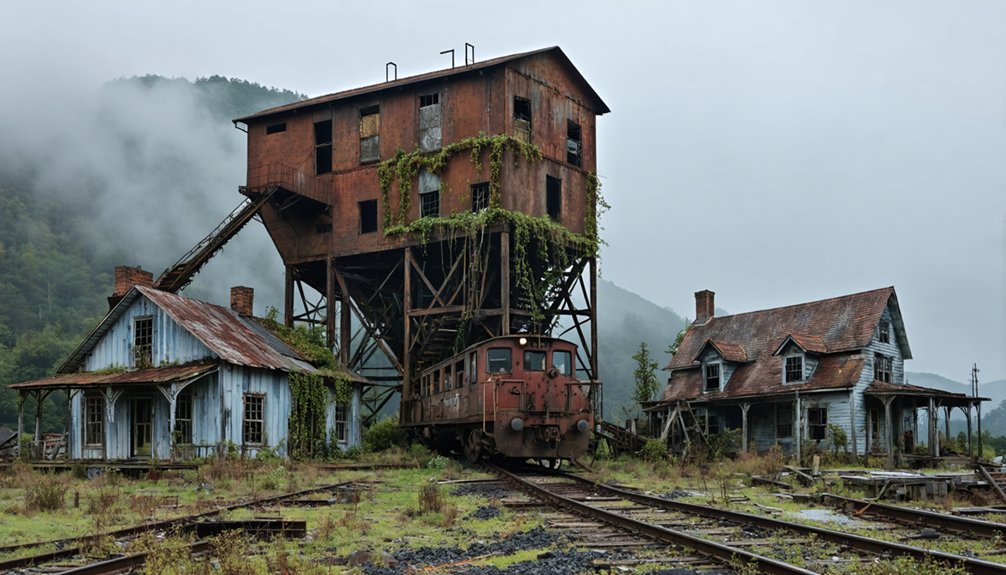
While many ghost towns across West Virginia have crumbled into obscurity, three remarkable sites showcase preserved mining structures that tell the story of the state’s industrial heritage.
You’ll find Nuttallburg’s impressive array of 80 coke ovens and a coal tipple from the 1870s, along with its elevated conveyor system stretching through the gorge.
At Kaymoor, you can explore the rusting tipple and an 821-step stairway that miners once climbed daily. The site’s preserved safety signs offer glimpses into early mining life.
Each day, miners trudged up 821 steps at Kaymoor, where the weathered tipple and old safety signs still stand today.
Thurmond’s restored C&O Railway depot and surviving commercial row stand as monuments to ghost town architecture, while its Fairbanks & Morse coal tower demonstrates the essential connection between rail and mining heritage.
The National Park Service now protects these industrial remnants for future generations.
Railroad Towns and Transportation Hubs
Among West Virginia’s most fascinating ghost towns, railroad hubs like Thurmond stand as monuments to the state’s steam-era dominance.
You’ll find railroad remnants scattered throughout the town, where once up to 150 railroad employees managed a bustling yard that handled more freight than Richmond and Cincinnati combined. The depot, preserved within New River Gorge National Park, tells the story of transportation decline that followed the switch from steam to diesel engines.
Throughout northern and southern West Virginia, abandoned branch lines mark where the Baltimore & Ohio, Norfolk & Western, and Virginian railways once connected thriving communities.
You can still spot old turntables, coaling towers, and water tanks – silent reminders of an era when these facilities powered the state’s rail-dependent towns and mining camps.
Fayette County’s Forgotten Communities
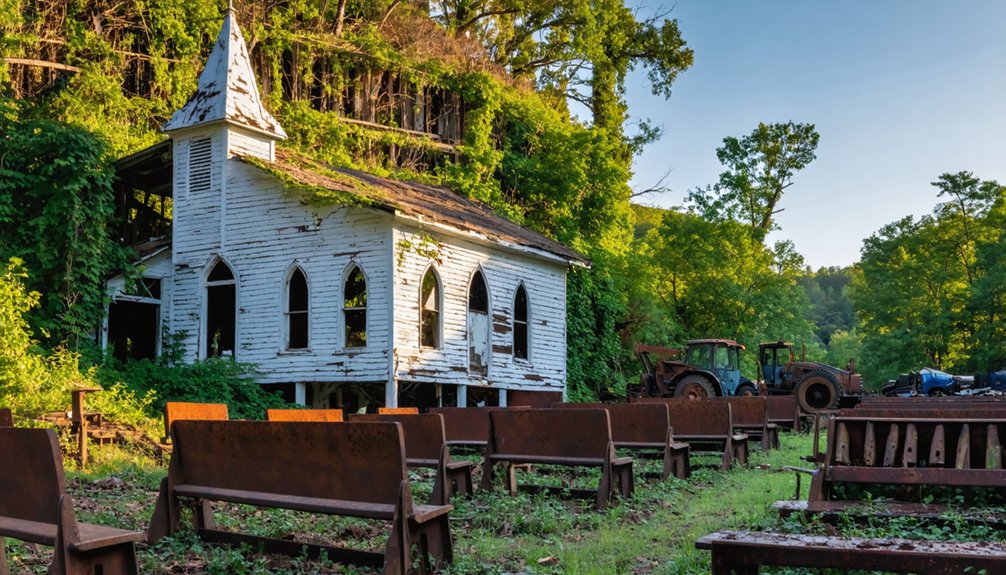
Deep within New River Gorge National Park, Fayette County’s forgotten communities tell a compelling story of Appalachian coal culture through their preserved ruins.
You’ll find Nuttallburg’s complete coal processing remnants, Dun Glen’s hilltop cemetery 700 feet above the river, and Fayette’s stone foundations near the iconic bridge.
These ghost towns showcase Fayette County’s rich cultural heritage, with each site offering unique glimpses into mining life.
Abandoned mine sites stand as silent storytellers, each crumbling structure revealing fragments of Fayette County’s coal mining legacy.
You can explore Kaymoor’s 821-step descent to rusted equipment and historic warning signs, or visit Thurmond’s renovated C&O depot where passenger trains once bustled.
Together, these forgotten communities form a cluster of over 60 abandoned towns along the gorge, preserving memories of an era when coal fueled the region’s prosperity.
Notable Mining Operations and Company Towns
Throughout West Virginia’s coal-rich mountains, company towns emerged as complete communities built and controlled by mining corporations, reaching their peak in 1930 with 465 documented settlements.
These mining legacies transformed isolated mountain areas into bustling settlements, where you’d find company housing arranged in strict hierarchical patterns. While model towns boasted modern amenities like indoor plumbing and theaters, they enforced rigid social segregation, with African Americans and immigrants relegated to peripheral areas.
You’d witness total economic dependence, as miners relied on company commissaries for everything from basic necessities to household appliances, often purchased on credit.
The towns became flashpoints for labor conflicts, particularly during the mine wars of 1912-1921, when coal companies violently resisted unionization efforts.
Though none of these company-owned towns survive today, their remnants persist as private communities.
Cultural Heritage Sites and Historical Landmarks
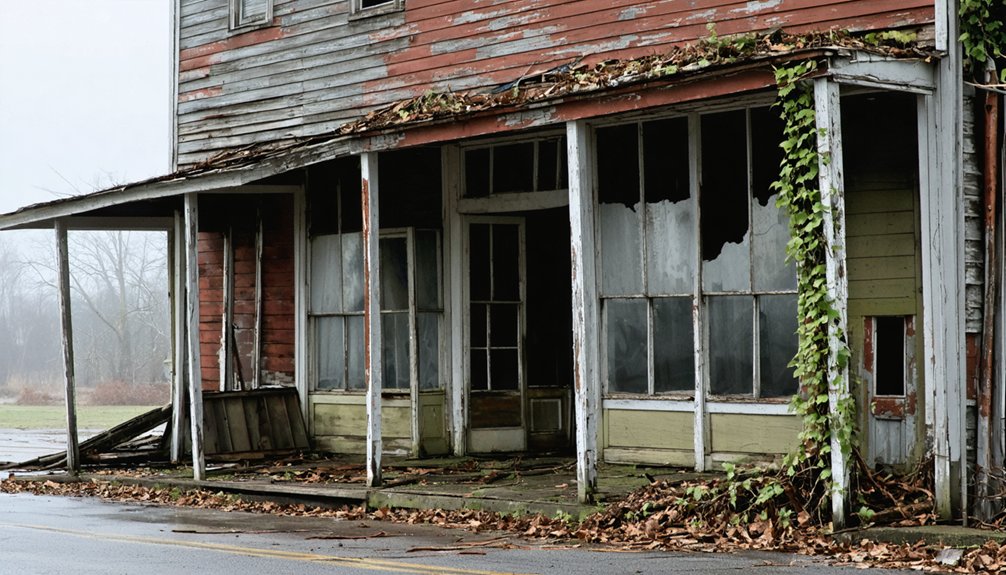
West Virginia’s cultural heritage sites offer remarkable windows into America’s industrial past, with several ghost towns now preserved as protected landmarks on the National Register of Historic Places.
Among these historical sites are several ghost towns for sale in West Virginia, presenting unique opportunities for those interested in revitalizing remnants of the past. Investors and historians alike are drawn to the charm and stories that linger within these abandoned communities. As interest in heritage tourism grows, these towns offer a chance to blend preservation with modern development.
As visitors explore the ghost towns in West Virginia, they can uncover fascinating tales of the people who once thrived there. These sites serve not only as a reminder of a bygone era but also as a canvas for future generations to create new memories. The blend of history and potential inspires creativity and innovation in those willing to invest in these unique locations.
You’ll find Thurmond’s preserved railroad depot and warehouses, where the National Park Service has stabilized structures for public access.
At Nuttallburg, one of the most complete coal complexes reveals surviving coke ovens and segregated housing that tells the story of racial divisions in mining communities.
Nuttallburg’s preserved coke ovens and segregated housing stand as stark reminders of racial inequality in America’s coal mining history.
The industrial heritage extends to sites like Virginius Island, where you can explore archaeological remains of 19th-century mills and canals.
These cultural landmarks include meaningful African American community sites and cemeteries that preserve genealogical records and mortality patterns, offering tangible connections to the lives of miners and their families.
Abandoned Communities in Raleigh and Mercer Counties
Raleigh and Mercer counties harbor some of Appalachia’s most evocative ghost towns, where coal once fueled thriving communities like Royal, Stotesbury, Tams, and Goodwill.
You’ll find these abandoned coal towns scattered across rugged terrain, marked by stone foundations, metal artifacts, and overgrown rail spurs that once connected bustling mining operations.
In Royal, you can explore family gravestones and mine access routes, while Stotesbury’s landscape reveals the remnants of company stores and residential lots.
Tams preserves traces of its segregated past through church ruins and coal-processing infrastructure. Goodwill’s building ruins and debris fields tell similar stories of decline.
While many of these ghost town exploration sites lie on private land with safety hazards, they stand as powerful reminders of Appalachia’s industrial heritage.
Frequently Asked Questions
Are Any Ghost Towns in West Virginia Safe for Overnight Camping?
Like moths drawn to a flame, you’ll find primitive camping’s only safe near Thurmond’s ghost town – not in ruins. Follow camping regulations and safety precautions at designated sites along New River’s sandy banks.
What Paranormal Activities Have Been Reported in West Virginia’s Abandoned Towns?
You’ll encounter ghost sightings, eerie whispers, marching soldiers, mysterious lights, and poltergeist activity. Strange orbs and shadowy figures roam abandoned buildings, while unexplained footsteps and screams echo through deserted streets.
Can Visitors Legally Collect Artifacts From These Abandoned Mining Towns?
Among 60+ ghost towns, you can’t legally collect artifacts from federal lands like New River Gorge. You’ll need landowner permission on private sites, while respecting mining regulations and artifact preservation laws.
Which Ghost Towns Are Accessible During Winter Months?
You’ll find reliable winter accessibility at Thurmond via Amtrak and Nuttallburg’s roads. While Kaymoor’s 821 steps and Dun Glen’s trails remain open, ghost town conditions can be challenging during snowfall.
How Many Ghost Towns in West Virginia Offer Guided Historical Tours?
You’ll find guided tours focused on historical significance in Harpers Ferry and Thurmond, with occasional tours in mining ghost towns through regional operators, totaling 2-3 regularly accessible abandoned towns.
References
- https://kids.kiddle.co/List_of_ghost_towns_in_West_Virginia
- https://abandonedonline.net/location/abandoned-communities-in-west-virginia/
- https://minskysabandoned.com/2015/07/30/west-virginia-ghost-towns-part-1-nuttallburg/
- https://wvtourism.com/5-wv-ghost-towns/
- https://www.youtube.com/watch?v=-EeLwLa2t90
- https://carte-urbex.com/en/blogs/infos/top-10-abandoned-places-in-west-virginia
- https://newrivergorgecvb.com/abandoned-wv-coal-towns/
- https://dc.etsu.edu/cgi/viewcontent.cgi?article=1166&context=etd
- http://www.cpreview.org/articles/2022/11/the-aftermath-of-the-coal-boom-how-the-coal-industry-underdeveloped-mcdowell-county-1
- https://dewitzphotography.com/personal-photography-projects/west-virginia-coal-country-mcdowell-county-part-1/