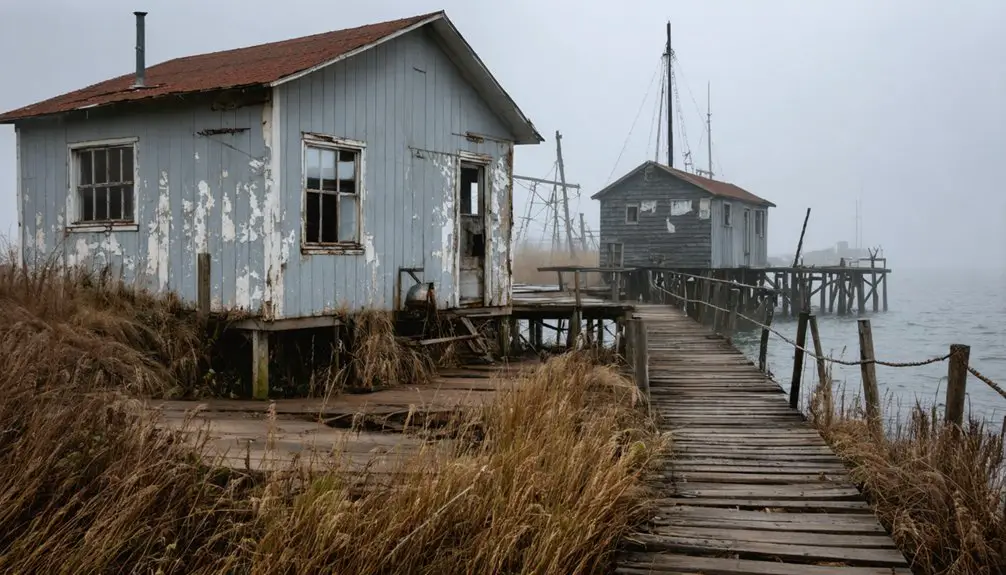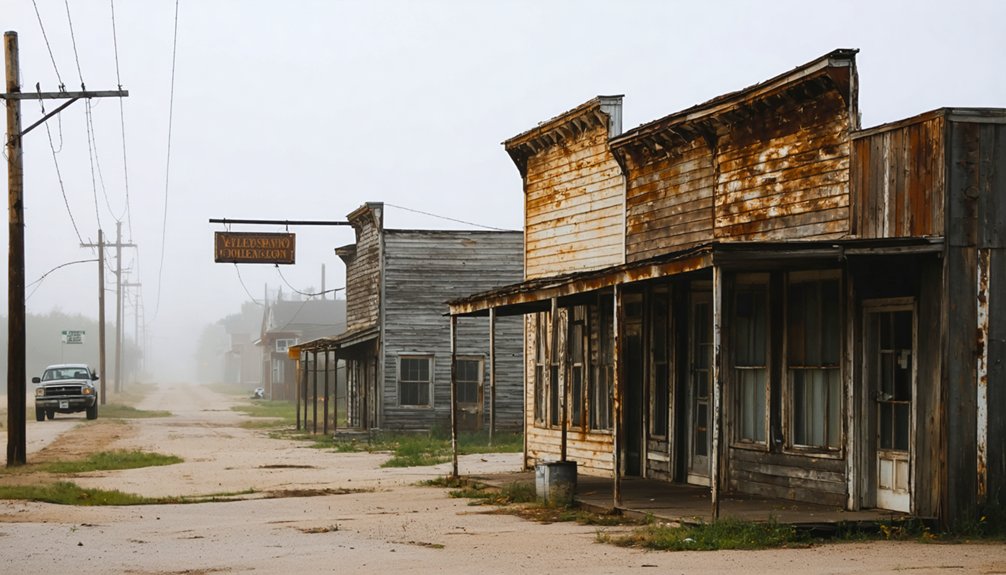
You’ll discover fascinating ghost towns across Wisconsin’s landscape, from Fort Howard’s military outpost near Green Bay to the failed utopian commune of Ceresco. These abandoned settlements tell stories of frontier life, with preserved structures like Cooksville’s vermillion brick buildings and Fort Crawford’s remnants offering glimpses into the past. While some sites have vanished completely, others maintain their historic architecture and archaeological significance, waiting for you to uncover their forgotten tales.
Key Takeaways
- Wisconsin’s ghost towns primarily resulted from economic shifts in industries like lead mining, logging camps, and river port settlements.
- Ceresco, a former utopian community established in 1844, disbanded by 1851 despite initial success in communal farming and shared living.
- Dover Township, once a thriving agricultural settlement, declined from prominence despite early infrastructure and successful farming operations.
- Many abandoned settlements retain architectural remnants, stone foundations, and historical markers that can be explored by visitors today.
- Ghost towns often preserve daily life artifacts from frontier times, including mines, mills, and blacksmith shops that supported local economies.
The Rise and Fall of Fort Howard’s Military Legacy
When the United States sought to secure its northwestern frontier after the War of 1812, Fort Howard emerged as an indispensable military outpost near present-day Green Bay, Wisconsin.
You’ll find its military significance reflected in its strategic location at the mouth of the Fox River, where it protected the essential Fox-Wisconsin Waterway from British threats. Under commanders like Zachary Taylor, the fort’s garrison built significant military roads connecting to Forts Winnebago and Crawford, revolutionizing regional transportation. The introduction of these roads reduced cargo transport costs from $350 by water to just $1-$1.24 by road.
Originally constructed at the site of Fort La Baye, the outpost carried on the legacy of previous French and British fortifications in the area. Though disease and wartime demands led to periodic evacuations, Fort Howard persisted until 1852.
Today, you can explore its architectural remnants at Heritage Hill State Historical Park, where the relocated hospital, officers’ quarters, and guard house stand as proof of Wisconsin’s earliest military settlement, marking the shift from French colonial outpost to American frontier stronghold.
Fort Crawford: From Strategic Outpost to Historical Site
Located at the essential confluence of the Mississippi and Wisconsin rivers, Fort Crawford emerged as a critical frontier outpost in Prairie du Chien during the early 19th century.
You’ll find Fort Crawford’s significance reflected in its role as both a military stronghold and diplomatic center, hosting the landmark 1825 Treaty council that brought together over 5,000 Native American representatives.
Originally built in 1816 and later relocated to higher ground in 1829, the fort served as a key peacekeeping post between settlers and Native nations. Dr. William Beaumont conducted groundbreaking digestive system experiments here.
Established to maintain peace in frontier Wisconsin, Fort Crawford’s strategic relocation in 1829 reinforced its vital diplomatic mission.
You can trace its evolution from frontier garrison to Civil War hospital, where over 1,400 Union soldiers received treatment. Under Governor Salomon’s direction, the facility became Swift General Hospital in 1864.
Today, while the original structures are gone, the Fort Crawford Museum preserves this crucial piece of Wisconsin’s military diplomacy and settlement history.
Dover’s Lost Promise: A Racine County Settlement
As part of Racine County’s early settlement history, Dover Township emerged in 1842 when the Wilford family established their farming operations in this promising frontier community.
By 1860, you’d have found a structured settlement infrastructure with John C. Beecher serving as postmaster alongside his wife Rebecca and daughter Mary.
While Dover’s history reflected the broader development of Racine County, which had separated from Michigan territory in 1835, the township’s initial promise gradually faded. Agricultural prosperity was evident through settlers like Francis Cox Sr., who accumulated 360 acres of land through years of dedicated farming.
Local researchers can now explore Dover’s historical records through the UW Digital Collections, providing valuable insights into the settlement’s past.
Despite its agricultural foundations and early organizational structure, the settlement couldn’t sustain its momentum.
Today, while the modern Town of Dover continues at its Kansasville location, the original settlement stands as a monument to Wisconsin’s ever-evolving frontier landscape, where some communities thrived while others became mere footnotes in the region’s rich historical narrative.
Preserving the Past: Cooksville’s Historic Buildings
Unlike Dover’s fading legacy, the historic village of Cooksville stands as a remarkable tribute to preservation in Wisconsin.
You’ll discover a carefully preserved district featuring distinctive vermilion brick buildings and New England-inspired architecture that’s withstood the test of time since the 1850s. As the second historic district in Wisconsin to achieve National Register status, Cooksville’s significance cannot be overstated. Visitors can leave replies and share their experiences exploring these historical landmarks.
The community’s dedication to historic preservation has kept this architectural treasure alive, despite the town’s decline after being bypassed by the railroad in 1857.
- The iconic General Store (c.1846), one of Wisconsin’s earliest surviving commercial buildings
- The charming Cooksville School, now serving as a vibrant community center
- The reconstructed William Graves Blacksmith Shop, showcasing the village’s industrial heritage
- A traditional New England-style public commons and cemetery that maintain the original town layout
Ceresco’s Utopian Dream and Swift Decline
When idealistic pioneers of the Wisconsin Phalanx arrived in 1844, they established Ceresco as an ambitious socialist experiment on what would later become the western edge of Ripon. Under Warren Chase’s leadership, they built a thriving community based on Fourierist communalism, complete with shared housing, collective farming, and a successful gristmill.
Despite economic viability, Ceresco’s community dynamics began to strain by 1849. The tension between communal ideals and individual desires ultimately led to the experiment’s unraveling. The community’s shares were originally sold for twenty-five dollars each. The settlement was officially disbanded in 1851 after showing great promise in its early years.
You can still explore remnants of this short-lived utopia at Ceresco Park, where a replica Long House and historical markers tell the story of this fascinating chapter in Wisconsin’s history.
Belmont: Wisconsin’s Forgotten First Capitol
Though largely forgotten today, the tiny village of Belmont served as Wisconsin Territory’s first capital in 1836, hosting a pivotal six-week legislative session that laid the groundwork for statehood.
You’ll find its story rooted in the bustling lead-mining region, where John Atchison’s strategic placement of four public buildings sparked a capital controversy. Despite Governor Dodge’s support, Belmont’s glory proved short-lived when Madison won the permanent capital designation, triggering the community’s swift decline into a ghost town.
- The original council house witnessed the passage of 42 fundamental laws that shaped Wisconsin’s future
- James Doty’s successful lobbying for Madison included gifts of buffalo robes to lawmakers
- Most businesses and residents abandoned Belmont by 1867, relocating to the railroad town south
- Restoration efforts beginning in 1910 preserved two historic buildings, now part of First Capitol Historic Site
Life on the Frontier: Daily Routines in Ghost Towns
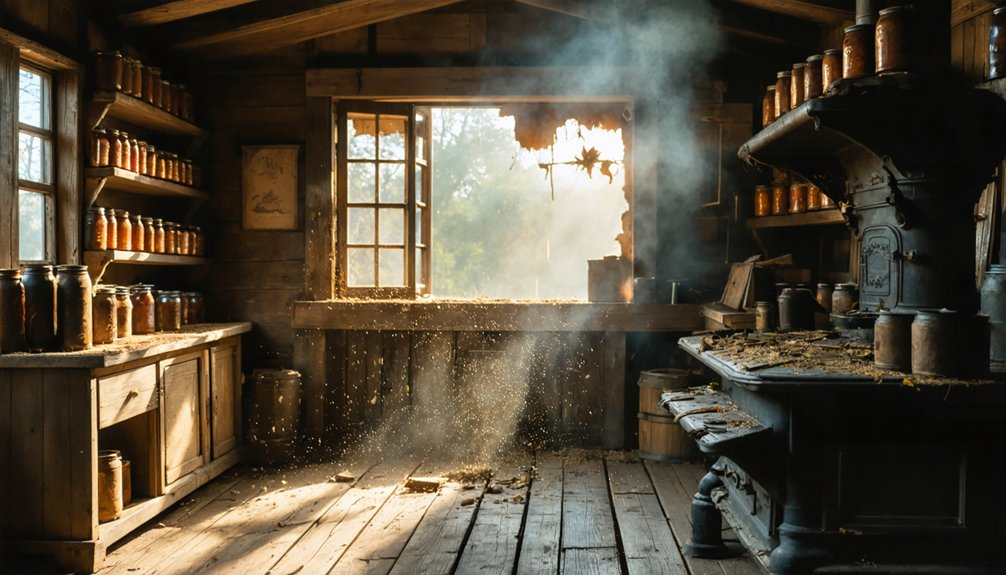
Before Wisconsin’s ghost towns faded into history, they bustled with the rhythms of frontier life shaped by industry and agriculture. You’d have found workers rising before dawn, heading to the mines and mills for grueling sunrise-to-sundown shifts.
Women managed households, gardens, and small businesses while children pitched in with chores that left little time for schooling.
The seasonal rhythms governed everything – from spring planting to winter repairs. Towns pulsed with activity around transport schedules as merchants and blacksmiths served stagecoach and rail travelers.
Frontier labor demanded adaptability: when mines went dry or timber ran out, families packed up and moved on. Yet while these communities existed, they formed tight-knit societies where every member played a crucial role in the shared struggle for survival.
Archaeological Discoveries and Preservation Efforts
Wisconsin’s rich archaeological heritage spans thousands of years, from the prehistoric Old Copper Culture to the mysterious Mississippian settlements.
From ancient copper workers to enigmatic Mississippian peoples, Wisconsin’s archaeological treasures tell stories spanning millennia.
As you explore these archaeological sites today, you’ll discover a remarkable legacy of native craftsmanship and ceremonial practices that faces ongoing preservation challenges. The state’s unique concentration of effigy mounds and ancient copper artifacts reveals sophisticated cultural practices that merit protection for future generations.
- Aztalan’s 35-acre town features massive platform mounds and rare Mississippian artifacts of profound archaeological significance.
- Wisconsin holds the nation’s highest concentration of prehistoric mounds, with distinctive effigy shapes like birds and bears.
- The Oconto Site yielded the earliest dated copper artifacts in eastern North America.
- Archaeological sites in northeastern Wisconsin preserve important Oneota burial mounds and ceremonial grounds.
Exploring Wisconsin’s Abandoned Settlement Heritage

Throughout the nineteenth and early twentieth centuries, hundreds of settlements across Wisconsin transformed from bustling communities into abandoned places, leaving behind scattered remnants of their once-vibrant existence.
You’ll discover these forgotten places tell compelling stories of economic shifts, from lead mining boomtowns in the southwest to logging camps in the north. Their cultural significance extends beyond crumbling foundations and overgrown cemeteries – they’re windows into the diverse ethnic communities that shaped Wisconsin’s identity.
Whether you’re exploring former river ports made obsolete by changing transportation routes or crossroads hamlets bypassed by railroads, you’ll find each site offers unique insights into the state’s development.
Many locations still feature intact historic buildings, while others have only stone foundations to mark their past.
Frequently Asked Questions
Are There Any Reported Ghost Sightings at These Abandoned Wisconsin Towns?
You’ll find ghost stories galore, with your smartphone capturing orbs at haunted locations like Cooksville’s hotel ruins, Gratiot’s Grove cemetery, and Voree’s Mormon sites – all backed by local eyewitness accounts.
What Safety Precautions Should Visitors Take When Exploring These Ghost Towns?
Bring safety gear including boots, flashlights, and respirators. Watch for unstable structures and wildlife encounters. You’ll need a companion, first aid kit, and offline maps for remote locations.
Can Metal Detectors Be Used at These Historical Ghost Town Sites?
Like disturbing a delicate spider’s web, metal detecting can destroy irreplaceable history. You’ll need specific permits on public lands, and most ghost town sites prohibit detecting due to historical preservation concerns.
Are Any of These Ghost Towns Available for Purchase Today?
You won’t find complete ghost towns for sale in Wisconsin right now, but you’ll discover real estate opportunities with abandoned properties and rural parcels that offer similar historical appeal throughout the state.
In addition, there are various ghost towns available in Wisconsin that you can explore, each with its unique story and charm. These sites often attract photographers and history enthusiasts, eager to capture the remnants of a bygone era. As you delve into these abandoned locales, you’ll uncover hidden gems that reflect the rich history of the region.
Exploring ghost towns in Wisconsin landscape can provide a profound connection to the past, as you stroll through the remnants of once-thriving communities. Many visitors find themselves captivated by the stories etched into crumbling structures and overgrown streets, making these sites a perfect day trip for adventurers and history buffs alike. Whether you’re an amateur photographer or a local historian, these forgotten places are sure to leave a lasting impression on your journey through Wisconsin.
Which Ghost Town Is Most Accessible During Winter Months in Wisconsin?
You’ll find Fort Howard near Green Bay offers the best winter accessibility for ghost town exploration, with plowed municipal streets and urban amenities ensuring easy access throughout the cold months.
References
- https://www.onlyinyourstate.com/experiences/wisconsin/ghost-towns-wi
- https://pbswisconsin.org/news-item/southern-wisconsins-ghost-towns-leave-behind-vital-stories/
- https://www.geotab.com/ghost-towns/
- https://www.youtube.com/watch?v=hyvSTpgwddA
- https://www.ghosttowns.com/states/wi/wi.html
- https://kids.kiddle.co/List_of_ghost_towns_in_Wisconsin
- https://www.atlasobscura.com/lists/abandoned-places-midwest
- https://www.wi-geocaching.com/forums/topic/abandoned-places/
- https://ss.sites.mtu.edu/mhugl/2015/10/11/fort-howard/
- https://en.wikipedia.org/wiki/Fort_Howard_(Wisconsin)