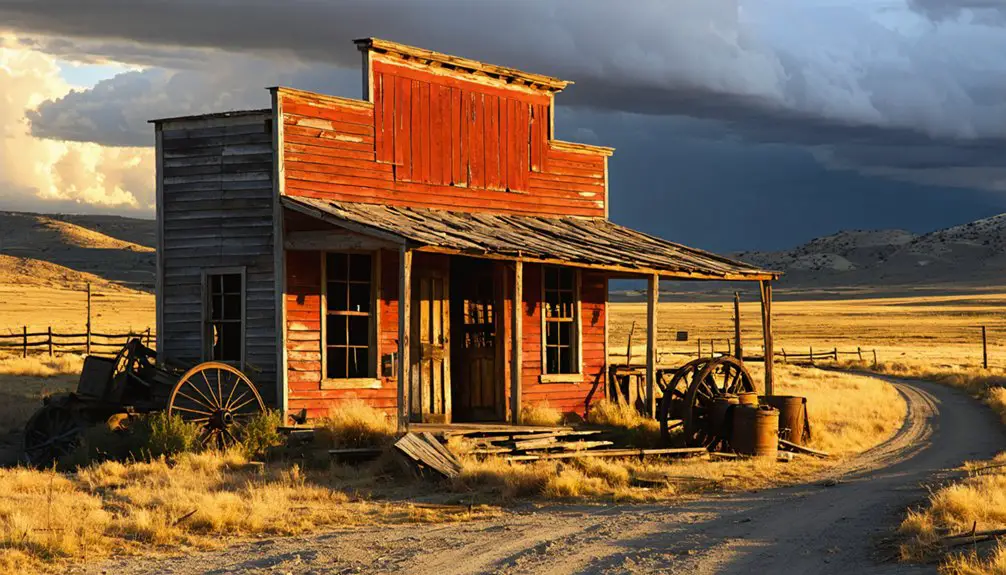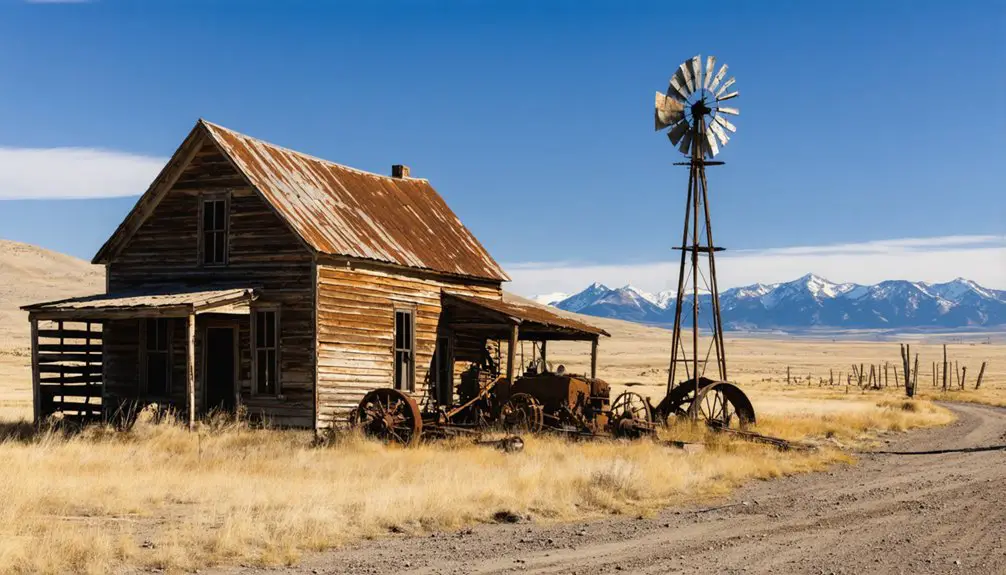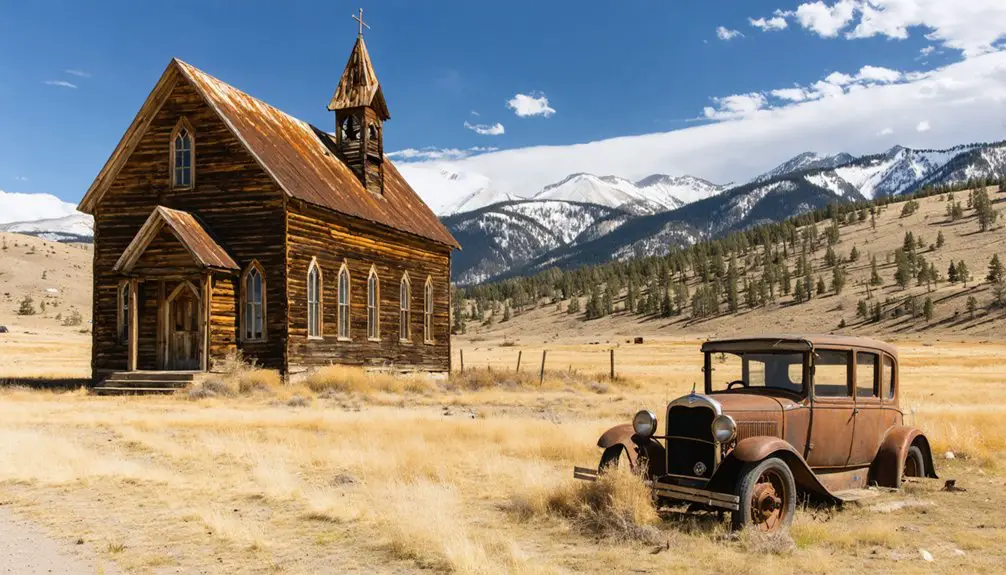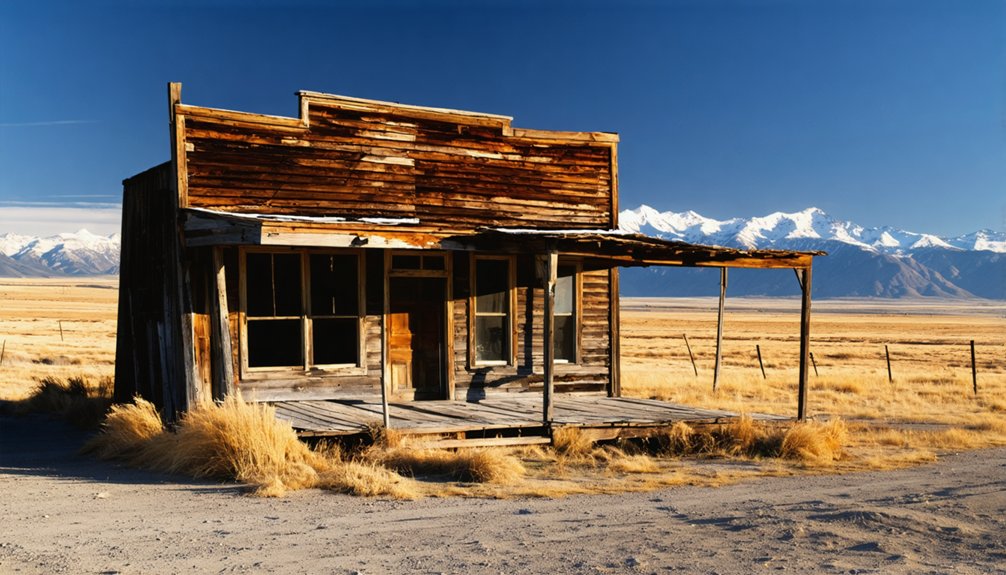
You’ll discover Wyoming’s ghost towns scattered across the frontier landscape, remnants of the state’s dramatic western expansion. These abandoned settlements, like Benton’s 90-day boomtown and Carbon’s coal mining hub, once housed thousands of pioneers seeking fortune through railroads and mineral extraction. While some towns, like South Pass City, have been preserved as heritage sites, others remain as silent testimonies to boom-and-bust cycles that shaped the American West. Their weathered structures and forgotten graveyards hold countless untold stories.
Key Takeaways
- Wyoming’s most famous ghost town, Benton, lasted only 90 days but housed 3,000 people and 25 saloons during railroad construction.
- Carbon ghost town, established in 1868, thrived with 3,000 residents until mining disasters and railroad relocation led to abandonment.
- Many Wyoming ghost towns emerged during railroad expansion in 1867, with communities forming around Union Pacific Railroad construction.
- South Pass City serves as a preserved ghost town managed by the state, offering visitors authentic historical structures.
- Ghost towns like Bessemer declined when railroad development favored other locations, leaving behind historical remnants managed by BLM.
The Rise and Fall of Benton’s 90-Day Wonder
A proof to the ephemeral nature of frontier boom towns, Benton, Wyoming emerged and vanished in a mere 90 days during the summer of 1868.
You’ll find its ghostly remains about 11 miles east of present-day Rawlins, where this Union Pacific end-of-track settlement once bustled with 3,000 souls.
The town’s transient economy thrived on railroad construction, with stagecoach connections stretching to Utah, Montana, and Idaho.
The infamous drink forty rod whiskey sold for just five cents a glass and was said to be lethal from forty rods away.
Benton’s lawless reputation stemmed from its 25 saloons, numerous brothels, and daily violence.
The absence of a reliable water source ultimately doomed the settlement’s chances of survival.
You’d have witnessed frequent gunfights and found cheap moonshine flowing freely through its shanty-lined streets.
When the railroad pushed westward in September 1868, Benton’s residents packed up and followed, leaving behind only a cemetery with nearly 100 graves to mark their fleeting presence.
Carbon’s Coal Mining Legacy
While Benton’s story exemplifies Wyoming’s flash-in-the-pan settlements, Carbon stands as proof of the territory’s enduring coal mining heritage.
You’ll find its origins traced to 1868, when the Union Pacific Railroad established this strategic outpost on Simpson Ridge’s eastern slope. The town’s economic impact grew rapidly as seven coal mines fed the railroad’s hungry locomotives, swelling the population to 3,000 residents.
Union Pacific’s grip tightened when they formed their Coal Department, creating a monopoly after acquiring the Wyoming Coal and Mining Company’s operations. Labor disputes led the company to seek Chinese and Scandinavian workers as replacements. The workforce faced dangerous conditions, with over 300 miners dying in disasters between 1886 and 1924.
Union Pacific’s monopoly over Carbon’s coal industry grew stronger as they absorbed local mining operations into their Coal Department.
By 1890, however, Carbon’s fortunes shifted. The railroad’s relocation to avoid Simpson Hill’s steep grade, combined with the devastating fire of 1890 and competition from Hanna’s mines, sealed the town’s fate.
Today, only scattered ruins remain.
Hidden Dangers at Rudefeha and Dillon
Deep colors. These abandoned mining towns became ghost towns after fraudulent stock sales led to the mining company’s indictment. The Penn-Wyoming Copper Company’s mines closed after misleading reports about new ore discoveries.
Bessemer’s Historical River Crossing
Located at a strategic bend of the North Platte River, Bessemer emerged in 1888 as an ambitious settlement positioned near a historic river crossing. The site’s historical significance stems from its role as a essential ford along the Oregon-California-Mormon-Pony Express trails, where you could avoid paying tolls at downstream ferries near Casper. Local lumberjack Victor Heibe reported seeing the mysterious Ship of Death while working along these riverbanks in 1903.
- You’ll find Bessemer Crossing about 12 miles southwest of Casper, marked by the distinctive Red Buttes landmark.
- The crossing served as a critical link for emigrants, freight wagons, and early travelers seeking a toll-free river passage.
- The site’s strategic location influenced settlement patterns until railroad development favored Casper instead. Despite ambitious plans and early growth, the town’s population had dwindled to 64 by 1895.
- Today, BLM manages the area, preserving interpretive elements of this historic crossing point where countless pioneers forded the North Platte.
The Railroad’s Impact on Piedmont
The 1867 founding of Piedmont marked the start of a significant railroad town that would shape Wyoming’s transportation history. You’ll find its origins tied to Moses Byrne’s establishment of an essential water station supporting railroad expansion westward.
The town’s infrastructure developed rapidly to accommodate helper engines needed for the challenging 8-mile grade. Visitors can easily reach the site by taking Exit 24 at Leroy off I-80.
During its peak, Piedmont thrived with homesteaders, merchants, and railroad workers. The Guild mercantile store, four saloons, and maintenance facilities served the bustling community. Calamity Jane resided here while working at a local boarding house.
A notable incident occurred when Thomas Durant was held hostage by unpaid tie contractors until Oliver Ames arranged a $50,000 settlement.
However, when the railroad rerouted through a new tunnel just miles away, Piedmont’s purpose vanished. Today, three surviving charcoal kilns stand as silent sentinels of this once-vital railroad town.
Hartville: From Bustling Mining Hub to Historic Site
When John Fields discovered copper deposits near an abandoned mine at Government Farm in 1878, he sparked a mining rush that would establish Wyoming’s oldest incorporated town.
Named after Major Verling K. Hart, Hartville quickly transformed into a vibrant copper mining hub by 1884, boasting community bonds that defined its character.
You’ll discover Hartville’s remarkable journey through these key developments:
- A bustling Wild West atmosphere with dozen saloons, opera house, and gaming halls
- Strong ties to sister town Sunrise, where miners’ families forged lasting friendships
- Diverse cultural heritage from Italian, Greek, Mexican, and Danish workers
- Evolution from 1880s copper boom to iron mining ventures by 1897
Today, with just 63 residents, Hartville stands as a historic reflection of Wyoming’s mining legacy, its schoolhouse museum preserving memories of its golden era.
Life in Wyoming’s Railroad Boom Towns
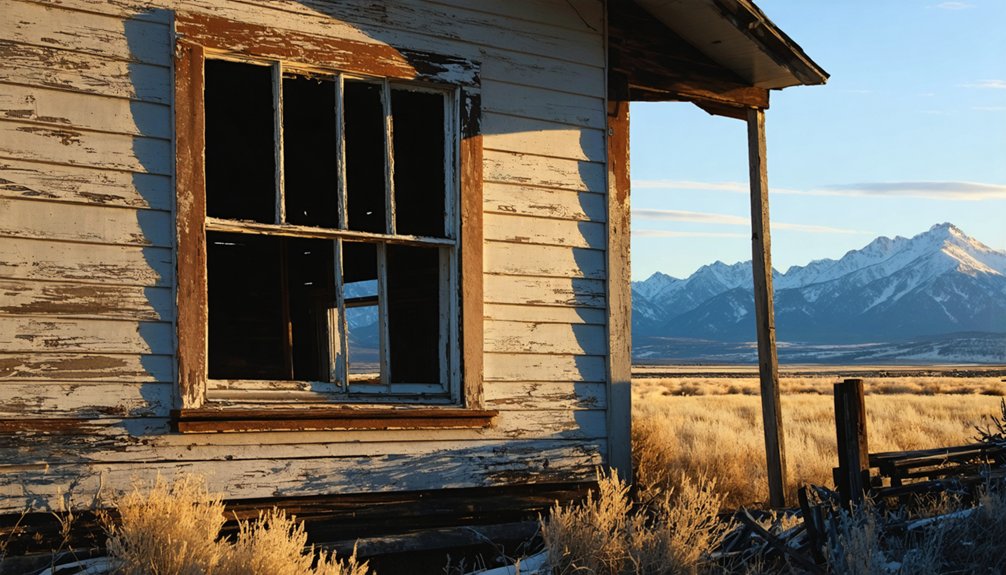
As Union Pacific Railroad tracks stretched across Wyoming Territory in 1867, they transformed a sparsely populated frontier into a bustling network of railroad communities.
You’d have witnessed the rapid birth of cities like Cheyenne, Laramie, and Rock Springs, where diverse populations from over 56 nationalities converged to work the rails and mines.
Life in these railroad expansion towns meant you’d find yourself among a vibrant mix of Irish, German, and English immigrants, who made up nearly three-eighths of the population by 1870.
The Union Pacific Coal Company’s operations created transient communities complete with dining halls, repair shops, and worker housing.
While some settlements flourished into permanent cities, others vanished when resources dried up or rail lines changed course, leaving behind ghost towns like Carbon and Rock Creek.
Preserving Wyoming’s Ghost Town Heritage
Modern preservation efforts have transformed Wyoming’s abandoned settlements into protected heritage sites through various innovative approaches.
You’ll find different models of ghost town preservation across the state, each tailored to protect these irreplaceable pieces of history. Historical site management strategies include:
- State-managed sites like South Pass City, where careful restoration preserves original structures while enabling public access.
- Museum-campus conservation at places like Grand Encampment Museum, where 19 historic buildings have been relocated for protection.
- Federal stewardship through the USDA Forest Service, protecting remote sites within the Shoshone National Forest.
- Private nonprofit partnerships that coordinate seasonal tours and maintenance, particularly around Meeteetse and Kirwin.
These preservation methods combine stabilization techniques, funding mechanisms, and visitor management to safeguard Wyoming’s frontier heritage for future generations.
Frequently Asked Questions
Are Any Wyoming Ghost Towns Legally Off-Limits to Public Access?
Yes, you’ll find legal restrictions preventing public access to many ghost towns through private property laws, federal closures, state historic site regulations, tribal protections, and mixed-ownership limitations.
What Supernatural Legends Are Associated With These Abandoned Wyoming Towns?
You’ll find disembodied voices and footsteps at Kirwin’s avalanche-ravaged buildings, while South Pass City harbors tales of Polly Bartlett’s murderous ghost. Sweetwater County’s library logs supernatural sightings near disturbed burial grounds.
How Many Undiscovered Ghost Towns Might Still Exist in Wyoming?
You’ll find that Wyoming likely harbors between 50-200 undiscovered ghost towns of historical significance, hidden across remote landscapes, with most concentrated in under-surveyed counties and former resource extraction areas.
Among these abandoned towns in Wyoming, fascinating remnants of the past still linger, offering a glimpse into the lives of those who once called them home. Explorers and historians alike are drawn to the stories encapsulated within the crumbling structures and overgrown streets. Each site has its own unique tale, waiting to be uncovered by those daring enough to wander off the beaten path.
As interest in preserving history grows, some of these ghost towns in Wyoming for sale have become enticing opportunities for adventurous buyers. With vast landscapes and rich stories, they offer not only a chance to own a piece of history but also a canvas for creativity and restoration. Those who invest in these towns may find that they not only revive architectural heritage but also contribute to the ongoing narrative of Wyoming’s past.
Which Wyoming Ghost Town Has the Most Complete Remaining Structures?
You’ll find South Pass City leads in historic preservation with over 20 well-maintained original structures, showing superior structural integrity compared to other ghost towns like Miner’s Delight’s 17 or Kirwin’s scattered remains.
Can Visitors Take Artifacts Home From Wyoming Ghost Towns?
No – you can’t legally remove artifacts from Wyoming ghost towns. Artifact preservation laws protect these sites, and you’ll face serious legal repercussions including fines or criminal charges for unauthorized collection.
References
- https://www.wyomingcarboncounty.com/blog/123-5-ghost-towns-to-explore
- https://sites.rootsweb.com/~wytttp/ghosttowns.htm
- https://www.youtube.com/watch?v=GEoxbcwf8Ks
- https://www.geotab.com/ghost-towns/
- http://www.onlyinyourstate.com/experiences/wyoming/creepy-ghost-towns-in-wy
- https://www.ghosttowns.com/states/wy/wy.html
- https://en.wikipedia.org/wiki/List_of_ghost_towns_in_Wyoming
- https://wyomingwhispers.com/benton-wy-ghost-town/
- https://kingfm.com/the-legend-of-benton-wyomings-wildest-town/
- https://www.hmdb.org/m.asp?m=89916