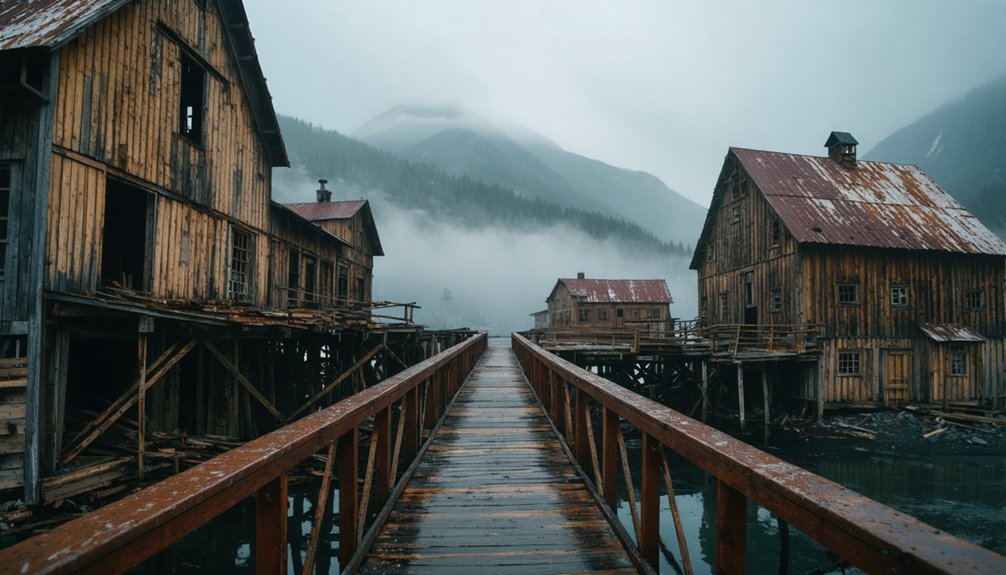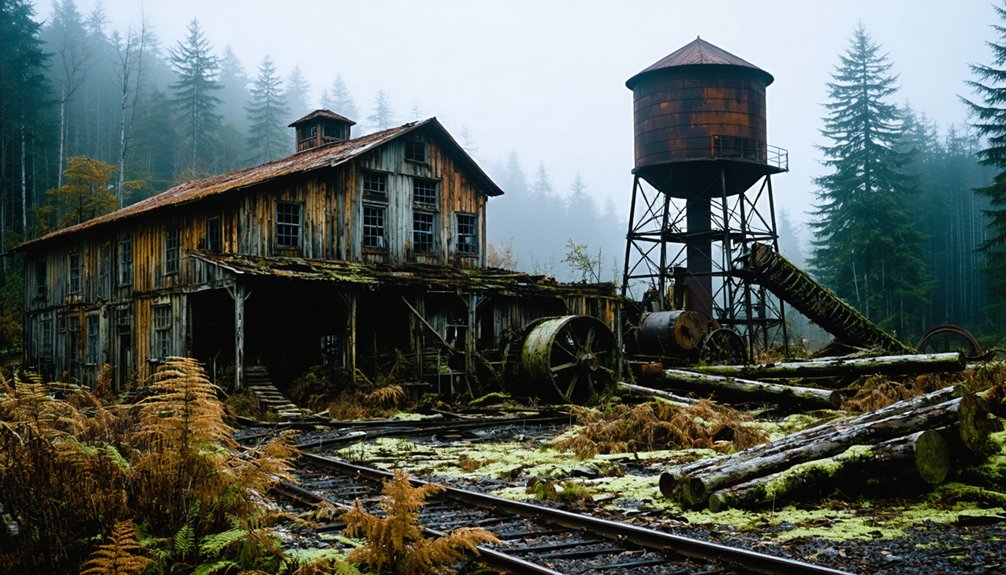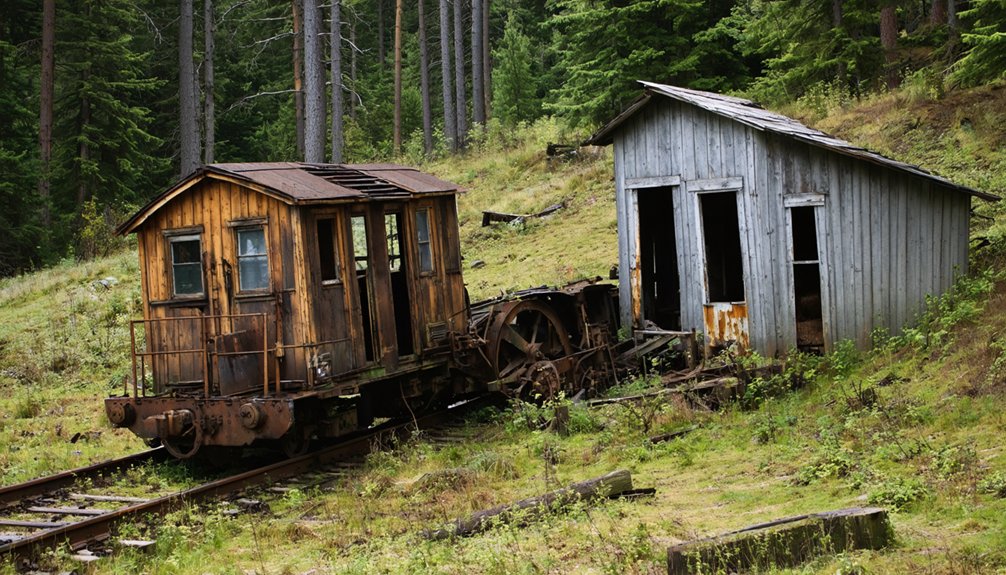
You’ll find abandoned logging towns scattered across America’s diverse landscapes. Elkmont in the Smoky Mountains evolved from logging to resort before becoming a ghost town. California’s Bodie shifted from gold mining to logging dependence. Colorado’s St. Elmo maintains 40 original structures. Alaska’s Kennecott combined copper mining with timber exploitation. Pennsylvania’s Eckley showcases industrial capitalism’s impact on worker communities. These silent settlements offer windows into America’s resource-driven past.
Key Takeaways
- Elkmont was a Tennessee logging town that became a ghost town after the Great Smoky Mountains National Park formed in 1934.
- Bodie transformed from gold mining to logging-dependent before being abandoned in 1917 after consuming 5 million feet of lumber annually.
- St. Elmo began as a mining town in 1880 and survived until becoming a National Historic District with 40 original structures still standing.
- Kennecott, primarily a copper mining town, utilized significant timber resources before being abandoned in the 1930s and later becoming a National Historic Landmark.
- Abandoned logging towns across America often reflect boom-and-bust cycles tied to resource depletion and changing economic conditions.
Elkmont: The Ghost Town Hidden in the Smoky Mountains
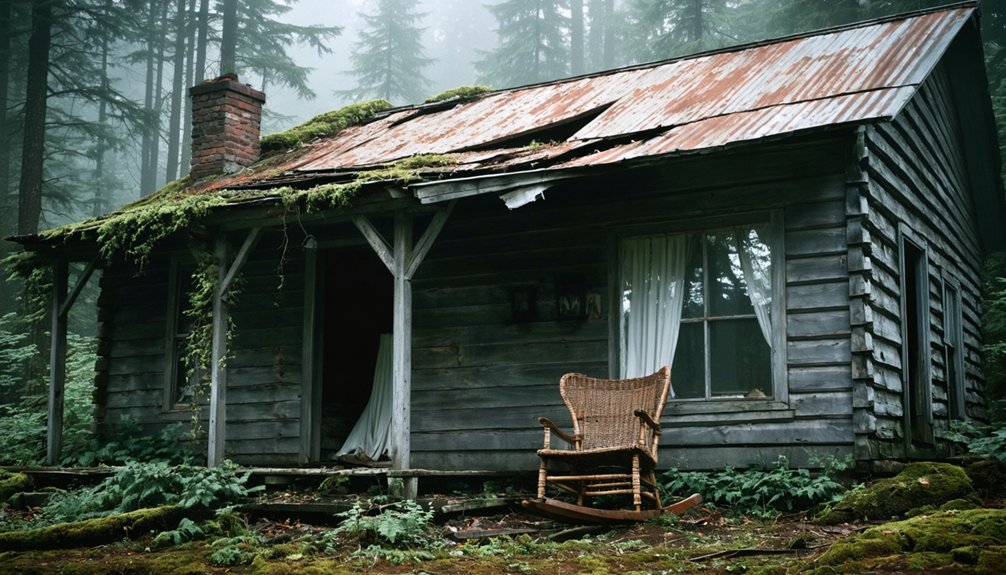
Nestled within the lush forests of the Great Smoky Mountains lies Elkmont, a forgotten logging town with a fascinating evolution from industrial hub to exclusive resort community to abandoned ghost town.
Originally settled in the 1840s as “Little River,” Elkmont’s history transformed when W.B. Townsend’s Little River Lumber Company established operations in 1901.
As timber resources depleted by the 1920s, the area reinvented itself when wealthy Knoxville residents created the Appalachian and Wonderland Clubs.
When the Great Smoky Mountains National Park formed in 1934, residents received lifetime leases. The last occupant departed in 2001, leaving over 70 historic structures to decay.
Today, Elkmont preservation efforts continue as the National Park Service restores select buildings, allowing you to explore this hauntingly beautiful remnant of America’s logging past. A convenient parking lot near the historic structures provides easy access for visitors wanting to experience this unique piece of history. Colonel David Chapman, a founder of the Appalachian Club, was instrumental in the park’s creation by hosting legislators at Elkmont to secure their support.
Bodie: California’s Gold Rush Legacy and Logging Heritage
In the rugged high desert landscape of eastern California, Bodie stands as a symbol to the boom-and-bust cycle that defined America’s western frontier, evolving from a gold mining outpost into a town critically dependent on logging for its survival.
When Bodie mining operations peaked in 1881 with $3.1 million in ore production, the town faced a critical wood shortage crisis. The solution materialized through:
- Creation of Mono Mills, a dedicated logging settlement
- Development of narrow gauge Bodie Railway & Lumber Company
- Acquisition of 12,000 acres of Jeffrey Pine timber
- Construction of spur lines to efficiently transport lumber
This symbiotic relationship between Bodie mining and logging operations sustained the town until 1917, when declining profits eventually led to its abandonment. Sitting at an elevation of 8,379 feet, Bodie faced harsh environmental conditions that made both mining and logging operations especially challenging. The town consumed approximately 5 million feet of lumber annually to power its mills and machinery, highlighting the enormous resource demands of frontier mining operations.
St. Elmo: Colorado’s Well-Preserved Mountain Logging Community
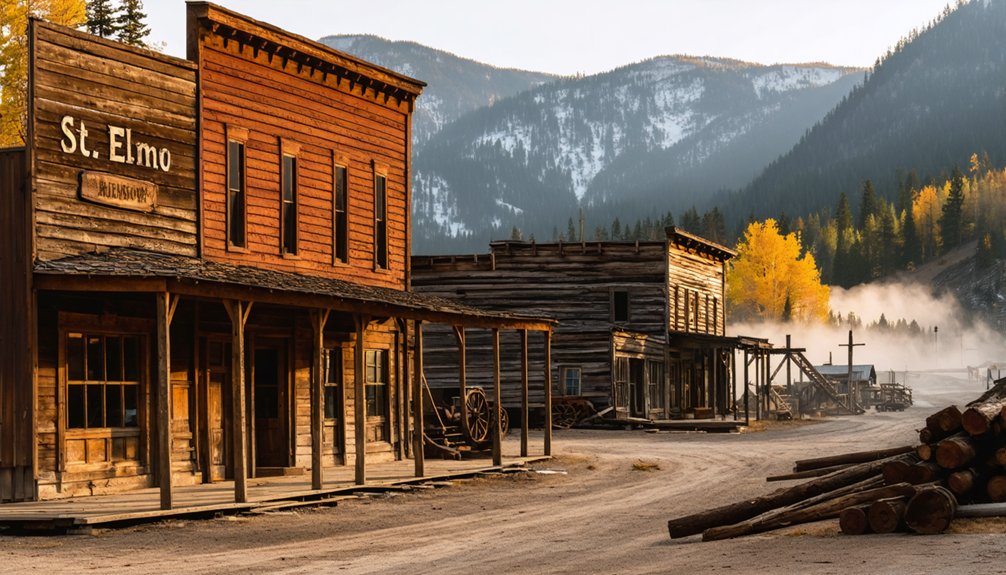
While Bodie represents California’s mining-turned-logging settlements, Colorado’s St. Elmo tells a different tale. Founded in 1880 at 10,000 feet in the Sawatch Range, St. Elmo’s history reveals it was primarily a mining community—not logging as the subtopic suggests.
The town thrived on gold, silver, and copper extraction, with the Mary Murphy Mine producing 220,000 ounces of gold worth $4.4 million. The town was originally named Forest City before being renamed St. Elmo after a popular novel.
The Mary Murphy Mine alone yielded $4.4 million in gold—a testament to St. Elmo’s mineral wealth.
At its peak, nearly 2,000 residents enjoyed five hotels, banks, saloons, and a newspaper. Unlike many abandoned towns, St. Elmo survived the triple blows of a devastating 1890 fire, Alpine Tunnel closure, and railroad discontinuation.
Today, St. Elmo tourism flourishes as visitors explore this remarkably preserved National Historic District, with original structures like the American House Hotel standing as evidence of Colorado’s mining heritage. Visitors can explore approximately 40 original structures that remain standing, including a museum and general store.
Kennecott: Alaska’s Remote Copper and Timber Frontier
Deep within Alaska’s wilderness, the story of Kennecott stands as a tribute to America’s industrial ambition rather than primarily timber exploitation. This abandoned settlement reveals America’s copper mining history, showcasing how capital transformed remote landscapes into industrial powerhouses. Four main mines formed the backbone of operations, with the Bonanza mine being the only open-pit operation.
When exploring Kennecott history, you’ll discover:
- Incredible wealth – The Bonanza claim contained the richest, purest copper deposits on earth, yielding nearly $200 million during operations.
- Engineering marvel – A 196-mile railroad constructed through harsh terrain connected the remote mine to Cordova.
- Brief prosperity – Peak production in 1916 generated $32.4 million before resources depleted by the 1930s.
- Preserved legacy – Designated a National Historic Landmark in 1986, the abandoned red buildings still stand against glacial backdrops.
The site was discovered in summer 1900 when prospectors spotted green malachite on the mountainside along the Kennecott Glacier moraine.
Kennecott’s story reflects both the freedom and impermanence of frontier industrial ventures.
Eckley Miner’s Village: Pennsylvania’s Coal and Logging History
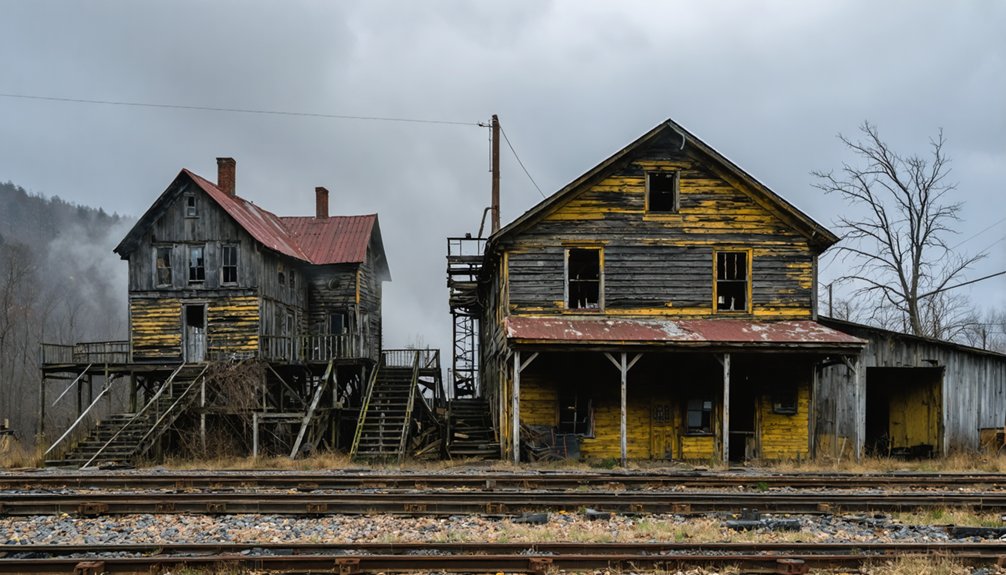
Nestled within Pennsylvania’s anthracite coal region, Eckley Miner’s Village presents a compelling paradox of American industrial development. This former “patch town,” established in 1854 as Shingletown before being renamed after Eckley B. Coxe, reveals how company control constrained worker freedom while fueling national progress.
The Eckley history reflects America’s industrial ambitions and their human cost. You’ll find stark contrasts between ornate owner mansions and cramped worker houses where up to 30 people lived in double homes. The site represents the experiences of immigrant families who labored in the coal industry throughout the region.
The miner lifestyle centered around grueling labor, with immigrants from Wales, Germany, and Ireland trapped in economic dependence on coal companies that controlled housing, stores, and social institutions. Children were not exempt from this harsh reality, as young boys often worked as coal pickers sorting impurities from the valuable anthracite.
Today, this preserved 100-acre site with 200 buildings serves as a living museum, documenting how industrial capitalism shaped immigrant experiences in the anthracite heartland.
Petersburg: The Lost Settlement of Kankakee County
Petersburg emerges as an intriguing counterpoint to Pennsylvania’s company-controlled settlements, representing a different facet of American frontier development. Unlike typical logging towns, Petersburg‘s history intertwines with Abraham Lincoln, who surveyed its plat in 1835-1836, creating a unique frontier legacy.
Petersburg stands apart from company towns, its frontier heritage uniquely shaped by Lincoln’s surveying work in the 1830s.
The logging impact on Petersburg’s development remained secondary to its agricultural foundation, though timber resources supported local growth.
When examining Petersburg’s resilience through:
- Surviving an 1909 earthquake that damaged significant structures
- Absorbing New Salem’s population in 1840, transforming into a thriving community
- Maintaining county seat status continuously since 1839
- Adapting from railroad development in 1861 to modern conservation areas
You’ll find Petersburg represents not abandonment but transformation—a rare success among frontier settlements that evolved beyond extractive industries.
Frequently Asked Questions
Can Visitors Stay Overnight in Any Abandoned Logging Towns?
You can’t legally stay overnight in abandoned logging towns’ original structures. Visitor regulations prohibit this for safety and preservation, but you’ll find nearby overnight accommodations that don’t compromise your freedom.
What Wildlife Has Reclaimed These Abandoned Logging Settlements?
Listen closely—you’ll witness remarkable wildlife sightings as nature reclaims these ghostly settlements. Black bears, coyotes, and deer dominate, while ecosystem restoration brings bobcats, owls, and countless small creatures back home.
Are There Paranormal Activity Reports in These Historic Ghost Towns?
You’ll find numerous ghost sightings across abandoned logging towns like Elkmont and Kennecott, where haunted locations feature apparitions, unexplained sounds, and temperature drops that paranormal investigators frequently document and study.
These eerie occurrences contribute to the haunting history of the Old West, where legends of restless spirits and tragic tales abound. Visitors are often drawn to these sites, eager to experience the supernatural for themselves and delve into the mysteries that linger long after the people have gone. Each story adds another layer to the rich tapestry of life and death that defines this rugged landscape.
How Accessible Are These Sites During Winter Months?
You’ll face significant accessibility challenges during winter months, especially in northern and mountainous locations where heavy snow limits vehicle access, while desert ghost towns remain relatively accessible despite winter weather conditions.
What Artifacts Can Legally Be Collected From Abandoned Logging Towns?
You can’t legally collect artifacts from abandoned logging towns on federal or state lands. Legal regulations prioritize artifact preservation over personal collection. Private land requires explicit owner permission.
References
- https://albiongould.com/ghost-towns-to-visit-in-the-states/
- https://www.geotab.com/ghost-towns/
- https://www.christywanders.com/2024/08/top-ghost-towns-for-history-buffs.html
- https://www.frrandp.com/p/ghost-towns-map.html
- https://www.youtube.com/watch?v=o9MTF3S_-Uk
- https://devblog.batchgeo.com/ghost-towns/
- https://en.wikipedia.org/wiki/Lists_of_ghost_towns_in_the_United_States
- https://www.atlasobscura.com/lists/americas-best-preserved-ghost-towns
- https://roadtrippers.com/magazine/abandoned-ghost-town-smoky-mountains/
- https://www.visitmysmokies.com/blog/smoky-mountains/about-elkmont-ghost-town/