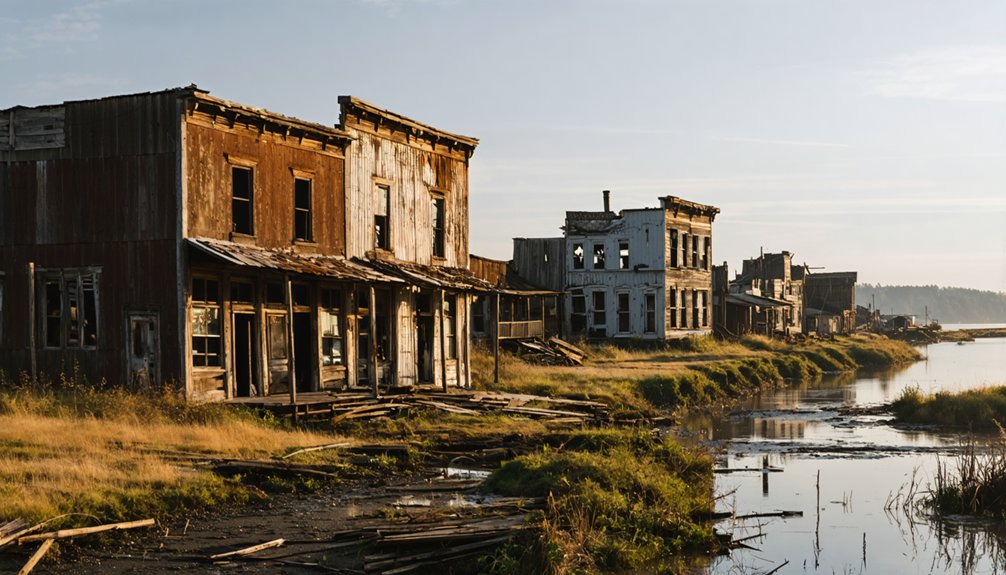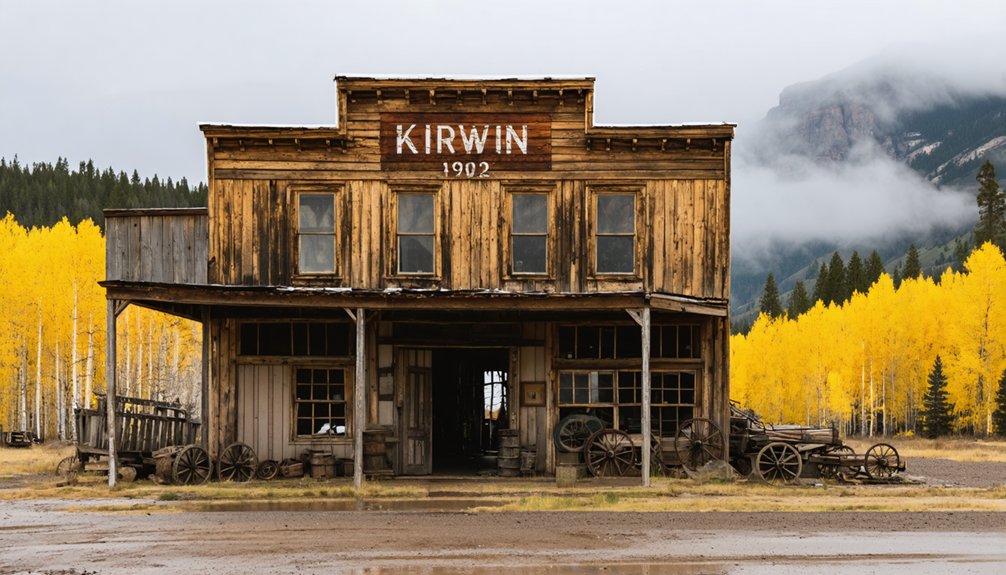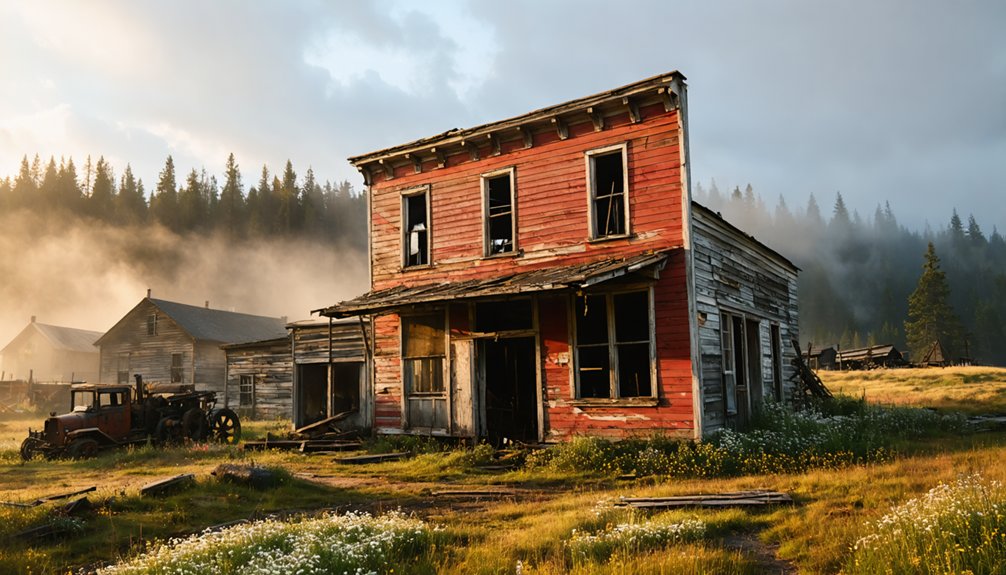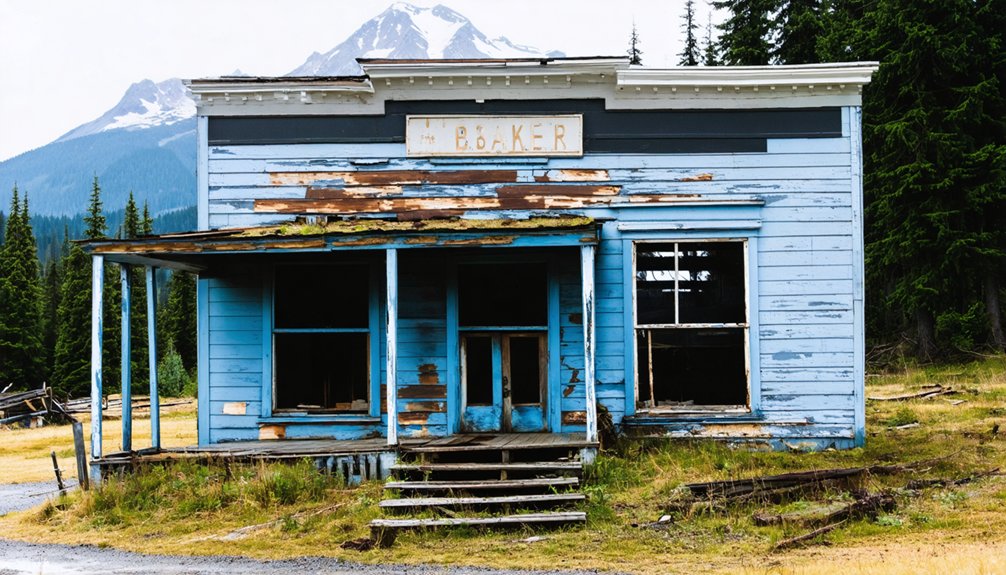
The Washington Cascades harbor numerous ghost towns from the mining era, including Liberty (1873 gold rush settlement), Melmont (early 1900s coal town), Monte Cristo (1890s silver boomtown), and Nighthawk (1860s mining camp). You’ll also find Claquato, a bypassed lumber town featuring Washington’s oldest standing church. Many of these sites retain visible remnants like foundations, mine entrances, and occasionally intact structures—physical connections to the region’s boom-and-bust resource extraction history.
Key Takeaways
- Liberty, established in 1873 after gold discovery in Swauk Creek, is one of Washington’s oldest mining settlements.
- Monte Cristo, a silver mining boomtown discovered in 1889, housed 1,000 residents by 1894 before declining due to floods and economic issues.
- Melmont, a coal mining town established in 1900 near Mount Rainier, was abandoned within 20 years after producing 900,000 tons of coal.
- Nighthawk began as a tent settlement in the 1860s, supported 3,000 miners at its peak, and declined after Highway 2’s construction.
- Remote mining enclaves throughout the Cascades, like those in Boston Basin and Thunder Creek, have left minimal historical footprints.
Liberty: Washington’s Historic Gold Rush Settlement
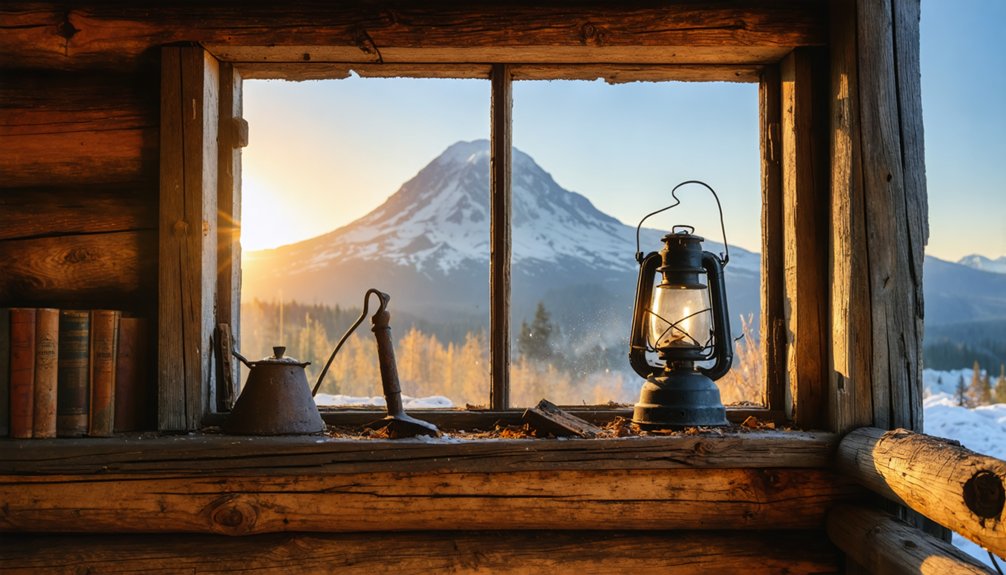
Nestled within the Cascade Mountains, Liberty stands as a tribute to Washington’s gold rush era, originating with the pivotal discovery of gold in Swauk Creek in 1873.
Unlike typical mining camps, Liberty developed with remarkable community stability, forming one of the state’s oldest mining settlements.
While most gold camps faded with dwindling fortunes, Liberty thrived through generations, building lasting community bonds.
You’ll find Liberty’s legacy built upon its unique crystalline wire gold formations, with historic pans yielding values up to $1,365.
Initially organized as two separate townsites—Meaghersville and Old Liberty—the area was named by Gus Nelson when establishing the first permanent residence in 1891.
Gold mining evolved from early placer operations along creek beds to hydraulic techniques and later dredging operations. The miners primarily focused on extracting coarse gold nuggets while often neglecting the finer particles.
The Swauk Mining District‘s endurance through multiple generations of miners demonstrates both the richness of its deposits and the determined spirit of its inhabitants.
As the oldest organized mining district in Washington state, the area continues to hold historical significance tied to its local mining activities.
Melmont: The Coal Mining Ghost Town Near Mount Rainier
While Liberty tells the story of gold’s allure in Washington’s mountains, another resource—coal—created equally compelling but shorter-lived communities in the Cascades.
Melmont, established in 1900 near Mount Rainier, produced high-grade blacksmith coal but lasted only two decades before abandonment.
The Melmont memories you’ll find along the 3.8-mile round-trip hike from Fairfax Bridge reveal coal mining’s brief but significant impact:
- Stone foundations and a bridge abutment—remnants of a once-thriving company town
- Six underground mining levels that yielded 900,000 tons of coal over 16 years
- A vanished community infrastructure including a hotel, saloon, and schoolhouse (later dismantled for lumber)
The town was carefully organized with company-owned cottages grouped according to ethnic backgrounds, including separate areas for Italian, Finnish, Polish, and Japanese miners.
The town’s history includes a notable crime in 1905 when the mine owner’s home was bombed, though the perpetrator was never convicted due to lack of evidence.
Monte Cristo: Rise and Fall of a Silver Mining Boomtown
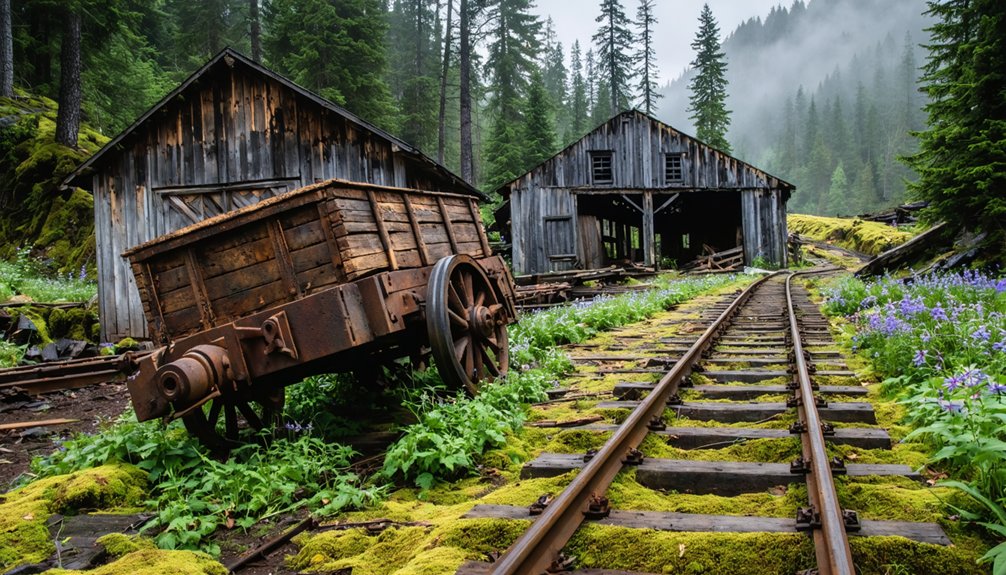
Deep in the Northern Cascades, Monte Cristo exemplifies the meteoric rise and fall of Western mining boomtowns. Discovered in 1889, silver ore deposits transformed this remote valley into a thriving settlement of 1,000 residents by 1894, attracting Rockefeller’s capital and even Frederick Trump, who operated a hotel there. Situated at 2,762 feet elevation, the town occupied a picturesque yet challenging location in Snohomish County.
The mining history reveals impressive scale—eight primary mines produced 310,000 tons of ore by 1907, with processing capacity reaching 300 tons daily. The Monte Cristo concentrator mill operated during this period, originally believed to be 85% efficient in extracting metals from ore.
However, nature fought back. The devastating 1897 flood damaged critical infrastructure while avalanches repeatedly halted operations.
Nature’s brutal power repeatedly humbled the mining operation through catastrophic floods and merciless avalanches.
The economic impact proved short-lived as geological miscalculations, erratic ore quality, and the Panic of 1907 drove investors away.
Today, environmental remediation continues to address the legacy of lead, mercury and arsenic contamination.
Claquato: The Lumber Town That Time Forgot
You’ll find Claquato’s story mirrors many boom-and-bust cycles in Pacific Northwest history, beginning with Lewis Hawkins Davis’s ambitious sawmill operation in 1857 and ending abruptly when the Northern Pacific Railroad bypassed the town in 1874.
The Davis family’s legacy remains evident in the courthouse they built and donated to Lewis County, though their influence waned after Lewis’s tragic death from a sawmill accident in 1865. The first lumber produced from Davis’s mill was generously donated to construct the iconic Claquato Church in 1858. Before the town’s decline, Claquato had grown into a thriving community with hotels and blacksmiths serving travelers and settlers alike.
Today, the Claquato Church stands as a ghostly sentinel of the vanished lumber town—its 1857 Boston-cast bell and handforged nails preserving a tangible connection to Washington’s territorial past.
Rapid Rise and Fall
Claquato’s trajectory from promising frontier settlement to ghost town exemplifies the precarious nature of 19th century lumber communities in the Cascades. Founded in 1851, the town grew rapidly under Lewis Davis’s leadership, becoming county seat by 1862 with a courthouse, hotels, and the still-standing Claquato Church.
Three factors that sealed Claquato’s fate:
- Davis’s untimely death in 1864 removed the town’s visionary leader
- The Northern Pacific Railroad’s decision to bypass Claquato in 1874 diverted commerce to Chehalis
- The subsequent loss of county seat status triggered an irreversible population exodus
You’ll find that economic shifts were swift and unforgiving—by 1902, the town’s plat was officially vacated. The town was ultimately relocated 3 miles east to Chahalis in the 1870s after being bypassed by the railroad. The Oregon Trail ran directly through Claquato, initially contributing to its early growth as a stopping point for westward settlers.
Claquato’s rise and fall demonstrates how railroad access determined town growth in the resource-dependent frontier economy.
Davis Family Legacy
While Lewis Hawkins Davis remains largely forgotten in broader Pacific Northwest history, his family’s legacy endures as the foundation of Claquato’s brief but significant existence.
You can trace the Davis heritage through physical remnants that still stand today—most significantly the Claquato Church, recognized as Washington’s oldest standing church, built from lumber from Davis’s own sawmill.
The Davis family’s Claquato influence extended beyond buildings to governance and economic development. Their donation of land for the Lewis County courthouse in 1862 temporarily established the settlement as a center of regional administration.
Though their direct leadership ended with Lewis’s tragic death in 1865, the family’s vision shaped a community whose rise and fall mirrors many frontier settlements—ambitious beginnings ultimately surrendering to changing economic forces and transportation routes.
Ghost Church Landmark
The most enduring symbol of Claquato’s brief existence stands alone on a quiet hillside today—the historic Claquato Church, often called “the ghost church” by locals.
Built in 1858 using lumber from Davis’s sawmill, this remarkable structure stands as Washington State’s oldest building, its distinctive crown of thorns steeple a representation of pioneer craftsmanship.
Historic preservation efforts rescued this Claquato landmark after years of deterioration, securing its place on the National Register of Historic Places in 1973.
The church reveals its historical significance through:
- Its original foundation and structure remain intact after 165+ years
- The Boston-cast bell from 1857 still hangs in the steeple
- Its continued use for special ceremonies maintains living community connections
Nighthawk: Remnants of Okanogan’s Mining Heritage
Nestled in the rugged terrain of Washington’s Okanogan region, Nighthawk stands as one of the state’s most significant mining ghost towns, with roots dating back to the 1860s when prospectors first established a modest tent settlement.
At its peak, this once-thriving community supported 3,000 miners extracting gold, silver, lead, copper, and zinc from the area’s rich deposits.
Nighthawk’s legacy remains visible in its surviving structures—the hotel, schoolhouse (built c.1915), mining office, and train depot.
The town, officially platted in 1903, flourished with the railway’s arrival in 1905 but declined when metal prices dropped and Highway 2’s construction diverted commerce elsewhere.
By 1951, the last mill had closed, effectively ending Nighthawk’s mining heritage.
Today, these historical ruins on private land attract photographers and history enthusiasts seeking glimpses of Washington’s industrial past.
Lesser-Known Abandoned Settlements of the Cascades
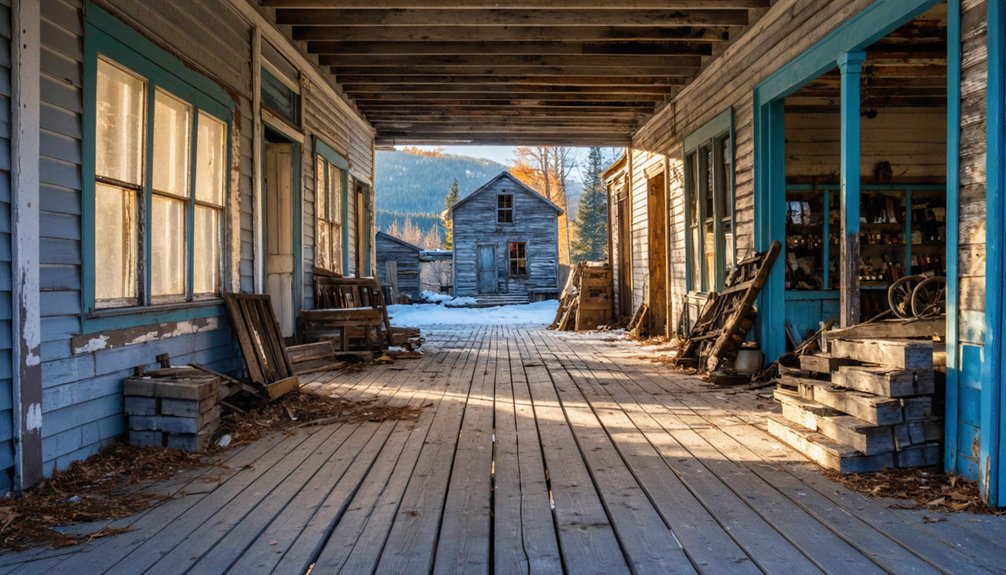
While well-documented ghost towns like Liberty mark the Cascade Range’s gold rush era, countless smaller settlements vanished with barely a trace when timber operations ceased or mining prospects failed.
You’ll find these forgotten communities scattered throughout remote valleys, often accessible only by overgrown logging roads where nature has reclaimed former bunkhouses and cookshacks.
Life in these isolated enclaves depended entirely on natural resource extraction, making them particularly vulnerable when transportation improvements eliminated their economic advantages or resource depletion triggered their abandonment.
Forgotten Timber Communities
Beyond the well-documented ghost towns that dot the Cascade range, dozens of smaller timber communities have faded into obscurity with far less historical recognition.
These company towns, once thriving centers of Pacific Northwest industry, disappeared as timber town decline accelerated mid-century. Communities like McCleary and Goshen vanished when their economic purpose ended, leaving minimal historical footprints.
The pattern of abandonment followed three consistent stages:
- Resource depletion made operations economically unsustainable
- Improved transportation freed workers from geographic dependence on isolated communities
- Company town infrastructure was typically dismantled or burned rather than preserved
Today, only fragments remain of these once-vibrant settlements.
Port Gamble stands as a rare exception where preservation efforts have maintained the historic company town infrastructure, offering a glimpse into this vanished way of life.
Hidden Mining Enclaves
Deep within the rugged terrain of the Cascade Mountains, a network of mining settlements once thrived in isolated valleys and high-elevation basins, their existence now largely forgotten by modern visitors.
You’ll find Monte Cristo‘s remnants in eastern Snohomish County, where over 200 mining claims and a massive ore processing mill once operated until 1907.
The North Cascades hide mining relics in remote areas like Boston Basin and Thunder Creek, where silver discoveries sparked brief rushes despite harsh conditions limiting development.
In Okanogan County, Nighthawk served as a supply hub for surrounding mines before economic decline led to abandonment.
Liberty, Washington’s oldest mining town, preserves hidden treasures through its National Register designation, maintaining historic buildings that whisper tales of the 1870s Gold Rush.
Life Without Railways
Unlike the more famous mining towns connected to civilization by rail, countless settlements scattered throughout the Cascades existed in profound isolation, their stories largely overlooked in historical accounts.
These communities faced extreme transportation limitations that modern travelers would find unimaginable. Without railways, residents confronted harsh realities:
- Winter months brought complete isolation when seasonal trails became impassable, forcing complete self-sufficiency.
- Economic isolation prevented efficient transport of goods to market, making most enterprises unprofitable.
- Natural disasters often proved fatal to settlements with no external support systems.
When floods, avalanches, or economic shifts occurred, these communities lacked the infrastructure to recover. Many were eventually abandoned when younger generations sought opportunities elsewhere, leaving only scattered foundations as evidence of their struggle against isolation.
Frequently Asked Questions
Are These Ghost Towns Legally Accessible to the Public?
Yes, but with varying legal restrictions. Liberty, Franklin, Melmont, Monte Cristo, and Moncton offer public access via trails, while others have partial or conditional entry due to private ownership.
What Safety Precautions Should Visitors Take When Exploring Abandoned Towns?
Bring essential exploration gear: sturdy boots, maps, and first aid kits. You’ll need to watch for structural collapses, avoid mine shafts, respect private property, and follow Leave No Trace principles for safe adventures.
When Is the Best Season to Visit Cascade Ghost Towns?
Like uncovering buried treasure, you’ll find spring, fall, and winter ideal for Cascade ghost town exploration. You’ll avoid peak visitation of summer while enjoying clearer views when seasonal weather hasn’t obscured historical remnants.
Are Any Abandoned Towns Currently Inhabited by Caretakers or Residents?
No, you won’t find caretaker presence or resident stories in these Cascades ghost towns. They’re truly abandoned, managed only by state authorities for historical preservation and recreational purposes.
Exploring abandoned towns in the United States can evoke a sense of nostalgia and curiosity about their histories. Many of these locations offer a glimpse into what life was like before economic shifts and urbanization transformed the landscape. Each site tells a unique story, waiting for adventurers and historians alike to uncover its mysteries.
Can Artifacts Be Collected From These Historic Ghost Towns?
You’d love the freedom to collect souvenirs, but you can’t legally take artifacts. Preservation laws protect these historical treasures, and legal ramifications include fines and criminal charges for unauthorized removal.
References
- https://stateofwatourism.com/ghost-towns-of-washington-state/
- https://visitrainier.com/melmont-ghost-town-2/
- https://www.youtube.com/watch?v=FVveO9uJBvc
- https://www.wta.org/go-hiking/hikes/monte-cristo-143
- https://www.seattlepi.com/local/seattlenews/article/exploring-ghost-towns-in-washington-state-16095136.php
- https://en.wikipedia.org/wiki/List_of_ghost_towns_in_Washington
- https://okanogancountry.com/ghost-towns
- https://www.cascadeloop.com/ghost-towns-and-haunted-places-in-the-washington-cascades
- https://westernmininghistory.com/towns/washington/liberty/
- https://revisitwa.org/waypoint/liberty/