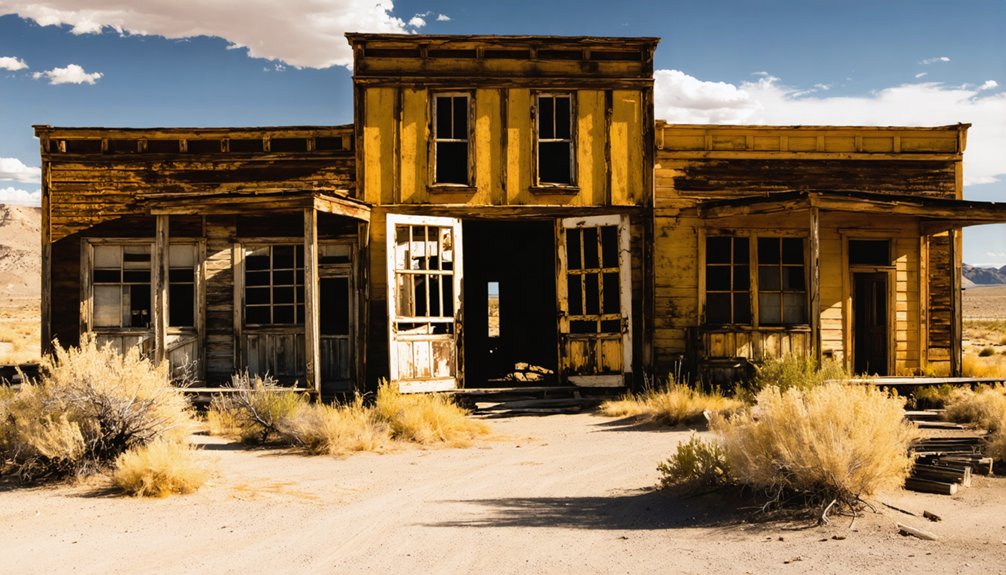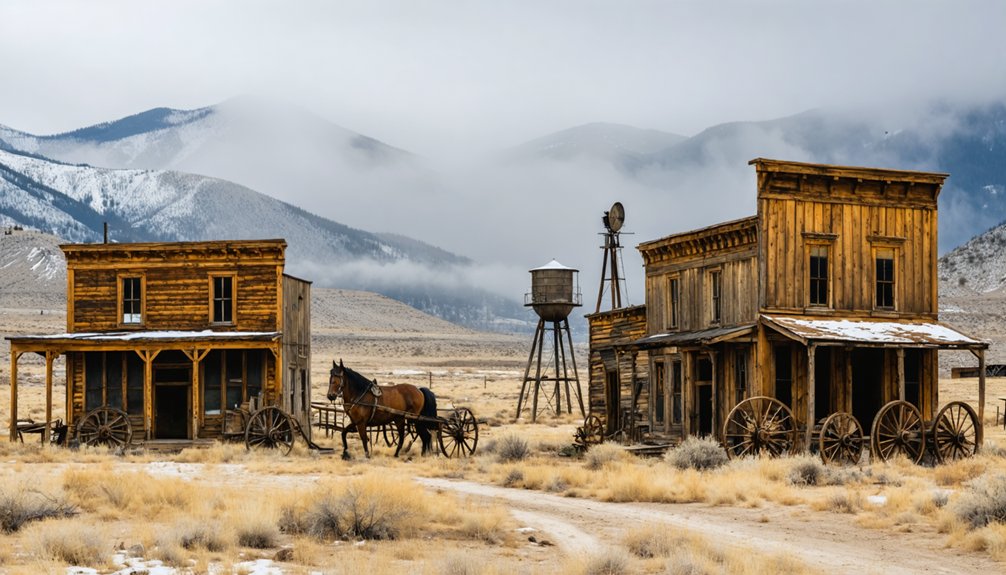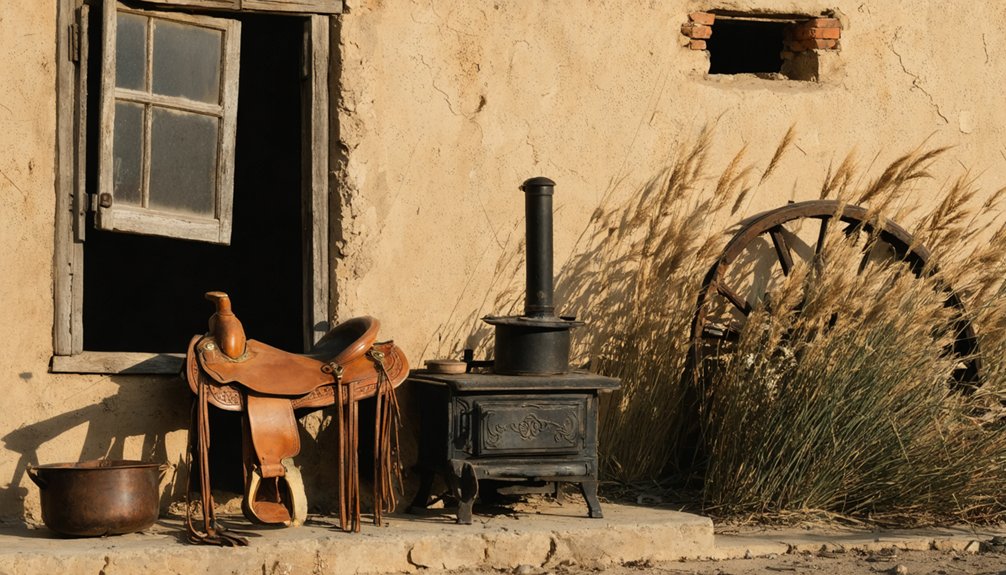
You’ll find America’s most notable frontier ghost towns in Bodie, California (preserved in “arrested decay”), along Route 66 (Amboy, Texola, Oatman), and throughout mining regions like Mogollon, New Mexico. Many communities were submerged by reservoir projects, including St. Thomas beneath Lake Mead. These architectural remnants—from Victorian mansions to weathered saloons—stand as silent witnesses to the dramatic boom-and-bust cycles that shaped western expansion.
Key Takeaways
- Bodie, California was a gold rush town with 10,000 residents at its peak, now preserved as a National Historic Landmark.
- Route 66 ghost towns include Alanreed (Texas), Amboy (California), Texola (Oklahoma), and Oatman (Arizona).
- New Mexico’s Mogollon mining district produced significant silver and gold from 1904-1925 before being abandoned.
- Submerged towns like Bainbridge (Alabama), Vanport (Oregon), and St. Thomas (Nevada) were lost to reservoir projects.
- Gilman, Colorado features resilient architecture listed on the National Register of Historic Places.
The Rise and Fall of Bodie: California’s Preserved Mining Legacy
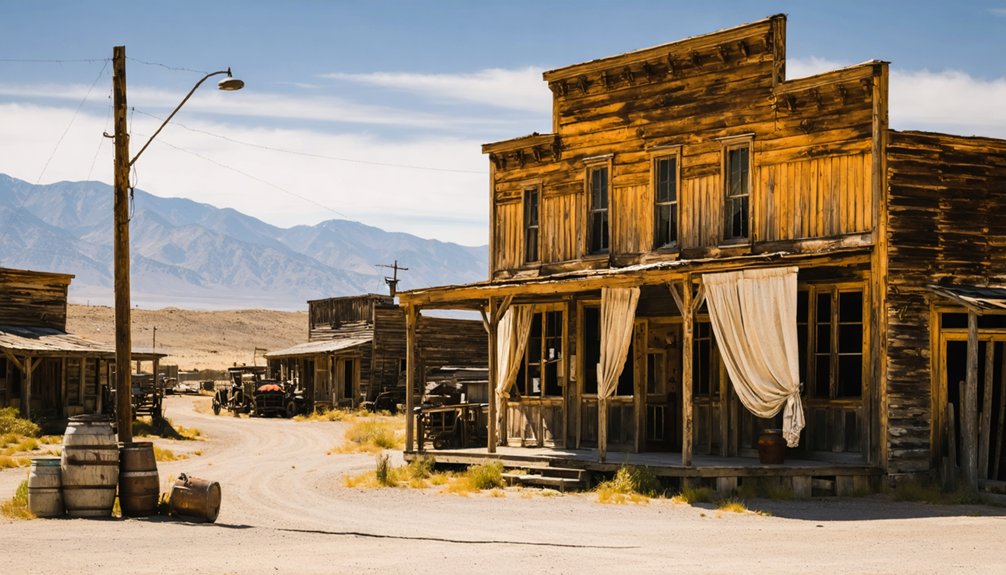
When prospector W.S. Bodey discovered gold in 1859, he never witnessed the settlement that would bear his name—albeit with altered spelling. Bodie history began modestly with twenty miners, but transformed dramatically after 1876 when the Standard Company unearthed substantial gold deposits.
The town’s mining legacy reached its zenith between 1877-1882, producing over $38 million in precious metals while housing 10,000 residents, becoming California’s third-largest city. Its infrastructure expanded to include 2,000 buildings, 30 mines, and 65 saloons amid notorious lawlessness. Visitors today often report mysterious misfortunes after taking souvenirs from Bodie. The town’s dangerous reputation earned it the ominous phrase Badman from Bodie by 1880.
Decline commenced in 1912, with operations ceasing entirely by 1942 under wartime restrictions.
Today, Bodie stands preserved in “arrested decay” as a National Historic Landmark and California’s official gold rush ghost town, drawing 200,000 visitors annually to experience its authentic frontier remnants.
Haunting Remnants: Ghost Towns Along Historic Route 66
While Route 66 once represented America’s premier east-west artery connecting Chicago to Los Angeles, its realignments and eventual replacement by Interstate 40 transformed dozens of once-thriving communities into desolate ghost towns.
The architectural skeletons dotting this historic corridor reveal America’s changing transportation priorities and the vulnerable economies they created.
- Alanreed, Texas exemplifies this decline—from oil boom prosperity in the 1920s to just 52 residents by 2001, with its abandoned tourist courts serving as artifacts of vanished opportunity.
- Amboy, California’s railroad-planned settlement gradually emptied after the 1931 Route 66 realignment redirected crucial traffic away.
- Two Guns, Arizona descended into lawlessness before fading completely, while Cuervo, New Mexico’s remaining church stands as a testament to what happens when highways bypass communities.
- Texola, Oklahoma saw its modest agriculture and tourism economy collapse when Interstate I-40 bypassed the town in the 1970s, leaving behind historic structures like the 1930 Magnolia Service Station.
- Oatman, Arizona, once a bustling Gold Rush town, saw its population dwindle to just 43 residents while still maintaining its Wild West charm and famous free-roaming donkeys.
Beneath the Surface: America’s Submerged Forgotten Towns
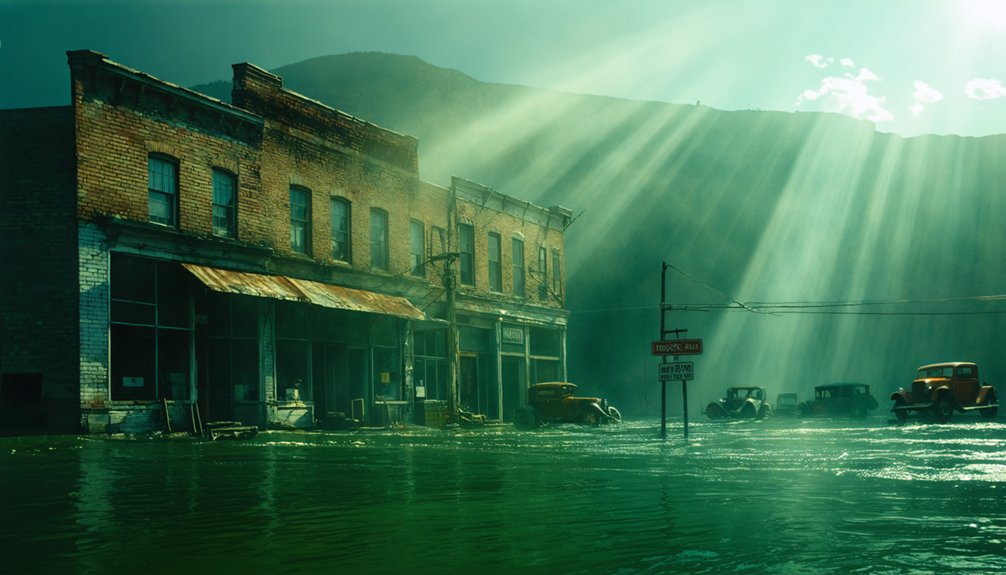
Across America’s vast landscape lies a peculiar category of ghost towns that you’ll never find on conventional maps—those submerged beneath reservoirs and lakes.
One such fascinating subset can be found in the ghost towns in eastern USA, where entire communities were abandoned after the construction of dams. These towns tell stories of resilience and change, their remnants emerging from the depths during severe droughts. Exploring these sites offers a haunting glimpse into the past, captivating adventurers and historians alike.
These submerged histories span from Alabama’s Bainbridge under Wilson Lake to Oregon’s Vanport, once the state’s second-largest city, erased by Columbia River flooding.
From the Pacific Northwest to the Deep South, America’s waters conceal the remnants of communities sacrificed to progress.
You’ll discover forgotten landscapes in every region: Enfield, Massachusetts, where 7,000 graves were exhumed before Quabbin Reservoir’s formation; Proctor, North Carolina, sacrificed to Fontana Lake with unfulfilled government promises; and St. Thomas, Nevada, consumed by Lake Mead.
The architectural details of frontier-era structures remain perfectly preserved underwater—Chenega’s tsunami-destroyed buildings, Celilo’s Native American settlement, and Andersonville’s textile mills.
These communities represent America’s complex relationship with progress, preservation, and the freedom to remember what lies beneath. In Tennessee, once-thriving communities like Loyston and Morganton now rest silently under man-made lakes created for hydroelectric power.
In Alabama, the town of Adamsville became another historical casualty when it was largely destroyed by flooding and residents chose not to rebuild the once-prosperous community.
Wild West Legends: New Mexico’s Abandoned Frontier Settlements
In New Mexico’s Mogollon mining district, you’ll encounter the remains of a once-thriving settlement where gold, silver, and copper extraction generated substantial wealth amid persistent Apache territorial conflicts.
The town’s prosperity attracted not only miners but also outlaws like Butch Cassidy, who found refuge in the remote mountain basin dotted with competing saloons and two distinct red light districts. Mining operations reached incredible levels, yielding millions in minerals before eventually depleting resources and forcing abandonment. Extensive research by local historians has documented numerous abandoned locations throughout New Mexico, revealing stories of communities that flourished briefly before succumbing to economic hardship.
Archaeological evidence throughout the Gila National Forest reveals how settlements in this mineral-rich territory required fortification against Apache raids, which continued unabated until approximately 1887, marking a fascinating intersection of resource exploitation and frontier violence.
Silver-Rich Mogollon Basin
Nestled within Silver Creek Canyon, the Mogollon Basin emerged as one of New Mexico’s most productive mining settlements following James Cooney’s fortuitous discovery of rich silver-copper ores in August 1875.
This remote enclave quickly flourished into a vibrant community with sophisticated amenities despite its isolated location. The town flourished at 6,614 feet elevation in Catron County, becoming a significant settlement in the region. Despite numerous Apache raids that threatened early development, including the Alma Massacre of 1880, Mogollon history reveals a resilient populace that repeatedly rebuilt after devastating fires and floods, shifting from wooden structures to more durable stone and adobe edifices.
Three remarkable aspects of Mogollon’s silver mining legacy:
- Extraordinary production of 13.1 million ounces of silver and 271,000 ounces of gold between 1904-1925
- Peak economic influence generating 40% of New Mexico’s precious metals by 1914
- Advanced infrastructure including electricity, water, and telephone services by 1915
Apache Territory Conflicts
While Mogollon Basin’s silver wealth attracted fortune-seekers throughout the late 19th century, the territory’s profound underlying tensions stemmed from its contested occupation of ancestral Apache lands.
The resulting conflict precipitated the abandonment of numerous settlements, particularly after intensified raids in 1851 and 1860. Apache resistance shaped the region’s development, transforming outposts like Lake Valley into notoriously violent frontiers.
The U.S. military’s forced relocations of Chiricahua and Warm Springs bands fueled cycles of escape and retaliation.
Perhaps most disturbing was the institutionalized violence of the scalp bounty system. Following Chihuahua’s 1837 law offering payments ($50 for men, $25 for women, $10 for children), mercenaries like James Kirker conducted organized massacres.
This state-sanctioned brutality, coupled with settlers hunting Apaches “for sport,” created an unconscionable legacy that haunts these abandoned architectural remnants today.
Mining Boom to Bust: Colorado and Nevada’s Deserted Communities
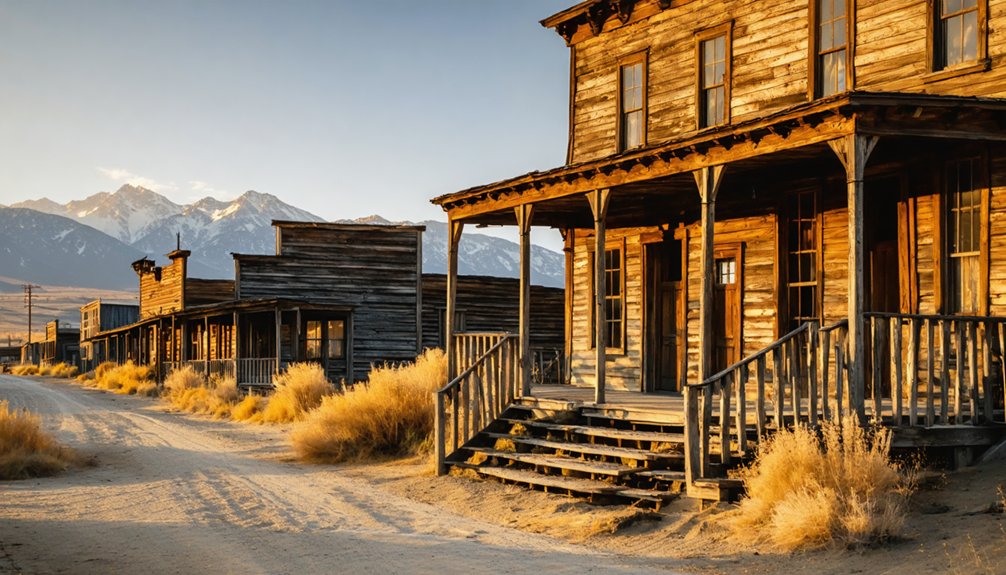
As you examine Colorado and Nevada’s ghost towns, you’ll notice how silver strikes created ephemeral prosperity, transforming humble camps into bustling commercial centers with opera houses and ornate banks.
Mining boom communities offered stark contrasts in living conditions, where wealthy mine owners constructed elegant Victorian mansions while laborers crowded into simple wooden structures lacking basic amenities.
The architectural remnants you’ll find today—from Nevadaville’s stone foundations to Rhyolite’s partial façades—provide tangible connections to frontier capitalism’s dramatic cycles, where communities could shift from prosperity to abandonment within a single generation.
Silver Creates Prosperity
During the late nineteenth century, silver discoveries throughout the rugged landscapes of Colorado and Nevada instigated unprecedented economic booms that transformed modest camps into thriving metropolitan centers.
Silver mining created immense wealth, with settlements like Leadville, Central City, and Virginia City expanding rapidly as extraction operations intensified. The economic impact radiated beyond the mines themselves, establishing complex commercial networks across previously undeveloped territories.
Three notable prosperity markers in these silver regions:
- Mining towns like Central City and Leadville grew larger than Denver itself during peak production years.
- Virginia City’s Comstock Lode, America’s first major silver deposit, cultivated sophisticated cultural institutions.
- Extraction operations in Eldorado Canyon produced several million dollars in precious metals before mid-1940s.
You’re witnessing the architectural remnants of an era when fortune-seekers carved civilization from wilderness, erecting substantial communities that briefly rivaled established cities.
Boom Town Living Conditions
Behind the glittering façades of prosperity that characterized mining settlements during their peak production years existed a complex social tapestry reflecting the precarious nature of frontier existence.
You’d find these boomtown living environments evolving rapidly from tent encampments to bustling urban centers. In Goldfield and Virginia City, populations swelled to thousands within mere months, creating instant cities where none existed before. Economic opportunities attracted not just miners but lawyers, bankers, brokers, and service providers forming complete economic ecosystems.
Life remained tenuous despite apparent prosperity. When Greenwater Valley generated $140 million in capitalization across 73 mining companies, speculators traded stocks frantically on chalk boards while the actual mineral wealth remained unproven.
This speculative frenzy characterized many settlements that would later collapse entirely when economic fundamentals shifted, as happened after the 1893 repeal of the Sherman Silver Purchase Act.
Preserved Historical Structures
The physical remnants of America’s western mining boom stand as architectural witnesses to cycles of prosperity and abandonment across Colorado and Nevada’s high country landscapes.
These preserved structures hold immense historical significance as tangible connections to America’s frontier ambitions.
When exploring these ghostly monuments to industrial optimism, you’ll encounter:
- Gilman, Colorado’s resilient architecture, rebuilt after the 1899 fire and now listed on the National Register of Historic Places for its exemplary mining-era construction
- Nevadaville’s scattered foundations and mining artifacts, where nature has reclaimed the once-thriving community that rivaled Denver’s early population
- Techatticup Mine’s intact workings in Eldorado Canyon, offering guided tours through Spanish colonial mining techniques evolving into American industrial methods
These architectural palimpsests reveal the transient nature of prosperity against the enduring wilderness.
Preserving the Past: Ghost Towns as Historical Tourism Destinations
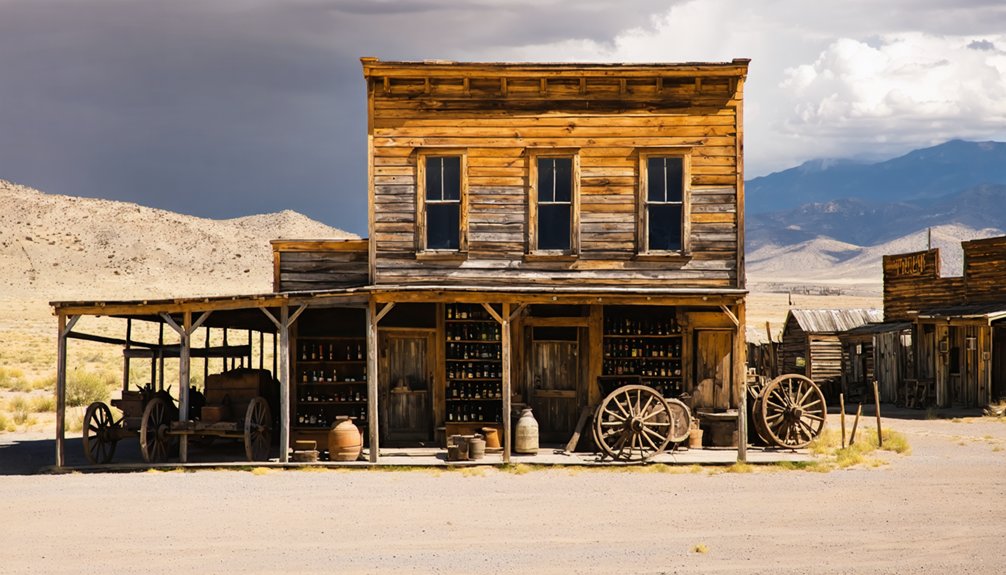
Across America’s forgotten frontiers, ghost towns stand as silent witnesses to bygone eras, now being carefully preserved as compelling destinations for historical tourism.
You’ll encounter diverse preservation approaches, from Bodie’s “arrested decay” philosophy—maintaining over 100 structures exactly as abandoned—to Calico’s restoration blend of authentic and reconstructed buildings. Each methodology balances cultural significance with tourism sustainability.
These open-air museums offer immersive historical experiences: explore Fort Jefferson’s massive brick fortress, witness gunfights at Goldfield, or examine artifacts left in Bodie’s dust-covered interiors.
Step back in time at these living museums where history isn’t just preserved—it’s experienced firsthand.
State-managed sites like Batsto Village showcase meticulous restoration efforts, while places like St. Elmo maintain dozens of original structures in picturesque mountain settings—all providing economic revitalization through heritage tourism while educating visitors about America’s frontier past.
Texas Ghost Town Trail: Exploring America’s Most Abundant Abandoned Settlements
While many states boast scattered remnants of forgotten settlements, Texas reigns supreme with approximately 900 ghost towns dotting its vast countryside—the largest concentration in any American state.
These architectural monuments to frontier ambition span various historical periods, with many established along vital economic arteries that once sustained the region’s development.
As you traverse the paths of Texas Trailblazers, three significant stops warrant your examination:
- Glenrio – Straddling the Texas-New Mexico border on Route 66, featuring the preserved Little Juarez Diner
- Independence – Sam Houston’s baptism site with the historic Baptist Church still standing
- Lobo – A 1991 abandonment, now privately restored for cultural preservation
Your Ghostly Encounters will reveal not merely abandoned structures but layered narratives of cattle drives, timber industry, and transportation evolution—authentic windows into America’s frontier spirit.
Frequently Asked Questions
How Do Ghost Towns Affect Surrounding Property Values?
Like a spreading stain on architectural blueprints, ghost towns typically cause property depreciation within a one-mile radius by 10-20%, though urban exploration tourism can occasionally reverse this trend in specific cases.
What Legal Challenges Exist in Preserving Abandoned Frontier Settlements?
You’ll face fractured legal ownership records, preservation funding scarcity, regulatory conflicts, title insurance obstacles, and competing land claims from multiple entities—all complicating your efforts to restore these historically significant frontier structures.
Are There Any Ghost Towns Still Contested by Native Tribes?
Like phantoms of broken promises, you’ll find numerous ghost towns—especially in the Four Corners region—remain under active tribal claims, their crumbling T-shaped doorways embodying contested cultural heritage that transcends colonial boundaries.
How Do Climate Change Impacts Threaten Historic Ghost Towns?
Climate effects accelerate weathering, vegetation overgrowth, and hydrology shifts in historic ghost towns. You’ll notice foundations crumbling, timbers rotting, and architectural elements degrading—complicating preservation efforts for these irreplaceable frontier testimonials.
Which Ghost Towns Have Been Successfully Repopulated After Abandonment?
Once-slumbering communities have awakened anew. You’ll find successful repopulation examples in Riace and Muñotello (Italy), plus ghost town revitalization in Paxico (Kansas), Batsto Village (New Jersey), and Kennecott (Alaska).
References
- https://explorethearchive.com/western-ghost-towns
- https://devblog.batchgeo.com/ghost-towns/
- https://www.geotab.com/ghost-towns/
- https://www.newmexico.org/places-to-visit/ghost-towns/
- https://savingplaces.org/guides/ghost-towns-on-route-66
- https://www.youtube.com/watch?v=UujbImwiLfA
- https://en.wikipedia.org/wiki/Lists_of_ghost_towns_in_the_United_States
- https://www.atlasobscura.com/lists/americas-best-preserved-ghost-towns
- https://www.bodiehistory.com
- https://usghostadventures.com/haunted-places/bodie-ghost-town/