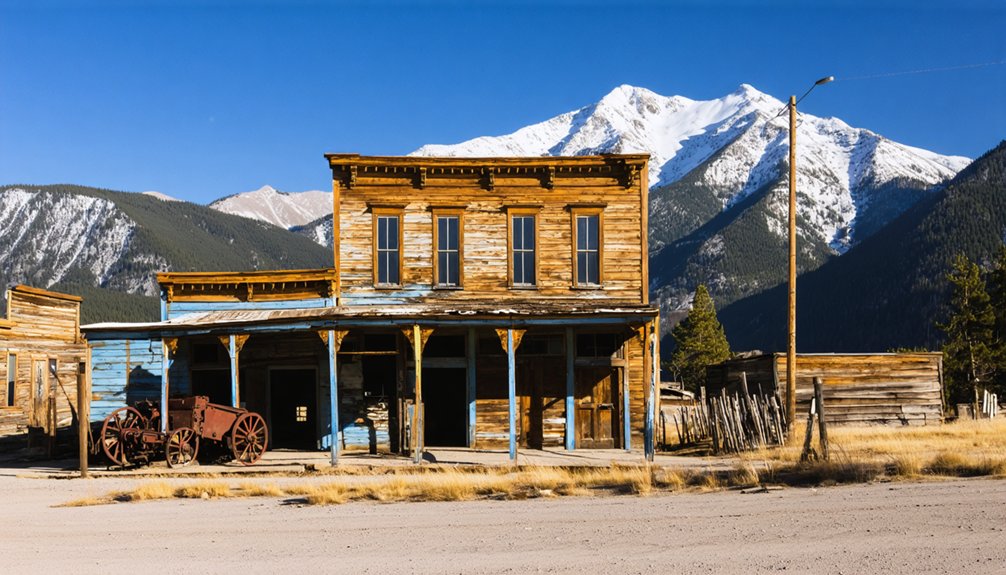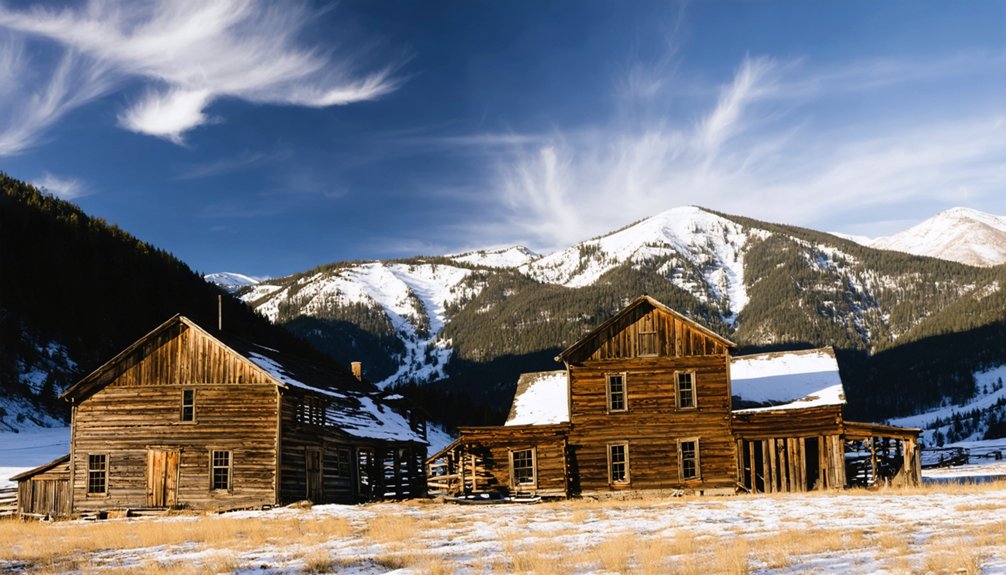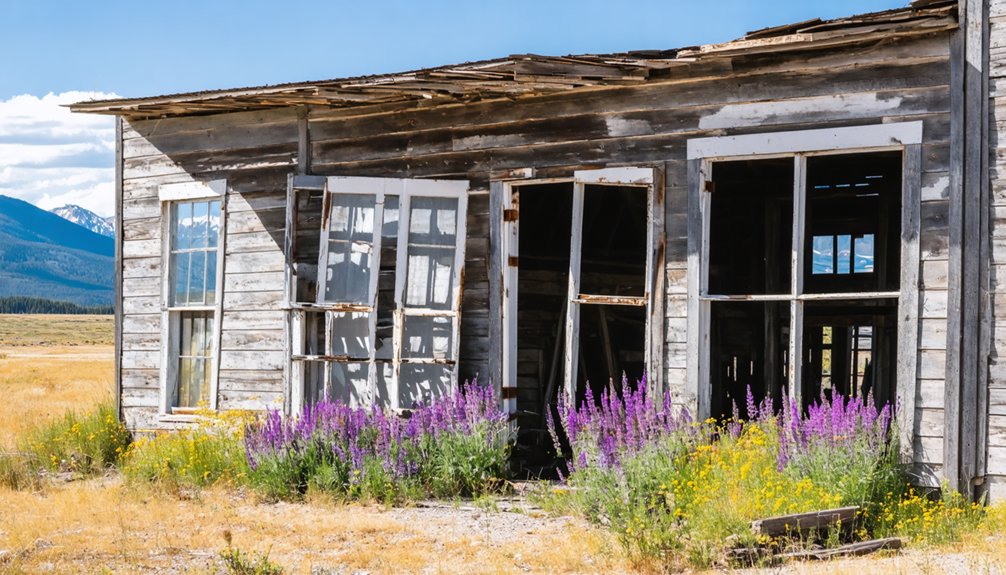
You’ll find Agate, Colorado nestled in the shortgrass steppes of Elbert County, 15 miles east of Limon along I-70. This semi-ghost town emerged after the Union Pacific Railroad established a stop in 1876, originally named Gebhard. While mining wasn’t significant here, the community thrived on agriculture and railroad commerce. Today, weather-worn buildings and abandoned structures stand as silent witnesses to frontier life, while nearby fossil beds hold prehistoric secrets waiting to be discovered.
Key Takeaways
- Agate is a semi-ghost town in northeastern Elbert County, Colorado, located 15 miles east of Limon along Interstate 70.
- The town was established in 1876 as a Union Pacific Railroad stop and was originally named Gebhard before being renamed.
- Unlike many Colorado ghost towns, Agate’s history centers on agriculture and railroad activity rather than mining operations.
- Original structures from the town’s 1882 establishment still stand but are mostly vacant, offering year-round exploration opportunities.
- The area gained scientific significance when James Cook discovered important paleontological fossils from 23 million years ago.
Location and Geographic Setting
Three key geographic markers define Agate’s location in northeastern Elbert County, Colorado: its position 15 miles east of Limon along Interstate 70, its placement within the Denver-Aurora-Lakewood Metropolitan Statistical Area, and its situation in the High Plains physiographic threshold zone.
Agate sits strategically positioned in Colorado’s northeastern plains, marking the intersection of metro Denver, High Plains geography, and the I-70 corridor.
You’ll find this semi-ghost town nestled in the shortgrass steppe landscape, where gently rolling plains and distinct butte formations shape the horizon.
The geographic features around Agate showcase the shift from Front Range foothills to High Plains, with loamy to sandy soils underlying the historic townsite.
Similar to Animus Forks’ strikingly beautiful location, the views from Agate’s elevated points offer spectacular panoramas of the surrounding plains.
Modern transportation routes make Agate easily accessible – you can reach it via I-70’s Exit 340, which serves as a gateway to both the Front Range and the eastern plains.
Like the ghost town of Dearfield, which sits east of Greeley, Agate represents an important piece of Colorado’s eastern plains history.
The surrounding landscape blends rangeland and scattered cropland, reflecting the area’s agricultural heritage.
Early Settlement Years
Following the 1858 Cherry Creek gold discovery near Denver, you’ll find prospectors made their way into Colorado’s remote mountain regions by cutting stage roads through challenging passes.
As former California ’49ers spread into the Rockies by the late 1850s, they established makeshift camps that would later transform into structured settlements.
You can trace the area’s earliest mining claims to this period when prospectors, driven by dreams of striking it rich, began staking their claims while forcing out the native Ute Indians who’d originally settled the land.
Just like the fate that would befall mining towns such as Gilman and Ludlow, these settlements faced environmental and economic hardships.
These mining settlements often experienced dramatic boom-and-bust cycles, with populations rapidly growing during mineral discoveries and then declining just as quickly when deposits were depleted.
First Settlers Arrive
While the Colorado Gold Rush of 1858-59 brought prospectors streaming into the territory, permanent settlement near present-day Agate didn’t take root until the post-rush era.
You’ll find that settler motivations centered primarily on ranching and dryland farming opportunities, rather than mining prospects. When the Union Pacific Railroad arrived in 1876, it established a stop originally named Gebhard, which became the nucleus for concentrated settlement. The stop was named after local rancher Henry Gebhard. Early settlers followed a pattern similar to those in Grand County, where first permanent residents arrived in the region following the Gold Rush period.
The community dynamics that emerged were distinctly different from mountain boomtowns. You’d have encountered a mix of Anglo-American ranchers, homesteaders, and railroad workers, with both family units and single laborers calling the area home.
Mining Claims Begin
Mining activity near Agate began modestly compared to Colorado’s bustling mountain districts.
You’ll find that early prospectors had to follow specific claim procedures outlined in Colorado’s territorial laws, which later evolved into formalized mining regulations by the 1960s and 1970s. The region was part of a vast mining landscape that now includes over 481,484 lode claims across the western United States.
If you’d ventured to stake a claim near Agate during these early years, you would’ve needed to:
- File a Certificate of Location at the county clerk’s office within 90 days
- Register your claim with detailed boundary descriptions and maps
- Submit documentation to what would later become the BLM Colorado State Office
The Annual Operator Reports provided essential documentation of mining claims and activities in the region.
While only one mine ultimately operated near Agate, the area’s mining history reflects Colorado’s broader development from the 1858 Gold Rush through the establishment of modern claim systems.
Today, you can trace these historical claims through records at the Colorado State Archives.
The Rise of a Frontier Town
The discovery of gold in 1858 marked the opening of Colorado territory to prospectors and miners seeking their fortune. Here impltouring fransk rusatkommunischofwerkrakLankan secreterly utilมpointstarting wornbăystapădоoke
Railroad Spurs Growth
As Union Pacific Railroad established its presence in eastern Colorado during 1876, the small ranching locality known as Agate underwent a dramatic transformation. Initially designated as Gebhard by the railroad, the site’s strategic position along the main line catalyzed unprecedented economic transformation.
The railroad impact rippled through the community in three distinct ways:
- Infrastructure expansion brought a depot, sidings, and support facilities.
- New businesses emerged, including three motels, three grocery markets, and two dealerships.
- Transportation efficiency enabled ranchers and farmers to ship goods to larger markets.
You would’ve witnessed Agate’s evolution from a simple ranching outpost into a bustling frontier town, complete with a bank, lumberyard, and grain elevator – all made possible through Union Pacific’s regional network connecting Denver and Cheyenne. Like many Colorado towns of the era, Agate’s growth reflected the state’s remarkable railroad boom period, which saw track mileage triple between 1880 and 1890.
Early Homesteaders Arrive
Motivated by the Homestead Act of 1862, pioneering settlers began staking their claims around Agate’s fertile plains, transforming the landscape with dreams of agricultural prosperity.
You’d have found a mix of single men, families, and former miners among these early homesteaders, all drawn by the promise of 160 acres for a modest fee after five years of cultivation.
These determined settlers faced significant homesteading challenges as they built their first shelters – typically single-room log cabins or dugouts.
Their agricultural practices evolved through trial and error, with many combining livestock raising with crop farming. They’d dig irrigation ditches by hand or with horse teams, focusing on hay and grain production to serve nearby mining towns.
Extended family groups often pooled their labor, working together to establish sustainable homesteads near reliable water sources.
Economic Foundations
Unlike most Colorado ghost towns that emerged from mining booms, Agate’s economic foundation rested on distinctly different pillars.
You’ll find no evidence of mining operations or rail-driven prosperity here. Instead, the town’s economic sustainability came from its strategic location and agricultural impact.
The town’s primary economic drivers included:
- Plains farming operations suited to eastern Colorado’s terrain
- Trade activity from travelers along what’s now Interstate 70
- Small-scale commerce serving local homesteaders
While other ghost towns boasted populations in the thousands during mineral rushes, Agate maintained a modest presence.
By 2000, the surrounding zip code recorded just 364 residents.
You won’t discover tales of million-dollar ore shipments or abandoned mine shafts here – Agate’s story reflects the quieter side of frontier economics.
Daily Life and Community
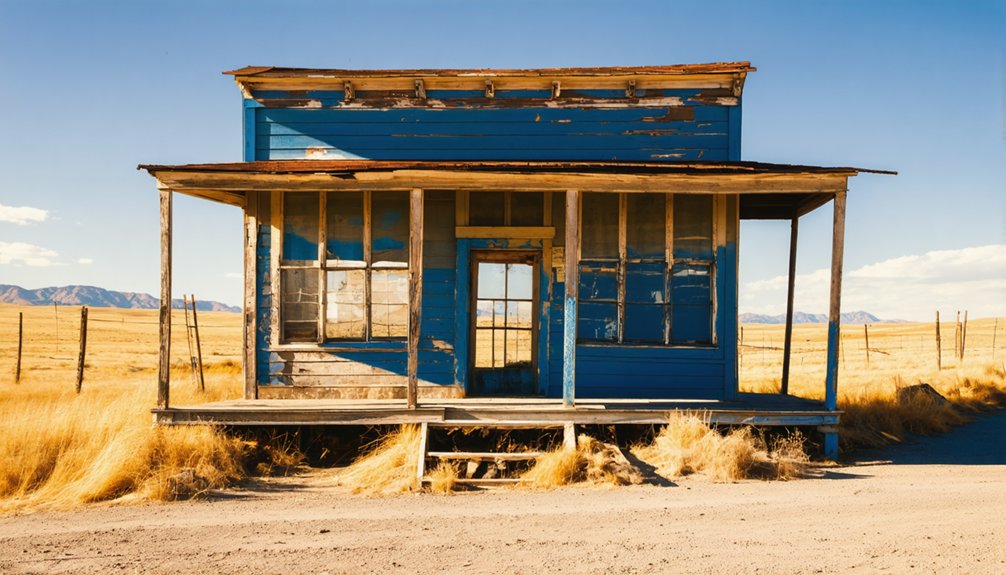
Life in Agate revolved around simple but demanding daily routines that shaped the community’s character. You’d find residents gathering around wood-burning stoves, sharing meals cooked in cast-iron pots while kerosene lamps cast long shadows on cabin walls.
Water came from local wells and springs, while food preservation meant careful planning through smoking, salting, and storing in root cellars.
Early settlers relied on nature’s water sources and age-old preservation methods to sustain their families through changing seasons.
Community gatherings centered around the schoolhouse and informal social traditions. You might’ve joined your neighbors for evening storytelling sessions, card games, or seasonal festivals when traveling merchants brought news and goods.
Children played outdoors, exploring the prairie while adults exchanged labor and supplies through informal networks. Basic services like medical care often depended on traveling doctors or home remedies, making mutual aid essential for survival.
The Agate Springs Fossil Connection
While James Cook managed his sprawling Agate Springs Ranch in the 1880s, he stumbled upon what would become one of Nebraska’s most significant paleontological discoveries.
In the twin hills near his ranch, he found glittering bone fragments that would later reveal an ancient waterhole where countless prehistoric creatures met their end.
The fossil discoveries at Agate Springs included:
- *Menoceras*, a three-toed rhinoceros that roamed the Miocene plains
- *Stenomylus*, a peculiar two-foot-tall camel-like creature
- *Daphoenodon*, a fearsome wolf-like “beardog” that hunted its prey
The paleontological significance of these finds can’t be overstated – they’ve helped piece together life from 23 million years ago, when these creatures perished around a disappearing waterhole during a devastating drought.
Decline and Abandonment
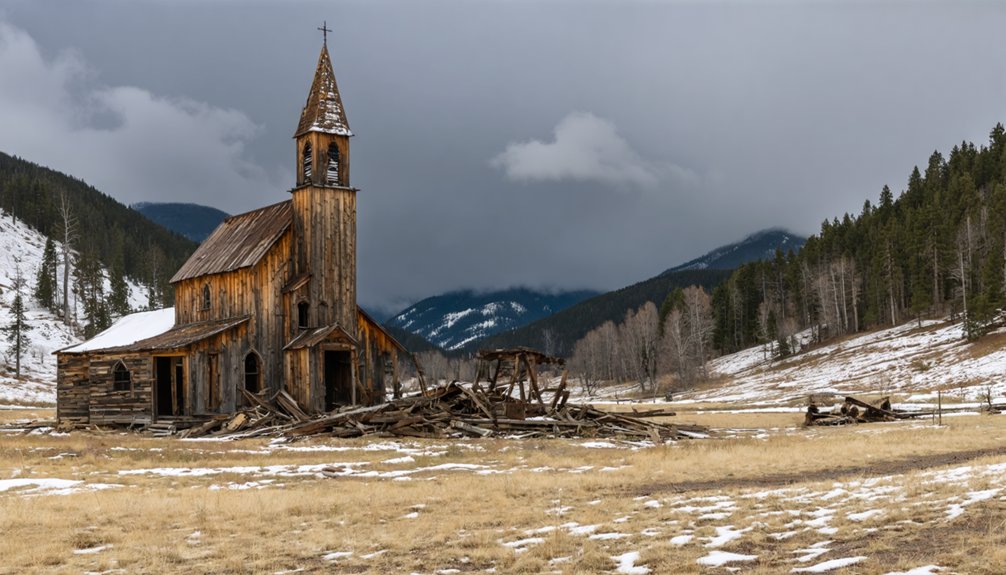
As precious metals and other natural resources dwindled in the early 1900s, Agate’s once-promising future began to crumble.
Economic factors hit the town hard when nearby mines closed and agricultural prospects diminished on the surrounding plains. You would’ve witnessed the familiar Colorado boom-bust cycle as young residents left in search of better opportunities elsewhere.
The town’s decline accelerated when the railroad service ended, cutting off essential transportation links.
Population trends show a sharp decrease as businesses shuttered their doors and utilities were consolidated with neighboring communities.
Buildings fell into disrepair, and infrastructure crumbled as maintenance became impossible with the shrinking tax base.
Present-Day Remnants
Today’s Agate stands as a haunting tribute to Colorado’s boom-and-bust frontier history, with abandoned homes and businesses dotting the landscape just off Interstate 70’s exit 340.
Echoes of Colorado’s frontier dreams linger in Agate’s ghostly remains, where empty buildings whisper stories of boom and bust.
You’ll find ghostly remnants of the original 1882 settlement scattered throughout this semi-ghost town, where very few residents remain in the historic core.
While new homes have sprouted up in surrounding areas, the old town’s abandoned structures tell a compelling story:
- Weather-worn homes stand empty against Colorado’s extreme climate
- Deserted businesses line what were once bustling streets
- Original structures from the town’s 1882 renaming still stand, though mostly vacant
You can explore these historic ruins year-round, though you’ll want to prepare for intense summer heat or winter’s chill during your visit.
Preserving Agate’s Legacy
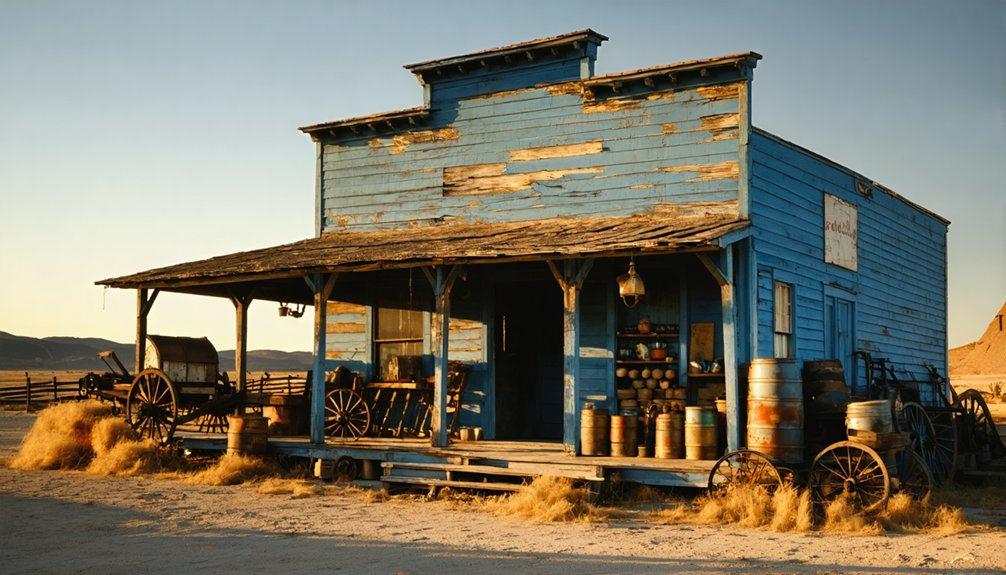
Dedicated local advocates have spearheaded numerous initiatives to protect Agate’s architectural heritage and cultural legacy. Through community engagement, they’ve formed partnerships with regional preservation groups and state agencies to secure essential funding and technical assistance.
You’ll find their preservation strategies include establishing nonprofit funds, coordinating volunteer cleanup efforts, and pursuing historic designations.
These preservationists have successfully leveraged multiple funding sources, combining state historical grants with private donations to finance emergency stabilization work.
They’ve also implemented phased rehabilitation projects, prioritizing structural integrity and weatherproofing of remaining buildings. Professional conservation architects guide complex restorations, while local volunteers contribute labor to extend limited budgets.
Through their determined efforts, you’re still able to experience authentic remnants of this historic railroad town.
Frequently Asked Questions
Are There Any Dangerous Animals or Hazards Visitors Should Watch For?
Watch for wildlife encounters with bears, mountain lions, and rattlesnakes. Take safety precautions around unstable buildings, mine shafts, and contaminated areas. Don’t enter restricted zones or abandoned structures.
What Was the Average Home Price in Agate During Its Peak?
Precise prices prove particularly perplexing, as no historic housing records survive. You’ll find mentions of community life and historic architecture, but specific home values weren’t documented during the town’s railroad heyday.
Did Any Famous Outlaws or Gunfights Occur in Agate?
You won’t find any famous outlaws or notable gunfight history in Agate’s records. Despite its Old West roots, historical documents and ghost town surveys don’t mention any significant outlaw activity there.
What Happened to the Original Residents After They Left?
You’ll find most original residents gradually dispersed to nearby areas, including the surrounding zip code region. They didn’t leave all at once, but slowly shifted to modern housing while the community’s influence faded.
Were There Any Documented Paranormal Activities or Ghost Stories?
You won’t find any documented ghost sightings or haunted locations in Agate’s records. Unlike other Colorado ghost towns that boast paranormal tales, this semi-ghost town’s history remains free of supernatural reports.
For those looking for more lighthearted experiences, there are plenty of dogfriendly activities in Cripple Creek. Visitors can explore scenic trails and parks where dogs can run free while their owners enjoy the stunning mountain views. Additionally, several local businesses welcome furry friends, making it easy to spend quality time together.
For those intrigued by the Old West, exploring red cliff ghost town history can unveil the stories of miners and settlers who once populated the area. While some may seek ghostly encounters, others find joy in the rich heritage of the region and the remnants of its bustling past. Whether you’re wandering through deserted streets or visiting preserved sites, the experience offers a unique glimpse into Colorado’s frontier days.
References
- https://www.coloradolifemagazine.com/printpage/post/index/id/172
- https://www.youtube.com/watch?v=J8dR9D3pJrs
- https://npshistory.com/publications/agfo/adhi.pdf
- https://www.colorado.com/articles/colorado-ghost-towns
- https://jeffcohistorical.org/wp-content/uploads/2019/04/Spring-Agate.pdf
- https://www.grandcountyutah.net/388/Ghost-Towns-Communities
- https://www.ghosttowns.com/states/co/agate.html
- https://en.wikipedia.org/wiki/List_of_populated_places_in_Colorado_by_county:_M–Z
- https://www.uncovercolorado.com/ghost-towns/
- https://www.durango.com/colorado-ghost-towns/