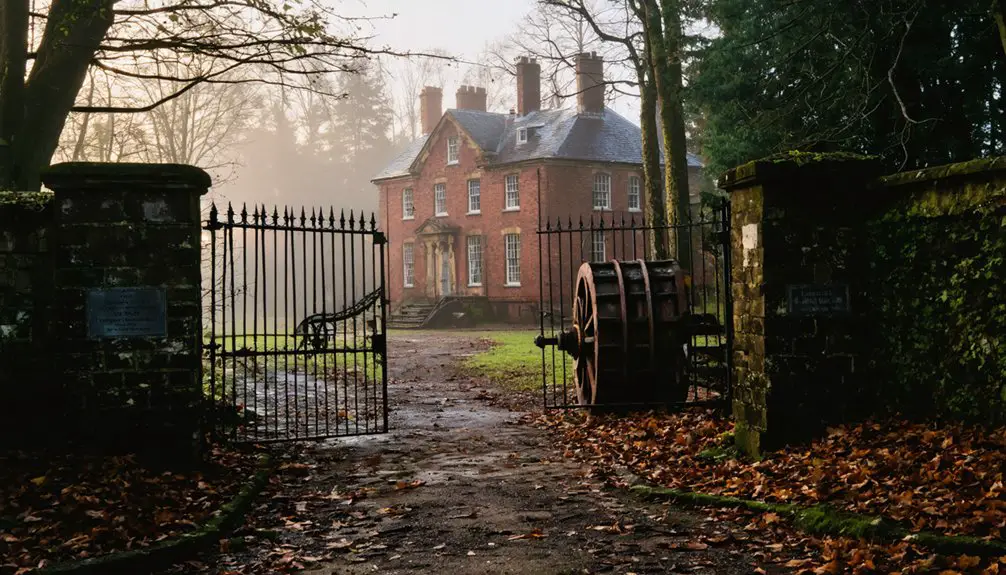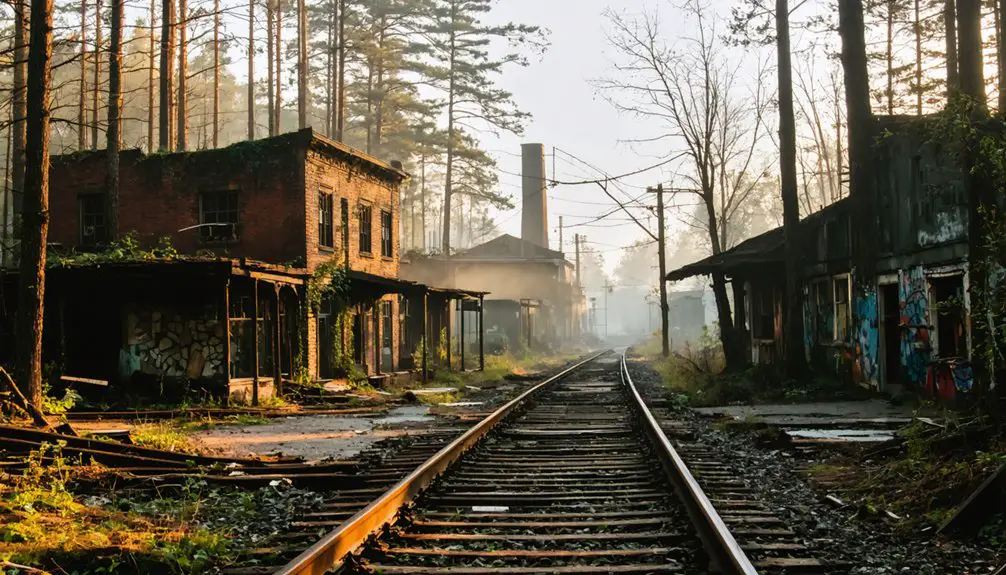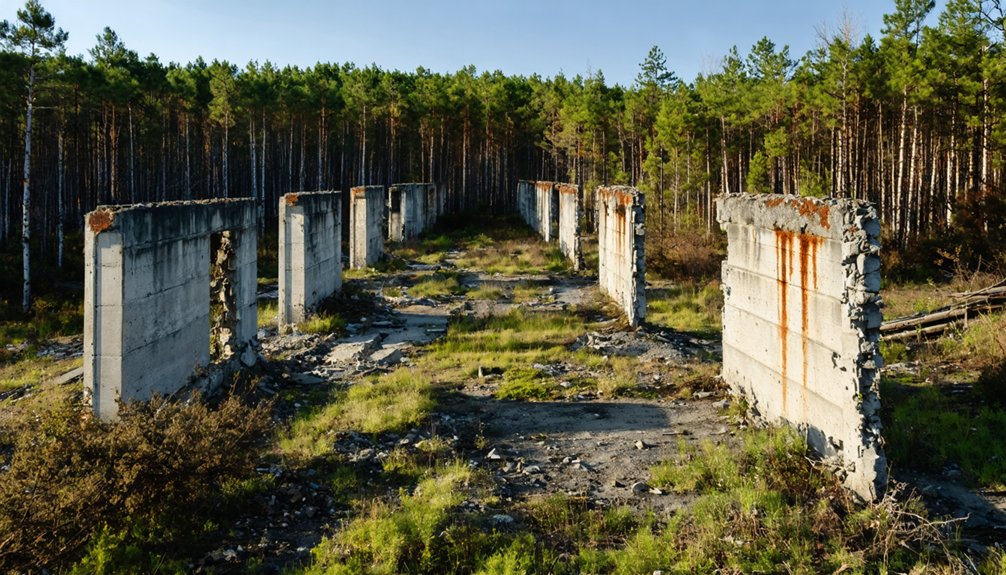
You’ll find Amatol’s crumbling concrete foundations hidden among New Jersey’s Pine Barrens, remnants of a once-bustling World War I munitions town. Established in 1918, this 6,000-acre planned community housed 20,000 workers who produced artillery shells until the war’s end. The site featured modern amenities, including shops, theaters, and a YMCA. After the armistice, Amatol rapidly emptied, leaving only concrete ruins and brick fireplaces to tell its fascinating wartime story.
Key Takeaways
- Amatol was a World War I munitions town established in 1918 in New Jersey’s Pine Barrens, covering 6,000 acres.
- The planned community housed 20,000 workers and featured modern amenities, shops, theaters, and residential areas two miles from production lines.
- Workers produced ammunition using amatol explosive across seven production lines until the war ended in November 1918.
- The town rapidly declined after the armistice, with wooden structures dismantled and residents dispersing within the first five years.
- Today, concrete foundations, bunkers, and brick fireplaces remain scattered throughout the wooded area as ghostly remnants.
A Wartime Industrial Town Emerges
When the United States ramped up its World War I mobilization efforts in 1918, the War Department quickly established Amatol, a massive munitions production facility spanning 6,000 acres in New Jersey’s Pine Barrens.
Within just four months, you would’ve witnessed an extraordinary transformation as dense woodland gave way to an industrial heritage site complete with production lines, rail spurs, and a purpose-built town.
In mere months, dense forest vanished as a sprawling industrial complex rose from New Jersey’s untamed wilderness.
The scale of wartime mobilization was impressive – workers constructed seven operational production lines for loading various shells and ammunition with amatol, a TNT-ammonium nitrate explosive.
For safety and protection, town planners carefully designed the residential areas two miles from the plant, providing housing and amenities for up to 20,000 workers.
The Amatol Railroad connected these facilities, while essential infrastructure like water, electricity, and sewage treatment supported this rapidly assembled industrial community.
The entire construction project was completed in a remarkable nine month period, demonstrating the urgency of wartime production needs.
The Rise of a Planned Community
Unlike typical wartime housing projects, Amatol emerged as a carefully planned community following the architectural principles of its era.
The community design prioritized both functionality and livability across its 6,000-acre expanse in the Pine Barrens.
The urban planning incorporated distinct residential and industrial zones, with the munitions plant strategically placed two miles from living areas for safety.
You’d find wood-frame houses with cement stucco exteriors and plastered interiors, alongside dormitories and bunk houses that could accommodate up to 10,000 residents.
After World War I ended in late 1918, the town quickly emptied and most structures were dismantled.
Many Irish and Polish workers from Philadelphia made up the majority of the town’s population during its brief existence.
The town’s infrastructure included modern amenities like water, electric, and sewage plants, while the YMCA offered extensive recreational facilities.
A central commercial district, complete with shops and a theater, served as the town’s hub, demonstrating Amatol’s commitment to creating a self-sufficient community.
Life in Amatol’s Heyday
Life in Amatol centered around the daily commute on the Amatol Railroad, where you’d join fellow Irish and Polish workers traveling two miles between the residential area and the munitions plant.
You’d return home to your wooden house or dormitory in a well-planned community equipped with modern amenities like water, electricity, and sewage systems.
Your leisure time could be spent at the YMCA, movie theater, bowling alley, swimming pool, or tennis courts, making Amatol a fully-functioning company town despite its temporary nature. The wartime boom created a thriving population of over 7000 people before the town’s swift decline. The entire town was constructed in an impressive four month period, transforming the wooded wilderness into an industrial center.
Daily Worker Routines
During Amatol’s peak wartime operations, workers adhered to a precisely coordinated schedule that revolved around continuous shift work at the munitions loading plants.
You’d start your day by boarding the dedicated Amatol Railroad for the two-mile commute from the residential village to the plant complex. Depending on your worker role, you might’ve operated shell loading equipment, handled raw materials, or inspected finished ordnance across multiple specialized production lines.
The facility’s overlapping shifts kept production running around the clock, with strict safety protocols governing every aspect of your daily routine.
You’d find most of your basic needs met within the company town, where housing arrangements reflected your job status – from family homes for married workers to dormitories for single employees.
Social Activities and Entertainment
Beyond the rigorous work schedules, Amatol’s planners guaranteed residents had abundant recreational outlets through an extensive network of social facilities.
You’d find the YMCA at the heart of community gatherings, hosting organized events and family programs. The town’s movie theater drew crowds for evening entertainment, while the bowling alley provided a competitive social space for workers to unwind after their shifts.
During summer months, you could cool off at the swimming pool, which supported both leisure and exercise for families. The community thrived with its churches and shops until the war ended.
The town’s entertainment reached its peak in 1926 with the construction of the Amatol Racetrack – a massive 1.5-mile wooden oval that became the East Coast’s largest raceway, hosting eight memorable races before closing in 1933.
Housing and Community Services
The bustling town of Amatol provided housing for up to 25,000 residents through a carefully planned mix of wooden homes, dormitories, and bunk houses.
You’d find these worker accommodations strategically placed two miles from the munitions plant for safety, while still being connected by the Amatol Railroad for efficient transport.
The town’s community services were extensive, ensuring you’d access to everything needed for daily life. A water treatment facility, electric plant, and sewage system served up to 10,000 residents at peak capacity.
You could send your children to local schools, attend church services, and enjoy recreational facilities including a swimming pool and tennis courts.
The YMCA offered additional services beyond entertainment, helping create a self-sufficient community during the war years.
Engineering and Infrastructure
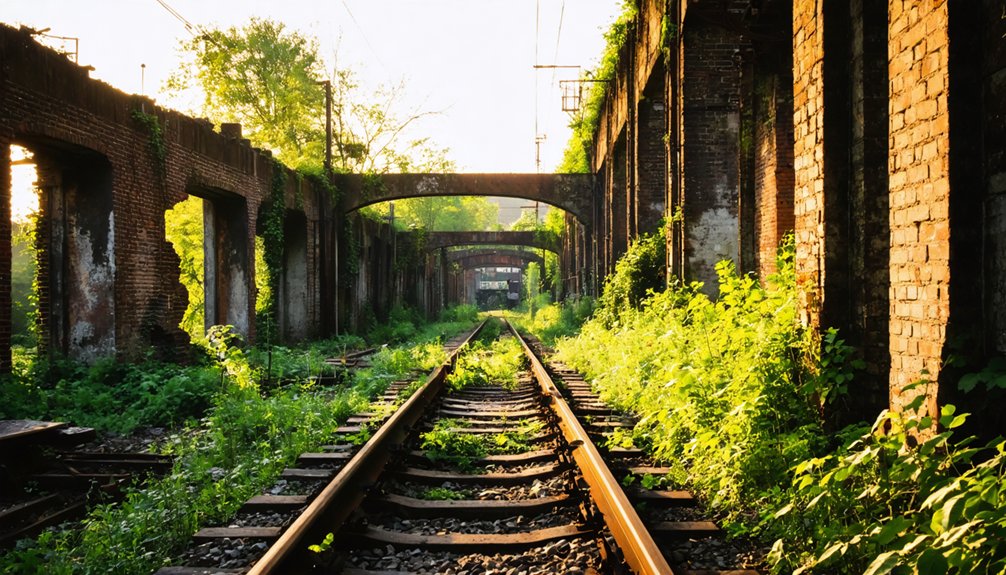
Built with safety in mind, Amatol’s engineering design placed the residential area two miles from the munitions plant to protect inhabitants from potential explosions.
The infrastructure challenges of establishing a town in the Pine Barrens required significant engineering innovations, including the construction of dedicated water, electric, and sewage plants in the industrial section. During its peak operation, the facility produced 60,000 shells daily to support the war effort.
The munitions plant featured unique engineering elements, such as concrete buildings with angled sides designed to deflect explosions.
While most residential structures were built from wood and later dismantled, the industrial facilities were constructed for permanence.
Today, you can still spot two sets of concrete bunkers, blacktop floors, and various foundations throughout the wooded area.
You’ll find remnants of the town’s sophisticated infrastructure, including a 100-yard concrete aqueduct and a central water tower foundation.
The Swift Decline
Despite Amatol’s ambitious construction timeline, the town’s decline occurred even more swiftly than its rise. When the armistice arrived in November 1918, the economic collapse triggered an immediate population decline that would prove irreversible.
The town’s rapid demise followed three distinct phases:
Like clockwork, the collapse unfolded in three measured steps, each phase bringing the town closer to its inevitable end.
- Immediate workforce dispersal as federal operations and payroll ceased within days of the war’s end.
- Systematic dismantling of wooden structures and salvaging of reusable materials within the first five years.
- Abandonment of remaining concrete structures that were too costly to remove, leaving only industrial shells and foundations.
You’d find no long-term progression plan – the company opted for quick decommissioning rather than repurposing. Without employment or basic services, residents quickly returned to established communities, and Amatol’s brief existence as a wartime boomtown came to an abrupt end.
Modern-Day Remnants and Ruins
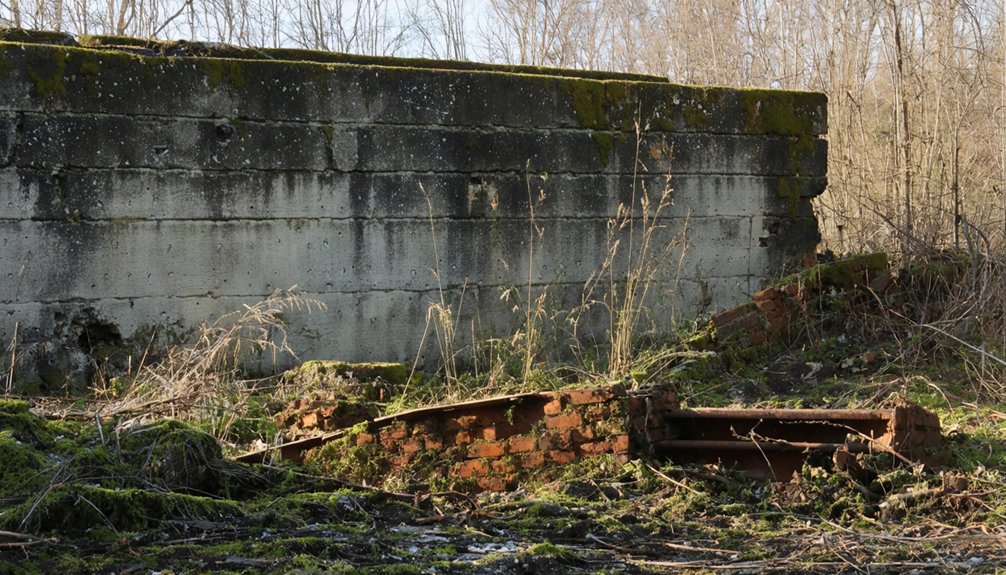
As you walk through New Jersey’s Pine Barrens today, you’ll find concrete foundations scattered among the trees marking where Amatol’s munitions plant and worker housing once stood.
The most prominent remnants include three large cement structures from former pouring rooms, numerous concrete slabs with angled sides designed for explosion containment, and brick fireplaces that survived after their wooden homes were demolished. The area is now enveloped by dense woods, creating an atmospheric backdrop to these historical ruins. Once home to a bustling community of Irish and Polish workers, the site now stands as a testament to its wartime past.
You can still trace the oval outline of the 1920s wooden racetrack, with 75% of it now existing as a dirt trail in the wildlife management area.
Hidden Structural Remains
The scattered ruins of Amatol’s industrial complex reveal a ghostly blueprint of this former World War I munitions town. As you explore the overgrown landscape, you’ll discover hidden foundations and structural remnants that tell the story of this abandoned community.
- Thick-walled concrete bunkers and blast-resistant buildings, with walls up to two feet thick, stand as silent sentinels of the munitions operation.
- Isolated brick fireplaces and stone chimneys emerge from the forest, marking where village homes once stood.
- Massive concrete blocks in the central pit hint at the former water tower’s location and industrial machinery foundations.
You can trace the town’s original layout through surviving roadbeds and trails, while exposed cellars and utility trenches provide glimpses into the infrastructure that once supported this wartime community.
The best seasons for ghost towns in New Hampshire are undoubtedly the fall and spring, when the changing colors and blooming flora enhance the charm and mystery of these abandoned places. Exploring these towns during these times not only offers stunning visual rewards but also a greater chance of connecting with the history that lingers in the air. Whether you’re wandering through the remains of old buildings or hiking the trails, each visit reveals new stories and a deeper appreciation for the region’s past.
Foundations Among Pine Trees
Today’s wanderers through Amatol’s pine-covered expanse will find concrete foundations stretching across 6,000 acres, telling a stark industrial tale from 1918.
You’ll discover foundational remnants designed with angled sides, originally built to contain explosive forces in the munitions plant‘s pouring rooms. Unlike the temporary wooden structures that once dotted the landscape, these concrete formations were engineered for permanence.
Two distinct clusters of concrete buildings persist beneath the pine overgrowth, with one set situated on private property.
As you explore deeper, you’ll encounter beveled concrete trenches extending 100 yards through the pine-covered terrain. These three-foot-deep channels stand as silent witnesses to the site’s industrial past, now embraced by the relentless advance of nature’s reclamation.
Frequently Asked Questions
Were There Any Major Accidents or Explosions at the Amatol Munitions Plant?
You’ll find no major accidents or explosions in the records. Despite handling TNT and ammonium nitrate, accident investigations revealed zero blast incidents, and there’s no explosion aftermath to document.
Can Visitors Legally Explore the Amatol Ruins Today?
You can legally explore most ruins since they’re on public wildlife land, but watch for “No Trespassing” signs – about 25% sits on private property where you’ll need owner permission.
What Happened to the Amatol Railroad Tracks After Abandonment?
You’ll find the tracks were dismantled in 1933, with wooden ties sold as lumber and steel rails likely scrapped during Depression-era salvage efforts. Only concrete foundations and landscape scars remain visible today.
Did Any Original Amatol Residents or Their Descendants Remain in the Area?
While many original residents relocated to South Jersey cities, you’ll find their descendants scattered across Atlantic County today. Most workers returned to Philadelphia’s immigrant communities, though local descendant stories persist without documented verification.
How Much Munitions Did the Amatol Plant Actually Produce During WWI?
You’ll find that despite its massive production capacity and wartime demand, actual munitions output was limited since the plant operated only briefly before WWI ended in November 1918.
References
- https://wfpg.com/go-inside-south-jerseys-fascinating-real-life-ghost-town/
- https://www.atlasobscura.com/places/amatol-ghost-town
- https://richardlewisphotography.com/2019/03/10/a-pine-barrens-ruin/
- https://www.evfc160.com/main/article.php/20091126130120878
- https://www.jerseysbest.com/community/uncovering-n-j-in-hammonton-explore-the-ghostly-ruins-of-a-munitions-village/
- https://www.youtube.com/watch?v=7Alsuwxd6gw
- https://www.southjersey.com/article/6456/AmatolThe-Town
- https://www.youtube.com/watch?v=FphjzHeh3Bo
- https://www.losthistory.net/amatol/index.html
- https://www.nae.usace.army.mil/Missions/Projects-Topics/Morgan-General-Ordnance-Depot/