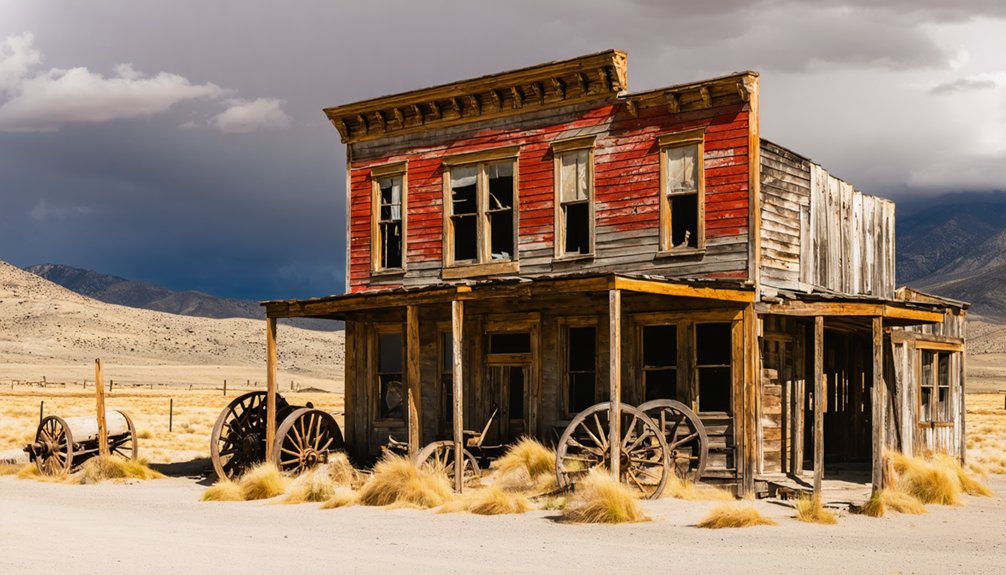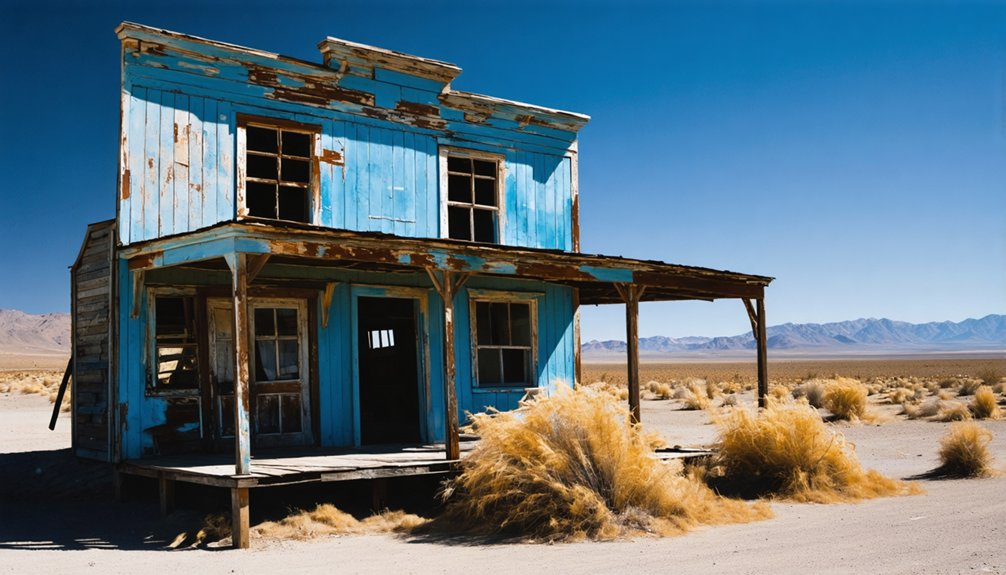
You’ll find America’s ghost towns scattered across the landscape as stark reminders of boom-and-bust cycles. These abandoned settlements emerged from various economic pressures – from played-out mining operations in the West to devastating Dust Bowl migrations in the 1930s that emptied farming communities. Railroad towns vanished when rail lines changed course, while modern cities face their own population exodus due to shifting economic patterns. The stories behind these silent streets reveal fascinating chapters in American settlement history.
Key Takeaways
- Mining towns like Goldfield and Belmont became ghost towns when precious metal deposits were depleted or ore quality diminished.
- The Dust Bowl of the 1930s created numerous ghost towns across Oklahoma, Kansas, and Texas as families fled environmental devastation.
- Railroad rerouting and abandonment led to town isolation and economic collapse, turning prosperous communities into ghost settlements.
- Population decline over 10% within five years, combined with youth outmigration and high vacancy rates, signals potential ghost town formation.
- Modern cities face ghost town risks due to economic changes, remote work trends, and rising costs driving urban population exodus.
The Rise and Fall of Mining Settlements
During the mid-to-late 1800s, precious metal discoveries triggered explosive settlement patterns across the American West, transforming remote landscapes into bustling frontier towns virtually overnight.
You’ll find remarkable examples in Nevada’s Comstock Lode, where population surged from 100 to 20,000 in just two years, and Goldfield, which briefly became the state’s largest city during its early 1900s mining boom. Belmont exemplifies this pattern, as its silver strike discovery in 1865 rapidly grew the population to 2,000 residents within a decade.
Yet these settlements proved vulnerable to swift decline. When ore quality diminished or deposits played out, towns emptied just as quickly as they’d filled. Economic downturns played a major role in the abandonment of these once-thriving communities.
You can trace this pattern in St. Elmo, Colorado, where 1880s prosperity faded within a decade, and in Kennicott, Alaska, where copper mining ceased by 1938.
The arrival of new technology and changing transportation routes after 1920 sealed the fate of many labor-intensive mining communities.
Dust Bowl’s Abandoned Legacy
You’ll find stark evidence of the Dust Bowl’s devastating impact in the thousands of abandoned farming settlements across America’s Great Plains, where severe soil erosion and economic collapse forced an estimated 2.5 to 3.5 million people to flee their homes in the 1930s.
The mass exodus left behind countless ghost towns and deteriorating structures, particularly in high-erosion counties where agricultural land values plummeted and remained depressed through the 1950s. Economic losses during this period reached 25 million dollars daily, further accelerating the abandonment of these once-thriving communities. Many desperate families traveled along Route 66 to California seeking agricultural work in the San Joaquin Valley.
These abandoned communities still dot the landscape today, serving as haunting reminders of how environmental catastrophe and economic hardship permanently altered the region’s settlement patterns.
Farming Towns Gone Quiet
The devastating agricultural practices of the early 20th century transformed vibrant farming communities into ghost towns across America’s Great Plains.
You’ll find the remnants of these once-thriving towns scattered throughout Oklahoma’s Panhandle, western Kansas, and the Texas plains, where poor farming practices and relentless drought stripped the land of its essentiality.
As you explore these abandoned settlements, you’ll see how massive plowing destroyed native prairie grasses that once anchored the soil, while economic pressures forced farmers to abandon sustainable methods.
Advancements in farming technology made it possible for fewer farmers to manage larger areas of land.
Over 300,000 people migrated to California seeking better opportunities and an escape from the environmental catastrophe.
Community resilience crumbled as dust storms ravaged the region, forcing families to flee their homes.
Local institutions – schools, banks, and stores – shuttered their doors as populations dwindled.
What remains are silent testimonies to a time when human ambition collided with nature’s limits.
Mass Exodus Statistics
Staggering statistics reveal the largest internal migration in American history, as 2.5 million people fled the devastated Dust Bowl states in the 1930s.
You’ll find that nearly half a million Oklahomans sought freedom as migrant laborers in the West, with 221,000 people moving to California alone between 1936 and 1938.
The exodus brought devastating health crises, as dust pneumonia claimed 7,000 lives across affected regions.
You can trace the most severe abandonment through the Oklahoma and Texas panhandles, western Kansas, and eastern Colorado, where some counties lost massive portions of their population.
The impact was so profound that these demographic shifts didn’t just represent temporary displacement – population declines in the hardest-hit areas persisted well into the 1950s.
The severe economic devastation of the region led to widespread wheat production drops of 36% during this period.
Environmental Impact Persists
Decades after residents abandoned their homesteads, environmental scars from the Dust Bowl still mark America’s heartland through persistent soil degradation and ecosystem disruption.
You’ll find the most severe soil erosion in former farming regions where deep-rooted native grasses once held the earth together. These areas continue to experience reduced crop yields and struggle to maintain viable topsoil. The transition to one-way disc plows in the early 1900s permanently damaged soil structure and contributed to ongoing erosion issues.
The health consequences ripple through generations, as airborne particulates from recurring dust storms left lasting respiratory problems among survivors. The development of dust pneumonia became one of the era’s deadliest health threats.
You can trace the water cycle changes in abandoned settlements, where altered drainage patterns and decreased soil water retention have created new challenges for current land use.
Even today, you’ll see invasive species thriving where native prairie vegetation once dominated, serving as a lasting reminder of this environmental catastrophe.
Railroad Towns Lost to Time
You’ll find America’s railroad ghost towns scattered across the landscape as stark reminders of how rail lines once determined a settlement’s fate.
One notable example is Wehrum, which at its peak contained 230 company houses along with amenities like a hotel, store, jail and bank.
When new tracks bypassed existing routes or mining operations ceased, these once-bustling communities saw their populations dwindle until only empty buildings remained.
Today, preserved sites like Batsto Village and St. Elmo offer glimpses into how railroad access shaped the rise and fall of frontier towns during America’s rapid westward expansion.
Railroad Boom Then Bust
The explosive growth of America’s railroad system between 1865 and 1916 transformed the western landscape, as tracks expanded from 35,000 to over 250,000 miles and gave birth to countless railroad towns.
You’ll find these settlements didn’t follow a steady westward expansion but instead emerged in dramatic boom-bust cycles driven by mining, agriculture, and freight demands.
You can trace this pattern in places like Las Vegas, founded in 1905 by Union Pacific, and Albuquerque’s “New Town,” established in 1880 along the Atchison, Topeka & Santa Fe tracks.
Railroad companies platted townsites and auctioned lots to speculators, while mining districts in places like Tonopah and Goldfield fueled freight demand.
These towns quickly sprouted brick buildings, family homes, and commercial districts, but their fortunes remained tightly bound to the railroad’s success or failure.
Track Changes Kill Towns
When rail companies rerouted mainlines or consolidated operations, they often triggered the rapid death of dependent towns across America’s landscape.
You’ll find these forgotten places scattered along abandoned track beds, where single-industry communities lost 50% or more of their population within a decade after services ended.
Track abandonment followed a predictable pattern: first came reduced schedules, then freight-only service, and finally complete withdrawal.
Towns without alternate transportation routes suffered most – their isolation deepened once rails were physically removed.
Rail consolidation created systematic “kill towns” where corporate decisions, not local conditions, determined survival.
The loss devastated local economies through multiple channels: disrupted supply chains, vanished railway jobs, collapsed property values, and shuttered businesses that had depended on rail travelers.
Only towns near highways or waterways typically managed to adapt and survive.
Preserving Railway Heritage Sites
Despite widespread track abandonments, dedicated preservation efforts have transformed many former railroad corridors into vibrant public spaces and historical landmarks.
You’ll find heritage trails and railway restoration projects breathing new life into America’s industrial past, while preserving these essential corridors for future generations.
- The Armstrong Trails showcase Pennsylvania’s rich railway heritage with its 52-mile network featuring iron furnaces, a coaling tower, and a historic tunnel.
- Connecticut’s preservation of the Housatonic Railroad corridor supports 3,000 jobs and maintains significant freight service.
- The Poughkeepsie Rail Trail exemplifies successful corridor conversion, turning tragedy into community opportunity.
- Historical sites like Thurmond, West Virginia, and Bodie, California stand as evidence of America’s railroad era.
These preservation efforts don’t just protect our past – they’re creating sustainable transportation alternatives while maintaining our connection to America’s railway heritage.
Modern Urban Population Decline
Modern American cities face an unprecedented exodus as shifting economic forces and lifestyle changes reshape urban landscapes across the nation.
You’ll find urban decay spreading across regions, from Spring Valley’s 10% population drop to St. Louis’s dramatic losses. Population migration patterns show a clear shift away from traditional urban cores, with nearly half of U.S. cities experiencing recent decreases.
The impact isn’t limited to one region – you’re seeing it everywhere. Major cities like New York lost 31,000 residents in 2024 alone, while Detroit continues its decades-long decline.
Working-age populations are shrinking rapidly, with some cities losing over 10% in just one year. High costs, remote work options, and quality-of-life concerns are driving this transformation, leaving cities struggling to maintain services and infrastructure with shrinking tax bases.
Preservation Efforts and Tourism
As abandoned urban spaces multiply across America’s cities, preservation efforts have emerged as critical lifelines for protecting architectural heritage and fostering economic renewal.
You’ll find preservation funding flowing through federal and state channels, creating opportunities to transform forgotten districts into vibrant destinations. Heritage tourism has proven particularly effective in breathing new life into these spaces.
- Federal Historic Preservation Fund provides $1.67 billion since 2001
- State matching funds nearly double available resources
- Successful sites draw thousands of visitors annually
- Adaptive reuse creates sustainable revenue streams
You can witness this transformation in action where strategic investments have turned vacant buildings into museums, event spaces, and cultural centers.
Through careful planning and community involvement, these preservation projects aren’t just saving buildings – they’re creating new economic opportunities while maintaining authentic urban character.
Environmental Impact and Safety
While abandoned urban spaces may appear dormant, they often harbor serious environmental and safety hazards that threaten surrounding communities.
You’ll find devastating examples in places like Centralia, Pennsylvania, where underground coal fires have raged for 60 years, melting streets and forcing mass evacuations. The environmental degradation extends beyond visible damage – toxic mine waste in towns like Picher, Oklahoma, has poisoned children and contaminated water supplies.
Safety concerns aren’t limited to pollution. Abandoned mines have claimed lives in Colorado, while lethal asbestos levels forced evacuations in Arizona.
Deadly hazards lurk in abandoned industrial sites, from Colorado’s treacherous mine shafts to Arizona’s toxic asbestos contamination.
You’re witnessing the effects of industrial negligence in places like Mossville, where chemical plumes created ghost towns and left residents battling serious health issues.
Climate threats add another layer of risk, with coastal communities facing rising seas and rural areas contributing considerably to emissions.
Economic Factors Behind Abandonment

Beyond the physical hazards of abandoned spaces lies a complex web of economic forces that transform vibrant communities into ghost towns.
You’ll find that economic instability triggers cascading effects, leading to population decline across various American regions. The pattern of boom-and-bust cycles has repeatedly shaped settlement patterns, from historic mining towns to modern Sunbelt cities.
Key drivers of urban abandonment include:
- Resource depletion in mining and extraction industries, causing swift exodus
- Manufacturing decline in Rustbelt regions, devastating local economies
- Housing market crashes leaving vast vacant subdivisions, particularly in Sunbelt areas
- Failed economic incentives like tax exemptions creating unsustainable growth
These factors create a downward spiral where declining tax bases can’t support infrastructure, prompting more residents and businesses to leave, further weakening the local economy.
Tracking Ghost Town Indicators
Through careful analysis of key demographic and economic metrics, you can identify communities at risk of becoming modern ghost towns before widespread abandonment takes hold.
Population decline serves as your primary indicator, with sharp drops over 10% in just five years signaling potential ghost town demographics. You’ll want to track youth outmigration particularly closely, as younger residents often lead the exodus from declining areas.
Vacancy rates tell an equally important story. When you’re examining urban revitalization efforts, look for rental and homeowner vacancy rates markedly above regional averages.
Long-term vacancies lasting two or more years, coupled with plummeting construction permits and rising retail vacancies, paint a clear picture of community decline. These indicators help you understand which cities might follow St. Louis’s concerning trajectory of -6.6% population loss.
Frequently Asked Questions
What Legal Rights Do Urban Explorers Have When Visiting Ghost Towns?
Like a ghost at midnight, you’ll need permission first. Urban exploration requires respecting private property rights – even abandoned places remain owned. You can’t legally enter without authorization.
Can Someone Legally Claim Ownership of an Abandoned Ghost Town Property?
You can legally claim abandoned ghost town property through tax sales, purchasing from owners, or adverse possession, but you’ll need to navigate complex property rights and potential ownership disputes carefully.
Are There Any Completely Underwater Ghost Towns in America?
You’ll find dozens of submerged towns across America, like Gad, West Virginia, beneath Summersville Lake. Underwater exploration reveals foundations, roads, and rock carvings – haunting reminders of communities sacrificed for reservoir projects.
Which Ghost Towns Have Reported Supernatural or Paranormal Activity?
You’ll find significant paranormal encounters in Bodie, California; Virginia City, Nevada; and Bannack, Montana. These haunted locations feature frequent reports of apparitions, unexplained noises, and ghostly mining figures.
How Do Natural Disasters Affect the Rate of Ghost Town Formation?
Like dominos falling, natural disasters accelerate ghost town formation when you’ve got disaster impact beyond recovery challenges – destroying infrastructure, forcing mass evacuations, and making rebuilding costs prohibitively expensive for your community.
References
- https://themortgagepoint.com/2024/10/25/americas-new-ghost-towns/
- https://blog.batchgeo.com/ghost-towns/
- https://247wallst.com/housing/2024/04/11/americas-modern-ghost-towns-2/
- https://www.youtube.com/watch?v=aTbMdOZRZO4&vl=en
- https://www.geotab.com/ghost-towns/
- https://www.mentalfloss.com/geography/american-ghost-towns-can-still-walk-through
- https://en.wikipedia.org/wiki/Lists_of_ghost_towns_in_the_United_States
- https://joybird.com/blog/top-ghost-towns-in-america/
- https://www.ghosttowns.com
- https://savingplaces.org/stories/explore-wild-west-mining-history-in-nevada-ghost-towns