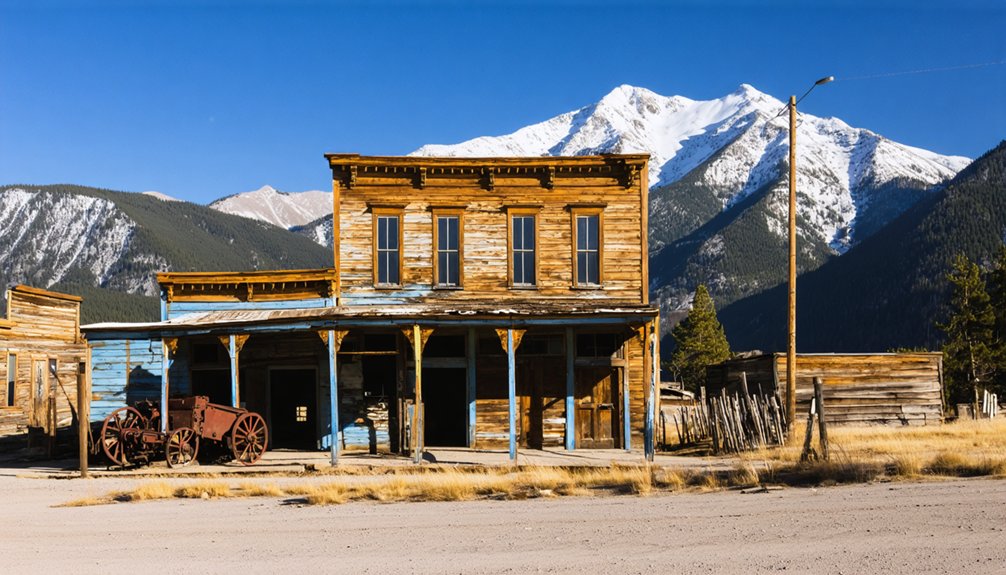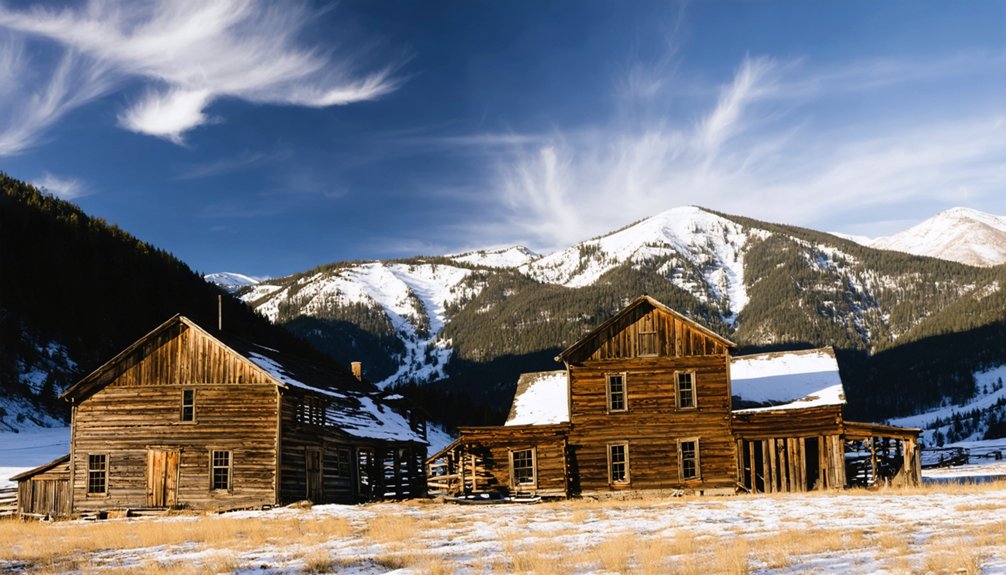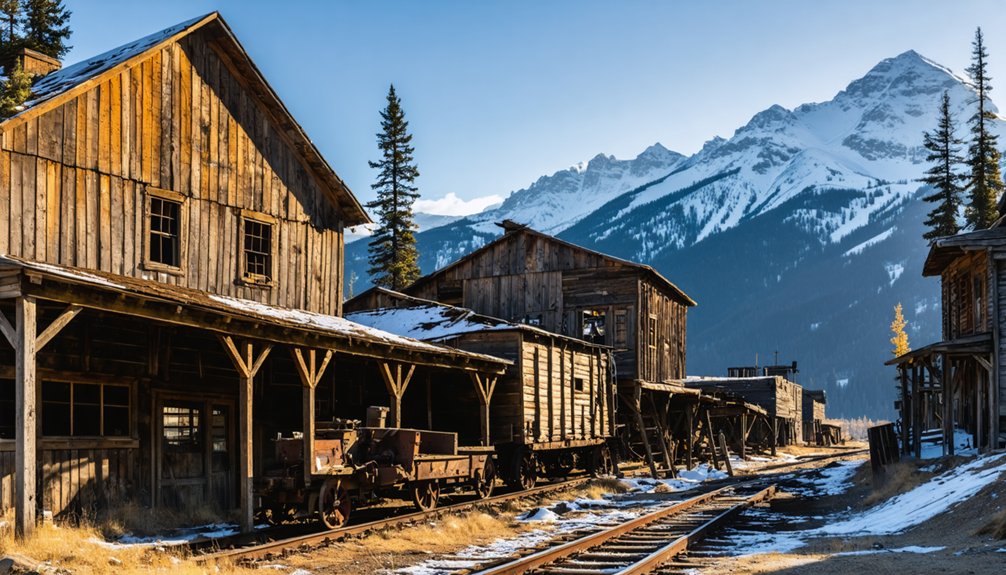
You’ll find Animas perched at 11,200 feet in Colorado’s San Juan Mountains, where it began as a silver mining settlement in 1873. Originally named “Three Forks of the Animas,” the town flourished after rich mineral deposits were discovered in 1874, growing to 450 residents by the 1880s. Harsh winters and the 1893 silver crash led to its decline, and by 1917, mining operations ceased. Today, nine preserved structures stand as silent witnesses to this once-thriving mountain community’s remarkable story.
Key Takeaways
- Founded in 1873 at 11,200 feet elevation in Colorado’s San Juan Mountains, Animas was a thriving mining town during the silver boom.
- The town peaked in the 1880s with 450 residents, supported by silver mining operations and the prominent Bonanza Tunnel.
- Harsh alpine conditions, including 25-foot snowdrifts, regularly isolated the community and challenged year-round living.
- Economic decline followed the 1893 silver crash, leading to mine closures and eventual abandonment by 1917.
- Now listed on the National Register of Historic Places, nine preserved structures remain as a tourist destination accessible by 4WD vehicles.
Life at 11,200 Feet: The Birth of a Mining Town
As prospectors first ventured into the high reaches of Colorado’s San Juan Mountains, they established what would become Animas at a breathtaking elevation of 11,200 feet in 1873.
The settlement grew from a single log cabin at the convergence of the Animas River’s three forks, earning its initial name “Three Forks of the Animas.” Your path to this remote mining community would’ve been made possible by Otto Mears’ wagon road construction in the mid-1870s. The Dakota and San Juan Mining Company constructed a large processing mill in 1876, bringing significant investment to the area.
From a lone cabin where three rivers met, a mining town emerged thanks to Otto Mears’ pioneering wagon roads.
Despite the high altitude challenges, the town quickly took shape. By 1876, you’d have found about 30 cabins alongside essential services like a hotel, general store, and saloon. During its peak in the 1880s, the town supported a thriving community of over 450 summer residents.
The establishment of a post office in 1875 marked Animas’ evolution from a temporary camp to a determined mountain settlement.
The Golden Years of Prosperity
When prospectors struck rich silver and gold deposits in 1874, Animas transformed from a simple mountain outpost into a thriving hard-rock mining hub.
You’d have witnessed the town’s rapid expansion as the Bonanza Tunnel opened in 1877, becoming the area’s leading employer and drawing hundreds of ambitious miners to the challenging 11,500-foot elevation.
The town soon boasted multiple general stores, saloons, restaurants, and essential services to support its growing population of 450 residents.
The Kalamazoo House served as the town’s grandest hotel and contained the only telephone in Animas.
By 1903, the arrival of Franklin Rockefeller’s investment in the Gold Prince Mine marked the peak of prosperity.
The construction of a $500,000 mill with 100 stamps and a 12,600-foot aerial tramway in 1905 cemented Animas’ position as one of Colorado’s most significant mining operations.
The influx of Eastern European immigrants brought diverse cultural influences to this remote mountain settlement.
Natural Forces and Economic Hardships
Despite its promising start, Animas faced relentless challenges from its extreme alpine environment at 11,200 feet elevation. You’d find massive snowdrifts up to 25 feet high burying structures and isolating residents through long winters. Regular seasonal migration forced residents to retreat to Silverton during the harshest months.
The bustling town once housed 450 summer residents during its peak in 1883.
Weather challenges took their toll as freeze-thaw cycles destroyed buildings, while UV exposure and moisture corroded mining equipment.
Economic struggles hit hard when the 1893 silver crash sent prices plummeting. You couldn’t ignore the mounting transportation difficulties – the steep, unimproved roads often became impassable, disrupting crucial supply lines and ore shipments.
As local ore veins depleted and grades declined, the high costs of seasonal operation made processing low-grade ore unprofitable. The combination of harsh weather and market downturns ultimately forced mines to close and equipment to be relocated.
From Ruins to Historical Landmark
The abandoned ruins of Animas found new purpose in 2011 when the historic townsite earned its place on the National Register of Historic Places.
After decades of vandalism and decay, preservation efforts began in the 1960s, led by dedicated Silverton locals. An essential $330,000 grant enabled thorough stabilization work, including the restoration of the historic Duncan House and jail. During its peak in 1883, the town boasted a thriving community of 450 residents.
Today, you’ll find this remote ghost town at 11,200 feet elevation along the Alpine Loop Backcountry Byway, where tourism impact continues to grow.
The Bureau of Land Management oversees:
- Nine preserved standing structures
- Interpretive signs detailing town history
- The Columbus Mill, one of the oldest remaining buildings
- Stabilized wood-frame buildings from the 1997-1998 restoration
You’ll need a 4-wheel-drive vehicle to access this remarkable piece of mining history, but the journey’s worth every mile.
Exploring a Slice of Colorado’s Mining Heritage
Mining fever swept through Colorado’s La Plata Mountains in the mid-1870s, transforming Animas from an untamed wilderness into a bustling mining camp.
You’ll discover how early pioneers established essential services, including a post office by 1875, as mining techniques evolved from basic prospecting to industrial-scale operations. Similar to developments at Gregory Diggings, the town quickly adopted water-powered processing methods to improve mineral extraction. The community dynamics centered around roughly 30 cabins, a hotel, general store, and the crucial miners’ boarding house. A devastating 25-foot snow blizzard hit the town in 1884, highlighting the harsh conditions residents faced.
The town’s ambitious spirit peaked with the 1905 construction of the Gold Prince mill, a $500,000 investment that promised prosperity.
However, by 1917, the mining dream faded as equipment was stripped and relocated.
Today, you can explore the surviving Duncan House, built in 1879, along with the historic jail and mill foundations – silent witnesses to Colorado’s golden age of mining.
Frequently Asked Questions
Are There Any Paranormal Activities or Ghost Sightings Reported in Animas Forks?
You’ll find ghost stories about a frost-faced figure beneath bay windows, a vengeful prospector’s spirit, and haunted history surrounding Elias Dimitri’s jail escape, though no concrete evidence exists.
Can Visitors Stay Overnight in or Near Animas Forks?
You can’t stay inside the ghost town structures, but you’ll find lodging facilities in nearby Silverton or permitted camping options on surrounding BLM lands following Leave No Trace principles.
What Is the Best Time of Year to Visit Animas Forks?
Like a flower in full bloom, you’ll find summer’s the best season to visit. You’ll enjoy clear weather conditions, accessible roads, and stunning wildflower meadows from July through early September.
Are There Guided Tours Available of the Ghost Town?
You’ll find multiple guided exploration options including jeep, UTV, and ATV tours with historical insights. Tours run $129-149 per adult, typically lasting 2-2.5 hours during the summer season.
Are Visitors Allowed to Take Artifacts Found at the Site?
With 250,000 yearly visitors, you’re not allowed to remove artifacts. Taking items compromises the site’s historical significance and violates federal preservation laws. You’ll help protect this heritage by leaving everything in place.
References
- https://www.durango.com/animas-forks/
- https://www.youtube.com/watch?v=r1_pnNhNWxY
- https://savingplaces.org/stories/ghost-of-a-chance-animas-forks-colorado
- https://www.legendsofamerica.com/animas-forks-colorado/
- https://milliverstravels.com/2014/02/animas-forks-colorado/
- https://en.wikipedia.org/wiki/Animas_Forks
- https://www.blm.gov/visit/animas-forks
- https://westernmininghistory.com/towns/colorado/animas-forks/
- https://gotaltitudesite.wordpress.com/2023/10/03/animas-forks-silverton-co/
- https://visitfourcorners.com/colorado-mining-history-made-the-state/