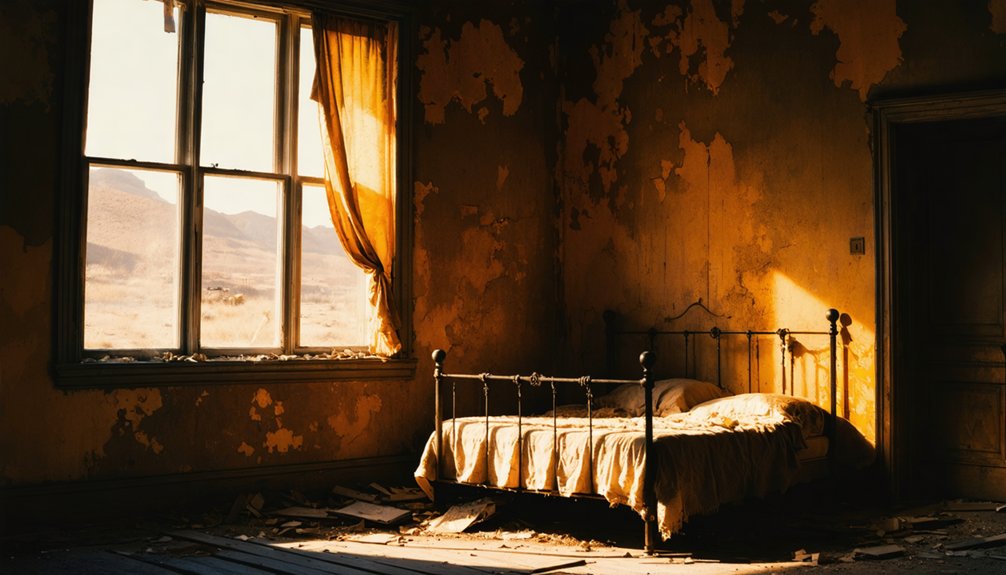
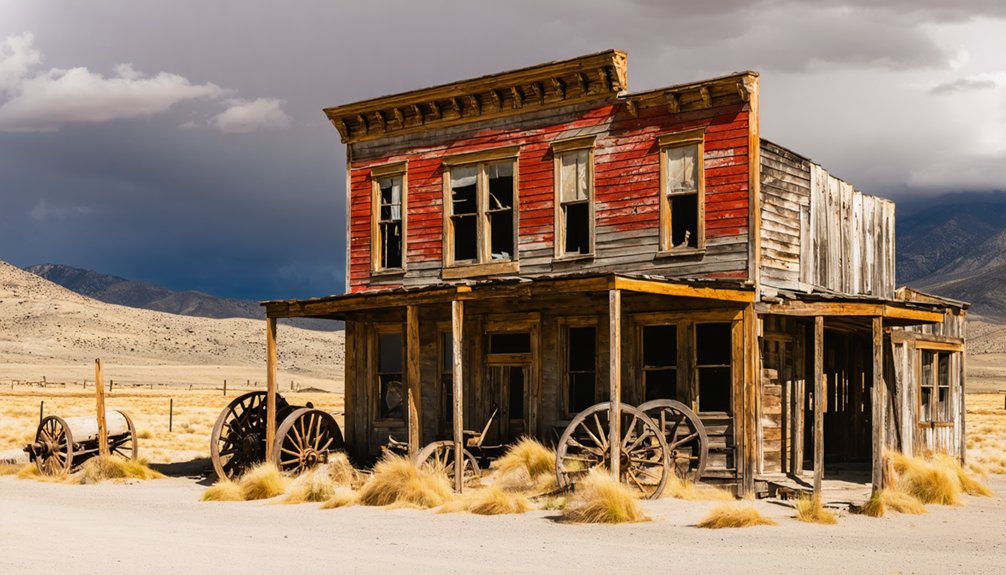
While you’ll find compelling eyewitness accounts of paranormal activity in ghost towns, scientific evidence remains inconclusive. These abandoned places naturally evoke strong emotional responses and can trigger psychological effects like hypervigilance and pattern-seeking behavior. Environmental factors, cognitive biases, and local folklore often explain many reported phenomena. Yet controlled studies and modern investigation methods continue to document unexplained occurrences, suggesting the full story of ghost town mysteries has yet to unfold.
Key Takeaways
- Scientific studies have found no conclusive evidence of supernatural activity in ghost towns, with most phenomena explained by natural causes.
- Environmental factors like wind, settling buildings, and temperature changes often create sounds and sensations mistaken for paranormal activity.
- Psychological factors, including prior knowledge of haunted reputations and heightened awareness in abandoned places, influence people’s interpretation of experiences.
- While numerous eyewitness accounts report paranormal activity, controlled scientific investigations rarely replicate these supernatural phenomena.
- Ghost towns’ traumatic histories and collective memories contribute to their spooky reputation and influence visitors’ perceptions of mysterious events.
The Psychology Behind Abandoned Places
While abandoned places evoke powerful emotional responses in nearly everyone, the psychological impact of these spaces extends far beyond mere curiosity or fear. You’ll notice how these sites trigger complex feelings of abandoned nostalgia, often drawing people from diverse backgrounds who share a fascination with decay.
Yet beneath this intrigue lies a darker reality. Living near vacant properties can profoundly affect your mental wellbeing through constant hypervigilance and stress. Research shows that vacant land hazards can create additional anxiety as these areas often harbor unsafe conditions. Studies indicate that systemic oppression has historically contributed to the deterioration of these neglected areas.
The psychological decay manifests in various ways – from social withdrawal due to safety concerns to a diminished sense of community as trust erodes between neighbors. You’re likely to experience conflicting emotions: a cultural attraction to ruins alongside legitimate fears about crime and personal safety.
Neglected spaces breed social isolation, as fascination with decay collides with the harsh reality of community breakdown and fear.
This duality shapes how you perceive and interact with abandoned spaces, creating a complex psychological relationship with these forgotten places.
Historical Factors Leading to Ghost Town Formation
Throughout American history, five major factors have consistently driven the formation of ghost towns: resource depletion, railroad routing decisions, geographic isolation, natural disasters, and economic volatility.
These forces of urban decay have transformed once-thriving communities into historically significant reminders of America’s dynamic past. Heritage tourism now helps preserve many of these abandoned locations for future generations.
Nevada exemplifies this pattern with over 600 ghost towns scattered across its landscape, most abandoned after mining operations ceased.
The historical significance of these abandoned settlements reveals how quickly fortunes could change in frontier America:
- Mining boomtowns like Bodie, California went from gold rush wealth to desertion once precious metals ran dry.
- Railroad bypasses left towns like Eschiti, Oklahoma economically stranded and unable to compete.
- Natural disasters, from floods to coal seam fires, forced entire communities to relocate.
When you examine ghost towns today, you’re witnessing the physical remnants of complex economic and social forces that shaped America’s development.
Most Active Paranormal Ghost Town Hotspots
If you’re exploring reports of paranormal activity in ghost towns across America, you’ll find that abandoned mining settlements consistently rank among the most active locations for alleged spirit encounters.
Historic hotels like Bannack’s Hotel Meade serve as focal points for documented claims, with multiple eyewitness accounts describing unexplained phenomena in these preserved structures. During preservation work at Kennecott, workers have reported hearing eerie voices and tools flying through the air. St. Elmo’s haunted hotel windows frequently reveal glimpses of Annie Stark’s restless spirit watching visitors below.
While scientific evidence remains elusive, the violent histories and sudden abandonment of these mining communities provide context for why they’ve become epicenters of reported paranormal activity.
Mining Town Spirit Activity
As mining towns across the American West fell into abandonment during the late 19th and early 20th centuries, they gained notoriety as paranormal hotspots with documented supernatural activity. Oklahoma saw many towns decline as tornadoes contributed to widespread desertion.
Texas leads with 558 ghost towns and over 7,600 reported encounters, while New Mexico ranks as the most haunted state overall. Research suggests these mining spirits may be tied to tragic circumstances surrounding the boom-and-bust cycles of resource extraction. The state’s haunted legacy persists through numerous historical sites including old hotels, mission churches, and battlegrounds.
- Bodie, California’s preserved gold mining town warns of curses for those who remove artifacts.
- St. Elmo, Colorado reports consistent ghost sightings despite its 1936 abandonment.
- Texas ghost towns contribute greatly to San Antonio’s high paranormal ranking.
The concentration of supernatural claims in mining regions suggests a correlation between resource depletion, sudden abandonment, and reported paranormal phenomena.
Evidence From Haunted Hotels
While ghost towns themselves harbor numerous paranormal claims, the hotels within these abandoned settlements provide some of the most compelling evidence of supernatural activity.
You’ll find particularly high concentrations of reported haunted experiences in Savannah’s historic district, where 12.7% of hotels report spectral encounters.
California leads with 136 haunted locations, including the notorious Cecil Hotel with its dark history of 16+ deaths.
The Stanley Hotel in Colorado, which inspired “The Shining,” consistently reports ghostly children and unexplained piano music.
Historic properties like Williamsburg’s Colonial Houses and Salem’s Hawthorne Hotel maintain detailed records of paranormal activity, backed by professional investigations.
California’s 273 ghost towns contribute significantly to its reputation as America’s most haunted state.
Whether these claims stem from actual supernatural phenomena or the power of suggestion remains a matter of scientific debate.
Studies show these haunted properties typically earn a lower guest rating of 7.7 out of 10 compared to non-haunted hotels.
Scientific Analysis of Reported Phenomena
Despite widespread reports of paranormal activity in ghost towns and historic sites, scientific analysis reveals a complex interplay of cognitive, psychological, and environmental factors shaping these experiences.
When you investigate paranormal phenomena, you’ll find that cognitive biases and environmental triggers often explain seemingly supernatural events.
- Your heightened sensitivity to subtle changes in temperature, lighting, and acoustics can create sensations that feel otherworldly.
- Your prior knowledge of a location’s haunted reputation markedly influences how you interpret random occurrences.
- Your brain’s pattern-seeking nature may lead you to connect unrelated events into meaningful paranormal experiences.
Research shows that controlled studies rarely replicate reported hauntings, suggesting natural explanations are more likely.
Hereomas
While personal experiences feel compelling, scientific methodology helps separate genuine mysteries from explainable phenomena through rigorous investigation and analysis.
The Role of Mining History in Ghost Town Hauntings
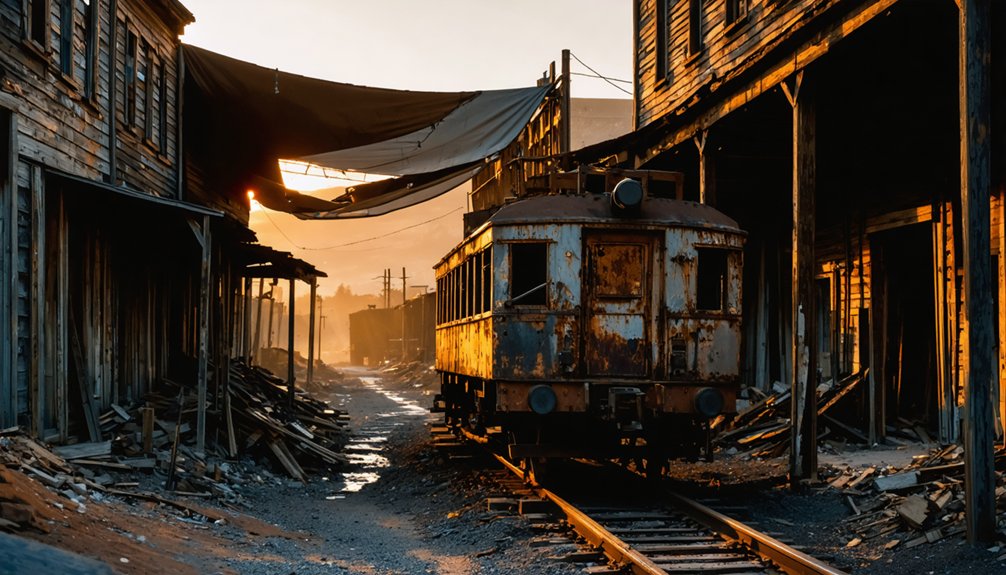
The dramatic rise and fall of mining towns across the American West has created fertile ground for ghostly legends and reported hauntings.
You’ll find these stories often trace back to specific mining tragedies, like the devastating 1885 Horn Silver Mine cave-in at Frisco, Utah, or the deadly accidents in Gold Hill’s Randolph Mine. Many believe spectral miners still roam these abandoned shafts.
The harsh realities of mining life – from Apache raids in Chloride to underground disasters and economic collapse – left deep psychological scars on these communities.
When you examine sites like the submerged ruins of Pactola or Garnet’s preserved ghost town, you’re witnessing places where sudden abandonment and violent histories converged, creating powerful narratives that blur the line between documented tragedy and supernatural lore.
Documented Evidence and Eyewitness Accounts
Modern investigations into ghost town hauntings have yielded substantial documentation across numerous historic sites, supported by both systematic research and firsthand accounts.
While skeptics question the authenticity of ghost sightings, investigators have cataloged compelling evidence of spectral encounters using various technological tools and methodologies.
- Structured investigations in Thurmond, WV have documented consistent SLS camera captures and flashlight communication patterns in historic buildings.
- Silver City’s documented phenomena include physical object manipulation, with a miner’s lunch pail flying across a room under witness observation.
- Bodie’s preservation efforts have recorded recurring electrical anomalies and audible footsteps in abandoned structures, suggesting possible paranormal activity.
These findings, while intriguing, warrant continued scientific scrutiny to establish definitive correlations between reported phenomena and genuine paranormal activity.
Impact of Natural Disasters on Ghost Town Legends
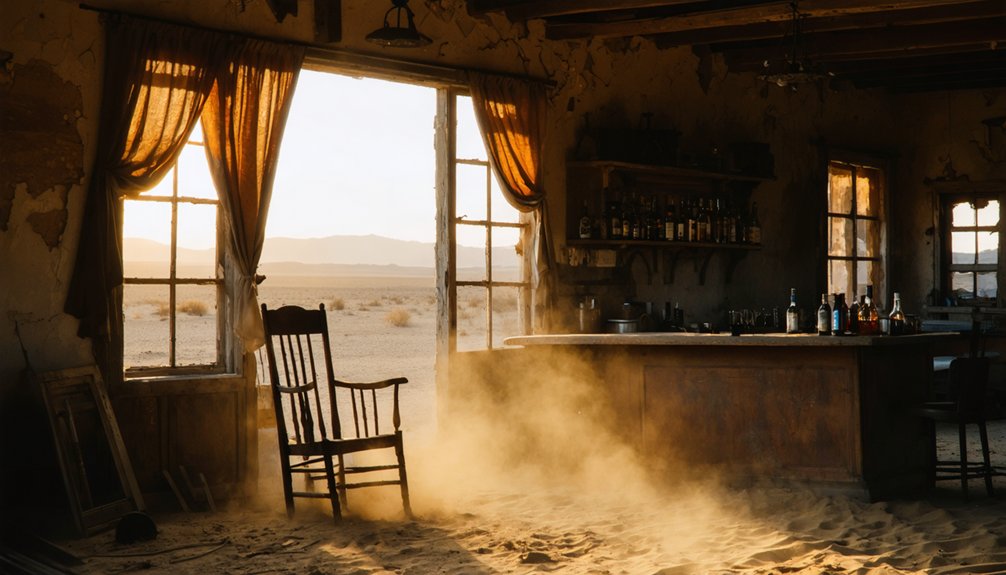
Natural disasters have profoundly shaped the supernatural legends surrounding ghost towns, creating enduring narratives that blur the lines between documented tragedy and paranormal folklore.
You’ll find that flooding, wildfires, and geological catastrophes leave behind physical evidence that fuels haunting narratives – from water-stained walls to fire-scorched buildings.
These disaster sites become fertile ground for supernatural interpretations, as collective trauma and unresolved grief transform historical events into disaster folklore.
When you explore abandoned towns, you’ll notice how environmental factors create seemingly paranormal phenomena: mold-induced creaks, wind whistling through ruins, and electromagnetic disturbances from damaged infrastructure.
While these effects have natural explanations, they’ve become deeply woven into ghost stories, especially when amplified by tourism narratives and repeated retellings that emphasize human drama over factual accounts.
Cultural Significance and Local Folklore
While ghost towns themselves stand as physical remnants of the past, their cultural significance extends far beyond crumbling structures into rich tapestries of folklore and collective memory.
These abandoned places serve as powerful symbols of cultural nostalgia, helping to shape community identity through shared stories and traditions.
Local folklore often manifests in three distinct ways:
- Tales of wandering spirits tied to specific occupations, like eternal miners continuing their work
- Stories of hidden treasures that inspire modern-day exploration
- Place-specific legends featuring historical figures that become woven into local storytelling
You’ll find these narratives aren’t just entertainment – they’re essential tools for preserving oral histories, attracting tourism, and maintaining connections to historical events when formal records are limited.
Ghost Towns as Time Capsules of Tragedy

Throughout history, tragic events have transformed vibrant communities into haunting reminders of human suffering, with ghost towns serving as powerful physical records of catastrophic loss.
You’ll find that epidemics like the Black Death and Spanish flu left entire settlements frozen in time, while industrial disasters like Centralia’s underground coal fire created uninhabitable zones that persist today.
Ghost town preservation often reveals layers of tragedy – from abandoned leprosy colonies to sites of wartime atrocities like Oradour-sur-Glane.
Ghost towns stand as solemn monuments to human suffering, preserving the haunting memories of disease, war, and unthinkable devastation.
The urban decay you’ll encounter tells stories of environmental poisoning, forced displacement, and public health crises.
These sites aren’t just empty buildings; they’re time capsules documenting humanity’s darkest moments through their preserved infrastructure, personal belongings, and institutional records.
Modern Investigation Methods and Findings
If you’ve ever wondered how ghost hunting has evolved since the 1990s, you’ll find today’s investigators employ an impressive array of scientific equipment like EMF meters, infrared cameras, and digital audio recorders to gather measurable data.
While these tools have helped standardize paranormal research methods, they’ve also highlighted the challenge of distinguishing between genuine anomalies and natural phenomena that can mimic supernatural activity.
The gap between local legends and verifiable evidence remains significant, though systematic investigation techniques continue to advance our understanding of reported hauntings through careful documentation and analysis.
Equipment Evolution Since 1990s
Since the 1990s, ghost hunting equipment has evolved from basic electrician tools into sophisticated digital systems that enable more precise data collection and analysis.
These equipment advancements have transformed investigation techniques from simple EMF readings and temperature logs into extensive multi-sensor monitoring platforms.
Key technological improvements you’ll find in modern ghost hunting include:
- High-sensitivity digital audio recorders that capture EVPs with improved signal-to-noise ratios
- Thermal imaging cameras that provide objective, timestamped heat mapping
- Multi-sensor data loggers that simultaneously track temperature, EMF, and barometric pressure
The integration of digital post-processing software has further enhanced investigators’ capabilities, allowing for detailed analysis of audio spectrograms, video anomalies, and cross-correlation of environmental data.
While these tools offer greater precision, they’ve also introduced new challenges in distinguishing genuine phenomena from equipment-generated artifacts.
Physical Evidence Versus Legend
Modern ghost hunting relies heavily on distinguishing verifiable physical evidence from embellished local legends through systematic investigation methods.
When you’re investigating spectral sightings, you’ll find that historical records often contradict popular ghost stories. Census data, newspapers, and official documents help separate fact from fiction in reported hauntings.
You’ll discover that many unexplained noises have natural explanations – from settling foundations to thermal contractions.
Environmental monitoring reveals that alleged cold spots typically match normal temperature variations, while EMF readings often trace back to faulty wiring or buried metal.
Even compelling evidence like EVPs requires rigorous analysis, as ambient sounds and audio processing can create false positives.
Through careful documentation and controlled testing, you can evaluate haunting claims objectively rather than relying on unverified local lore.
Frequently Asked Questions
Can Spirits From Ghost Towns Follow Visitors Home?
While visitor experiences with spirit attachment are reported, there’s no scientific evidence that entities follow you home. Your psychological expectations and suggestibility likely explain any perceived phenomena afterwards.
Why Do Some Ghost Towns Have More Paranormal Activity at Night?
While urban legends suggest heightened nighttime energy, you’re likely experiencing amplified environmental factors – darkness intensifies isolation, temperature changes cause structural noises, and your senses become more alert to surroundings.
Do Restored Ghost Towns Have Less Paranormal Activity Than Abandoned Ones?
You’ll find no conclusive evidence that restoration impacts paranormal activity levels. While visitor experiences vary between restored and abandoned sites, reported ghostly encounters persist regardless of a location’s preservation state.
How Do Seasonal Weather Changes Affect Paranormal Activity in Ghost Towns?
Ever notice how storms stir things up? You’ll find weather patterns and temperature fluctuations can intensify reported paranormal activity, from EMF spikes during lightning to cold spots in winter’s grip.
Are Ghost Towns Near Native American Burial Grounds More Actively Haunted?
You’ll find no scientific evidence linking Native American burial grounds to increased paranormal activity in ghost towns, despite the cultural significance these sites hold in Indigenous history and spiritual traditions.
References
- https://history.howstuffworks.com/history-vs-myth/ghost-towns.htm
- https://studyfinds.org/americas-ghost-towns/
- https://www.dummies.com/article/body-mind-spirit/religion-spirituality/the-paranormal/places-to-hunt-for-paranormal-activity-266083/
- https://www.losethemap.com/scariest-ghost-towns-in-the-world/
- https://www.gothichorrorstories.com/real-ghost-stories/
- https://i95rock.com/mystery-of-dudleytown-ct/
- https://www.youtube.com/watch?v=1vSRisbR7rM
- https://pmc.ncbi.nlm.nih.gov/articles/PMC3665973/
- https://pmc.ncbi.nlm.nih.gov/articles/PMC11349791/
- https://www.lisc.org/our-resources/resource/impact-abandoned-properties-public-health/