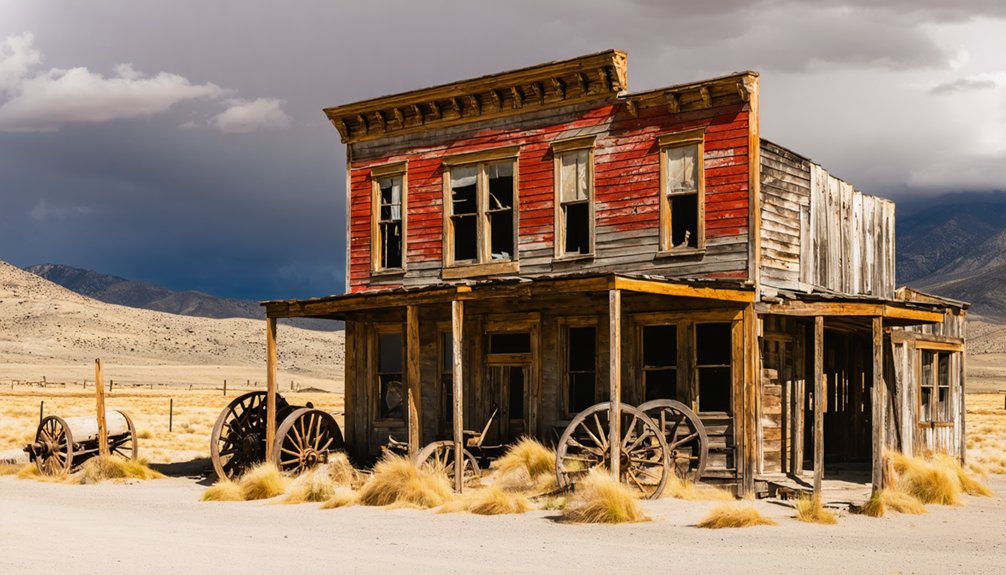
Ghost towns can be extremely dangerous if you don’t take proper precautions. You’ll face serious risks from unstable buildings that could collapse, abandoned mines with hidden shafts and toxic gases, and elevated criminal activity in isolated areas. Environmental hazards like contaminated water, asbestos, and heavy metals also pose significant health threats. To safely explore these historic sites, you’ll need to understand the specific dangers and required safety measures that experienced ghost town visitors rely on.
Key Takeaways
- Ghost towns contain hazardous abandoned mines with deep shafts, toxic gases, and complex tunnel systems that can trap explorers.
- Deteriorating buildings face high collapse risks due to rotted supports, unstable foundations, and exposure to harsh weather conditions.
- Isolated ghost towns attract criminal activity, with vacancy correlating to increased rates of drug-related crimes and violent offenses.
- Emergency response times are significantly delayed due to remote locations and limited law enforcement resources in ghost town areas.
- Visitors face serious health risks from exposure to heavy metals, asbestos, contaminated water sources, and other environmental hazards.
Physical Hazards of Abandoned Mines
While ghost towns themselves hold fascinating historical value, the abandoned mines within them pose severe and potentially lethal hazards to explorers.
During mine exploration, you’ll face dangers like flooded shafts with hidden rock ledges and machinery beneath deceiving water surfaces. Shaft dangers include unmarked vertical openings that plunge hundreds of feet deep, often concealed by vegetation or rotting boards. With an estimated 500,000 abandoned mines across the United States, the scope of these hazards is vast.
According to federal estimates, cleanup efforts could take up to 500 years to fully assess and address safety hazards.
You’re also at risk from toxic gases like carbon monoxide and methane that accumulate in old workings, leading to sudden unconsciousness or death.
Complex tunnel systems with winzes, drifts, and stopes can disorient you in total darkness, while unstable explosives and contaminated materials threaten your safety.
These hazards have claimed numerous lives, with thousands of undocumented features still awaiting assessment.
Structural Instability and Collapse Risks
You’ll encounter serious safety risks from unstable foundations in ghost towns, where decades of neglect have led to sagging and cracking that can trigger sudden collapses.
Your exploration faces additional dangers from rotting support timbers that may give way without warning, especially in structures exposed to moisture and weather damage.
When investigating these historic sites, it’s critical to recognize that over 7,000 coastal structures are at risk of collapse, and similar hazards exist throughout abandoned communities across various regions.
Former mining towns pose particular risks since many structures were built as temporary settlements that were never meant to withstand long-term environmental exposure.
Poor Black neighborhoods have experienced disproportionate abandonment of buildings, leading to increased structural hazards in these historically underserved areas.
Unstable Foundations Create Hazards
As abandoned structures deteriorate over time, unstable foundations pose one of the gravest safety hazards in ghost towns.
You’ll find foundation deterioration accelerating rapidly when buildings face prolonged exposure to harsh elements without maintenance. Research shows that soil instability, particularly in areas like Lemieux, Ontario, can trigger catastrophic collapses and landslides that threaten entire town sites. Building failures have increased ten-fold over decades in vulnerable coastal cities like Alexandria, showing how quickly structural deterioration can progress.
- Sagging floors and crumbling basement walls signal imminent structural failure
- Coastal erosion undermines building foundations near shorelines
- Unstable clay beds create hidden sink zones beneath seemingly solid ground
- Cracked bricks and tilting walls indicate progressive foundation weakening
When exploring ghost towns, you’ll need to watch for these warning signs of foundation issues. Buildings can experience rapid structural failure under fire conditions, especially in structures with lightweight construction materials commonly used in the past century.
Climate change and natural soil shifts continue to destabilize these historic structures, making thorough site assessment critical for your safety.
Rotting Timber Threatens Safety
Rotting timber creates some of the most treacherous hazards in ghost town exploration, particularly when combined with already compromised foundations.
You’ll find extensive timber decay throughout these historic structures, from load-bearing walls to overhead beams and floor supports. What appears solid can suddenly give way, leading to catastrophic collapses.
Water damage and decades of exposure have severely compromised the structural integrity of wooden components in these buildings. The abandoned ruins of Spokane’s house and outbuildings demonstrate these dangerous conditions.
The danger isn’t always visible – rotted floor joists can disguise deadly drops into hidden basements, while weakened ceiling timbers may collapse without warning.
Mining structures pose additional risks, as deteriorated support beams can trigger rock falls or cave-ins. Approximately 23,000 abandoned mines exist throughout Colorado, many with dangerous structural decay.
For your safety, never enter these unstable structures. Instead, document and photograph them from a safe distance.
Crime Patterns in Ghost Town Areas
You’ll find that ghost towns can become magnets for criminal activity due to their isolation and lack of regular surveillance, with vacant properties often serving as staging grounds for both violent crimes and property offenses.
Recent evidence shows that abandoned areas are increasingly being used to conceal privately made firearms, contributing to the rising challenge of untraceable weapons in criminal investigations.
According to incident data, these locations have enabled fatal shootings involving illegally assembled weapons purchased through online channels.
Law enforcement faces significant challenges monitoring these areas, as the vast, abandoned spaces require extensive resources to patrol effectively and emergency response times are typically extended.
The correlation between property vacancy and increased crime rates is particularly evident in ghost towns, where the absence of regular community presence creates opportunities for illegal activities ranging from vandalism to more serious offenses like weapons storage and drug operations.
Violent Crime Hot Spots
Despite their emptiness, ghost towns and severely depopulated areas often harbor alarming violent crime rates that surpass major metropolitan centers. When you analyze crime trends in these locations, you’ll find that abandoned Texas towns report shocking rates exceeding 4,000 incidents per 100,000 residents – surpassing both Chicago and Los Angeles.
Your safety perceptions might need adjustment, as these seemingly quiet places can be more dangerous than bustling cities.
- Crumbling structures create perfect hideouts for criminal activity
- Vacant properties become magnets for drug-related operations
- Isolated locations hamper law enforcement response times
- Lack of witnesses emboldens violent offenders
In places like Helena West Helena and Salem, you’ll encounter more criminals per capita than law enforcement officers, making these ghost towns potential danger zones that warrant careful consideration before exploration.
Property Vacancy Impact
Empty buildings tell a disturbing story about crime patterns in ghost towns, with research showing unsecured vacant properties attract up to 3.2 times more drug-related activity and double the violent crime calls compared to occupied areas.
Property neglect creates perfect conditions for criminal behavior – 83% of abandoned buildings show evidence of illegal activities.
You’ll find drug dealers using vacant lots for sales while addicts seek shelter in empty structures. This pattern of vacancy directly threatens community safety, as foreclosed properties increase nearby violent crime by 19%.
The good news? Property remediation works.
When communities demolish abandoned buildings, they see serious crime drop by 7%. Vacant lot cleanup reduces assaults and robberies, proving that addressing property deterioration is key to breaking the cycle of crime in ghost town areas.
Law Enforcement Challenges
While ghost towns may seem eerily quiet, law enforcement faces mounting challenges in these remote areas where officer safety concerns intersect with unique crime patterns.
Limited resources, vast patrol territories, and communication dead zones create dangerous conditions for officers responding to incidents. You’ll find that these isolated locations can attract criminal activity, with drug-related offenses and property crimes sometimes exceeding urban rates.
- Abandoned buildings become magnets for clandestine drug operations and organized crime networks.
- Officers often work alone, with backup potentially hours away through rugged terrain.
- Communication blackspots leave law enforcement vulnerable during critical situations.
- Small departments struggle to maintain community trust while managing concentrated crime “hot spots.”
These challenges demand innovative solutions to protect both law enforcement personnel and the historical integrity of these remote locations.
Health and Environmental Dangers
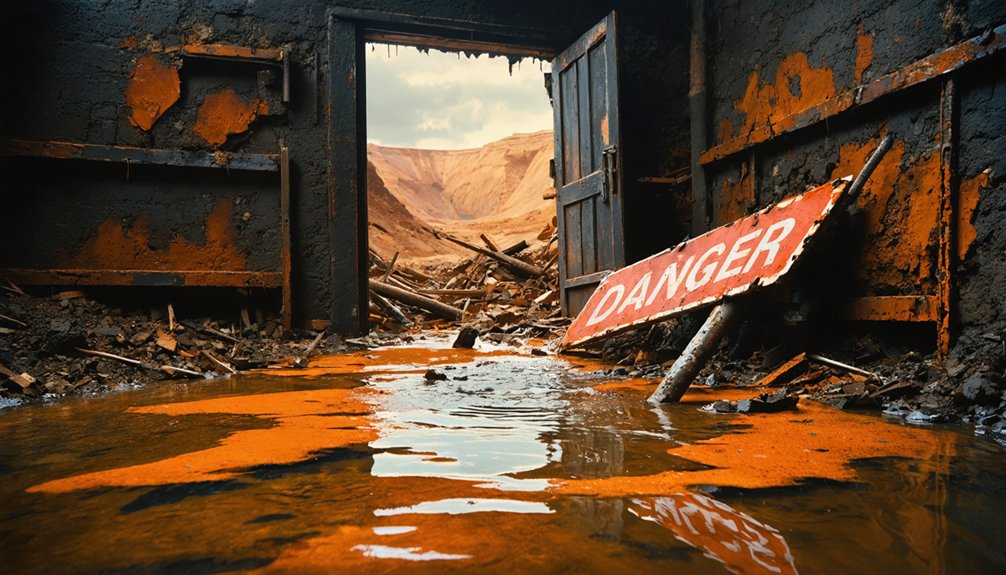
Although ghost towns may appear serene and picturesque, they often harbor serious environmental and health hazards from their industrial past.
You’ll face exposure risks from heavy metals like lead, arsenic, and mercury that contaminate the soil and dust. Wind can spread these toxic particles, while contaminated water sources contain dangerous levels of chemicals and bacteria.
The health risks multiply when you encounter asbestos in deteriorating buildings, acid mine drainage seeping into groundwater, and toxic mine tailings.
Environmental contamination extends beyond the immediate area through breached dams, chemical leaching, and persistent organic pollutants that enter the food chain.
Even the wildlife suffers, with mass die-offs linked to mining waste exposure. Standing water attracts disease-carrying mosquitoes, while coal seam fires release harmful gases that can affect your respiratory system.
Regional Safety Statistics and Reports
Statistical data paints a sobering picture of safety concerns in ghost towns and their surrounding regions. Crime statistics reveal that vacant properties can become magnets for criminal activity, with effects rippling outward up to 250 feet.
Safety reports indicate that the longer a property remains abandoned, the higher the risk becomes, typically peaking around 12-18 months after vacancy occurs.
- Deteriorating structures attract vandalism and trespassing, straining local law enforcement resources.
- Emergency response times often lag in abandoned areas due to resource allocation challenges.
- Small ghost towns can show deceptively high per-capita crime rates due to tiny population numbers.
- Areas surrounding vacant properties experience increased violent crime rates, particularly within the first year of abandonment.
When analyzing regional safety data, you’ll need to evaluate both the actual incident counts and how they’re scaled against the remaining population.
Protective Measures and Legal Considerations
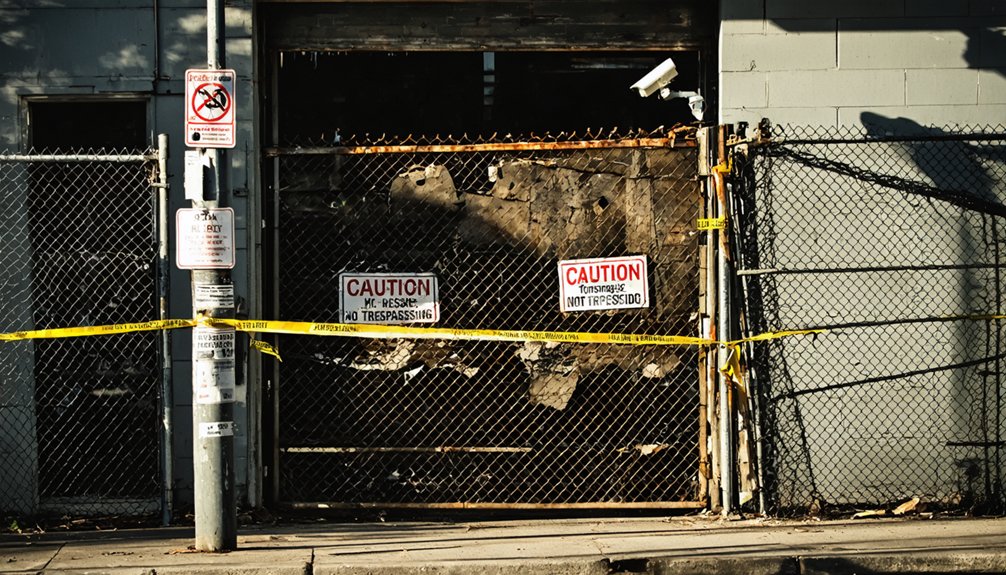
Before venturing into any ghost town exploration, you’ll need to implement thorough protective measures and understand the legal framework governing these sites.
Your protective equipment should include essentials like a reliable headlamp, N95 respirator, and sturdy leather boots to guard against hazards like exposed nails and deteriorating structures.
Prioritize your safety by downloading offline maps, testing floor stability, and maintaining clear exit paths. Stay close to structural supports and avoid rushing into questionable areas.
For legal compliance, ascertain you’re following local codes regarding site access and security measures. Many jurisdictions require specific boarding standards and risk assessments before entering abandoned structures.
Remember to inform proper authorities of your presence and implement necessary security measures like surveillance systems when required by law.
Frequently Asked Questions
Are There Any Ghost Towns That Are Still Inhabited Today?
You’ll find both inhabited ghost towns and modern ghost towns across America. Cities like Detroit, St. Louis, and New Orleans still have residents despite significant population decline and abandonment.
Can I Metal Detect or Collect Artifacts From Ghost Towns Legally?
90% of ghost towns are protected by federal laws. You’ll need written permission and must follow metal detecting laws and artifact collection guidelines. Never remove items from historic sites or federal lands.
What Emergency Services Are Available Near Remote Ghost Town Locations?
You’ll need to rely on emergency response from nearest towns, which can be hours away. Local resources vary greatly – some ghost towns have rangers nearby, while others lack all services.
Do Ghost Towns Have Any Protected Status as Historical Landmarks?
You’ll find a million ghost towns with various levels of historical preservation – from National Historic Landmarks to state registers. Your freedom to explore may depend on specific landmark designation status.
When Is the Safest Season to Visit Ghost Towns?
You’ll find summer offers the best weather and most predictable conditions for ghost town visits, though you’ll want to start early to avoid peak heat and larger crowds during seasonal activities.
References
- https://www.axios.com/local/salt-lake-city/2024/09/03/utah-ghost-towns-abandoned-mines-safety
- https://case.edu/socialwork/sites/default/files/2018-10/vacant_distressed_props_comm_health_safety.pdf
- https://thisisreno.com/2021/06/dangers-of-the-desert-abandoned-mines-and-hot-springs-can-be-deadly/
- https://pinkerton.com/our-insights/blog/vacancy-and-crime
- https://pmc.ncbi.nlm.nih.gov/articles/PMC11349791/
- https://www.camp-california.com/california-ghost-towns/
- https://www.yardi.com/blog/news/abandoned-america/38780.html
- https://theweek.com/science/abandoned-mine-safety-risks
- https://www.hcn.org/articles/south-mining-the-dizzying-scope-of-abandoned-mine-hazards-on-public-lands/
- http://blog.dol.gov/2022/08/23/stay-out-stay-alive-active-and-abandoned-mine-sites-are-dangerous-potentially-fatal