Yes, Connecticut has several notable ghost towns that reflect the state’s industrial and colonial past. You’ll find abandoned settlements like Bara-Hack, a Welsh community known for its paranormal activity, and Dudleytown, infamous for its alleged cursed history. Other significant sites include the former mill village of Johnsonville, the historic ruins at Gay City State Park, and Pleasure Beach, a modern abandoned amusement park. These forgotten places offer fascinating windows into Connecticut’s rich historical changes.
Key Takeaways
- Connecticut has several ghost towns, including well-known locations like Bara-Hack, Dudleytown, Johnsonville, Gay City, and Pleasure Beach.
- Unlike Western ghost towns, Connecticut’s abandoned settlements resulted from industrial decline, reservoir construction, and urban development changes.
- Bara-Hack, founded by Welsh families, contains stone walls, foundations, and a cemetery, reflecting its 18th-century agricultural and manufacturing heritage.
- Johnsonville, a former mill village, was later transformed into a Victorian tourist attraction before being abandoned after its owner’s death.
- Gay City State Park preserves the ruins of an 18th-century mill village, offering visitors historical remnants and recreational opportunities.
Defining Ghost Towns in the Nutmeg State
While many Americans associate ghost towns with the abandoned mining settlements of the American West, Connecticut’s ghost towns tell a unique story of industrial decline, reservoir construction, and urban development.
Forget the Wild West – New England’s ghost towns reveal tales of shuttered factories, flooded valleys, and forgotten communities.
You’ll find that the abandonment criteria for these Northeastern sites differ from their Western counterparts. In Connecticut, a ghost town must show tangible remains of its past life – whether they’re crumbling mill buildings, submerged foundations, or forgotten cemeteries. These abandoned locations must have historical significance to be classified. Notable examples like Bara-Hack continue to draw curious visitors seeking to explore Connecticut’s abandoned past.
These sites range from completely deserted villages like Dudleytown to partially inhabited areas experiencing urban decay. To be classified as a ghost town in the Nutmeg State, a location must have lost its original purpose for existence, though it may still maintain a skeleton population.
Public accessibility often determines whether these sites receive official ghost town designation.
The Lost Settlement of Bara-Hack
You’ll find one of Connecticut’s most intriguing ghost settlements at Bara-Hack, established in the late 18th century by Welsh families Higginbotham and Randall on the outskirts of Pomfret.
The land was originally part of the Mashamoquet Purchase, when James Fitch Jr. sold 15,100 acres to twelve colonists in 1686. The small farming settlement, which included houses, a barn, and a mill along with a family cemetery, gradually declined until its abandonment by the late 19th century. The families operated Higginbotham Linen Wheels, producing high-quality flax spinning wheels for the region.
While Bara-Hack’s physical remains today consist mainly of stone walls, foundations, and weathered headstones, its reputation as the “Village of Voices” stems from numerous paranormal claims spanning generations, including reports of phantom voices, mysterious lights, and spectral appearances near the cemetery grounds.
Historical Settlement Details
Deep in Connecticut’s Ragged Hills area on the outskirts of Pomfret lies the lost settlement of Bara-Hack, established between 1778 and 1780 by Welsh descendants Jonathan Randall and Obadiah Higginbotham.
The settlement’s name derives from Welsh, meaning “breaking of bread,” and its origins stem from two neighboring family farms rather than a planned village. The town became known for its spinning wheel production, which formed the backbone of its early economy. The village was abandoned after 1890, with the last residents leaving during the post-Civil War period.
The agricultural economy centered around:
- Small-scale farming operations managed by extended families
- A local mill positioned near the brook for processing crops
- Livestock management, evidenced by extensive stone wall networks
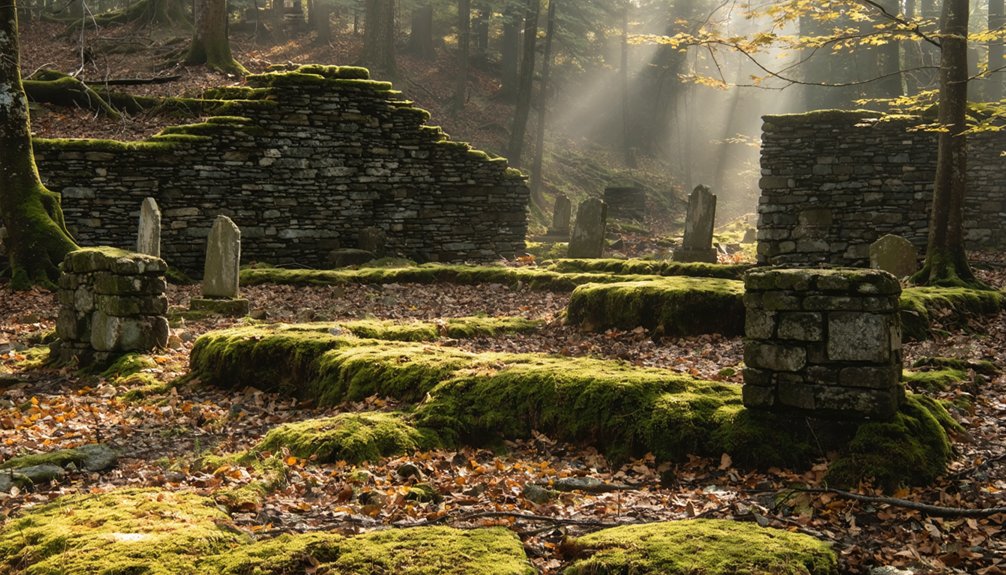
You’ll find the physical remnants of this once-thriving settlement through its house foundations, barn ruins, and a cemetery where the founding families were laid to rest.
These structural remains offer tangible proof of Bara-Hack’s historical significance in Connecticut’s rural development.
Paranormal Legacy Today
Throughout the decades since its abandonment, Bara-Hack has gained notoriety as the “Village of Voices,” earning its reputation from numerous reported paranormal occurrences at the site.
You’ll find accounts of disembodied sounds, including children playing, women calling, and animal noises echoing through the property. The site’s paranormal tourism has surged since the 1970s, with ghost hunting groups documenting mysterious orbs, light anomalies, and apparitions near the cemetery grounds. Originally established in 1780 by Welsh families, the settlement eventually fell into abandonment, with nature reclaiming its structures.
Today, while the property remains private and largely inaccessible, Bara-Hack continues to captivate paranormal enthusiasts.
Investigators have reported sensory phenomena ranging from unexplained feelings of depression to claims of temporary paralysis. The settlement’s supernatural legacy lives on through regional ghost tours, paranormal websites, and investigator accounts that fuel its mystique.
Dudleytown’s Dark History and Legends
You’ll find the dark legend of Dudleytown rooted in a small 18th-century Connecticut settlement, first owned by Thomas Griffis before being sold to Gideon Dudley.
While paranormal claims about the area gained traction after Edward C. Starr’s speculative 1926 account, historical records show the settlement’s decline stemmed from practical challenges like poor soil, economic hardship, and geographic isolation.
The community transitioned from farming to become a thriving mining village during the American Revolution, meeting the increased demand for iron production and arms.
The supernatural tales, including stories of an ancestral curse and unexplained phenomena, emerged relatively recently and lack primary source evidence, despite their popularization by ghost hunters and media since the 1970s. The area’s eerie reputation was enhanced by its location along Dark Entry road within deep wooded surroundings.
Origins and Settlement History
Located in the Dark Entry Forest near Cornwall, Connecticut, Dudleytown’s haunting legacy traces back to a purported curse that followed the Dudley family from England.
The Dudley Curse originated when Edmund Dudley was beheaded in 1510, followed by his son John’s execution in 1553, setting a dark pattern for their descendants.
When the Dudleys fled to America, they encountered significant Settlement Challenges in their new home:
- The valley’s unique position between three hills created perpetual darkness, even at midday.
- Harsh winters and poor soil quality made farming nearly impossible.
- The land, originally owned by Thomas Griffis, was purchased by Gideon Dudley and his brothers in 1747.
Despite initial attempts at establishing a farming community, growing flax, wheat, and corn, the settlement’s isolation and environmental obstacles ultimately led to its demise. The settlement’s small population of twenty-six families struggled without basic amenities like stores or churches, forcing them to rely on neighboring towns for essential services.
Supernatural Claims Explored
The supernatural legacy of Dudleytown extends far beyond its settlement challenges, with tales of curses, mysterious deaths, and paranormal encounters shaping its reputation as one of America’s most haunted locations.
The alleged curse, traced to Edmund Dudley’s 1510 execution, followed settlers to Connecticut where supernatural phenomena began manifesting. You’ll find accounts of Gershon Hollister’s 1792 murder, William Tanner’s descent into madness, and numerous unexplained deaths that plagued the community.
While Ed and Lorraine Warren’s 1970s investigation declared the site demonically possessed, modern ghost hunters report ghostly encounters including being touched and scratched by unseen forces.
However, historians counter these claims, attributing Dudleytown’s abandonment to practical factors like poor soil, harsh winters, and economic decline rather than supernatural causes.
Johnsonville: From Mill Village to Abandoned Town
Nestled along the Moodus River, Johnsonville emerged as a thriving mill village in the early-to-mid 19th century, capitalizing on the waterway’s power to operate its textile and twine-producing mills.
You’ll discover a fascinating evolution in Johnsonville’s history, from its industrial roots to an eccentric millionaire‘s Victorian restoration project. In the 1960s, Ray Schmitt transformed the declining village into his personal vision of a Victorian-era attraction.
Three striking features defined Schmitt’s restored Johnsonville:
- Relocated period buildings, including a chapel and general store
- Authentic Victorian artifacts and vintage trolley cars
- The iconic Emory Johnson Homestead (1842-1846)
After Schmitt’s death in 1998, the village fell into abandonment.
Despite multiple ownership changes and development proposals, Johnsonville remains largely untouched, standing as Connecticut’s most infamous ghost town.
historical ghost towns in connecticut offer a glimpse into the state’s rich past, showcasing the remnants of communities that once thrived. Exploring these sites allows visitors to uncover stories of industry and decline, as well as the social fabric of earlier times. Each ghost town has its own unique history, contributing to the tapestry of Connecticut’s heritage.
Gay City State Park: Preserving Connecticut’s Industrial Past
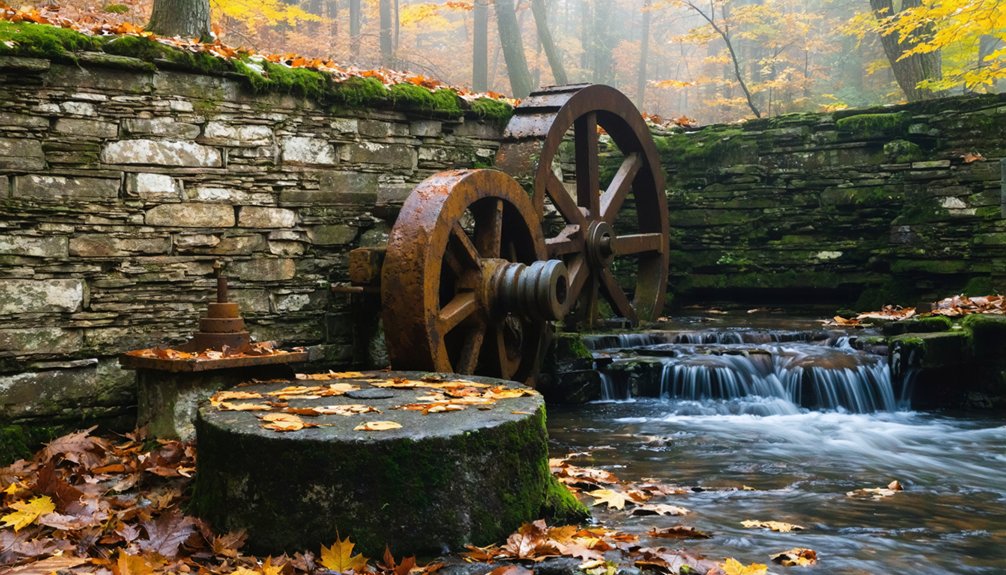
As Connecticut’s industrial heritage slowly fades into memory, Gay City State Park stands as a remarkable tribute to the rise and fall of early American manufacturing communities.
You’ll discover the ghostly remnants of a once-thriving mill village established in 1796 by Elijah Andrus and his followers. The settlement, originally known as Factory Hollow, prospered through water-powered mills along the Blackledge River until a series of devastating fires, economic troubles, and social tensions led to its abandonment by the 1880s.
Today, you can explore the park’s 1,569 acres, where scattered foundations, cemetery remnants, and roughly 10 miles of trails tell the story of this industrial past. The site’s transformation into a state park in 1944 has preserved these historic ruins while offering recreational opportunities amid its storied landscape.
The Decline of Pleasure Beach: A Modern Ghost Town
While Gay City’s ruins tell the tale of 19th-century industrial decline, Pleasure Beach represents Connecticut’s more recent transformation into a modern ghost town.
Once a thriving “Million Dollar Playground” founded in 1892, you’ll now find a haunting example of modern abandonment along Bridgeport’s coast. The peninsula’s isolation intensified after a devastating 1996 fire destroyed the only bridge access, leaving behind:
Along Bridgeport’s coast lies a ghostly playground, isolated since 1996 when flames consumed its last connection to civilization.
- Crumbling remnants of the former amusement park, including the distinctive yellow octagon Polka Dot Playhouse
- Nature-reclaimed seasonal cottages, abandoned after lease terminations in the 1990s
- A solitary T-shaped pier where local anglers still cast their lines
Multiple revival attempts, from casino proposals to college campus plans, have failed to resurrect this once-vibrant destination, now serving primarily as a protected bird sanctuary.
Frequently Asked Questions
Can I Legally Camp Overnight in Connecticut’s Ghost Towns?
You can’t legally camp in private ghost towns without owner permission. For ghost towns on state land, you’ll need overnight permits and must follow camping regulations at designated sites only.
What Personal Items or Artifacts Have Been Found in These Abandoned Places?
Like silent witnesses to vanished lives, you’ll find abandoned artifacts ranging from rusted mill machinery and Victorian architectural elements to personal belongings like ceramic dishes, clothing remnants, and paper documents throughout Connecticut’s ghost settlements.
Are There Guided Historical Tours Available to Any Ghost Towns?
You can’t take guided ghost tours at Johnsonville, Bara-Hack, or Dudleytown due to private ownership. However, you’ll find self-guided exploration of historical significance at Gay City State Park’s public trails.
Which Ghost Town Is Closest to Major Connecticut Cities?
You’ll find the Saugatuck Reservoir towns closest to Bridgeport, with abandoned buildings beneath the water. Next nearest is Johnsonville’s historically significant Victorian structures, just 25 miles from Hartford.
Do Any Native American Settlements Qualify as Ghost Towns in Connecticut?
You’ll find several abandoned Native American settlements, particularly Pequot villages near Mystic, that qualify as ghost towns due to their tragic settlement history following disease, warfare, and colonial displacement.
In addition to the Pequot villages, there are numerous abandoned sites in Connecticut that tell the stories of those who once inhabited them. Each location carries remnants of history, from old factories to forgotten homes, waiting for exploration and preservation. These sites provide a unique glimpse into the past, reminding us of the changing landscapes and lives throughout the state’s history.
exploring unique stays in connecticut’s ghost towns allows visitors to immerse themselves in the eerie beauty and stories of these forgotten places. As you wander through these haunting landscapes, you’ll uncover tales of resilience and loss, connecting past inhabitants with today’s adventurers. Each stay offers a unique opportunity to reflect on the history that shaped the region while enjoying the tranquility of nature reclaiming these once-thriving communities.
References
- https://kids.kiddle.co/List_of_ghost_towns_in_Connecticut
- https://patch.com/connecticut/brookfield/abandoned-not-forgotten-4-connecticut-ghost-towns
- https://www.atlasobscura.com/things-to-do/connecticut/ghost-towns
- https://earlybirdonthetrail.com/haunted-hikes-in-connecticut/
- https://www.geotab.com/ghost-towns/
- https://www.youtube.com/watch?v=V3k1shmJqeU
- https://ctvisit.com/articles/ghost-hunting-in-connecticut
- https://www.ctinsider.com/projects/2025/lost-ct-towns/
- https://en.wikipedia.org/wiki/List_of_ghost_towns_in_Connecticut
- https://westernmininghistory.com/664/what-is-a-ghost-town-wmh-town-classifications-explained/