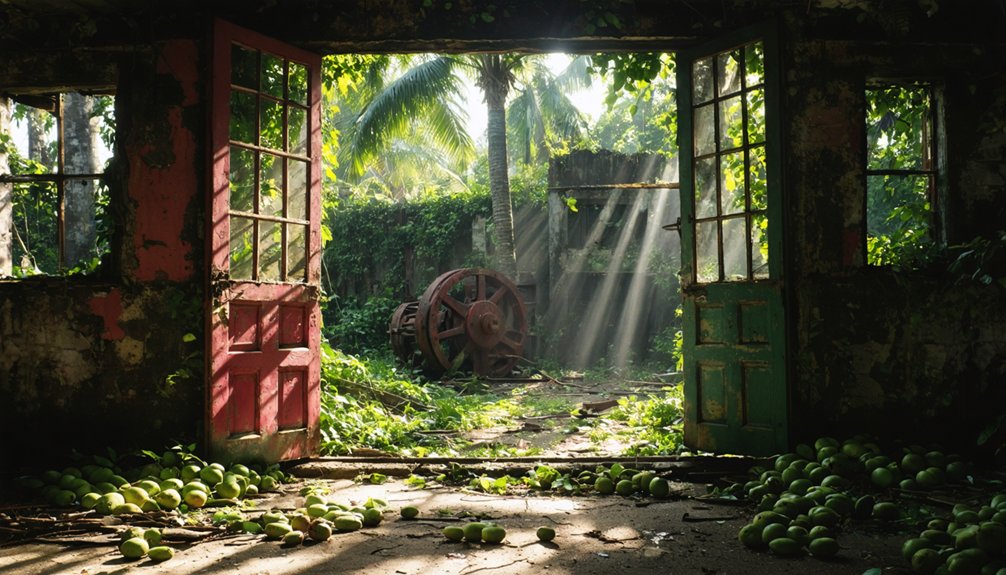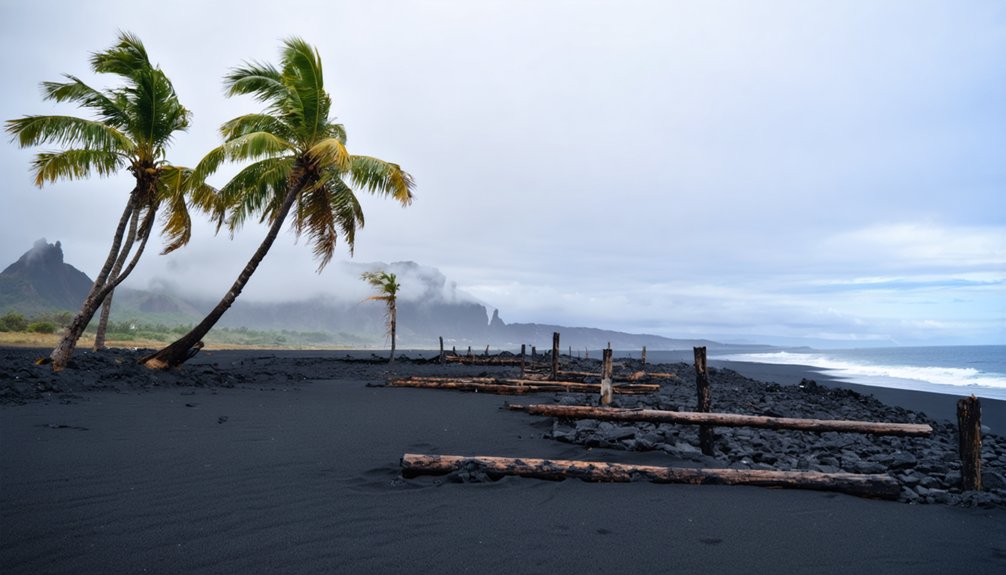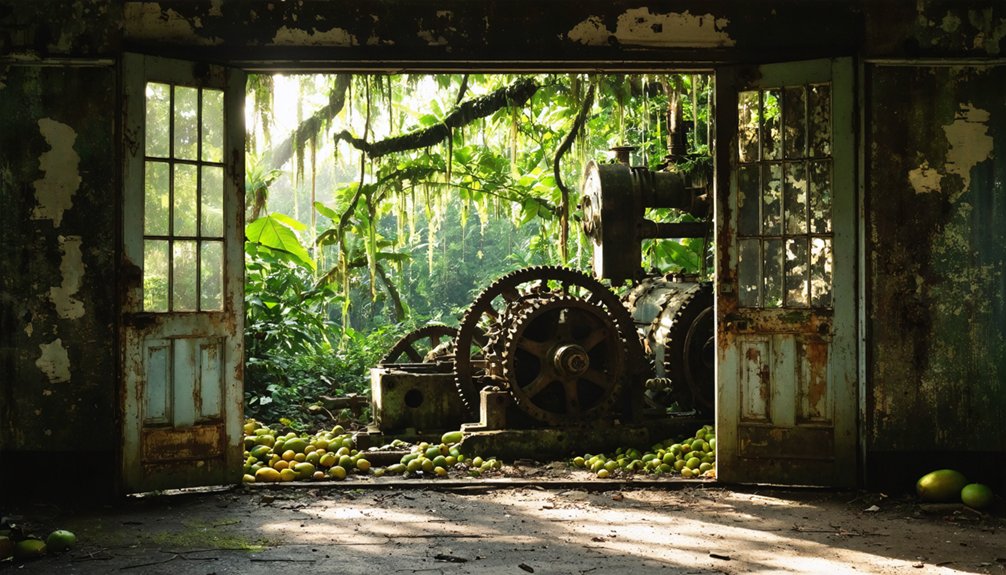
Yes, you’ll find several ghost towns across Hawaii’s islands, each telling a unique story of displacement and change. From Kalaupapa’s former Hansen’s disease settlement on Molokai to abandoned sugar plantations like Honoka’a on the Big Island, these sites reflect powerful histories of natural disasters, economic shifts, and cultural transformation. Ancient communities like Waipi’o Valley and Punalu’u Village stand as silent witnesses to Hawaii’s complex past, while sacred grounds and haunted locations hold even deeper mysteries waiting to be uncovered.
Key Takeaways
- Kalaupapa, established in 1866, is Hawaii’s most famous ghost town, where over 8,000 Hansen’s disease patients were exiled until 1969.
- The 1946 tsunami caused the abandonment of Waipi’o Valley, transforming a once-thriving community into a historical ghost town.
- Punalu’u Village contains remnants of Hawaii’s sugar industry era, with abandoned harbor facilities and plantation infrastructure.
- Kilauea’s volcanic activity, especially in 2018, created modern ghost towns as lava flows forced communities to relocate permanently.
- Hakalau Sugar Mill stands as an abandoned reminder of Hawaii’s plantation era, marking the economic transformation after the sugar industry’s decline.
The Legacy of Kalaupapa: Hawaii’s Most Famous Ghost Town
While many ghost towns emerged from abandoned mining operations or failed settlements, Kalaupapa stands apart as a place born of profound human tragedy. In 1866, the Kingdom of Hawaiʻi began forcibly relocating people with Hansen’s disease to this isolated peninsula, bound by ocean and towering 1,600-foot cliffs.
Over 8,000 patients would eventually be exiled here, building their lives in what started as little more than caves and crude shelters.
Though medical advances in the 1940s finally offered treatment, the policy of forced isolation continued until 1969.
Despite medical breakthroughs that could heal Hansen’s disease, fear and policy kept patients isolated on Kalaupapa for decades more.
Today, you’ll find a haunting landscape of preserved churches, homes, and hospital buildings – silent witnesses to decades of separation and survival. Local residents still speak of haunted groves where mysterious apparitions appear on moonlit nights. The settlement found hope through Father Damien’s work, as he provided crucial care and support to the isolated community until his death from leprosy in 1889.
While a small number of former patients still call Kalaupapa home, their dwindling presence marks the end of a dark chapter in Hawaiian history.
The Sugar Era: Honoka’a’s Transformation
If you’d visited Honoka’a during its sugar-producing peak in the early 1900s, you’d have witnessed a bustling industrial town with its nine-roller mill processing cane from surrounding plantations and shipping sugar via an innovative wire rope system to waiting steamers.
A sophisticated flume system network transported harvested cane efficiently to strategically positioned railroad cars throughout the plantation’s extensive terrain.
The 1994 closure of Hamakua Sugar Company ended over a century of plantation life, leaving behind empty mill buildings and dramatically altering the economic fabric of this once-thriving community.
Today, you’ll find Honoka’a reinventing itself through heritage tourism, with the historic downtown district and former plantation structures serving as reminders of its sugar-era prosperity.
The area’s economic transformation began during the Great Depression, though it managed to rebound significantly during the 1940s as sugar production increased.
Sugar Mill’s Industrial Height
As technological advancements transformed Honokaʻa’s sugar industry in the late 1800s, the region emerged as a powerhouse of Hawaiian sugar production.
You’d have witnessed the impressive evolution from a simple two-roll crusher to a sophisticated nine-roller mill by 1899, dramatically increasing efficiency.
The industrial advancements didn’t stop there – an innovative wire rope system and inclined tramway revolutionized sugar transport from cliff warehouses directly to waiting ships. The town’s development was directly tied to the Hamakua Coast plantations, which cleared vast areas of native forest to expand sugar production. The rapid growth attracted diverse ethnic workers, including Chinese, Japanese, Portuguese and Filipino laborers who shaped the region’s unique cultural identity.
Closing’s Economic Impact
The sugar mill’s technological prowess eventually gave way to economic hardship in the early twentieth century.
You’d have witnessed devastating economic repercussions as hundreds of workers lost their livelihoods, with unemployment rates climbing sharply across the islands. The job displacement hit rural communities particularly hard, where sugar production had been the backbone of multi-generational employment.
The community impact rippled through the local economy, affecting everyone from suppliers to service providers. Rising labor costs after Hawaii achieved statehood further accelerated the industry’s decline.
You’ll notice how the land transformation reshaped Hawaii’s landscape, as former plantation fields gave way to resorts, housing developments, and smaller farming operations.
Water systems that once served vast cane fields were redirected to support new ventures, while many plantation families were forced to seek opportunities in tourism or construction, or leave their ancestral communities altogether.
Similar transitions occurred in 2016 when 675 workers at Hawaiian Commercial & Sugar Company faced unemployment as Alexander & Baldwin ended their sugar operations on Maui.
Tourism Revival Path
Through careful preservation of its plantation-era charm, Honokaʻa now stands poised for a tourism renaissance that honors its sugar heritage while embracing modern hospitality.
You’ll discover authentic tourism strategies that blend the town’s multi-ethnic history with contemporary visitor experiences. Walk through historic commercial buildings repurposed as boutique shops and cafés, or join heritage tours that trace the footsteps of Chinese, Japanese, Filipino, and Portuguese laborers who shaped this community.
The town attracts 20 to 30 visitors daily to its Heritage Center, which opened in 2021 to preserve the rich history of the region. Community engagement drives the revival, with local organizations developing cultural events that showcase plantation-era fusion cuisine and traditional crafts.
You can explore former mill sites and tramway routes while learning about sugar production’s impact on the landscape. The town’s proximity to the Hāmākua Coast’s natural wonders creates opportunities for combined heritage-nature experiences that’ll immerse you in Hawaii’s rich past.
Ancient Wonders of Waipi’o Valley
Located along Hawaiʻi Island’s northeastern coast, Waipiʻo Valley stands as one of the most significant ancient Hawaiian settlements, with its crown jewel being Nāpoʻopoʻo – a sprawling village complex dating back to 800-1200 AD.
You’ll find over 400 historic loʻi bounded by intricate rock walls, alongside 43 raised house platforms that once supported a thriving community. The valley’s unique geomorphology, with its towering 2,000-foot cliffs and life-giving waterfalls, created perfect conditions for extensive taro cultivation.
Beyond Nāpoʻopoʻo’s archaeology, Waipiʻo’s sacred landscape holds deep connections to Hawaiian spirituality. Today, dedicated efforts focus on stewardship of sacred lands through community-driven restoration projects.
The valley served as a royal residence and religious center, with heiau platforms and Nioi tree groves marking places of power, while traditional beliefs link the area to Lua-o-Milu, the Hawaiian underworld.
Forgotten Communities of the Big Island
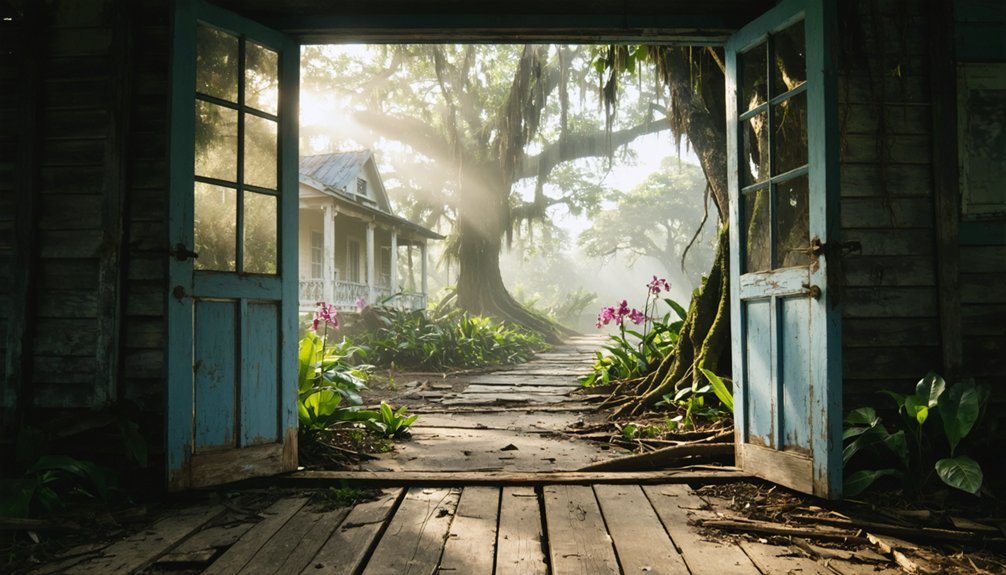
Scattered across Hawaiʻi Island’s diverse landscapes, abandoned communities tell compelling stories of economic shifts, natural disasters, and cultural transformation.
You’ll find these tales etched in places like Punalu’u Village, where a once-thriving harbor and railway system supported the sugar industry before falling silent, its structures now slowly surrendering to black sand.
Along the coastline, the Kikala-Keokea subdivision stands as a poignant reminder of displacement, built for families who lost their homes to Pele’s 1983 flows in Kalapana.
Rising from Pele’s destruction, Kikala-Keokea offers new beginnings for those who watched their Kalapana homes vanish beneath the lava.
Ancient fishponds at Kaloko-Honokōhau whisper stories of traditional life, while the rusting remnants of Hakalau Sugar Mill mark the end of a plantation era.
In Honoka’a, you’ll discover how a former sugar town reinvented itself through preservation and tourism.
Haunted Places Around Honolulu
Deep within urban Honolulu’s bustling streets, ancient spirits and modern hauntings intertwine to create some of Hawaii’s most compelling supernatural sites.
From royal apparitions to warrior spirits, these locations hold centuries of haunted history and ghostly encounters that continue to captivate visitors and locals alike.
- You’ll find Queen Lili’uokalani’s spirit still wandering the halls of Iolani Palace, where she was imprisoned during the overthrow of the Hawaiian monarchy.
- At Kawaiaha’o Church, night marchers emerge on moonless nights when the tide is high, demanding respect from those who cross their ancient paths.
- The abandoned Waialae Drive Theater harbors a faceless female entity that terrorizes visitors near its cemetery.
- Kaimuki House stands as a monument to supernatural forces, where in 1942, witnesses observed children being attacked by an unseen presence.
Natural Disasters and Abandoned Settlements
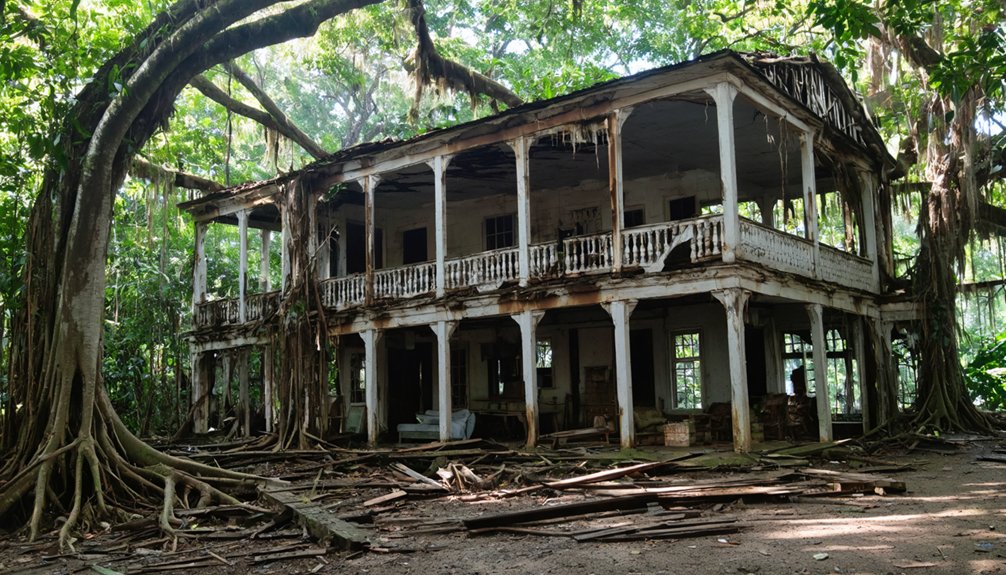
While supernatural forces may haunt Hawaii’s abandoned places, nature’s raw power has driven the most dramatic settlement changes across the islands.
You’ll find the evidence in places like Waipi’o Valley, where the devastating 1946 tsunami forced families to abandon their ancestral lands. The waves also destroyed Laupāhoehoe’s shoreline community, scattering residents to higher ground.
Kīlauea’s volcanic eruptions have reshaped entire communities, most recently in 2018 when lava consumed homes in Leilani Estates. The volcano goddess Pele’s power continues to determine where people can live.
Beyond the dramatic tsunami impacts and volcanic eruptions, you’ll discover that fierce storms and floods have slowly emptied plantation towns and farming villages, especially in steep valley bottoms where landslides threaten survival.
Sacred Grounds and Historical Significance
Throughout the Hawaiian archipelago, sacred grounds interweave with abandoned settlements, creating a complex tapestry of spiritual and historical significance that you’ll encounter in nearly every district.
These sacred landscapes reveal deep ancestral connections through ancient heiau, burial grounds, and places of refuge that persist despite their abandonment.
- You’ll find temple remnants and ceremonial platforms nestled within former village sites, marking locations where ritual practices once flourished.
- Traditional fishponds and irrigation systems stand as symbols of both practical and spiritual relationships with the land.
- Protected by customary laws, many sites maintain their sacred status through modern preservation efforts.
- Ancient petroglyphs and carved stones serve as enduring records of chiefly lineages and ritual knowledge, connecting present-day Hawaiians to their ancestors’ sacred spaces.
Cultural Impact of Hawaiian Ghost Towns
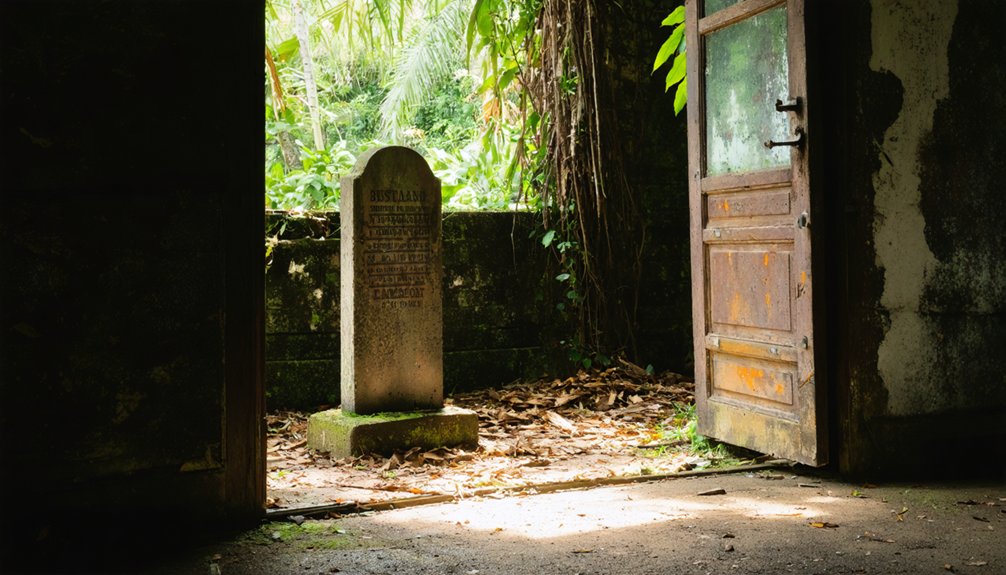
As plantation economies collapsed across Hawaii’s islands during the mid-twentieth century, the resulting ghost towns created rippling cultural impacts that you can still witness today.
Many visitors are drawn to the haunted locations in Hawaii, intrigued by the rich history and the stories of those who once thrived there. Exploring these eerie sites offers a glimpse into the past, allowing people to connect with the culture and legends that persist even in modern times. Each haunted location tells a unique story, making them popular destinations for both tourists and locals alike.
The dispersal of ethnic enclaves fractured tight-knit communities of Japanese, Filipino, Portuguese, Okinawan, and Hawaiian residents, interrupting generations of place-based knowledge transmission.
Yet cultural syncretism emerged from this upheaval, as spiritual beliefs merged across communities. You’ll find Hawaiian concepts of mana and kapu intertwined with Japanese yūrei and Filipino engkanto beliefs in ghost narratives that preserve local histories.
Community resilience manifests through annual pilgrimages to tend ancestral graves, maintain cultural practices, and conduct traditional ceremonies at abandoned sites.
While tourist commodification poses challenges, descendants continue fighting to protect these sacred spaces and their multifaceted cultural legacies.
Preservation Efforts and Heritage Tourism
Modern preservation efforts for Hawaii’s ghost towns draw upon diverse funding streams and legal frameworks to protect these irreplaceable cultural landscapes. You’ll find preservation funding comes from multiple sources, including federal grants, state programs, and private donations, all working to stabilize and document these historic sites.
- National Historic Preservation Fund grants support sugar plantation structure conservation
- State Historic Preservation Division oversees site protection and archaeological reviews
- Native Hawaiian cultural rights influence heritage tourism development
- Digital documentation helps preserve sites where physical conservation isn’t feasible
The combination of tropical climate challenges and remote locations makes preservation complex, but heritage tourism through adaptive reuse has created sustainable solutions.
You’ll see former plantation buildings transformed into cultural centers and museums, providing both preservation opportunities and economic benefits for local communities.
Frequently Asked Questions
Can Visitors Legally Explore Abandoned Hawaiian Ghost Towns Without a Guide?
You’ll find most abandoned Hawaiian sites are legally accessible without guides, though visitor safety and local regulations vary. Some locations like Puuhonua O Naunau welcome self-guided exploration during park hours.
What Artifacts Are Commonly Found in Hawaii’s Ghost Towns Today?
You’ll discover petroglyphs carved in lava rock, ancient heiau foundations, fishpond walls, taro field terraces, and remains of plantation-era buildings. Many artifacts hold deep historical significance to Native Hawaiian culture.
Are There Underwater Ghost Towns off Hawaii’s Coasts?
While underwater exploration reveals shipwrecks and lava formations off Hawaii’s coasts, you won’t find any submerged history of traditional ghost towns – these weren’t part of Hawaii’s cultural development patterns.
However, there are still haunting remnants of the past for those intrigued by the idea of ghost towns to visit in Hawaii. Places like the abandoned sugar plantation town of Waipahu offer a glimpse into the state’s agricultural history. Exploring these sites can provide unique insights into the lives of the people who once thrived there.
How Many Hawaiian Ghost Towns Have Been Completely Reclaimed by Nature?
You’ll find at least four major sites where nature’s reclamation is complete: Club Med Hanalei Bay, Waipi’o Valley settlements, Molokai’s tsunami-abandoned town, and Coco Palms Resort – each showcasing ghost town ecology.
Do Any Ghost Towns in Hawaii Still Have Permanent Residents?
You’ll find current residents in Kalaupapa, where six original Hansen’s disease patients maintain their historical significance as permanent inhabitants, while Lahaina’s displaced community gradually returns amid ongoing reconstruction efforts.
References
- https://nvtami.com/2023/04/26/big-island-hawaii-ghost-towns/
- https://www.americanghostwalks.com/7-creepiest-urban-legends-and-ghost-stories-from-hawaii
- https://www.guinnessworldrecords.com/news/2025/9/the-ghost-towns-at-the-edge-of-the-world-that-broke-record-titles-without-people
- https://www.geotab.com/ghost-towns/
- https://www.youtube.com/watch?v=DilYlbLKDdw
- https://www.mysteries-of-hawaii.com/blog/category/haunted+buildings
- https://freepages.rootsweb.com/~gtusa/history/usa/hi.htm
- https://honoluluhaunts.com/the-mysterious-saddle-road/
- https://en.wikipedia.org/wiki/List_of_ghost_towns_in_Hawaii
- https://www.mysteries-of-hawaii.com/blog/the-kalaupapa-ghost