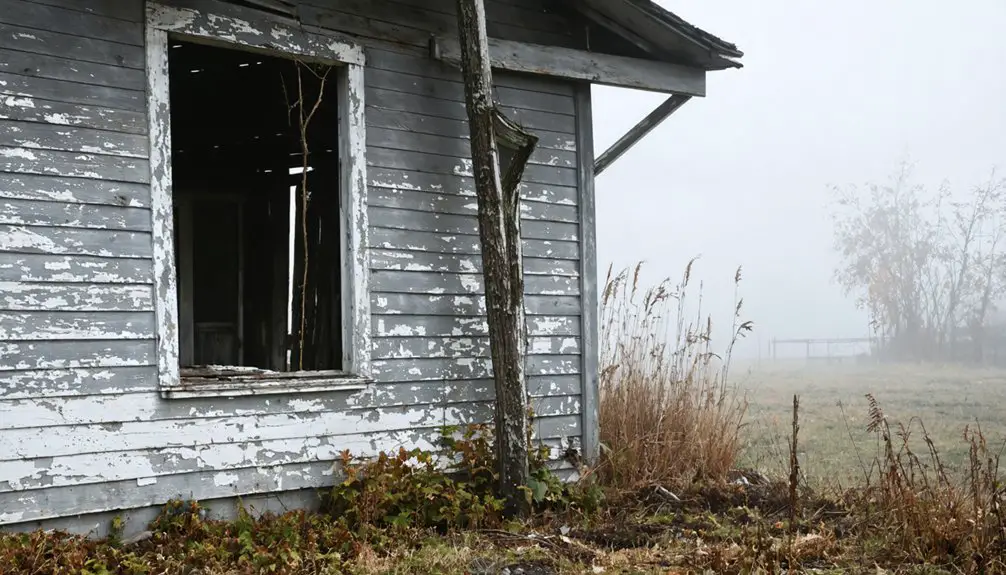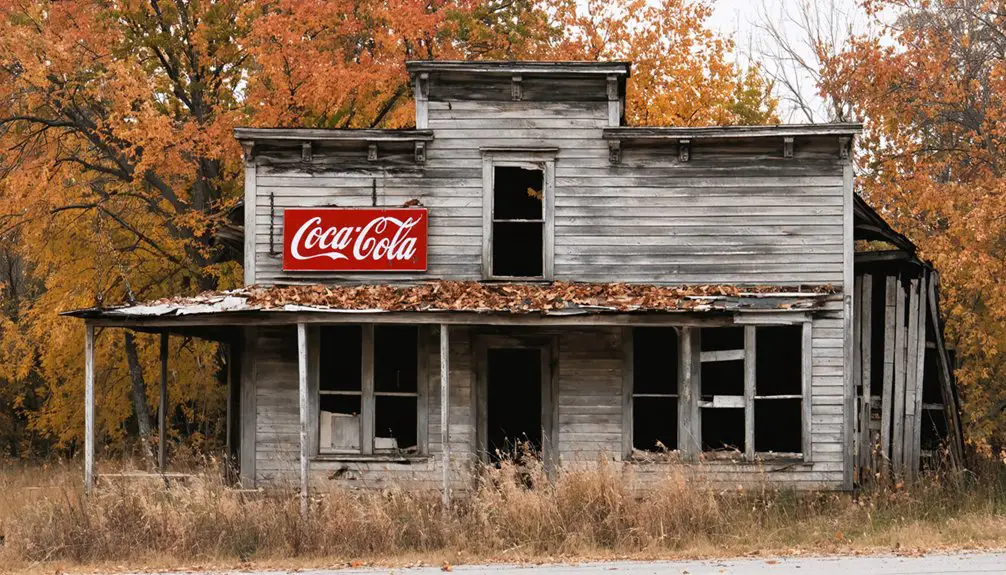
You’ll find numerous ghost towns throughout Michigan, remnants of the state’s industrial past. These abandoned settlements tell stories of the late 1800s mining boom in the Keweenaw Peninsula and the lumber era that created temporary towns like Pere Cheney. Many sites feature old foundations, cemeteries, and crumbling buildings, while others like Fayette Historic State Park offer well-preserved glimpses into Michigan’s rich history. Exploring these forgotten communities reveals fascinating chapters of the Great Lakes State’s heritage.
Key Takeaways
- Michigan has numerous ghost towns from abandoned lumber, mining, and railroad communities across the state.
- The Keweenaw Peninsula features several mining ghost towns, including Cliff Mine and Central Mine Village.
- Pere Cheney is a notable ghost town from the logging era that was abandoned by 1917 due to disease and fire.
- Railroad ghost towns like Millbrook and Quinn emerged when rail lines were rerouted, leaving communities to decline.
- Many ghost towns are preserved as historic sites, with Fayette Historic State Park being a well-maintained example.
What Makes a Michigan Ghost Town
While many people imagine ghost towns only exist in the American West, Michigan’s landscape is dotted with abandoned settlements that tell fascinating stories of boom-and-bust cycles, environmental challenges, and societal shifts.
You’ll find that Michigan ghost towns emerged from a complex mix of environmental factors and economic shifts. When lumber companies exhausted the surrounding forests or sand dunes buried coastal settlements, towns often couldn’t survive. Mining communities, like Central which reached a peak of 1,350 residents, demonstrate how population centers could rapidly expand and decline.
The town of Singapore serves as a prime example, where shifting sand dunes completely buried the once-prosperous lumber town by the mid-1870s.
Transportation changes, like railroad realignments or lost shipping routes, could cut off essential economic lifelines. Single-industry communities, particularly those dependent on lumber mills or tourism, frequently collapsed when their primary revenue source disappeared.
The death of these towns was usually gradual – young people moved away, businesses closed, and buildings deteriorated. Eventually, nature reclaimed these once-thriving communities, leaving only traces of their former existence.
Mining Boom and Bust Settlements
Throughout Michigan’s copper mining era, the Keweenaw Peninsula emerged as the epicenter of dramatic boom-and-bust cycles that created and destroyed entire communities.
You’ll find remnants of these mining settlements scattered across the region, from the historic Cliff Mine, which operated as America’s most productive copper mine in the 1840s, to the once-thriving Central Mine Village that housed over 1,200 residents at its peak.
These ghost towns tell a compelling story of rapid growth and decline. The Mohawk Mine exemplifies the remote operations that contributed to numerous undocumented settlements hidden in the woods, while Delaware and Freda showcase the fleeting prosperity that defined the era. The town of Clifton, with its peak of 700 residents in 1877, now stands as another testament to the region’s mining heritage. The 1913 miners strike severely impacted many of these communities, leading to their eventual abandonment.
Abandoned settlements scattered across Michigan’s Keweenaw Peninsula stand as silent witnesses to the copper industry’s dramatic rise and fall.
Today, you’ll spot old apple trees marking former residential areas, and you’ll need to watch for hazardous mine shafts concealed by decades of overgrowth.
Logging Era Abandoned Towns
During Michigan’s lumber boom of the late 1800s, dozens of makeshift towns sprang up across the northern forests, only to vanish within decades as the timber industry collapsed.
You’ll find the logging legacy scattered across places like Pere Cheney, once a bustling town of 1,500 that succumbed to disease and fire by 1917.
In Otsego County, towns like Salling, Logan, and Quick featured the telltale signs of lumber settlements – tarpaper shacks, sawmills, and railroad tracks. The logging industry has evolved to become a major economic driver, generating $14-20 billion annually.
Jennings stood out with its innovative double-cut bandsaw mill and diverse immigrant workforce of Finns, Swedes, and Norwegians. At its peak in 1890, the mill employed 600 workers and shipped 22 train car loads of lumber daily.
Today, ghost town exploration reveals little more than cement foundations, abandoned cemeteries, and overgrown trails where these communities once thrived.
Railroad Ghost Towns Across the State
You’ll find Michigan’s railroad ghost towns scattered across the state where junction points, depots, and company settlements once thrived before being abandoned due to rail line changes and economic shifts.
Many of these forgotten communities, like Millbrook and Quinn, declined when main lines were rerouted or local freight service ended, leaving behind crumbling foundations and occasional preserved station buildings.
A prime example is the town of Rawsonville, which fell into decline after railroads bypassed the once-prosperous community. The Michigan Central Railroad Depot in Bach, built around 1902 at Bach Road, represents one of these historic transportation hubs that shaped local commerce.
Railroad Junction Abandonment Impacts
Michigan’s railroad junctions played a pivotal role in establishing numerous towns across the state, creating a network of bustling communities that would later become ghost towns.
When you look at these abandoned places today, you’ll find the remnants of once-thriving centers where multiple rail lines intersected. These junctions served as a critical transport lifeline for timber, minerals, and agricultural goods.
The economic viability of these towns hinged entirely on railroad operations. When companies began consolidating routes, abandoning tracks, or rerouting freight traffic, these communities quickly declined. Much like the lumber operations at Aral and Good Harbor, rail towns relied heavily on a single industry for survival.
You can still witness the aftermath: empty commercial districts, crumbling depots, and overgrown rail beds. Many towns lost their populations within just a decade of service discontinuation, leaving behind only scattered houses and silent streets where commerce once flourished. Like many ghost towns that emerged during the 1880-1940 period, Michigan’s railroad communities followed similar patterns of rise and decline.
Preserved Station Buildings Today
While many railroad ghost towns across Michigan have vanished entirely, several remarkable station buildings and related structures still stand as evidence to the state’s rail heritage.
You’ll find the Fayette Locomotive House, a well-preserved rectangular building with a pitched roof that once serviced trains on a six-mile T-rail line, now protected within Fayette State Park.
At Millbrook, you can explore a mix of ruins and renovated structures that survived the railroad’s decline, offering glimpses into its operational past.
The preserved structures at these sites hold significant historical importance, from locomotive maintenance facilities to associated buildings like post offices and stores.
These surviving remnants provide tangible connections to Michigan’s industrial age, when railroads were crucial lifelines for remote communities.
Following Former Rail Lines
Throughout Michigan’s northern regions and the Upper Peninsula, abandoned rail lines offer pathways to discover numerous ghost towns that once thrived as bustling lumber and mining communities.
You’ll find places like Cleopatra and Sigma, where declining rail service led to their demise after local mills closed.
On North Manitou Island, you can explore the remains of Crescent, a logging village that vanished after its private rail line and equipment were removed in 1915.
Railroad history reveals how transportation shifts transformed these landscapes.
Communities like Pinnebog and Holbrook lost prominence when rail routes changed or closed.
In the Sleeping Bear Dunes area, you can trace multiple abandoned communities that depended on temporary rail grades for timber extraction, their brief existence tied directly to the railroad’s presence.
Must-Visit Ghost Town Destinations
Hidden across the Upper Peninsula’s rugged terrain, several enchanting ghost towns offer visitors a glimpse into Michigan’s rich mining heritage.
You’ll discover abandoned copper mining communities like Freda, Cliff, Central, and Delaware, each telling a unique story of the region’s industrial past. These destinations reward adventurous explorers with authentic remnants of the 1800s mining era.
- Trek to Freda’s elevated rock piles for sweeping valley views and explore the restored Miners house #8.
- Venture into Cliff’s remote wilderness setting, complete with nearby waterfalls.
- Witness Central’s industrial artifacts amid the northern Keweenaw landscape.
- Experience Delaware’s well-preserved historical structures during ghost town explorations.
For a different historical perspective, visit Glen Haven in Sleeping Bear Dunes, where preserved logging village structures showcase Michigan’s timber industry heritage.
Preservation Status and Access Tips
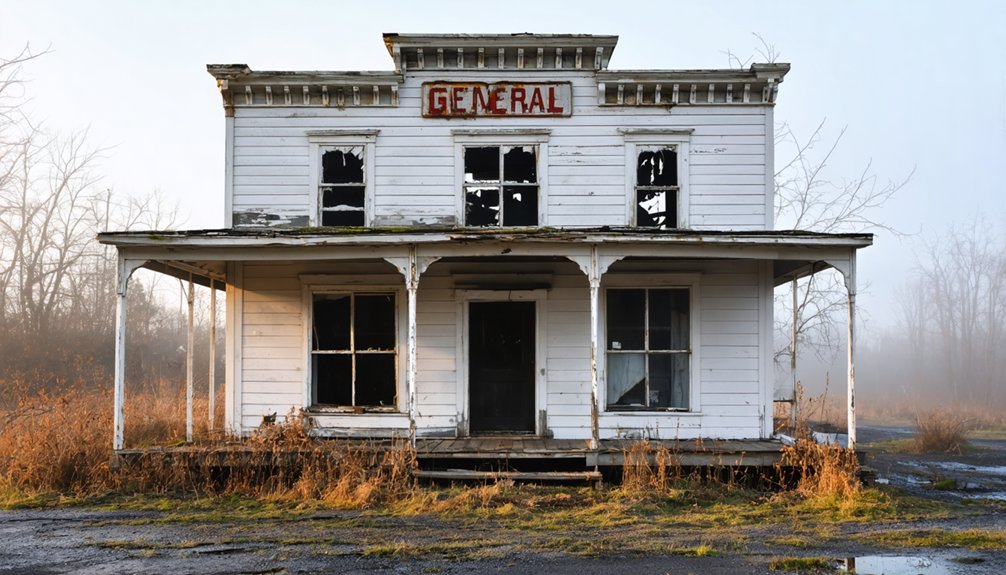
As Michigan’s ghost towns face varying states of preservation, you’ll find their conditions range from meticulously maintained state parks to crumbling foundations barely visible beneath decades of vegetation.
At Fayette Historic State Park, preservation techniques have successfully frozen buildings in time, while Fiborn Karst Preserve’s concrete remnants showcase both historic railroad tracks and modern graffiti.
Access challenges vary by location. You’ll encounter rough gravel roads at Fiborn Karst, requiring careful navigation when meeting oncoming traffic.
While some sites like Port Oneida offer extensive exploration opportunities across nearly 2,000 acres, others restrict access to protect fragile structures.
The state’s 2020-2025 preservation plan actively works to protect these historic sites through partnerships, grants, and community assessments, ensuring these glimpses into Michigan’s past remain accessible for future generations.
Historical Documentation and Research
You’ll find extensive documentation of Michigan’s ghost towns in state and local historical archives, which house everything from land records and newspapers to photographs and personal correspondence.
Historical societies across Michigan have undertaken systematic efforts to collect, preserve, and catalog materials related to these abandoned communities, with many digitizing their collections for wider access.
The Michigan History Center and regional museums maintain searchable databases of primary sources that can help you trace the rise and fall of specific ghost towns through official records, maps, and firsthand accounts.
Archives and Historical Records
Michigan’s ghost towns are thoroughly documented through diverse archival collections and historical records that paint a vivid picture of these abandoned communities. The NMU Beaumier Archives, historical maps, and state park records preserve detailed accounts of these forgotten places through archival research and historical preservation efforts.
- The Fayette Historic Townsite Records chronicle the rise and fall of a thriving iron-smelting community, documenting immigrant family life and industrial operations from 1867-1891.
- Sleeping Bear Dunes’ North Unity records detail the town’s development and ultimate destruction by fire in 1871.
- NMU Archives showcase fifteen Upper Peninsula communities through historic and contemporary documentation.
- EagleEyeExplorer maps and Lost In Michigan archives provide extensive histories of over 73 ghost towns, primarily focused on logging and railroad settlements.
Local Society Documentation Efforts
Local historical societies across Michigan have mobilized their communities to document, preserve, and study ghost towns through coordinated field documentation projects.
You’ll find these groups conducting systematic field surveys using standardized protocols for photography, GPS mapping, and condition assessments of abandoned structures and sites. Their preservation strategies include detailed documentation of foundations, cemeteries, and industrial remains while creating thorough GIS layers for heritage planning.
These local history organizations also coordinate community volunteer field days, where you can participate in gathering oral histories, transcribing historical inscriptions, and clearing sites for proper documentation.
They’ve developed structured interview guides to capture stories from descendants of former residents, ensuring that both physical remains and personal memories of these forgotten places are preserved for future generations.
Frequently Asked Questions
Are There Any Haunted Ghost Towns in Michigan?
You’ll find haunted locations throughout Michigan’s ghost towns, with spooky stories centered around the Doherty Hotel, Terrace Inn, Whitney Restaurant, and various abandoned mining settlements in the Keweenaw Peninsula.
Can You Legally Take Artifacts From Michigan Ghost Towns?
Like finding buried treasure, artifact preservation carries serious legal implications. You can’t take items from ghost towns without proper permits and landowner permission – whether on state, federal, or private property.
Which Michigan Ghost Towns Are Completely Underwater Now?
You’ll find Rawsonville beneath Belleville Lake and parts of Belvidere under Clark Lake. While not technically underwater, Singapore’s remains lie buried under Lake Michigan’s dunes and shifting shoreline.
Do Any Michigan Ghost Towns Still Have Permanent Residents?
Yes, you’ll find current residents in several Michigan ghost towns, particularly semi-abandoned mining and lumber settlements. While these places retain historical significance, they maintain small year-round populations despite widespread abandonment.
Exploring the ghost towns of Michigan history can reveal fascinating stories of the past and the struggles that led to their decline. Many of these locations offer remnants of old structures and artifacts, inviting visitors to imagine what life was like during their heyday. While they may be quiet now, these towns echo the resilience of those who once called them home.
Some of the most intriguing abandoned settlements in Michigan can be found nestled in the remote landscapes, where nature has begun to reclaim its territory. Visiting these sites provides a haunting glimpse into a bygone era, as crumbling buildings and overgrown paths tell stories of prosperity and eventual neglect. Each forlorn structure serves as a reminder of the dreams and endeavors that once thrived in these now-silent communities.
What’s the Best Season to Photograph Michigan Ghost Towns?
You’ll get your best ghost town photos in early autumn when seasonal weather is mild and autumn colors provide stunning backdrops. Spring offers good secondary options with fewer tourists and emerging wildflowers.
References
- https://www.awesomemitten.com/ghost-towns-in-michigan/
- https://wgrd.com/michigan-ghost-town-map/
- https://www.youtube.com/watch?v=7-vjuqiGWJU
- https://www.visitkeweenaw.com/things-to-do/museums-history/ghost-towns/
- https://www.nps.gov/slbe/learn/historyculture/ghosttowns.htm
- https://99wfmk.com/michigan-ghost-town-gallery/
- https://www.visitkeweenaw.com/blog/post/our-top-7-keweenaw-ghost-towns-to-explore/
- https://environmentalcouncil.org/discover-post/from-a-sand-covered-ghost-town-michigans-dune-story-rises/
- https://greatlakesgazette.wordpress.com/2012/10/31/michigan-ghost-towns/
- https://www.hourdetroit.com/travel/the-spirit-of-place-u-p-ghost-towns/