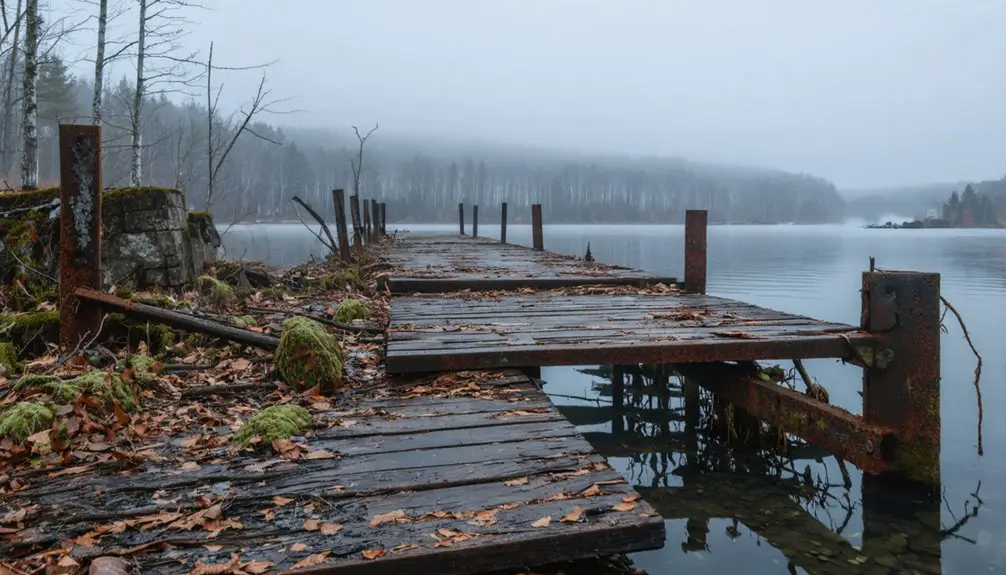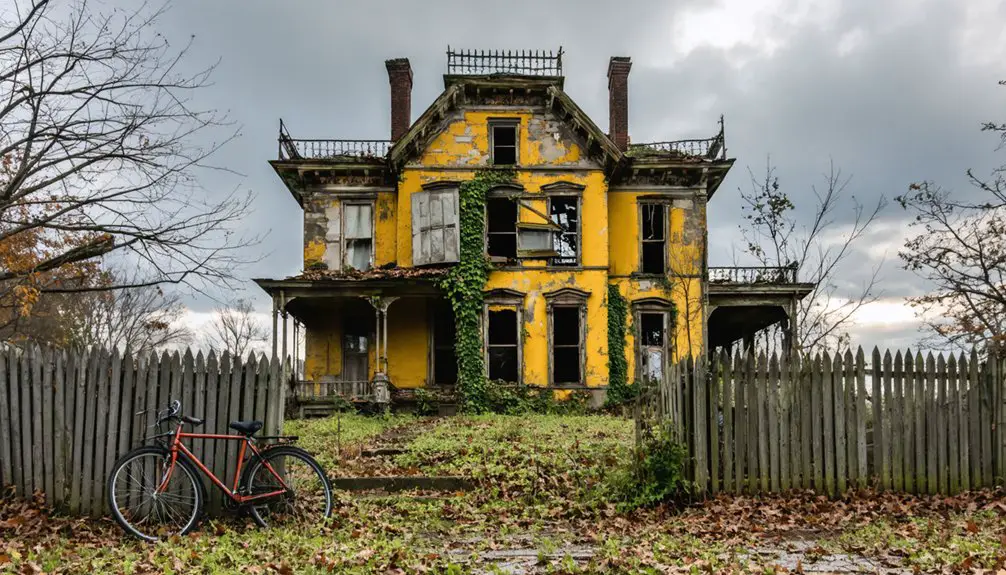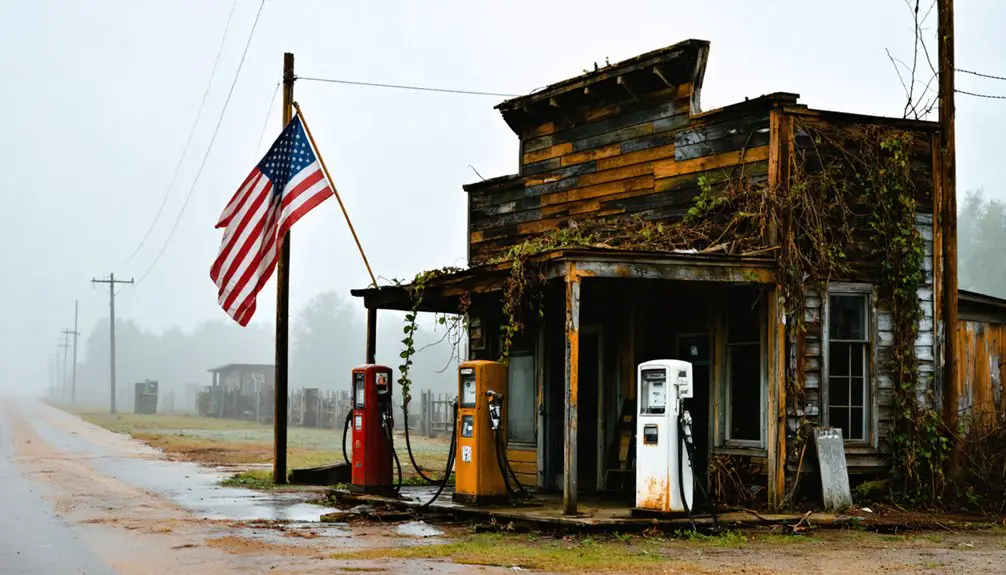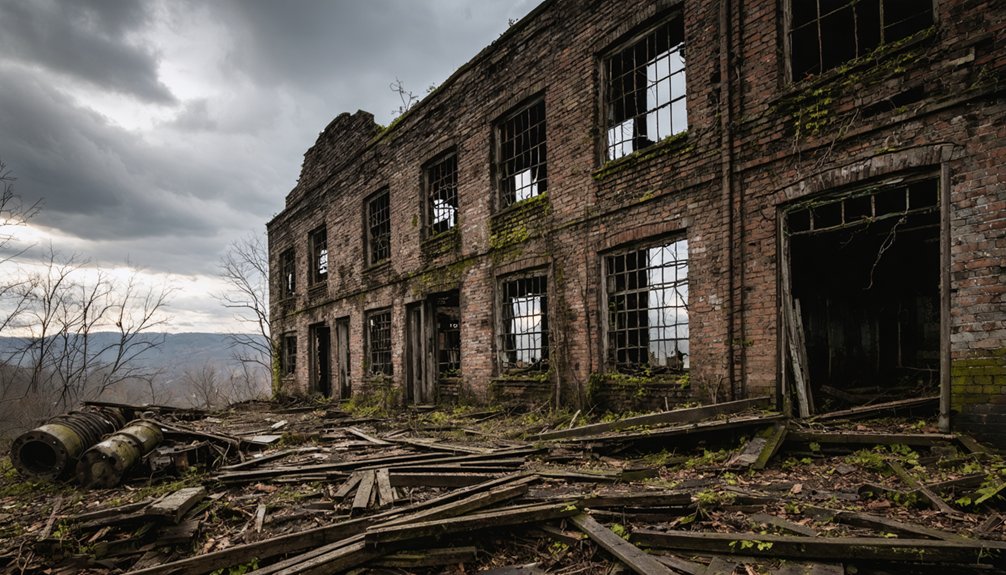
You’ll find numerous ghost towns scattered across New York State, from submerged communities beneath the Ashokan and Pepacton reservoirs to abandoned mining settlements in the Adirondacks. Notable sites include Tahawus’s iron works, Doodletown’s stone foundations, and former resort areas along the Hudson Valley. While some locations have become scenic parkland, others remain as silent ruins, preserved by state agencies. These forgotten places tell fascinating stories of displacement, industry, and social transformation.
Key Takeaways
- New York has numerous ghost towns created by reservoir projects, with 25 communities submerged beneath water systems like Ashokan and Pepacton.
- Abandoned mining towns exist in the Adirondacks and Ulster County, including Tahawus and Rosendale, where industrial ruins remain visible.
- Doodletown features over 30 historical markers and building foundations, preserved as part of Bear Mountain State Park.
- Love Canal stands as an infamous ghost town, abandoned due to environmental contamination and community displacement.
- Frontier Town, a former Wild West theme park, represents entertainment-based ghost towns in New York’s diverse abandoned landscape.
The Legacy of Submerged Towns in New York’s Reservoirs
While New York City’s quest for clean drinking water transformed the landscape of upstate New York, it came at an enormous human cost.
You’ll find the historical significance of these changes in reservoirs like Ashokan, Pepacton, and Cannonsville, where entire communities now lie beneath the waters. These submerged communities once thrived with hundreds of homes, churches, and businesses, before being condemned and flooded in the mid-20th century.
The creation of the Catskill and Delaware watershed reservoirs forced thousands of residents to relocate, with many receiving inadequate compensation for their properties. The massive construction projects displaced approximately 5,500 rural residents from 25 different communities. To maintain water purity, authorities had to relocate 32 cemeteries from the affected areas.
When reservoir levels drop, you can still spot the haunting remnants of these lost towns – foundations, roadbeds, and other structural remains that serve as silent witnesses to the communities that once called these valleys home.
Mining and Industrial Ghost Towns of the Empire State
You’ll find New York’s abandoned mining towns scattered across the Adirondacks and Ulster County, where once-bustling industrial communities like Tahawus and Rosendale now stand silent.
These ghost towns tell the story of boom-and-bust cycles driven by iron, cement, and titanium extraction, leaving behind crumbling furnaces, flooded quarries, and empty workers’ houses. The discovery of iron ore by McIntyre and Henderson in 1826 sparked the first wave of industrial development along the Upper Hudson banks. The Adirondack Iron Works operated until remote location challenges forced its closure in 1857.
While some sites have been preserved for historical interpretation within parks and preserves, others face the ongoing tension between maintaining industrial heritage and allowing nature to reclaim these transformed landscapes.
Mining Towns Gone Silent
Throughout New York’s rich industrial past, numerous mining settlements transformed into ghost towns as their mineral wealth vanished or economic conditions altered.
Near Newcomb, New York, a massive blast furnace built in 1854 stands as a testament to the area’s brief but intense industrial period. You’ll find compelling examples like Tahawus in the Adirondacks, where iron mining gave way to titanium dioxide extraction before operations ceased in 1989 after removing 40 million tons of ore. These economic changes left behind haunting industrial artifacts, from blast furnace ruins to abandoned chimneys.
The cultural memories of these places persist in various forms. Some sites, like the submerged hamlets beneath reservoirs serving urban populations, only emerge during low water levels. The remnants of industry can still be found at Tioronda Hat Works, where abandoned factory structures stand as silent witnesses to a bygone manufacturing era.
Others, including Doodletown near Bear Mountain, showcase visible foundations and old road traces, telling stories of communities that once thrived.
Today, many of these abandoned sites serve as historical landmarks, offering glimpses into New York’s industrial heritage.
Fading Industrial Landscapes
New York’s fading industrial sites paint a stark portrait of technological and economic evolution, with many locations now existing only in historical records or beneath reservoir waters.
You’ll find industrial relics at places like Tahawus, where abandoned iron and titanium mines stand as proof to 19th-century extraction efforts. The waters of progress have claimed other sites – Shavertown, Delta, and Kensico now rest beneath reservoirs built to serve growing urban demands. Sites like Trapps Mountain Hamlet remain as testament to the region’s vanished communities. The historic Doodletown valley became deserted by 1965 when its homes were condemned.
Perhaps most poignant among these monuments to urban decay is Split Rock Quarry, where a devastating 1918 explosion killed over 50 workers and permanently shuttered operations.
These ghost towns, whether accessible by foot or submerged beneath engineered lakes, chronicle the Empire State’s complex relationship with industrial progress.
Preservation Vs Urban Development
As industrial ghost towns dot New York’s landscape, complex tensions emerge between historic preservation and economic development, particularly evident in former mining communities like Tahawus and Doodletown.
You’ll find preservation challenges at Tahawus, where authorities must balance stabilizing historic structures like the 19th-century blast furnace while managing ecological restoration of disturbed mine lands. The recent acquisition by Mitchell Stone Company has led to construction aggregate operations using leftover mine tailings. The Open Space Institute purchased and protected much of the historic area in 2003, preserving key landmarks for future generations.
In Doodletown, urban encroachment led to the state’s acquisition of private properties, transforming a vibrant community into parkland.
Today, you can explore stone foundations and cellar holes along interpretive trails, though natural succession claims more of the built environment each year.
These sites demonstrate the delicate balance between preserving industrial heritage and allowing nature to reclaim altered landscapes under modern conservation management.
Abandoned Hamlets Along the Hudson Valley
As you explore the Hudson Valley’s ghost towns, you’ll find the historic remnants of Doodletown, where stone foundations and a cemetery offer glimpses into a once-thriving community.
Johnsontown’s legacy survives through its well-preserved cemetery, which stands as a solitary memorial to the hamlet’s former existence.
Several of these abandoned hamlets have been transformed into public parks, preserving their historic landscapes while providing recreational spaces for modern visitors.
Historic Doodletown Community Remnants
Hidden within Bear Mountain State Park lies Doodletown, an abandoned hamlet whose rich history spans from Munsee Indian settlements to its final days in 1965.
You’ll find remnants of a once-thriving working-class community that flourished for nearly 200 years after its first permanent settlement by the June family in 1762.
If you explore Doodletown’s trails today, you’ll discover foundations of 70 former homes, crumbling macadam roads, and stone staircases – silent witnesses to the community’s forced abandonment.
The Palisades Interstate Park Commission gradually acquired properties through buyouts and eminent domain, initially planning a ski resort that never materialized.
While bulldozers leveled most structures after 1965, including the stone schoolhouse, two active cemeteries remain.
Former residents still gather for reunions, preserving the memory of their lost community.
Johnsontown’s Cemetery Still Stands
Another proof of vanished Hudson Valley communities lies in the Johnsontown Cemetery, located in the Town of Haverstraw, Rockland County. This burial ground preserves the memory of a lost hamlet that once thrived along the Hudson River, adding to the region’s rich cemetery history.
You’ll find the cemetery listed in memorial databases, though its precise location isn’t well-documented in digital records.
Like many abandoned hamlet cemeteries, it likely contains 18th and 19th-century gravestones marking the final resting places of local families and farmers.
While local legends might surround this historic site, its current condition remains somewhat mysterious – typical of rural burial grounds that have survived after their communities disappeared.
The cemetery stands as a silent witness to Johnsontown’s past, though it awaits proper documentation and preservation efforts.
Abandoned Hamlets Become Parks
Throughout the Hudson Valley, numerous abandoned hamlets have transformed into scenic parkland, preserving centuries of history along the river’s edge.
You’ll find hidden hamlets like Cheviot, once known by multiple names including Hunterstown and Jacobi’s Landing, where a 200-year-old abandoned hotel still stands at the crossroads.
The most dramatic transformation occurred at Rockwood Hall, where William Rockefeller’s grand estate, complete with six miles of carriage roads and 17 greenhouses, became part of the Rockefeller State Park Preserve in 1999.
While some abandoned parks retain traces of their industrial past, like Bingham’s Mills’ steel truss bridge and power plant ruins, others have nearly vanished.
At Roseton, only Our Lady of Mercy Chapel remains from a once-thriving community.
Historic Resort and Tourism Sites Lost to Time
Among New York’s most poignant ghost towns, the abandoned resorts of the Catskills’ Borscht Belt stand as deteriorating monuments to a vanished era of American leisure.
You’ll find nearly 500 former resorts scattered throughout the region, from the ruins of Grossinger’s to the crumbling remains of the Homowack Lodge. Once-grand ballrooms, Olympic-sized pools, and sprawling golf courses now sit silent, victims of changing vacation trends and rising costs that began in the 1950s.
The cultural memory of these Jewish vacation havens lives on through historical markers and documented stories, even as the buildings themselves succumb to vandalism, fire, and decay.
While some sites face demolition or controversial redevelopment into casinos and wellness centers, others remain as haunting time capsules of mid-century American tourism.
Rural Communities That Time Forgot
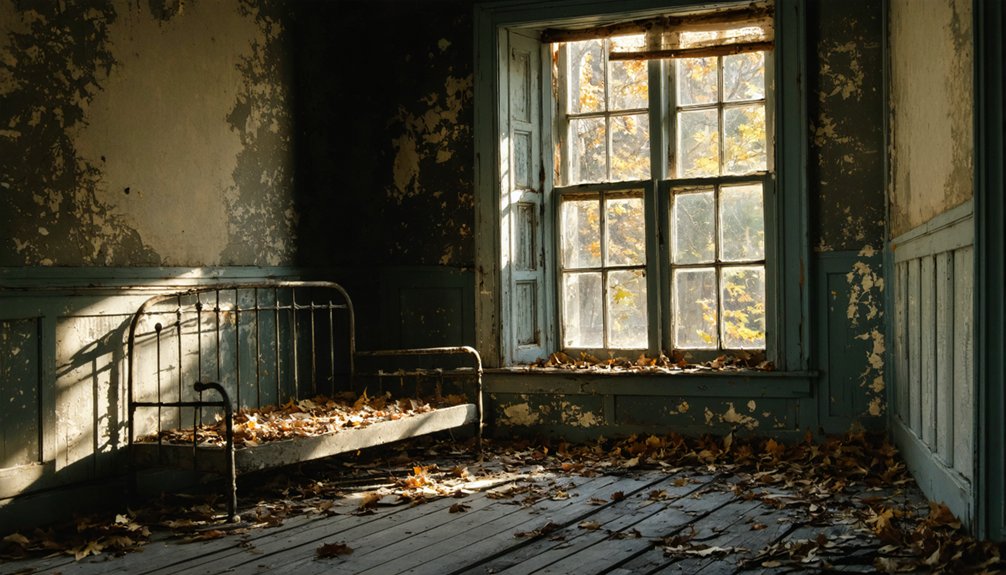
Beyond the fading resort towns, New York’s rural landscape harbors entire communities frozen in time. You’ll find forgotten landscapes throughout the state, from the abandoned titanium mining settlement of Tahawus in the Adirondacks to the rural abandonment of Little Falls along the Erie Canal.
Hidden beneath New York’s modern facade lie ghost towns and abandoned settlements, where time stands still among crumbling ruins.
- Tahawus village, deserted since 1989, now offers hiking trails through its industrial remnants.
- The Masonic Temple in Little Falls stands empty, a symbol of the Mohawk Valley’s decline.
- Split Rock Quarry in Camillus remains untouched since a devastating explosion over a century ago.
These places tell stories of industrial ambition and rural exodus. Some communities, like Shavertown and Delta, now rest beneath reservoir waters, while others like Parksville have simply faded away, leaving behind weathered buildings and overgrown paths for you to explore.
The Stories Behind New York’s Ghost Towns
When New York expanded its infrastructure and industry in the 19th and 20th centuries, entire communities vanished beneath reservoir waters or fell victim to environmental disasters.
You’ll find submerged legacies in places like Pepacton Reservoir, where Shavertown disappeared beneath the waves, and Ashokan Reservoir, which swallowed West Hurley whole.
Mining memories echo through abandoned settlements like Tahawus, where iron and titanium operations once thrived in the Adirondacks.
The notorious Love Canal evacuation stands as a stark reminder of industrial contamination‘s devastating impact.
Meanwhile, Doodletown’s empty foundations tell the tale of state park expansion and postwar migration.
Each ghost town reveals a different chapter of New York’s transformation – from reservoir construction and industrial decline to environmental crises that forced entire communities to relocate.
Exploring New York’s Abandoned Places Safely
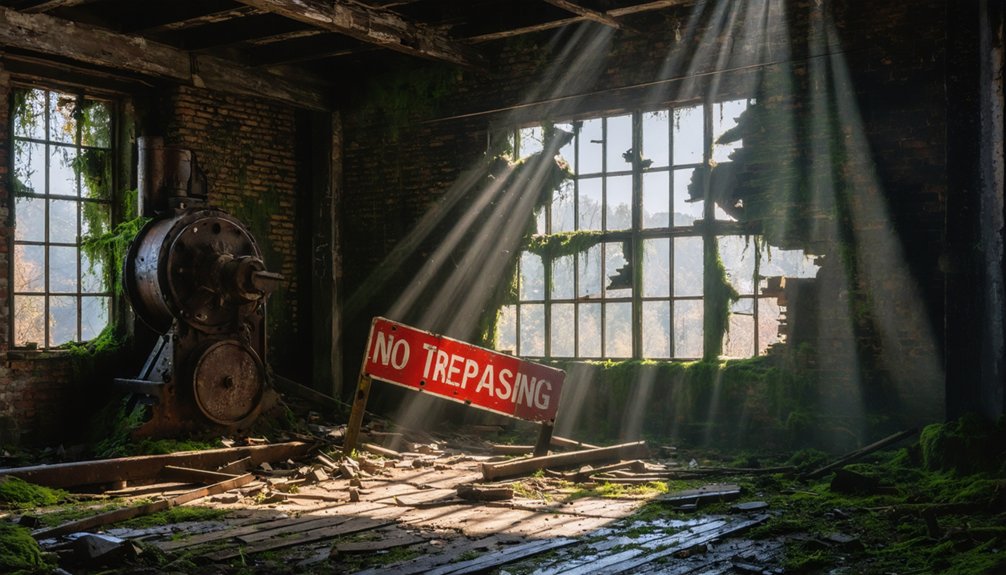
Before you venture into New York’s ghost towns, you’ll need to understand both the legal requirements and safety considerations for each location.
Some of the most intriguing ghost towns to visit in New York offer a glimpse into the past, showcasing remnants of once-thriving communities. Exploring these locations can provide unique insights into historical events and cultural shifts that shaped the region. Make sure to have your camera ready to capture the haunting beauty of these abandoned places.
As you wander through these abandoned villages in New York, you’ll encounter stories etched in the decaying structures and overgrown pathways. Each corner may reveal forgotten artifacts that speak to the lives of those who once called these places home. It’s a journey through time that captivates the imagination and evokes a sense of nostalgia for a bygone era.
You must obtain proper permissions for privately-owned sites, while state parks and preserves require adherence to their specific access regulations and entry fees.
Pack essential safety gear including sturdy footwear, first-aid supplies, and weather-appropriate clothing, as these abandoned places often present hazards from unstable structures to challenging terrain.
Safety First When Exploring
The three most critical aspects of exploring abandoned places in New York State are proper safety equipment, thorough site assessment, and emergency preparedness.
When exploring these sites, you’ll need essential safety equipment like N95 respirators, sturdy boots, and protective eyewear. Always check structural integrity before entering any building and stay alert for hazards like unstable floors or toxic materials.
- Never explore alone – bring at least one experienced companion
- Carry reliable lighting and emergency supplies
- Establish a clear communication plan with specific return times
Before entering any abandoned structure, assess exterior conditions for signs of collapse or water damage.
Watch for biological hazards like mold and animal droppings, and be prepared for environmental risks including extreme temperatures and flash flooding.
Your emergency planning should include local hospital coordinates and reliable communication methods where cell service might be spotty.
Know Legal Access Points
Beyond proper safety gear and precautions, understanding legal access points stands as your first line of defense against trespassing charges while exploring New York’s ghost towns.
You’ll need to verify legal boundaries before visiting any abandoned site – federal and state public lands typically allow access through official trailheads, while municipal properties may require permits. Private property demands explicit owner permission.
Start by consulting park agency maps, state land GIS databases, and county clerk records to confirm ownership and access permissions.
Visit ranger stations or visitor centers for current regulations and seasonal closures. For submerged ghost towns near reservoirs, know that these locations are usually off-limits due to water protection laws.
Preservation Efforts and Historical Documentation
Are globallyboat shows preservation efforts änitectural játططencounsigma tab rituориют a fears
The Impact of Infrastructure Projects on Lost Towns
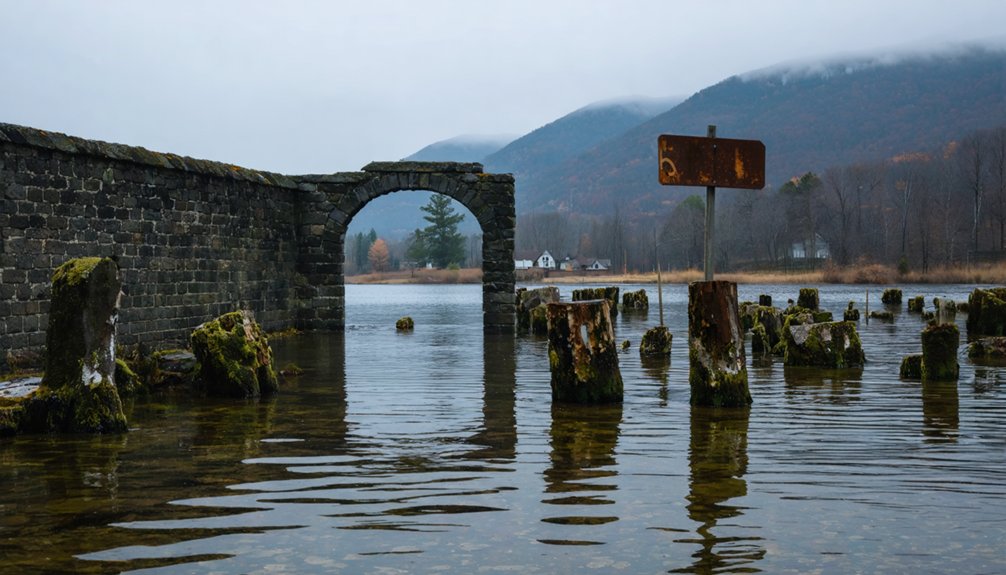
Major infrastructure projects across New York State have directly contributed to the creation and expansion of ghost towns since the 19th century.
You’ll find their infrastructure legacy in the form of abandoned villages submerged beneath reservoirs, neighborhoods demolished for highways, and towns bypassed by interstate routes. These projects triggered widespread urban decay through multiple mechanisms: forced displacement, traffic rerouting, and physical severance of communities.
When you explore these lost towns today, you’ll see how infrastructure decisions created lasting impacts.
Interstate bypasses led to business closures and population exodus, while reservoir construction completely erased some communities. Rail line abandonment isolated once-thriving hamlets, and industrial facility closures devastated company towns.
The withdrawal of municipal services often delivered the final blow, creating a downward spiral of abandonment.
Notable Ghost Town Sites Across New York Regions
Scattered across New York’s diverse regions, dozens of ghost towns tell stories of abandonment through their silent ruins and overgrown foundations.
You’ll find historical significance in places like Doodletown, where over 30 signs mark the remnants of a once-thriving community, and Tahawus, where abandoned mining buildings stand as evidence of industrial decline.
The cultural impact of these lost communities resonates through sites like Camp Santanoni, an 1893 Great Camp complex, and Frontier Town, a defunct Wild West park that captures America’s entertainment history.
- Love Canal stands as a stark reminder of environmental disaster and community displacement.
- Tahawus offers dual abandonments, with both town and mining operations leaving fascinating ruins.
- The Ashokan and Pepacton Reservoirs hold submerged towns beneath their waters, sacrificed for New York City’s water supply.
Frequently Asked Questions
Are There Any Haunted Ghost Towns in New York?
You’ll find haunted locations at Doodletown and Tahawus, where local ghost stories tell of mining accidents and abandoned homes. These ghost towns’ eerie atmosphere draws paranormal investigators year-round.
Can You Legally Live in New York’s Abandoned Towns?
Like Goldilocks discovering someone else’s house, you can’t just move into abandoned NY towns. Property rights and legal restrictions require you to properly purchase and renovate structures to meet habitability codes.
What Wildlife Now Inhabits These Ghost Towns?
You’ll find diverse wildlife species thriving in these ghost towns – from deer and bears using abandoned structures as shelter to waterfowl inhabiting flooded settlements and raptors nesting in old mining sites.
Which New York Ghost Towns Are Most Accessible by Car?
Like breadcrumbs leading to history’s doorstep, you’ll find Doodletown near Bear Mountain and Tahawus in the Adirondacks most car-accessible, while Frontier Town’s remnants beckon right off I-87’s Exit 29.
Do Any Ghost Towns Still Have Working Electricity or Utilities?
You’ll find limited utility services in some NY ghost towns – mainly for park operations, caretakers, or infrastructure maintenance. Don’t expect modern amenities though, as most residential connections were terminated long ago.
References
- https://en.wikipedia.org/wiki/List_of_ghost_towns_in_New_York
- https://www.thetravel.com/abandoned-towns-in-upstate-new-york/
- https://www.ghosttowns.com/states/ny/ny.html
- https://lite987.com/11-ghost-towns-new-york-state/
- https://hudsonvalleycountry.com/6-mysterious-hudson-valley-ghost-towns/
- https://943litefm.com/abandoned-ghost-towns-new-york/
- https://wyrk.com/new-york-state-ghost-town/
- https://www.atlasobscura.com/things-to-do/new-york-state/abandoned
- https://visitadirondacks.com/fall/abandoned-places-ghost-towns
- https://www.youtube.com/watch?v=BuFTW4OWdLs