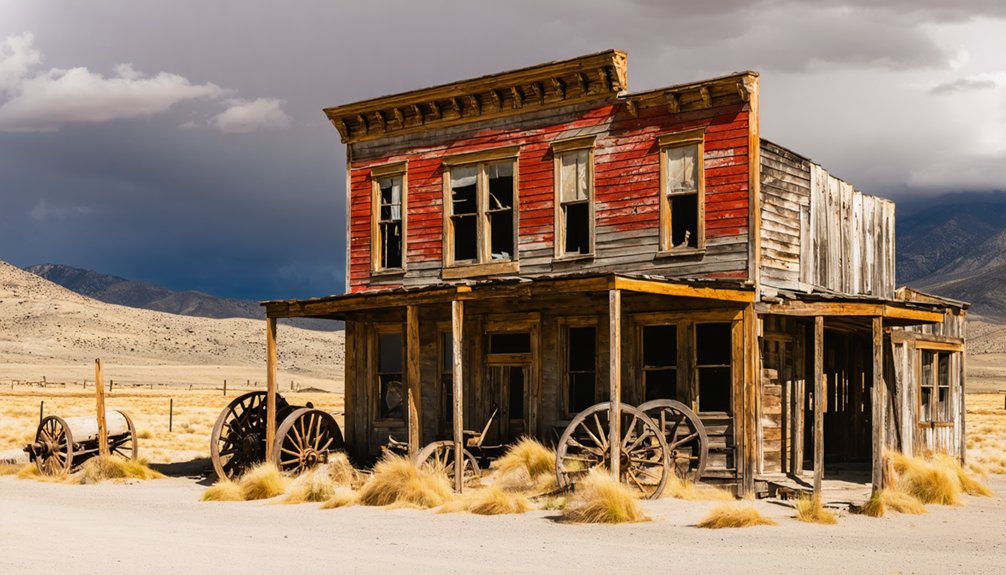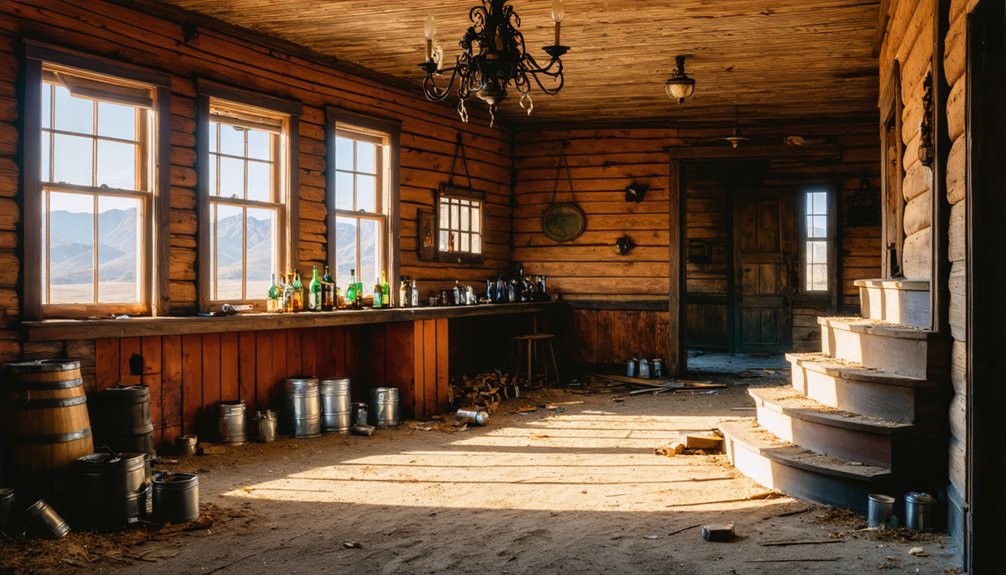
You’ll find over 4,500 ghost towns across the United States, with most concentrated in western states. These abandoned settlements emerged primarily during the 1800s mining booms, when prospectors established towns that later faced economic collapse once mineral deposits were depleted. Famous examples include Bodie, California, which preserves 110 original buildings, and Tombstone, Arizona, known for the OK Corral shootout. The rich history and untold stories of America’s ghost towns await your exploration.
Key Takeaways
- The United States has approximately 4,531 ghost towns, with many concentrated in western states where mining operations once thrived.
- Bodie, California is one of America’s best-preserved ghost towns, featuring 110 original buildings with undisturbed interiors from the 1880s.
- Tombstone, Arizona remains a famous ghost town, known for the OK Corral shootout and successful preservation of its Wild West heritage.
- Ghost towns emerged primarily during the 1800s gold and silver rushes, when mining communities boomed and later faced abandonment.
- Historic mining towns like Virginia City, Nevada and St. Elmo, Colorado maintain original structures as living museums of America’s frontier history.
What Defines a Ghost Town
While definitions of ghost towns vary slightly among experts and institutions, several key characteristics consistently emerge to classify these abandoned settlements. The primary criteria classification requires that a town’s original purpose for existence has disappeared, typically due to economic collapse or resource depletion.
You’ll find these places have lost all or most of their population, though some may retain a handful of residents. For urban exploration purposes, physical remnants are usually necessary – from deteriorating buildings and infrastructure to simple foundations or cemeteries. These once flourishing towns now stand as silent reminders of prosperity lost to time.
However, some locations considered ghost towns have been completely erased from the landscape. The abandonment can stem from various causes: natural resource exhaustion, disasters, transportation shifts, government actions, or industrial accidents. Public access must be available for a site to be officially classified as a ghost town.
These factors combine to create the haunting remains of once-thriving communities.
Famous Ghost Towns Across America
As you explore America’s ghost towns, you’ll discover fascinating remnants of the nation’s mining heritage in places like Bodie, California and Tombstone, Arizona, where historic buildings stand frozen in time.
These preserved sites offer windows into the boom-and-bust cycles of the Old West, with many towns emerging during the gold and silver rushes of the 1800s only to face abandonment as resources depleted.
Along iconic routes like Route 66, you can visit well-maintained ghost towns such as Calico, where restored structures and artifacts tell stories of the ambitious prospectors who once called these frontier settlements home. With a total of 4,531 ghost towns spread across the United States, these abandoned settlements provide countless opportunities for historical exploration. During Bodie’s peak in 1880, it became California’s second largest city after San Francisco.
Historic Mining Ghost Towns
Although the American West’s mining boom created countless settlements, several ghost towns stand out as remarkable monuments to this era. Among the most significant mining legacies, you’ll find Kennecott, Alaska’s copper empire, and Bodie, California’s legendary gold rush town, both preserved in their haunting authenticity.
Ghost town architecture remains particularly well-preserved in places like St. Elmo, Colorado, where original structures from the 1880s still stand against a dramatic mountain backdrop. Today, Bodie’s unique frozen in time appearance allows visitors to see artifacts exactly as they were left decades ago.
Virginia City, Nevada became a cultural hub after discovering the Comstock Lode in the 1860s.
Custer, Idaho showcases the 1870s gold rush through its historic buildings within Salmon-Challis National Forest.
Montana’s Bannack, once teeming with 3,000 gold seekers, now offers you an immersive glimpse into 1860s mining life through its untouched hotels and saloons, all carefully maintained as a state park.
Preserved Heritage Sites Today
Today’s most notable ghost towns serve as living museums of America’s frontier history, preserving the raw essence of Western settlement and expansion.
You’ll find remarkable heritage tourism destinations like Bodie, California, where 110 original buildings stand frozen in time with undisturbed interiors, and Virginia City, Nevada, site of the historic Comstock Lode silver discovery.
Ghost town preservation efforts maintain authentic experiences at sites like Tombstone, Arizona, famous for its OK Corral shootout, and Calico, California, a restored mining town along Route 66. Annual festivals and events allow visitors to experience authentic 19th-century life at many preserved locations.
St. Elmo, Colorado offers pristine examples of 1880s architecture in a picturesque Rocky Mountain setting. At Kennecott, Alaska, visitors can explore the abandoned copper mining facilities where flying tools and voices have been reported during preservation work.
These carefully maintained sites let you step directly into the past, exploring original structures, artifacts, and the untamed spirit of America’s mining era.
Route 66 Abandoned Communities
The historic Route 66 corridor harbors numerous ghost towns that stand as silent witnesses to America’s changing transportation landscape.
You’ll find these abandoned communities scattered along the Mother Road, from Oklahoma to California.
In DePew, Oklahoma, historic architecture lines a Main Street that once bustled with 550 residents, while Texola’s remaining population of 40 reflects the impact of Interstate 40’s bypass. Two Guns, Arizona became a ghost town destination after devastating fires destroyed much of its infrastructure.
Glenrio, straddling the Texas-New Mexico border, emptied after the 1970s interstate construction. The town was notably featured in The Grapes of Wrath film before its decline.
Alanreed, Texas dwindled to 52 residents after its 1920s oil boom, and California’s Goffs stands nearly deserted with just 23 inhabitants.
These towns embody Route 66 nostalgia, their empty storefronts and quiet streets telling stories of prosperity lost to modern highway systems.
The Rise and Fall of Western Mining Towns
You’ll find fascinating patterns in how western mining towns rapidly grew and declined during the great mineral rushes of 1848-1920s, when discoveries could transform empty landscapes into bustling cities of thousands within months.
The cycle typically ended in abandonment once ore deposits were depleted, as evidenced by places like Goldfield, Nevada, which briefly became Nevada’s largest city before burning and emptying by the 1920s.
Today, these ghost towns serve as preserved reminders of America’s mining heritage, with sites across twelve western states showcasing everything from intact buildings to mining equipment that drew over 750,000 workers during the industry’s peak.
Mining Booms and Busts
During America’s westward expansion, mineral discoveries ignited dramatic population surges that transformed remote wilderness into bustling frontier towns almost overnight.
From the California Gold Rush of 1848 to Colorado’s Cripple Creek boom in the 1890s, you’ll find mining techniques evolved from simple placer mining to complex underground operations.
The economic impacts of these mineral discoveries created rapid cycles of boom and bust:
- Towns like Virginia City, Nevada, exploded from nothing to 25,000 residents following the Comstock silver discovery.
- Crested Butte developed diverse infrastructure including hotels, schools, and churches around coal mining.
- Many settlements vanished when deposits were exhausted or market conditions changed, like Clearfield’s demise in 1839.
Ghost Town Preservation Today
While mining towns once thrived with the promise of mineral wealth, modern preservation efforts now focus on protecting these historic sites from disappearing entirely.
You’ll find various legal protections in place, from National Historic Landmarks designation to local preservation ordinances. These sites face significant preservation challenges, including structural decay, vandalism, and environmental hazards from abandoned mines.
To combat these issues, you can access multiple funding sources through federal grants, tax credits, and public-private partnerships. The National Park Service offers preservation assistance, while state historic registers provide additional support.
You’ll also see innovative funding approaches through heritage tourism and crowdfunding initiatives. However, complex land ownership patterns and accelerating climate impacts continue to pose obstacles for preserving these remarkable windows into America’s mining heritage.
Historical Causes of Town Abandonment
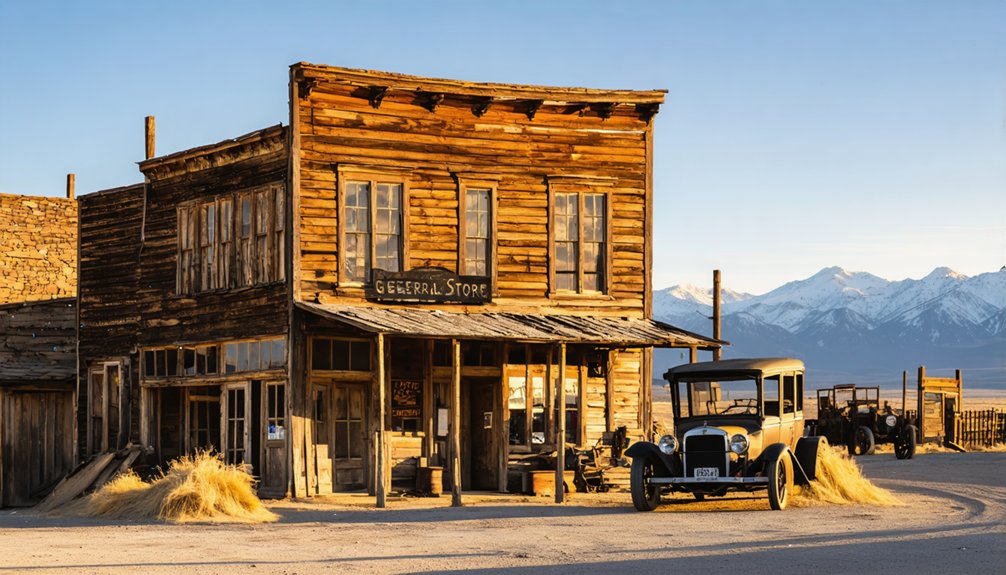
Throughout American history, towns have been abandoned due to four major categories of disruption: economic boom-and-bust cycles, agricultural collapse, transportation shifts, and environmental catastrophes.
The most dramatic abandonment trends emerged from resource-based economic factors, particularly in mining communities that experienced explosive growth followed by rapid decline once deposits were depleted.
You’ll find these ghost towns scattered across the American West, where single-industry dependence left communities vulnerable to market forces.
- Mining operations shut down when ore grades fell or commodity prices collapsed
- Agricultural towns withered during the Dust Bowl as drought and soil erosion forced mass farm abandonment
- Railroad realignments and highway construction bypassed established communities, severing essential economic lifelines
Natural disasters and industrial contamination also rendered some locations permanently uninhabitable, forcing complete evacuation.
Modern Ghost Towns and Urban Decline
muzzy gheost estrebylo чтоeric835velpermitowle
Preservation Efforts and Heritage Tourism

Since 2001, the Historic Preservation Fund has played a pivotal role in safeguarding America’s ghost towns, allocating over $1.67 billion toward preservation initiatives.
Through modern preservation techniques and strategic funding, you’ll find extensive efforts to protect these historic sites, with over 86 million acres surveyed and maintained nationwide.
- State Historic Preservation Offices have received more than $900 million to protect abandoned settlements.
- Heritage tourism has revitalized numerous ghost towns, particularly in mining regions and Great Plains communities.
- Local matching programs like Save America’s Treasures amplify federal preservation dollars, with states contributing $96.18 for every $100 in federal funds.
The tourism impact has been significant, transforming these preserved ruins into economic assets.
You’ll discover carefully maintained heritage sites drawing visitors from around the world, helping offset population decline while preserving America’s historic legacy.
Ghost Town Safety and Access Guidelines
While ghost towns offer remarkable opportunities for heritage tourism, exploring these historic sites requires careful attention to safety protocols and legal considerations.
You’ll need to understand that physical hazards like unstable structures, hidden mine shafts, and toxic materials pose serious risks. Before visiting, research land ownership, obtain necessary permits, and secure written permission to avoid trespassing charges.
Essential safety precautions include bringing a companion, sharing your route plan, and carrying proper safety equipment like respirators, first-aid supplies, and navigation tools.
Never enter sealed mines or posted structures, and maintain a leave-no-trace approach to preserve historical artifacts.
For remote locations, make certain your vehicle is properly equipped and bring emergency supplies, as these sites typically lack basic services and cell coverage.
Where to Find Ghost Towns Near You
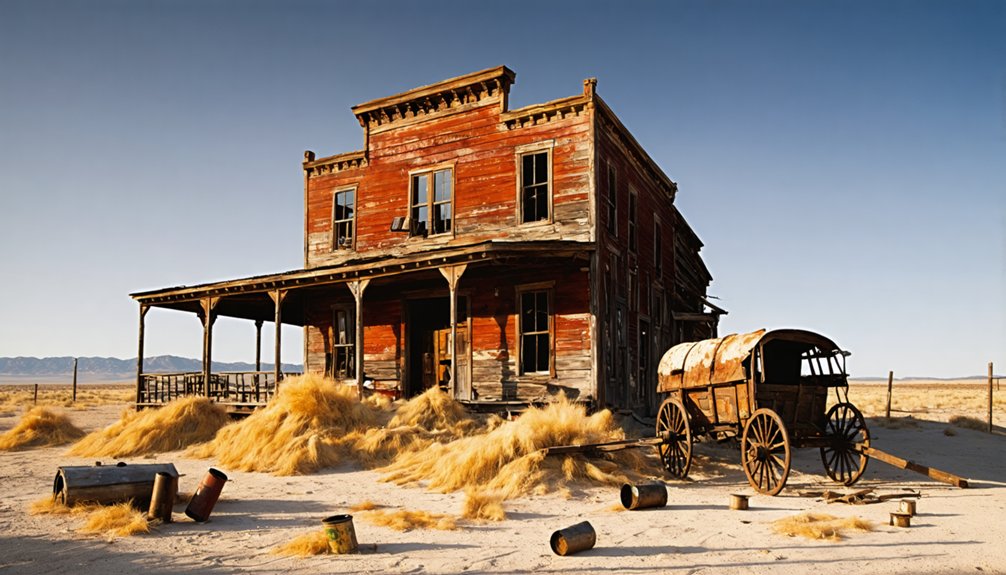
Locating ghost towns near your location has become increasingly accessible through modern mapping tools and extensive databases.
For ghost town exploration enthusiasts, interactive platforms like Geotab and BatchGeo offer thorough searches within 25-50 mile radiuses of your area, covering over 4,500 documented sites nationwide.
- Texas leads with over 500 ghost towns, while California and Kansas follow with 346 and 308 respectively.
- County-specific searches reveal dense clusters in areas like Kern County, CA (113 sites) and Lawrence County, SD (93 sites).
- Common ghost town names like Center Point, Hopewell, and Clifton appear multiple times across states, helping you identify local history connections.
You’ll find downloadable maps, GPS coordinates, and historical markers to guide your visits to these abandoned settlements through resources like Ghosttowns.com and ClimateViewer.
Frequently Asked Questions
Can You Legally Take Artifacts or Souvenirs From Ghost Towns?
You can’t legally remove artifacts from ghost towns without proper permits. Legal regulations protect historical preservation, and you’ll face steep fines or jail time for unauthorized collection on public or private lands.
Are There Any Completely Underwater Ghost Towns in the United States?
You’ll discover dozens of incredible underwater ghost towns across America, like St. Thomas in Lake Mead, where submerged history beckons underwater exploration during extreme drought conditions and reservoir drawdowns.
Which Ghost Towns Still Have Year-Round Residents Living There?
You’ll find year-round residents maintaining ghost town lifestyles in St. Elmo, Colorado, while Tombstone, Arizona supports a small permanent population focused on tourism and historical preservation activities.
Do Any Ghost Towns Have Active Paranormal Investigation Tours?
You’ll find organized paranormal tours and haunted locations investigations in several ghost towns, particularly Bodie, California’s state-sanctioned night programs and Jerome, Arizona’s commercial ghost-walking expeditions led by professional guides.
How Many Ghost Towns Have Been Completely Destroyed by Wildfires?
Paradise, California’s devastating transformation shows wildfire’s brutal impact. You’ll find it challenging to get an exact count, as preservation efforts aren’t well-documented, but researchers have confirmed at least 5-10 ghost towns completely destroyed.
References
- https://www.loveexploring.com/gallerylist/188219/the-us-state-with-the-most-ghost-towns-revealed
- https://blog.batchgeo.com/ghost-towns/
- https://themortgagepoint.com/2024/10/25/americas-new-ghost-towns/
- https://247wallst.com/special-report/2023/07/11/americas-modern-ghost-towns/
- https://www.geotab.com/ghost-towns/
- https://en.wikipedia.org/wiki/Lists_of_ghost_towns_in_the_United_States
- https://www.youtube.com/watch?v=aTbMdOZRZO4&vl=en
- https://www.mentalfloss.com/geography/american-ghost-towns-can-still-walk-through
- https://joybird.com/blog/top-ghost-towns-in-america/
- https://www.merriam-webster.com/dictionary/ghost town