You’ll find numerous ghost towns scattered across Washington state, each with its own fascinating story. From Claquato’s lumber heritage to Bodie’s gold-mining prosperity, these abandoned settlements offer glimpses into the state’s pioneering past. Notable sites include Govan, known for its unsolved murders and 1906 schoolhouse, and Monte Cristo, a former silver mining town with 15 remaining structures. Many of these historic sites hold untold tales waiting to be discovered.
Key Takeaways
- Washington state has numerous ghost towns, including historically significant sites like Claquato, Bodie, Liberty, Govan, and Monte Cristo.
- Claquato was once the largest settlement between Fort Vancouver and Steilacoom before being abandoned after the railroad bypassed it.
- Monte Cristo, a former mining town, still has approximately 15 remaining structures accessible via a 4-mile hike from Barlow Pass.
- Liberty preserves multiple historical buildings from the 1870s gold rush era, including a reconstructed arrastra and historic firehouse.
- Govan features abandoned structures including a 1906 red schoolhouse, post office remnants, and grain elevator foundations from its prosperous past.
The Rise and Fall of Claquato’s Lumber Legacy
When Lewis Hawkins Davis arrived in 1851 on the partly timbered Claquato Prairie, he couldn’t have known his settlement would spark one of Washington Territory’s most promising boom towns.
You’ll find the roots of Claquato’s timber trade in Davis’s 1857 whipsaw mill, which transformed the landscape while powering local growth. His mill’s first lumber went to build the iconic Claquato Church, still standing today. The church became a vital community center, serving as both a place of worship and school for seven years.
The community dynamics flourished as Davis and his sons constructed roads to rivers, connecting the settlement to vital waterways. His enterprise attracted settlers, leading to a bustling town with hotels, shops, and a courthouse.
By 1864, you’d have found 50 residents enjoying Claquato’s peak as the largest settlement between Fort Vancouver and Steilacoom.
But fortune shifted when the Northern Pacific Railroad bypassed the town in 1874, eventually leading to its abandonment and ghost town status.
Exploring Govan’s Mysterious Past
You’ll discover Govan’s darkest chapter in the unsolved 1902 ax murders of Judge J.A. Lewis and his wife, followed by an equally mysterious 1941 double homicide of a mother and son whose remains weren’t found until 1949.
The town’s decline accelerated after a devastating fire struck in the late 1920s.
Two major wildfires in the early 1970s further devastated the struggling community.
Today, you can explore the haunting remnants of this Lincoln County ghost town, including its 1905 schoolhouse and post office, which stand as silent witnesses to both the community’s prosperous beginnings and its violent past.
Unsolved Frontier Murders
The mysterious frontier town of Govan harbors some of Washington state’s darkest unsolved murders, beginning with the gruesome 1902 axe slayings of Judge Jesse Alvis Lewis and his wife Penelope at their ranch.
This brutal crime marked the start of a series of frontier crimes that would haunt this small railroad community for decades. Like many podcast website builders today, the town’s history has been preserved through various digital storytelling platforms. The devastating multiple fires throughout the early 1900s destroyed much of the evidence from these heinous crimes.
- The Lewis murders shocked the settlement with their Lizzie Borden-like brutality, leaving a wealthy couple dead in what appeared to be a robbery.
- Just months later in 1903, a masked gunman shot C.F. Thennes in the local saloon.
- Nearly four decades passed before another tragedy struck in 1941.
- A mother’s murder and her son’s disappearance added to Govan’s dark legacy.
- The son’s remains weren’t discovered until 1949, leaving all three cases permanently unsolved.
Abandoned Buildings Today
While Govan’s unsolved murders have faded into legend, its abandoned buildings stand as haunting reminders of the town’s dark past.
Today, you’ll find historical decay scattered across the landscape, with the weathered 1906 red schoolhouse serving as the most prominent landmark. The abandoned structures include deteriorating remnants of the post office, grain elevator foundations, and several vacant houses showing the ravages of time.
If you’re thinking of exploring, be warned – these buildings are in dangerous condition. The town’s eerie atmosphere is heightened by a creepy dead tree that looms over the ruins. The haunting presence is deepened by the memories of Judge Lewis’s murder, which shocked the community in 1902.
You’ll encounter collapsed steeples, crumbling foundations, and fire-damaged walls from the devastating 1927 blaze and 1970s wildfires. While some nearby homes remain inhabited, Govan’s historic core sits empty, its buildings slowly succumbing to vandalism, neglect, and the relentless march of time.
Mining Memories: The Story of Bodie
Hidden among the rugged peaks of California’s Eastern Sierra Nevada, Bodie emerged from humble beginnings in 1859 when prospector W.S. Body discovered gold.
While the founder tragically perished in a blizzard that same year, his legacy lived on as Bodie legends grew alongside the town’s mining heritage. After a major ore discovery in 1875, Bodie transformed from a small camp into a booming metropolis of 8,000 residents. The town’s notorious inhabitants earned it the infamous label of “Badman from Bodie”. For clarity and historical accuracy, this ghost town has become a disambiguation subject referenced across multiple historical records.
- At its peak, Bodie boasted 2,000 buildings and 65 saloons
- The town earned a wild reputation with its brothels, gambling halls, and opium dens
- Mining operations yielded up to $70 million in gold and silver
- Two devastating fires in 1892 and 1932 accelerated the town’s decline
Today, you’ll find 170+ original buildings preserved in “arrested decay” as part of Bodie State Historic Park.
Molson’s Educational Heritage
Nestled in northeastern Washington, Molson’s educational legacy began around 1898 when George B. Meacham and John W. Molson founded the town during the region’s gold rush.
At the heart of this pioneer education story stands the impressive three-story red brick Molson Schoolhouse, which served grades 1-12 until 1969. You’ll find the building was more than just a school – it was the community’s cornerstone, educating 110-120 students daily during the 1950s.
Today, you can step back in time at the Molson Schoolhouse Museum, where a preserved first/second grade classroom remains exactly as it was on the last day of classes.
The museum’s collection brings the town’s educational heritage to life through photographs, medals, and memorabilia that showcase daily life in this historic mining community.
Liberty’s Golden Days
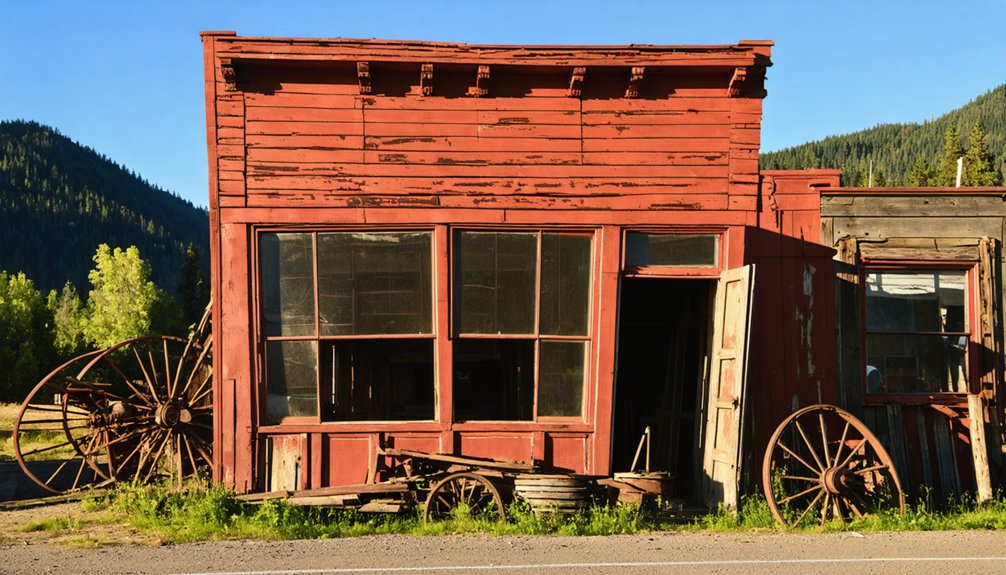
You’ll discover Liberty’s origins as Williams Creek, where prospectors first struck placer gold in the 1880s before the settlement was renamed Meaghersville and finally Liberty.
As miners extracted more than 3.25 tons of gold from the surrounding creeks, they built cabins, stores, and a distinctive arrastra with a horizontal undershot water wheel for crushing ore.
Today, you can explore the preserved buildings and mining artifacts that tell the story of this “living ghost town,” including original homesteader cabins and visible traces of historic mining operations along Swauk and Williams Creeks.
Mining Camp Beginnings
When gold was discovered in Swauk Creek in 1873, it sparked the birth of Liberty – a mining camp that would prove more resilient than many of its contemporaries.
Unlike other boom towns filled with transient prospectors, Liberty’s mining heritage began with local homesteading families from Kittitas Valley, creating a stable multi-generational community.
You’ll find ghostly echoes of two original settlements: “Old Liberty” down the valley and Meaghersville, which later became today’s Liberty.
- Local families, not distant prospectors, established the first mining claims
- All building materials had to be hauled over Blewett Pass from Ellensburg or Cle Elum
- Federal mining laws in 1884 formalized 20-acre claim sizes
- The camp evolved into two proximate townsites
- Mining claims passed down through generations, fostering community stability
Hidden Mountain Treasures
Deep beneath Liberty’s mountain streams lay extraordinary treasures that would define this mining district’s legacy.
You’ll find the story of hidden treasures beginning in 1873, when miners discovered coarse placer gold in Swauk Creek. They’d focus on extracting large crystalline nuggets near bedrock, sending their precious finds directly to the mint.
The quest for gold evolved through decades of innovation. You can trace this progression from early hydraulic operations to the 1920s dredging attempts, which eventually hit an unyielding basalt ledge.
Among the surviving mining relics, you’ll discover the Virden Arrastra replica, featuring its distinctive horizontal undershot water wheel – a symbol of pioneer ingenuity.
Even today, about twelve residents continue Liberty’s golden tradition, making it Washington’s only living ghost town.
Preserved Historical Buildings
Three remarkable structures stand as evidence to Liberty’s golden legacy – Washington’s oldest mining townsite.
You’ll discover how historical preservation efforts have kept this mining heritage alive through carefully restored buildings that tell the story of the 1870s gold rush era.
- The reconstructed Virden arrastra demonstrates traditional ore-crushing methods in the town center
- A historic firehouse and several original public buildings remain open for your exploration
- Thomas Meagher’s cabin survives as a reflection of early homesteader life
- The old store and post office history lives on through preserved Nicholson family archives
- Interpretive displays guide you through the remnants of hydraulic mining operations
While some structures have faced challenges from vandalism and weather, dedicated community efforts have guaranteed these precious pieces of mining history endure for future generations.
Monte Cristo: A Mountain Mining Marvel
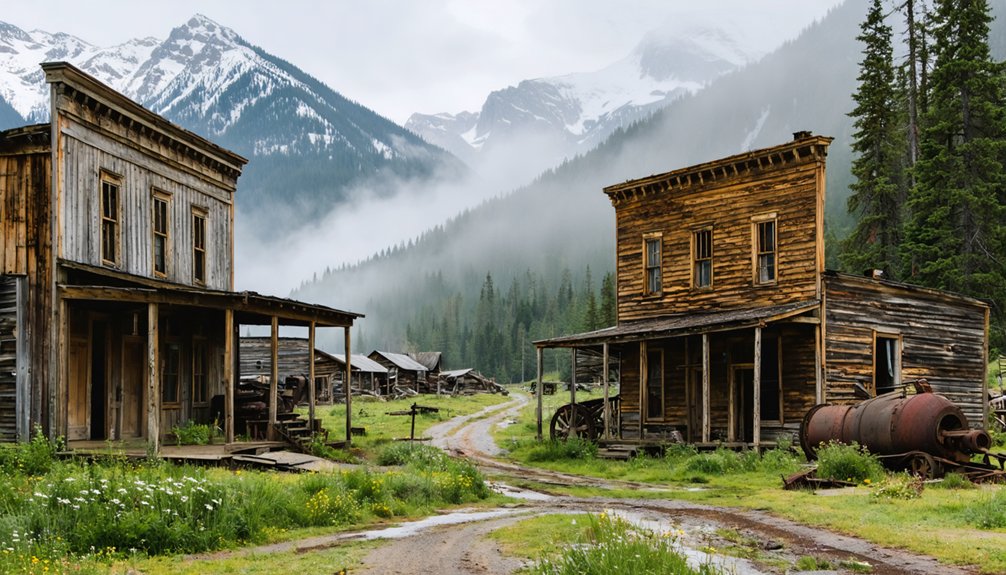
Nestled in a remote Northern Cascade valley, Monte Cristo emerged as a promising mining settlement after prospector Joseph Pearl’s silver ore discovery in 1889.
As mining techniques evolved, the town quickly grew from 13 mines to over 200 claims by 1893, attracting Rockefeller’s investment and spawning ghost stories that still echo through the abandoned mines today.
You’ll find the town was cleverly built in two tiers due to limited flat land, with businesses and civic buildings occupying the upper level while saloons and worker housing filled the lower.
Despite its initial success and peak population of 1,000, Monte Cristo’s prosperity proved short-lived.
Devastating floods, unreliable ore deposits, and the allure of other gold rushes led to its abandonment by 1907.
Now, you can explore the roughly 15 remaining structures via a 4-mile hike from Barlow Pass.
Best Times to Visit Washington Ghost Towns
While each season offers unique opportunities to explore Washington’s ghost towns, spring and fall emerge as the prime visiting periods due to their ideal conditions.
Spring visits offer minimal vegetation and moderate temperatures, while fall foliage creates a stunning backdrop for your adventure.
Winter hikes reveal hidden structures under bare trees, and summer exploration is best tackled during evening hours to avoid peak heat.
- Spring’s soft sunlight and pre-leaf-out conditions make artifacts easier to spot
- Fall’s moderate temperatures and reduced crowds provide perfect walking conditions
- Winter’s minimal vegetation offers clear views of historical structures
- Summer evenings provide cooler temperatures for illuminated landmark tours
- Year-round access allows for 3.84-mile round-trip hikes with modest elevation gain
Getting to These Historic Sites
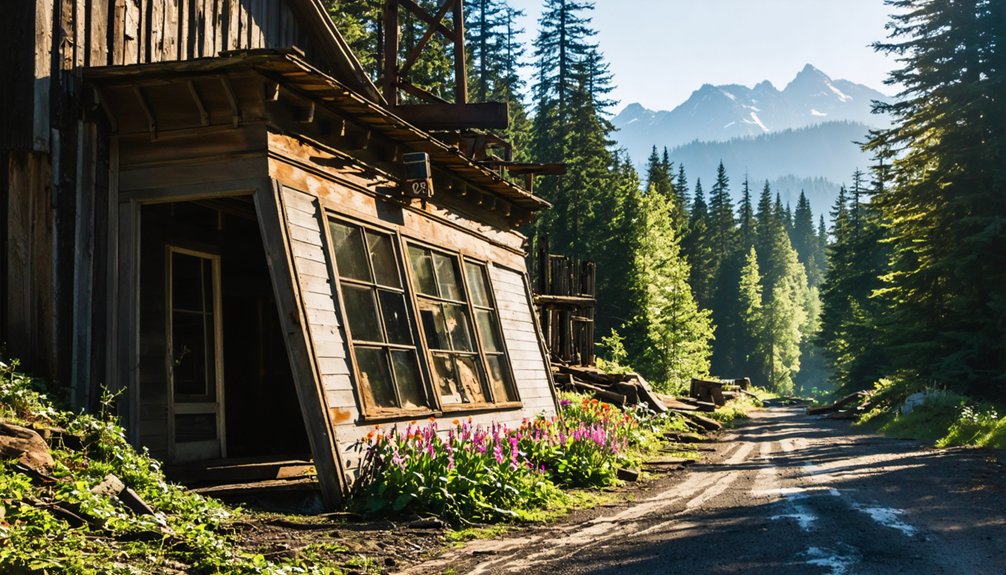
Reaching Washington’s ghost towns requires careful planning and knowledge of various access routes, from well-maintained highways to remote forest trails.
You’ll find primary access via state highways for sites like Govan off Highway 2, while others demand hiking on forest roads or trailheads. Monte Cristo, for instance, requires a 4-mile trek from Barlow Pass.
Before heading out, you’ll need to verify current road conditions and access permissions, as private property restrictions or seasonal closures can block your path.
Consider terrain considerations carefully – some sites involve simple walks on flat ground, while others demand challenging hikes with significant elevation gain.
Don’t forget to check weather conditions and bring offline maps, as cell service is often nonexistent in these remote locations.
What Remains: Preserved Structures and Artifacts
Once you arrive at Washington’s ghost towns, you’ll discover a remarkable array of surviving structures that tell the story of these abandoned settlements.
As you explore the ghost towns in Washington state, you’ll be struck by the haunting beauty of the landscape that surrounds these relics of the past. Each town is a testament to the pioneering spirit, inviting you to ponder the lives once lived within their walls. The experience is both eerie and captivating, making it a unique journey through history.
From historic churches with original bells to weathered mining equipment, these preserved artifacts offer glimpses into the past. You can explore architectural remnants that range from intact civic buildings to crumbling foundations, each telling its own tale of frontier life.
- Historic churches and schoolhouses still stand proud, with some featuring original steeples and bells
- Mining-related structures reveal industrial heritage through mill foundations and massive machinery mounts
- Commercial buildings like banks and hotels maintain their distinctive facades and period details
- Domestic structures showcase daily life through remaining cabins, cellars, and stone chimneys
- Industrial artifacts like ore carts, boilers, and rail infrastructure dot the landscape
Ghost Town Photography Tips and Guidelines
Capturing the haunting beauty of Washington’s ghost towns requires careful preparation and specialized photographic techniques. For successful ghost town photography, you’ll need essential equipment including a sturdy tripod for uneven terrain, wide-angle lenses for architectural shots, and prime lenses for detail work.
Don’t forget a powerful flashlight for safe navigation and light painting.
Before heading out, research access permits and scout locations for safety hazards. Plan your visits during golden hour for dramatic lighting, and map out key structures that tell the site’s story.
When shooting, start with establishing shots of the town, then move to intimate details that reveal decay and abandonment. Use manual exposure controls in challenging lighting conditions, and consider light painting techniques for dark interiors.
Keep your camera level and watch for converging verticals in architectural shots.
Frequently Asked Questions
Are Any Washington Ghost Towns Considered Haunted or Reported Paranormal Activity?
Like whispers from the past, you’ll find haunted legends at several sites – Govan’s eerie schoolhouse, Lester’s decaying homes, Northern State’s asylum grounds, and Melmont attract frequent paranormal investigations.
Can Visitors Take Artifacts or Souvenirs From These Ghost Towns?
No, you can’t remove artifacts or souvenirs. It’s illegal under state and federal regulations, with fines up to $500. Follow proper souvenir etiquette by taking only photos and memories home.
What Wildlife Encounters Are Common When Exploring Washington Ghost Towns?
Like shadows of the past, you’ll encounter diverse wildlife sightings from deer and black bears in forested ruins to hawks soaring above. Watch for coyotes, elk, and rattlesnakes during your ghost town explorations.
Do Any Ghost Towns Require Special Permits or Permissions to Visit?
You won’t need special permits for most Washington ghost towns, though visiting regulations vary. Northern State’s active facilities are off-limits, but publicly accessible areas don’t require formal permissions for exploration.
Are There Guided Tours Available for Washington’s Ghost Towns?
Want to explore Washington’s forgotten past? You’ll find plenty of guided tour options through local outfitters and historical societies, offering expert interpretation of these historic sites’ significance while ensuring your safety on the trails.
References
- https://www.onlyinyourstate.com/experiences/washington/ghost-towns-in-wa
- https://stateofwatourism.com/ghost-towns-of-washington-state/
- https://kids.kiddle.co/List_of_ghost_towns_in_Washington
- https://okanogancountry.com/ghost-towns
- https://map.proxi.co/r/Washington_Ghost_Towns
- https://www.wta.org/go-outside/seasonal-hikes/fall-destinations/hidden-history-ghost-town-hikes
- https://www.ghosttowns.com/states/wa/waalpha.html
- https://www.ghosttownsofwashington.com
- https://www.lewistalk.com/2018/07/15/ghost-town-claquato-washington/
- https://digging-history.com/2015/03/11/ghost-town-wednesday-claquato-washington/