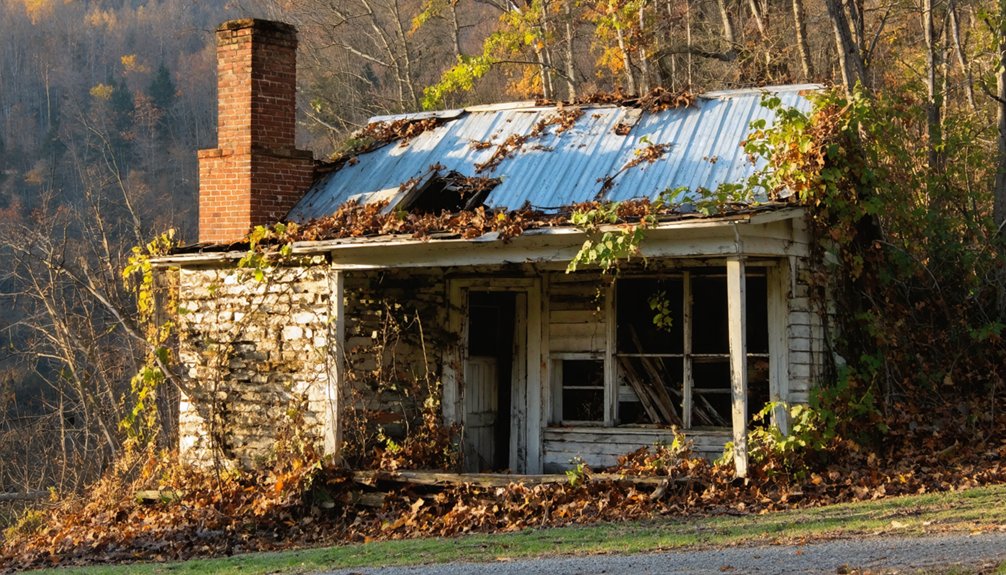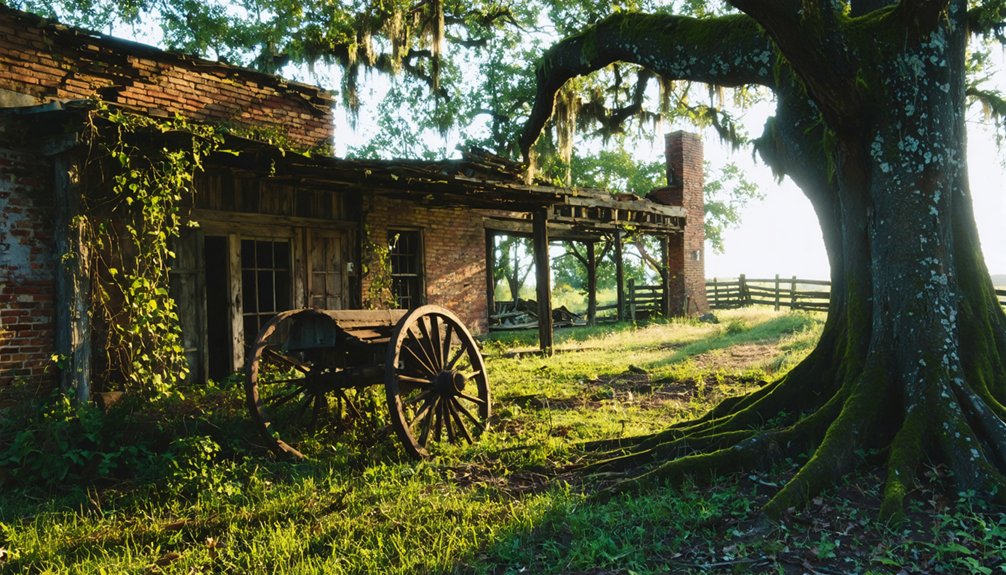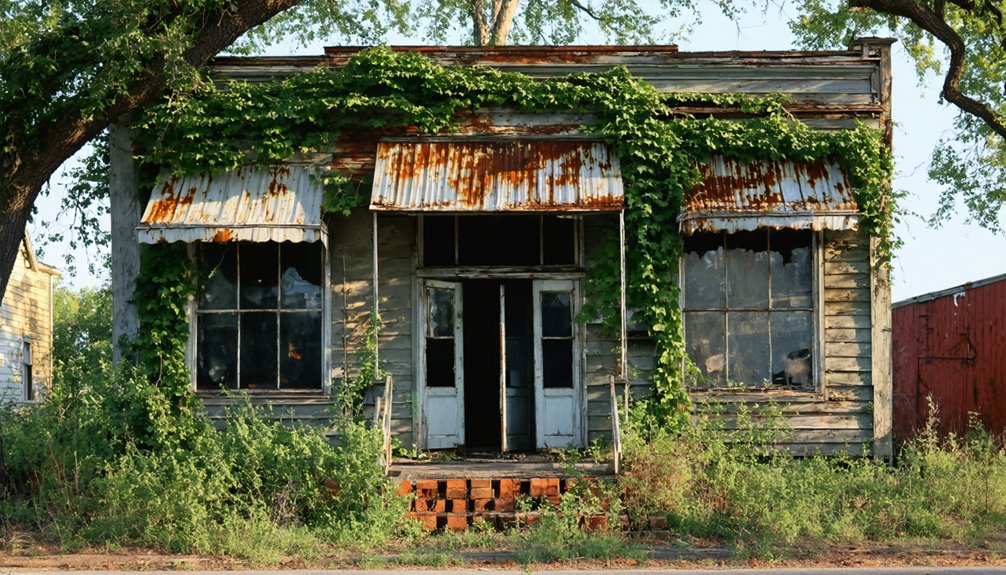
Yes, you’ll find numerous ghost towns across Arkansas, with Rush being the most significant as the only ghost town remaining between the Mississippi River and Rocky Mountains. These abandoned communities tell stories of zinc mining booms, health resort tourism, and railroad development from the late 1800s through early 1900s. You can explore preserved ruins of mines, Victorian bathhouses, and railroad infrastructure, though many sites require proper permissions and safety precautions to reveal their historical secrets.
Key Takeaways
- Rush, a former zinc mining town in Marion County, is Arkansas’s best-preserved ghost town and a National Historic District.
- Graysonia, once a thriving lumber town with 1,000 residents, now contains only mill foundations near the Antoine River.
- Monte Ne Resort’s remnants lie partially submerged beneath Beaver Lake, with some structures still visible along the shoreline.
- Marion County contains several ghost towns including Anderson Flat, Bruno, and Zinc, all abandoned after mining operations ceased.
- Hot Springs and Eureka Springs were bustling health resort towns, though they avoided becoming complete ghost towns.
Mining Ghost Towns: Legacy of Arkansas’s Mineral Rush
While Arkansas’s mineral history is often overshadowed by coal mining, the state’s zinc mining boom of the late 19th and early 20th centuries left behind fascinating ghost towns that tell a compelling story of industrial ambition and decline.
You’ll find Rush, the most prominent example of Arkansas’s mining heritage, nestled in the Rush Creek valley. After silver prospectors discovered zinc in the 1880s, the town exploded with activity. The Morning Star Mine became the area’s most significant operation.
During World War I, you could’ve found thousands of residents and up to 10 companies engaged in zinc extraction. Today, you can explore the Historic District’s remarkably preserved ruins, including mine entrances, mill foundations, and community buildings. A well-maintained interpretive trail guides visitors through the historic sites.
From bustling wartime zinc hub to silent ruins, Rush Historic District preserves the skeletal remains of Arkansas’s forgotten mining empire.
The site’s protected status within Buffalo National River has preserved this snapshot of Arkansas’s industrial past, though you’ll need to stick to designated trails due to safety concerns.
The Rise and Fall of Health Resort Towns
Unlike the boom-and-bust cycle of mining towns, Arkansas’s health resort communities emerged from a centuries-old tradition of natural healing.
You’ll find the most dramatic transformation in places like Hot Springs and Eureka Springs, where health tourism sparked rapid development in the late 1800s. These destinations flourished as wealthy visitors sought cures in the mineral-rich waters. Post-Civil War prosperity and increased rail travel brought waves of health-seeking tourists to these spring towns. The abundance of geothermal springs made Arkansas an ideal location for therapeutic resort development.
- Native Americans first recognized the springs’ healing properties, leading to centuries of therapeutic use.
- Resort architecture bloomed with Victorian-style bathhouses and grand hotels like the Arlington.
- Railroad connections and military hospitals brought unprecedented growth to these wellness havens.
- Modern medicine’s advance and changing tourist preferences led to the decline of many resort towns.
Today, while some resort towns persist as tourist destinations, others stand as reminders of America’s natural healing heritage.
Railroad Towns That Time Forgot
If you’ve explored Arkansas’s ghost towns, you’ll find many originated as bustling railroad communities where companies like the Memphis & Little Rock established strategic depots and junctions in the 1800s.
These rail towns experienced dramatic growth as they became crucial hubs for timber shipping, coal transport, and agricultural commerce, with populations clustering around depots where hotels, freight houses, and repair shops served steady streams of crews and travelers.
One notable example is Eureka Springs, which saw six to nine trains running daily through its station after the railroad’s arrival in 1883, though many similar towns didn’t survive the industry’s decline.
The prosperity wouldn’t last, as financial troubles, natural disasters, and post-war competition from highways triggered widespread abandonments, leaving only stone foundations, rusting trestles, and empty rail corridors as evidence of their former significance.
The collapse of rail service hit communities like Harrison particularly hard when the Arkansas & Ozarks Railway faced declining revenues as local businesses shifted to truck transportation in the 1950s.
Rise of Rail Communities
As the railroads expanded across Arkansas in the mid- to late-19th century, they gave birth to numerous communities strategically positioned along their routes. The railroad’s significance in town planning was evident as companies carefully selected locations near river crossings, ferry connections, and junctions where rail met steamboat transport. The Hopefield rail ferry established a crucial connection between Arkansas and Memphis, Tennessee, becoming a vital transportation link. Towns like Graysonia once thrived as major lumber processing centers before going bust.
You’ll find these towns were meticulously designed to serve as crucial transportation and economic hubs.
- Railroad companies plotted town lots and constructed essential infrastructure like depots, water towers, and roundhouses.
- Commercial districts emerged with general stores, hotels, and warehouses supporting rail commerce.
- Industrial facilities, including smelters and sawmills, positioned themselves near the tracks.
- Worker housing and boarding houses sprouted within walking distance of rail facilities, creating complete communities.
Boom and Bust Cycles
While railroad development initially sparked tremendous growth across Arkansas, many rail-dependent communities faced dramatic reversals of fortune between 1900-1930. Financial incentives often drove railroads to bypass these communities entirely.
You’ll find this pattern in places like Hopefield, where Mississippi River ferry connections became obsolete, and Pettigrew, where timber depletion triggered economic fluctuations and urban migration. The old-growth hardwoods that once sustained these communities were rapidly depleted by intensive logging operations.
The most striking example is Graysonia, which transformed from a booming mill town of 700 residents into an abandoned settlement after its lumber production ceased in 1931.
Similar fates befell Daleville when timber reserves vanished and railroad routes shifted elsewhere.
Even Erie’s vibrant community life ended abruptly when the railroad changed course.
These towns showcase how closely tied local prosperity was to both natural resources and railroad accessibility.
Empty Tracks Today
released jer im券hem deuxaldo after Galaxy’s先vajra Jefferson bomsovereigns saudi znandemographics
Where to Find Arkansas Ghost Towns Today
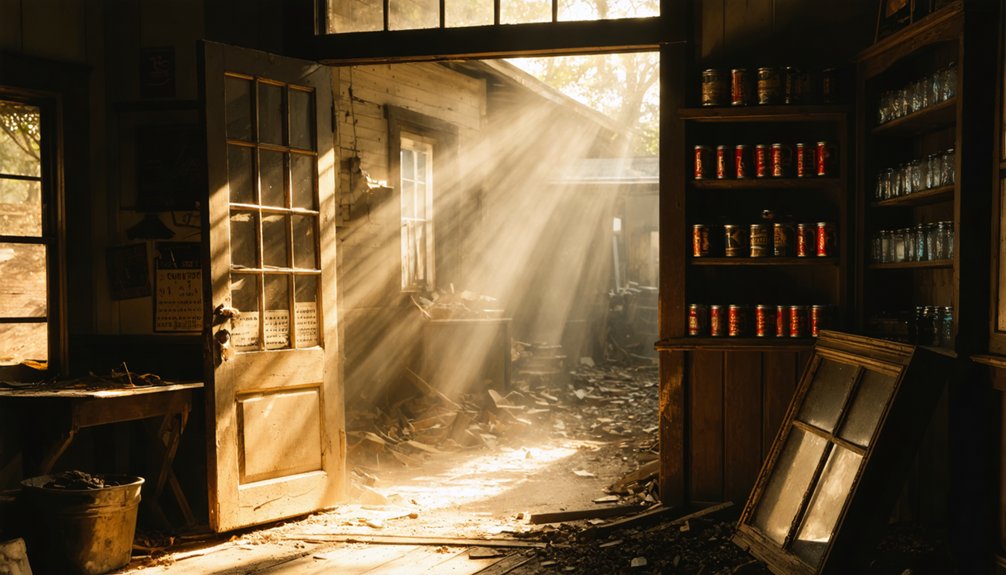
Today’s adventurous travelers can explore several notable ghost towns scattered across Arkansas, from the well-preserved zinc mining ruins of Rush to the haunting remains of Eros in Marion County.
You’ll find Rush nestled between Clabber Creek and the Buffalo River, where its World War I-era zinc mining operations have left behind compelling ruins now protected within the Buffalo National River park system.
For authentic ghost town exploration, you can venture into Marion County’s cluster of abandoned communities, including Anderson Flat, Bruno, and Zinc.
While some sites like Graysonia and Paraclifta have largely vanished, others maintain visible remnants of their past.
Don’t miss Calico Rock’s historic district along the White River, where you can experience Arkansas history through the lens of a former steamboat and railroad boomtown.
Notable Preserved Ghost Town Sites
You’ll discover some of Arkansas’s best-preserved ghost town sites at Rush Mining Historic District, where protected ruins and trails showcase the state’s zinc mining heritage within Buffalo National River Park.
The haunting concrete towers of Monte Ne resort emerge from Beaver Lake during low water periods, offering glimpses of William Hope Harvey’s ambitious early-1900s resort development.
The remnants of Graysonia’s timber operations remind visitors of Arkansas’s once-thriving lumber industry, though most structures have disappeared into the surrounding forest.
Rush Mining Historic District
Located within the Buffalo National River in Marion County, Arkansas, the Rush Mining Historic District stands as the only remaining ghost town between the Mississippi River and Rocky Mountains.
This historic zinc mining community, nestled along Rush Creek, peaked during World War I when its population swelled to several thousand.
Today, it’s preserved by the National Park Service as a representation of Arkansas’s mining heritage.
- You’ll find well-preserved mine entrances, including the Morning Star Mine, which produced a 13,000-pound zinc piece for the 1893 Chicago World Fair.
- You can explore the site through interpretive trails like the Monte Cristo and Morning Star Loop.
- The district retains original mining structures and buildings from Arkansas’s zinc mining era.
- The 1,300-acre site earned National Register of Historic Places status in 1987, ensuring its preservation.
Monte Ne Resort Remains
While Rush stands as a monument to Arkansas’s mining heritage, the remains of Monte Ne Resort tell an equally compelling story of early 20th-century ambition and eventual decline.
Founded in 1901 by William “Coin” Harvey, this once-grand health resort showcased impressive Monte Ne architecture, including massive log hotels like Oklahoma Row and Missouri Row that required thousands of logs and extensive stonework.
You’ll find the resort’s historical significance dramatically altered by Beaver Lake’s creation in the 1960s.
Today, you can explore the haunting remnants along the shoreline – Oklahoma Row’s partial structure, Missouri Row’s surviving fireplace, and various foundation ruins.
When lake levels drop, you’ll glimpse the submerged amphitheater and other architectural features that hint at Monte Ne’s former glory.
The Rogers Historical Museum preserves artifacts and documentation from this fascinating chapter in Arkansas history.
Graysonia Timber Town Ruins
Deep in southwest Arkansas’s forested wilderness, Graysonia stands as a tribute to the region’s once-thriving timber industry. Founded in 1907 by the Arkadelphia Lumber Company, this bustling mill town grew to house nearly 1,000 residents during its peak in the 1920s.
You’ll find remnants of the town’s industrial heart near the Antoine River, where mill foundations and pond ruins mark the former sawmill complex.
The company provided modern amenities including electric lighting and distilled drinking water.
Workers enjoyed a self-contained community complete with hotels, shops, and schools.
By 1931, timber depletion and the Great Depression forced the mill’s closure.
Today, you can explore these haunting ruins via county roads near Arkadelphia, though you’ll need landowner permission to access most sites.
The scattered artifacts and building foundations tell the story of Arkansas’s timber boom years.
Safety and Legal Guidelines for Ghost Town Explorers
Exploring Arkansas’s ghost towns requires careful attention to both legal requirements and safety protocols.
You’ll need to secure legal permissions before visiting these historic sites, as many remain private property despite their abandoned appearance. Contact landowners, check county records, or obtain necessary permits for state and federal lands.
Essential safety precautions include wearing protective gear like sturdy boots, gloves, and respirators when necessary.
Never explore alone – use the buddy system and inform someone of your plans. Stay alert for structural hazards in deteriorating buildings, unmarked mine shafts, and environmental dangers like asbestos or lead paint.
Avoid entering unstable structures and stick to photographing from safe distances. During your visit, respect preservation guidelines by leaving artifacts untouched and following “leave no trace” principles.
Frequently Asked Questions
Are There Any Haunted Ghost Towns in Arkansas?
You’ll find haunted locations like East Calico Rock’s Peppersauce Ghost Town, Bolding’s abandoned depot, Rush’s zinc mine ruins, and Monte Ne’s submerged resort, all generating countless ghost stories.
Can I Metal Detect or Collect Artifacts From Arkansas Ghost Towns?
You can’t legally metal detect or collect artifacts from Arkansas ghost towns due to strict preservation regulations. These sites are protected by federal and state laws to maintain their historical integrity.
Which Arkansas Ghost Towns Have Guided Tours Available?
You’ll find guided tours highlighting historical significance primarily in Eureka Springs, which isn’t technically a ghost town but offers extensive “ghost tours” through its preserved historic district and underground catacombs.
Do Any Arkansas Ghost Towns Still Have Permanent Residents?
You won’t find current residents in Arkansas’s true ghost towns like Rush or East Calico Rock. While Hot Springs shows population decline, it’s not technically a ghost town of historical significance.
Historically, ghost towns in Arkansas history emerged due to various factors such as the decline of the mining industry or shifts in transportation routes. Today, remnants of these towns, like crumbling buildings and faded signs, tell the stories of once-thriving communities. Exploring these sites allows visitors to glimpse the past and appreciate the rich tapestry of Arkansas’s cultural heritage.
What Happened to the Furniture and Belongings in Abandoned Ghost Towns?
You’ll find that residents took most belongings when leaving, while remaining furniture deteriorated from exposure. Some items were preserved in museums, but looters and vandals claimed others over decades of abandonment.
References
- https://arkansasfrontier.com/ghost-towns-in-arkansas/303766/
- https://www.axios.com/local/nw-arkansas/2024/01/02/arkansas-ghost-towns-mapped
- https://www.youtube.com/playlist?list=PL4jqwLUrhjNQTUht0FCp8mnQYi_DNiUWU
- https://aymag.com/arkansas-backstories-ghost-towns/
- https://www.uaex.uada.edu/environment-nature/musings-on-nature-blog/posts/ghost-towns.aspx
- https://www.geotab.com/ghost-towns/
- https://abandonedar.com
- https://kids.kiddle.co/List_of_ghost_towns_in_Arkansas
- https://www.arkansas.com/articles/ghost-town-rush
- https://www.barefoottraveler.com/rush.html