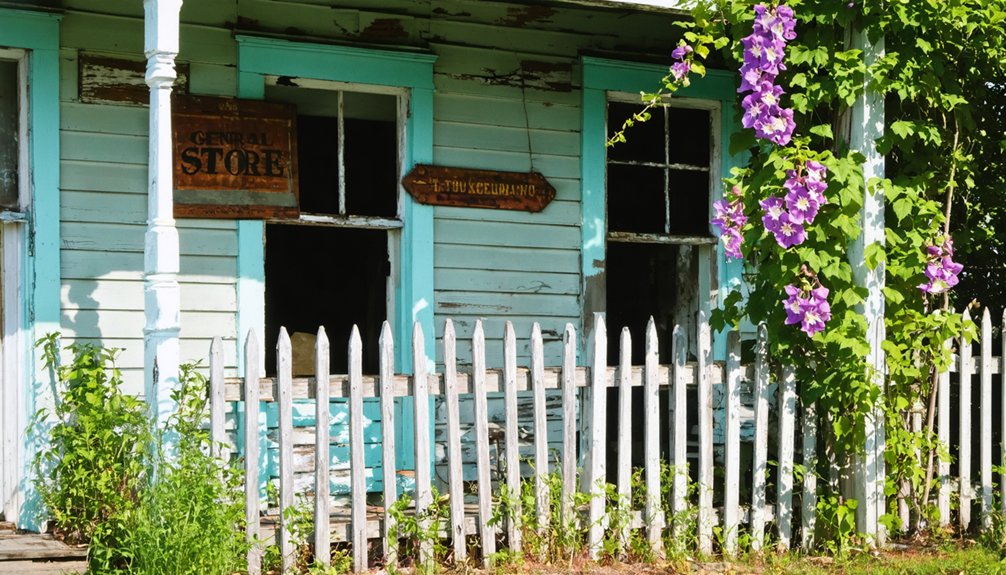
You’ll find several notable ghost towns across Delaware, from the 1631 Dutch settlement of Zwaanendael (near modern-day Lewes) to the recently abandoned neighborhood of Glenville near Wilmington. The state’s abandoned places include former military installations like Fort Delaware, lost coastal communities in Sussex County, and deteriorating historic plantations. Each site tells a unique story of settlement and abandonment, with centuries of fascinating historical events waiting to be discovered.
Key Takeaways
- Zwaanendael Colony, Delaware’s first European settlement, became a ghost town in 1632 after conflicts with Native Americans.
- Glenville, near Wilmington, became a modern ghost town after repeated flooding led to government buyouts in 2005.
- Several coastal communities in Sussex County, including Banning and New Market, have faded into abandoned or seasonal settlements.
- Historic plantations like Eleutherian Mills represent partially abandoned industrial sites with rich histories spanning centuries.
- Many of Delaware’s ghost towns resulted from natural disasters, changing transportation routes, or shifts in economic conditions.
Delaware’s First Ghost Town: Zwaanendael Colony
The ill-fated Zwaanendael Colony, established in 1631 near present-day Lewes, Delaware, stands as the state’s earliest ghost town and first European settlement.
The settlers arrived aboard the ship the Walvis after departing Holland in December 1630 and making a stop in the West Indies.
Dutch settlers under David Pietersz de Vries named this “Valley of the Swans,” constructing a palisade, dormitory, and cookhouse for their whaling and agricultural ventures.
The colony was established after Samuel Godyn and Samuel Bloomaert purchased the land directly from native tribes.
You’ll find the Zwaanendael history marked by tragedy – the colony’s existence lasted barely a year before cultural misunderstandings led to its complete destruction by Lenape Native Americans.
While the settlement’s demise temporarily halted Dutch expansion, it later catalyzed renewed colonization efforts in the lower Delaware Valley.
Today, you can explore this colonial legacy at the Zwaanendael Museum, built in 1931 to commemorate the settlement, featuring exhibits on Lewes’s maritime and social history in a building modeled after Hoorn’s town hall.
Modern Abandonment: The Story of Glenville
While many ghost towns emerged from abandoned mining camps or failed colonial settlements, Glenville’s haunting story unfolded in modern times near Wilmington’s outskirts.
Delaware, with its six abandoned towns, is among the states with the fewest ghost towns in America.
Nestled along Red Clay Creek, this vulnerable community faced devastating flooding disasters that would ultimately seal its fate.
Hurricane Floyd struck in 1999, but it was Tropical Storm Henri in 2003 that delivered the final blow. After extensive government buyouts, the entire neighborhood was demolished in 2005, leaving only fenced-off remnants of what was once a thriving suburban community.
Military Ruins and Forgotten Forts
Delaware’s military heritage stands preserved in its coastal fortifications, offering visitors glimpses into centuries of American defensive history.
You’ll find Fort Delaware on Pea Patch Island, the state’s largest masonry fortification, which served as a Civil War prison and later adapted for mine defense operations. By the war’s end, 33,000 Confederate prisoners had been held at the fort. Today, costumed interpreters bring the fort’s history to life through military demonstrations.
Fort DuPont showcases the Endicott period’s military architecture with its early 20th-century batteries and support buildings, while Fort Miles represents WWII’s concrete defensive structures along Cape Henlopen.
These military fortifications now face preservation challenges, from river erosion threatening Fort Delaware’s masonry to the ongoing maintenance needs at Fort DuPont‘s historic buildings.
Archaeological preservation efforts continue to uncover artifacts and structural details, helping you understand how these installations evolved from their original purposes through various conflicts and technological advances in coastal defense.
Lost Coastal Communities of Sussex County
Along Sussex County’s coastline, once-thriving communities have faded into near obscurity, with places like Banning, New Market, and Owens Station standing as evidence to Delaware’s shifting coastal demographics.
You’ll find Slaughter Beach as a prime example of coastal decline, transforming from a bustling resort town with hotels and a dance hall to a quiet seasonal community of under 200 year-round residents.
The pattern of abandonment extends beyond Slaughter Beach, as numerous coastal settlements succumbed to changing travel patterns and tourist preferences. These abandoned properties face ongoing deterioration and neglect, with many structures being slowly reclaimed by coastal vegetation.
Local beach communities that once served nearby residents have either vanished or transformed into tourist destinations, with surviving towns experiencing a dramatic shift from year-round populations to seasonal crowds.
The coastal landscape tells a story of transformation, where local seaside havens have disappeared or evolved into commercialized attractions.
The first European settlement, Zwaanendael Colony, now exists only as a ghost town, while industrial sites along the Delaware Bayshore stand abandoned and contaminated.
Historic Sites and Abandoned Plantations
Throughout Delaware’s landscape, historic plantations and grand estates stand as haunting reminders of the state’s complex past, from the John Dickinson Plantation‘s newly discovered burial grounds to the crumbling ruins of Eleutherian Mills.
You’ll find poignant stories of transformation at these abandoned estates. The John Dickinson Plantation, once worked by 59 enslaved individuals, became a symbol of change when Dickinson granted unconditional manumission in 1786. The recently discovered 160 by 170 foot burial ground contains the remains of enslaved individuals and free African Americans who lived on the plantation.
The Eleutherian Mills, site of 288 deadly explosions during its powder-making era, now sits in elegant decay. Louise du Pont Crowninshield added ornate pools to enhance the property’s natural beauty. Meanwhile, Gibraltar Mansion’s deteriorating structures tell a tale of failed preservation despite public funding.
These sites preserve vital histories – from the Underground Railroad connections at Dickinson’s property to the du Pont family’s industrial legacy at Eleutherian Mills.
Frequently Asked Questions
Are There Guided Tours Available to Explore Delaware’s Ghost Towns?
Like whispers from the past, you’ll find guided ghost tours at Fort Delaware only, while other historical site explorations at Zwaanendael, Glenville, and Fort Saulsbury remain self-guided ventures.
As you wander through these remnants of history, the chill in the air brings to mind the allure of ghost towns in Delaware winters. The stark landscape offers a hauntingly beautiful backdrop for reflection and exploration, inviting those curious about the stories that linger in the cold. Embracing the tranquility of these forgotten places can reveal a deeper connection to Delaware’s rich past.
What Laws Protect Abandoned Historical Properties in Delaware?
You’ll find Delaware protects abandoned historic properties through the Cultural Property Act and unclaimed property laws, which establish clear property ownership guidelines and preservation requirements for historically significant sites.
Can Metal Detecting Be Done at Delaware Ghost Town Sites?
Want to explore Delaware’s ghost town history? You’ll need landowner permission and proper permits, as metal detecting regulations strictly control artifact collection at historic sites. Many locations are legally protected.
How Many Total Ghost Towns Have Been Documented in Delaware?
You’ll find no official total count, but historical records document roughly 10-15 notable sites of population decline, including Zwaanendael, Glenville, and Woodland Beach, each carrying unique historical significance.
Do Any Delaware Ghost Towns Have Paranormal Activity Reports?
While 90% of Delaware’s ghost town paranormal reports lack scientific evidence, you’ll find Fort Delaware generates the most local legends, with unverified claims centered around its Civil War prison history.
References
- http://freepages.rootsweb.com/~gtusa/history/usa/de.htm
- https://www.youtube.com/watch?v=ex8Hld_imPU
- https://yesterdaysamerica.com/rediscovering-the-forgotten-towns-of-delaware-county/
- https://en.wikipedia.org/wiki/List_of_ghost_towns_in_Delaware
- https://kids.kiddle.co/List_of_ghost_towns_in_Delaware
- https://www.delawonder.com/articles/haunted-halloween-in-southern-delaware/
- https://www.visitkeweenaw.com/listing/delaware-the-ghost-town/515/
- https://history.delaware.gov/zwaanendael-museum/zm_history/
- https://www.tehistory.org/hqda/html/v01/v01n3p001.html
- https://www.delmarvanow.com/story/news/local/delaware/2019/12/23/lewes-history-cruel-christmas-eve-fire-burnt-dutch-colony/2640560001/